
Tunnel projects set pace for UAE water sector
14 October 2025

The UAE’s water sector has recorded $1.91bn in contract awards so far in 2025, a more measured pace than in recent years, but one that comes ahead of a potentially transformative 12 months for the market.
The total is lower than the $3.10bn awarded in 2024 and the $6.15bn in 2023, reflecting a year focused on network expansion rather than large-scale production assets. Only one major desalination project has reached the contract stage so far this year. The $400m Saadiyat seawater reverse osmosis independent water project (IWP) in Abu Dhabi, awarded to Spain’s Acciona, remains the single largest contract signed to date.
Most of this year’s awards have come from Dubai Municipality through a series of mid-sized contracts, generally in the $50m to $150m range, covering stormwater, sewerage and drainage upgrades.
DSST programme
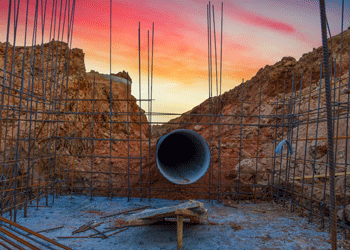
The next phase is already taking shape, however, with several major projects moving through procurement. The largest is Dubai Municipality’s $22bn Strategic Sewerage Tunnel Programme (DSST), which represents most of the country’s current pipeline.
In September, the municipality issued a refresher request for qualifications (RFQ) for the next phase of the DSST public-private partnership (PPP) project, which aims to increase total sewage treatment capacity by 1 million cubic metres a day to serve an expected population of 6.3 million by 2040.
The scheme, which also aims to reduce the number of pumping stations from 70 to just two, involves the construction of deep tunnels, terminal pumping stations and extensive sewer links.
Four contracts under the Warsan and Jebel Ali components of the DSST have now advanced to prequalification. The $5bn Warsan Package W will deliver a 16-kilometre deep tunnel and a terminal pumping station with a capacity of 830 million litres a day.
The Jebel Ali packages, known as J1 North, J2 South and J3 Links, will extend the network across the southern corridor. The J3 package includes the construction of 129km of sewer links and will be implemented under a design-build-finance PPP model, featuring a concession period spanning 25 to 35 years. Bidding for all four packages is set to begin soon, with contract awards targeted for March 2026.
Tasreef project
The $8.2bn Tasreef wastewater and drainage programme is also advancing. The initiative aims to expand Dubai’s rainwater drainage network and boost capacity by 700% by 2033.
In April, local firm DeTech Contracting won the $136m first contract to upgrade the West Deira stormwater system. The remaining contracts for work in Jebel Ali, Dubailand and on Sheikh Mohammed Bin Zayed Road/Al-Yalayis Road are at the bidding or bid evaluation stage. These are expected to be awarded later this year, or in early 2026.
Tender pipeline
Beyond tunnel works, the overall tender pipeline is valued at $30.98bn, including $1.68bn of pipeline projects and $1.39bn of treatment plants, with smaller packages covering pumping stations, district cooling and reservoirs. The makeup shows how the market is entering an investment phase focused on water networks that will prepare the system for the next round of large-scale capacity projects later in the decade.
Over $2bn-worth of projects are currently under bid evaluation, with some of these projects expected to move to award before the end of the year, which could bring the 2025 total closer to last year’s figure.
This includes a contract for the construction of a $400m district cooling plant project on Palm Jebel Ali, set to be awarded under a joint venture of National Central Cooling Company (Tabreed) and Dubai Holding.
In Ras Al-Khaimeh, plans are moving forward for the emirate’s first sewage treatment plant to be developed under a PPP model. Two consortiums have submitted bids to develop and operate the 60,000 cubic-metre-a-day facility.
While Dubai Municipality has driven most of this year’s activity, other entities have also played a role. Emirates Water & Electricity Company’s (Ewec) Saadiyat IWP has been the largest single contract, alongside network and stormwater awards from Al-Dhafra Region Municipality, Abu Dhabi Sewerage Services Company, Etihad Water & Electricity and Dubai Electricity & Water Authority.
The pattern of activity this year aligns with previous investment cycles. Periods of heavy desalination and treatment awards are typically followed by phases of large-scale network development. While 2025 has so far been steady rather than headline-grabbing, the outlook is significantly stronger.
With more than $2bn in projects under evaluation and nearly $31bn in the tender pipeline, the UAE’s water sector is on the brink of a major investment wave. The DSST, Tasreef and a series of supporting network initiatives are expected to define this next phase, laying the groundwork for future capacity expansion.
MEED's November 2025 special report on the UAE also includes:
> GOVERNMENT: Public spending ties the UAE closer together
> ECONOMY: UAE growth expansion beats expectations
> BANKING: Stability is the watchword for UAE lenders
> UPSTREAM: Adnoc strives to build long-term upstream potential
> DOWNSTREAM: Taziz fulfils Abu Dhabi’s chemical ambitions at pace
> POWER: UAE power sector hits record $8.9bn in contracts
> CONSTRUCTION: UAE construction faces delivery pressures
> TRANSPORT: $70bn infrastructure schemes underpin UAE economic expansion

Register for MEED's guest program now to access this article.
Exclusive from Meed
-
 Agentic AI comes for the customer journey
8 April 2026
-
 UAE water investment broadens beyond desalination
8 April 2026
-
 UAE banks ready to weather the storm
8 April 2026
-
-

All of this is only 1% of what MEED.com has to offer
Subscribe now and unlock all the 153,671 articles on MEED.com
- All the latest news, data, and market intelligence across MENA at your fingerprints
- First-hand updates and inside information on projects, clients and competitors that matter to you
- 20 years' archive of information, data, and news for you to access at your convenience
- Strategize to succeed and minimise risks with timely analysis of current and future market trends

Related Articles
-
Agentic AI comes for the customer journey
8 April 2026
The entire architecture of digital commerce rests on one assumption: that a person initiates a transaction – a consumer browses, selects, confirms and pays. Every layer of security, authentication and fraud prevention is calibrated to that sequence.
Agentic AI, systems that can reason through a complex instruction and plan what needs to happen and act autonomously with minimal human input, disrupts this model at its foundation.
This is not a hypothetical shift, but one already well on its way to impacting commerce. In the UAE, 70% of consumers already use AI tools when shopping – a 44% increase on 2024 figures, according to Adyen’s 2025 Retail Report. In travel, 68% of UAE consumers used AI to book holidays in 2025 – a 57% year-on-year rise.
 “What makes agentic AI different from the AI tools we’ve seen so far is that it doesn’t just respond or recommend,” says Daumantas Grigaravicius (pictured, right), head of Middle East at Adyen, speaking to MEED. “It can take a complex instruction, reason through it, plan what needs to happen and act autonomously on a user’s behalf.”
In retail, he says, that means AI agents handling the entire customer journey – discovering products across multiple platforms, comparing prices, applying discounts and completing the purchase – based on a single instruction.
In hospitality, an agent could plan and book a trip end-to-end, adjusting plans if flight schedules change. In financial services, it could monitor accounts and time international transfers to secure better exchange rates.
From browsing to delegating
When AI agents take over the discovery process, the consumer will shift from navigating individual apps and websites to setting preferences that inform how an AI agent acts.
“The customer journey becomes less about navigating touchpoints and more about setting preferences and letting AI handle execution,” Grigaravicius says. For UAE consumers who already value convenience and efficiency, this is a natural evolution.”
AI will select products based on data: price, quality metrics, delivery times and sustainability scores – replacing the current advertising, social media and consumer algorithms.
“This puts pressure on merchants to compete on substance rather than just marketing appeal,” notes Grigaravicius, though there will remain a distinction between the routine and the personal.
“Consumers will still want to be involved in choices that carry emotional weight,” he says. “What changes is that the mundane, repetitive aspects get automated, which makes the whole process feel far less cluttered and more streamlined.”
The merchant’s dilemma
For service providers, the challenge is clear: their offering needs to be easy for AI agents to find; their systems have to connect smoothly; and their value proposition needs to deliver.
The risk is that if the entire customer journey is contained within a chat interface, merchants could find themselves cut off from the relationship they have spent years building.
“There’s a real concern that hard-won brands could be reduced to commodities, perhaps just a featureless API endpoint in a bot’s decision-making logic,” says Grigaravicius.
The industry has confronted versions of this anxiety before. The leap from desktop e-commerce to mobile prompted similar fears of disintermediation.
“Mobile didn’t replace digital storefronts; it added a powerful, specialised channel for high-intent customers,” he says. “Agentic AI is likely to follow a similar path.”
One defence is tokenisation. “When an AI agent completes a purchase, the merchant can still recognise the customer through their secure tokenised credentials,” says Grigaravicius.
“This allows them to apply loyalty benefits, personalise offers and maintain a cohesive relationship across channels.”
Rethinking identity and fraud
If AI agents are executing transactions at scale, the security apparatus designed around human behaviour also needs to adapt.
The traditional fraud-prevention toolkit assumes that personal data alone is sufficient proof of identity, but this assumption weakens when the entity initiating the transaction is an AI agent.
“The old way of proving identity no longer holds,” says Grigaravicius. The counter is dynamic identification based on patterns of real commercial behaviour – looking at how customers and businesses actually transact, rather than relying on one-off checks that can be faked.
In principle, AI agents could reduce overall fraud by detecting behavioural anomalies across millions of data points, validating transactions in real time and flagging suspicious patterns before a transaction completes.
“AI agents don’t fall for phishing emails, don’t share passwords and can’t be socially engineered in the traditional sense,” says Grigaravicius. “So the net effect, if designed correctly, should be a reduction in overall fraud.”
Liability and standards
Where a compromised AI agent executes a fraudulent transaction, the chain of responsibility nevertheless needs to be resolved. Grigaravicius argues for a shared model between the AI platform provider, the merchant, the payment processor and the consumer.
“Where it gets complex is in cases where an AI agent is manipulated through no clear fault of any single party,” he says. “These scenarios require pre-agreed frameworks for liability allocation, which is why industry collaboration on standards is so important.”
Adyen is a partner of the Google-led Agent Payments Protocol initiative, which includes more than 60 tech and payment firms, and has also joined the Agentic AI Foundation, which aims to bring together companies to shape how autonomous systems interact.
Two-year horizon
The next phase – the transition from experimental, single-task agents to collaborative, multi-agent systems managing complex end-to-end processes – is likely to mature within two years, according to Grigaravicius.
The barriers are structural, with the sector needing robust authentication processes and interoperability across merchant systems, as well as consumer trust.
For now, the technical talent pool also remains thin. “The demand for people who understand both the commercial and technical dimensions of agentic AI far exceeds what is currently available,” Grigaravicius notes.
For the Gulf’s service economy, the opportunity is to serve as a proving ground. E-commerce penetration is high, regulatory appetite for fintech innovation is strong and consumer willingness to adopt runs well ahead of global averages.
The foundational questions – who verifies identity, who bears liability and whether merchants retain autonomy over their own customer relationships – need to be settled before adoption outpaces the infrastructure designed to support it.
“The rise of agentic AI is not a zero-sum game,” says Grigaravicius. “For agentic AI to become sustainable and profitable, we must build infrastructure that delivers genuine trust, transparency and merchant autonomy – because only that way will we achieve outcomes that benefit all.”
https://image.digitalinsightresearch.in/uploads/NewsArticle/16250712/main.gif -
UAE water investment broadens beyond desalination
8 April 2026
Desalination investment slowed in the UAE last year as awards in the segment fell to $400m, their lowest annual total since 2021.
Although overall market activity remained strong, reaching $3.4bn in total water sector awards, the only major desalination award in 2025 was the Saadiyat seawater reverse osmosis (SWRO) independent water plant (IWP) being developed by Spain’s Acciona.
This project accounted for 12% of total awards, reflecting a gradual decline in desalination investment over the past few years.
In 2024, the segment accounted for 22% of total water infrastructure awards. That figure was 25% in 2023 and 35% in 2022.
Tasreef programme
Beyond desalination, the market has been driven largely by transmission infrastructure over the past 12 months, most notably Dubai Municipality’s AED30bn ($8.1bn) Tasreef programme, which aims to strengthen stormwater drainage systems across the emirate for the next century.
In February, the municipality confirmed it had awarded contracts for five new projects under phase two of the programme to expand and strengthen Dubai’s stormwater drainage network.
These include two contracts awarded to local firm DeTech Contracting and one to China State Construction Engineering Corporation for stormwater drainage infrastructure. In addition, two consultancy contracts were awarded for the study and design of drainage systems in selected areas across the emirate.
Cumulatively valued at AED2.5bn, the new projects will serve 30 vital areas, spanning approximately 430 million square metres and supporting an estimated population of three million residents by 2040.
The latest deals build on an earlier package of projects awarded in April 2025 under phase one of the Tasreef programme. The overall masterplan aims to expand Dubai’s rainwater drainage capacity by 700% by 2033.
Sewage treatment
While 2025 was a quiet year for sewage treatment contract awards, 2026 began with a key milestone as Ras Al-Khaimah awarded its first sewage treatment project under a public-private partnership (PPP).
The contract was awarded to a consortium of Abu Dhabi National Energy Company (Taqa), Saur (France) and Etihad Water & Electricity (UAE).
The $120m project involves developing a wastewater treatment plant with a capacity of 60,000 cubic metres a day (cm/d), expandable to 150,000 cm/d.
The deal is seen as significant not just because it adds capacity, but because it establishes a repeatable template for future private sector participation in municipal infrastructure, a segment that has historically been harder to structure than power or desalination.
Cooling
According to MEED Projects, four cooling contracts were awarded last year, with total investment rising from $161m in 2024 to $205m in 2025.
The segment continues to be led by Empower, which holds more than 80% of Dubai’s district cooling market and operates at least 88 plants across the emirate.
Dubai Electricity & Water Authority (Dewa) now owns 80% of the company, having recently increased its stake in a $1.4bn deal.
In February, Empower announced it had begun the design of its fifth district cooling plant in Dubai’s Business Bay, as part of a wider scheme in the area with a total planned capacity of 451,540 refrigeration tonnes (RT).
The wider Business Bay development comprises nine plants, of which four are already operational and two are currently at the design stage.
Separately, last August, Empower signed a contract to design a $200m district cooling plant at Dubai Science Park, with a total capacity of 47,000 RT serving 80 buildings.
Project pipeline
Looking ahead, the tender pipeline points to sustained market activity, particularly in transmission and wastewater infrastructure.
A key near-term project is the Dubai Strategic Sewerage Tunnels (DSST) PPP, one of the emirate’s largest planned infrastructure schemes. Contracts for three packages are expected to be awarded in the coming months.
The masterplan covers the construction of two deep tunnel systems terminating at pump stations serving the Warsan and Jebel Ali sewage treatment plants (STPs). The scheme will convert Dubai’s sewerage network from a pumped system to a gravity-based system, helping the emirate replace ageing pumping stations and meet long-term capacity requirements.
The main contracts for the J and W packages are expected to be awarded first, with three consortiums in the running, while the Phase 2 Links package is currently under tender, with bids due on 30 June.
Transmission continues to dominate procurement, led by the tunnels scheme, accounting for $21.7bn under bid evaluation and $2.5bn at main contract bidding stage.
The wider pipeline also shows growing momentum in treatment, cooling and storage, underlining how investment is increasingly spread across the broader water infrastructure value chain.
This includes a major dam rehabilitation project in Hatta, covering four dams at Hatta, Ghabra, Al-Khattem and Suhaila, as well as the expansion of the Jebel Ali STP, which will add 100,000 cm/d of treatment capacity.
Dubai Municipality is also preparing to tender the main construction package for the Warsan STP later this year. While previously expected to be procured as a PPP, the project is now set to move forward as an engineering, procurement and construction (EPC) contract.
The focus of desalination activity, meanwhile, is on two upcoming projects being procured by Etihad Water & Electricity (EtihadWE). The first of these involves the construction of a $200m SWRO plant in Ras Al-Khaimah, which has already been put out to tender.
The second involves a $200m SWRO plant in Fujairah, estimated to cost $400m. The request for qualification (RFQ) documents were submitted last year, with the project expected to advance through procurement in the coming months.
Several desalination projects are also moving through construction, with the Shuweihat 4 IWP due to come online soon with a capacity of 318,225 cm/d, while at least three more plants are scheduled for commissioning next year.
https://image.digitalinsightresearch.in/uploads/NewsArticle/16300198/main.gif -
UAE banks ready to weather the storm
8 April 2026
Amid unprecedented turbulent geopolitics, Emirati lenders are putting on a confident face. More than one month in from the Iran conflict, Dubai’s largest bank, Emirates NBD, raised $2.25bn in long-term financing – obtaining, it said, the tightest pricing in the bank’s history for a syndicated loan, which aims to strengthen the bank’s liquidity position.
Bankers view this as a token of the sector’s resilience. “Strong oversubscription from international lenders, together with tight pricing, reflects continued market confidence in the UAE’s financial sector,” said Shayne Nelson, Emirates NBD’s CEO.
UAE banks entered the crisis in a strong position. Capital and liquidity buffers are robust, with an aggregate capital adequacy ratio of 17.1% in Q4 2025 – well ahead of the minimum 10.5% level. The loan-to-deposit ratio stood at 77.7%, another metric indicating its latitude to extend ample credit to the economy.
Performance levels last year were impressive. Total assets in the UAE banking system rose 17% in year-on-year terms to AED5,340bn ($1.45bn) by end-2025. Asset quality ratios improved, supported by a 16.2% reduction in non-performing loans (NPLs). Large banks revealed strong profits. The largest Emirati lender, First Abu Dhabi Bank, reported a 24% increase in net income to AED21.11bn ($5.7bn), while Abu Dhabi Commercial Bank similarly saw full-year pre-tax profits rise by 21% to AED12.8bn.
Analysts paint a picture of a broadly healthy banking system, at least pre-conflict. “In 2025, we saw some margin pressure, as competition for liquidity increased. UAE banks’ profitability metrics declined a bit. But banks entered this crisis in the best shape for the last 10 years. Take the NPL ratio; at around 3%, it’s been on a declining trend for the last five years,” says Anton Lopatin, senior director, financial institutions at Fitch Ratings.
Support package
The events since 28 February have clearly ruffled the surface calm, although the UAE Central Bank has stepped in to provide additional support, announcing on 19 March a resilience package mainly made up of precautionary support measures focused on liquidity and forbearance. This comes amid reports of a sharp decline in liquidity in the banking system.
The package allows lenders to access liquidity and to use capital buffers to support the economy. Banks enjoy enhanced access to reserve balances up to 30% of the cash reserve requirement.
“The central bank has a strong ability to support banks in the UAE, as it has AED1tn ($270bn) in external reserves. It means that it is able to provide support if needed, backed by these reserves,” says Lopatin.
According to Lopatin, overnight deposits at the Central Bank have declined slightly since the conflict escalated, but nothing too severe. “Judging by liquidity indicators at the sector level, it’s under pressure, but it’s still healthy,” he says.
Ongoing risks
Nonetheless, a protracted conflict would raise asset quality concerns, given the likely impact on companies in sectors such as infrastructure, real estate, tourism and aviation – those most exposed to war-related effects. In the UAE, hospitality, tourism and real estate also have weaker links to the sovereign.
Disruption to air traffic and tourist inflows is likely to have only a small direct impact on UAE banks, whose lending to the transport (mostly aviation) and tourism sectors is limited. Fitch estimates the two combined accounted for less than 3% of total loans at end-2025.
“The UAE has always been sensitive to the real estate market performance. It has recovered strongly since Covid, with prices up by 60%. But if there is less economic activity, and less belief in Dubai as a safe jurisdiction, real estate would be among the first sectors to suffer,” says Lopatin.
Corporate real estate accounted for 13% of gross loans at end-2025, down from 20% at end-2021, and this sector is likely to be the main source of new Stage 3 loans if the conflict is prolonged, warned Fitch in a rating note issued on 2nd April.
Some banks still have high concentrations in their loan books, namely Sharjah Islamic Bank (29%), Ajman Bank (28%), Commercial Bank International (CBI; 41%), Commercial Bank of Dubai (20%) and United Arab Bank (UAB; 20%). Their asset-quality metrics could weaken, said Fitch, adding profitability pressures, if the real estate price correction exceeds its pre-conflict expectations.
Already, two Dubai property developers have seen their sukuk (Islamic debt securities) fall into distressed territory, as investor concerns about credit quality and refinancing risks start to register. In mid-March, Fitch Ratings placed Dubai real estate firm Binghatti on a negative rating watch, signalling a potential downgrade.
Too early to assess
Yet analysts caution against reading too much into this at this stage. “UAE banks’ total exposure to real estate is not so significant,” he says. “Currently, it’s less than 15%, the lowest level in 10-15 years. Any impact on banks will be gradual, but it will be under pressure, so banks will be under pressure too. Some smaller UAE banks entered this crisis with less cushioning and higher NPLs and therefore could be affected more.”
Refinancing risk may also affect the government-related entity (GRE) sector, with these anticipating around $11.5bn in debt maturing this year, according to estimates from Capital Economics, a consultancy.
If the refinancing of GRE debt proves too expensive, then UAE banks may have to step into the breach with new credit facilities.
“The longer the conflict lasts, refinancing becomes a point of stress,” says Lopatin.
The capacity of the likes of Emirates NBD to raise finance in the most trying conditions suggests a wider resilience that may stave off worst-case scenarios for UAE banks. The next weeks and months will doubtless be testing for them, and the possibility of cash flow problems yielding a worsened loan quality position is one that will be taken seriously.
However, the capital and liquidity buffers painstakingly built up since the Covid pandemic mean banks are ready to weather the storm.
https://image.digitalinsightresearch.in/uploads/NewsArticle/16251184/main.gif -
Dubai extends bid deadline for Jebel Ali STP expansion
8 April 2026
Dubai Municipality has extended the deadline for contractors to submit bids for a contract covering the expansion of the Jebel Ali sewage treatment plant (STP) phases one and two.
The upgraded facility will be capable of treating an additional sewage flow of 100,000 cubic metres a day (cm/d), with the expansion estimated to cost $300m.
The scope includes the design, construction and commissioning of infrastructure and systems required to support the increased capacity.
The new bid submission deadline is 30 April. The original deadline was 2 April.
Located on a 670-hectare site in Jebel Ali, the original wastewater facility has a treatment capacity of about 675,000 cm/d following the completion of phase two in 2019, combining approximately 300,000 cm/d from phase one and 375,000 cm/d from phase two.
The main element of the expansion involves modifications to the secondary treatment process at Jebel Ali STP phase two.
UK-headquartered KPMG and UAE-based Tribe Infrastructure are serving as financial advisers on the project.
It is understood that the project is part of long-term plans to treat about 1.05 million cm/d once all future phases are completed.
MEED recently revealed that the municipality is preparing to tender the main construction package for the Warsan STP by the end of the year.
As MEED understands, the Warsan STP had previously been expected to be procured as a public-private partnership scheme.
However, the main construction package will now be procured as an engineering, procurement and construction contract.
The project involves the construction of a sewage treatment plant with a capacity of about 175,000 cm/d, including treatment units, sludge handling systems and associated infrastructure.
https://image.digitalinsightresearch.in/uploads/NewsArticle/16298710/main.jpg -
Prequalification begins for King Salman Stadium early works
8 April 2026
Register for MEED’s 14-day trial access
Saudi Arabia’s Sports Ministry has invited companies to prequalify for a contract covering early works at the King Salman International Stadium in Riyadh.
The notice was issued on 8 April, with a prequalification deadline of 28 April.
The stadium will cover about 660,000 square metres (sq m) and have a seating capacity of 92,000. Facilities will include a 150-seat royal suite, 120 hospitality suites, 300 VIP seats and 2,200 dignitary seats.
The wider development will include sports facilities covering more than 360,000 sq m, including two training fields and fan zones, a closed sports hall, an Olympic-sized swimming pool, an athletics track, and outdoor courts for volleyball, basketball and padel.
The stadium is set to host the final of the 2034 Fifa World Cup and will serve as the Saudi national football team’s main base.
US-based architectural firm Populous is the lead architect for the stadium.
Construction of the stadium is expected to be completed by 2029.
The stadium will be located next to King Abdulaziz Park.
Firms submitted prequalification statements for the main design-and-build contract in February.
Saudi Arabia stadium plans
In August 2024, MEED reported that Saudi Arabia plans to build 11 new stadiums and refurbish four facilities for the 2034 Fifa World Cup.
Eight stadiums will be located in Riyadh, four in Jeddah and one each in Al-Khobar, Abha and Neom.
A further 10 cities will host training bases: Al-Baha, Jazan, Taif, Medina, Alula, Umluj, Tabuk, Hail, Al-Ahsa and Buraidah.
There are expected to be 134 training sites across the kingdom, including 61 existing facilities and 73 new venues.
Saudi Arabia was officially selected to host the 2034 Fifa World Cup during an online convention of Fifa member associations at the Fifa Congress on 11 December 2024.
MEED’s April 2026 report on Saudi Arabia includes:
> COMMENT: Risk accelerates Saudi spending shift
> GVT &: ECONOMY: Riyadh navigates a changed landscape
> BANKING: Testing times for Saudi banks
> UPSTREAM: Offshore oil and gas projects to dominate Aramco capex in 2026
> DOWNSTREAM: Saudi downstream projects market enters lean period
> POWER: Wind power gathers pace in Saudi Arabia
> WATER: Sharakat plan signals next phase of Saudi water expansion
> CONSTRUCTION: Saudi construction enters a period of strategic readjustment
> TRANSPORT: Rail expansion powers Saudi Arabia’s infrastructure pushTo see previous issues of MEED Business Review, please click herehttps://image.digitalinsightresearch.in/uploads/NewsArticle/16298708/main.jpg
