
Petrofac seeks to reclaim lost ground in UAE projects market
17 June 2026
 Commentary
Indrajit Sen
Oil & gas editor
Petrofac has turned a corner. The completion of sales transactions for its Asset Solutions business in April and the UAE-based unit Petrofac Emirates in late May mark the end of a tumultuous period for the UK-headquartered company that started in at least 2019. They are also the beginning of a new chapter.
Since the start of the decade, Petrofac has been rattled by problems cascading from a corruption scandal that led key clients in the Middle East and North Africa (Mena) region to suspend the company from project tendering. It also caused widespread layoffs, saw the company's shares delisted from the London Stock Exchange in May 2025 and, ultimately, forced the firm to file for administration in the UK in October due to mounting financial challenges.
In the midst of these legal and financial struggles, the Covid-19 pandemic dealt further blows to Petrofac's operations.
Yet despite the troubles of its besieged parent company, Abu Dhabi-based Petrofac Emirates continued to win oil and gas contracts from Abu Dhabi National Oil Company (Adnoc Group).
Petrofac Emirates, which was established in Abu Dhabi in 2008 and operates a major base in the emirate of Sharjah, won approximately $6.4bn-worth of engineering, procurement and construction (EPC) contracts in the Mena region in the first half of the decade, according to data from regional project tracker MEED Projects. Nearly half of the company's total contract awards in 2020-25 was generated in the UAE.
Petrofac Emirates won major contracts for the third tranche of the first phase of Adnoc Gas’ Rich Gas Development programme in June 2025, valued at $1.2bn. The contracts cover engineering, procurement and construction management services and overseeing the procurement and construction contracts for the building of a new inlet facility; two new gas dehydration and compression trains, each with a capacity of 420 million cubic feet a day; and associated infrastructure at the Das Island liquefaction facility.
Petrofac Emirates is also a key contractor within Adnoc Gas’ larger scheme to upgrade its sales gas pipeline network across the UAE. The firm has won two out of eight EPC packages for the project, which is also known as Estidama.
Separately, Adnoc Gas awarded Petrofac a $615m EPC contract in October 2023 for the carbon dioxide (CO2) recovery project at the Habshan complex. The planned Habshan carbon capture, utilisation and storage facility will have the capacity to capture and permanently store 1.5 million tonnes a year of CO2 within geological formations deep underground.
Looking ahead, Petrofac Emirates is expected to thrive under its new ownership – a consortium of financial investors. The group is led by New York-headquartered hedge fund Mason Capital Management and UK-based asset management firm Pearlstone Alternative, and is expected to make significant investments to improve Petrofac Emirates’ core capabilities and increase the company's workforce.
The management change at Petrofac Emirates also comes at an opportune time, as Adnoc strives to achieve an oil production capacity of 5 million barrels a day by 2027 – in a campaign known as Accelerated Integrated Programme 5 – and attain gas self-sufficiency by the end of the decade.
With its financial stability secured under the new owners, a resurgent Petrofac is likely to compete to regain its lost share of the UAE projects market – as well as for Adnoc Group’s recently announced AED200bn ($54.45bn) capital expenditure budget for new project awards in 2026-28.


Register for MEED's guest program now to access this article.
Exclusive from Meed
-
 Saudi water sector hits sharp slowdown
8 September 2026
-
 Kuwait grants loan for GCC grid extension study
8 September 2026
-
 Chinese firm to set up $300m anode facility in the UAE
8 September 2026
-
 Riyadh tenders Expo 2030 Souq areas package
8 September 2026
-
 Powering the next chapter with nuclear energy
8 September 2026
All of this is only 1% of what MEED.com has to offer
Subscribe now and unlock all the 153,671 articles on MEED.com
- All the latest news, data, and market intelligence across MENA at your fingerprints
- First-hand updates and inside information on projects, clients and competitors that matter to you
- 20 years' archive of information, data, and news for you to access at your convenience
- Strategize to succeed and minimise risks with timely analysis of current and future market trends

Related Articles
-
Saudi water sector hits sharp slowdown
8 September 2026

Saudi Arabia’s water sector has recorded a sharp slowdown in contract awards this year, with $3.94bn of new contracts awarded as of early September.
According to regional project tracker MEED Projects, this is well below the $10.7bn recorded in 2025, $13bn in 2024 and a record $15.3bn in 2023.
The slowdown comes as several major projects remain in the procurement process, with some yet to reach financial close or contract award, while tender deadlines for other schemes have been pushed back.
Among the largest is the estimated $2bn Riyadh-Qassim independent water transmission pipeline. The 859-kilometre project will have a transmission capacity of 685,000 cubic metres a day (cm/d). Vision Invest was selected as the preferred bidder last December; however, more than eight months later, an official developer’s agreement has not yet been signed.
Similarly, the Arana and Hadda independent sewage treatment plant (ISTP) projects have yet to reach the financial close originally targeted for the second quarter. The two schemes will provide a combined treatment capacity of 350,000 cm/d.
Delays extend further down the procurement pipeline. The latest developer bid deadline for the estimated $150m Riyadh East ISTP is 29 September, almost a year after the request for proposals (RFP) was issued in October 2025.
Procurement for the main contracts for the Jubail-Buraidah and Ras Mohaisen-Baha-Mecca independent water transmission system projects could also slip into 2027, amid delivery-model changes by Water Transmission Company.
New awards
The market received a boost in September when Saudi Arabia’s National Water Company (NWC) announced it had signed a SR1.3bn ($347m) deal with a Saudi-Chinese consortium for package 10 of its long-term operations and maintenance programme.
The consortium – comprising China’s Jiangsu United Water Technology and Saudi-based Armada Holding – will rehabilitate, operate and maintain nine sewage treatment plants (STPs) with a combined design capacity of more than 337,000 cm/d. Based on the latest procurement timeline, it is unclear whether the selected consortium for package 11 will be formally announced this year. Packages 12 and 14 remain under tender while package 16 is next in line, with its RFP not expected to be issued before November.
NWC is the second-largest awarding entity by value in 2026, accounting for $1.09bn, or about 28% of the total. Saudi Aramco is the largest, with $2.15bn, meaning the two organisations account for more than 82% of awards so far this year.
Aramco’s activity has been led by two major oil field developments. In June, it awarded the $1.5bn Safaniya onshore surface facilities project: package 1 to a joint venture of Tecnimont and Consolidated Contractors Company. The package includes a water treatment and injection plant supporting upstream production.
It also awarded the second phase of its Zuluf water treatment project to a joint venture of Almar Water Solutions and AlJomaih Energy & Water. The project will add a 308,000-cm/d treatment facility at Tanajib in the Eastern Province, supplying water for injection at the offshore Zuluf oil field.
The concentration of awards in industrial projects this year has been notable. Against the slowdown in municipal water infrastructure procurement, much of the value awarded so far has been linked to the water requirements of oil and gas and mining developments.
The third-largest award is the $350m Taif Ar Rjum water pipeline project, being developed by Saudi Arabian Mining Company (Maaden) in Mecca. The project will support the Ar Rjum gold mining and processing facility and is being developed under a build-own-operate-transfer model.
By project type, treatment projects make up the largest share of awards, at $2.85bn or about 72% of the total. Transmission projects account for $980m and cooling projects for a further $110m, while no major desalination or water storage contracts have been awarded so far this year.
Project pipeline
The slowdown in awards appears to reflect the timing of projects moving through procurement rather than a fundamental weakening in demand for water infrastructure.
Saudi Arabia continues to face rising demand for desalination, wastewater treatment and water transmission as population growth and industrial expansion drive demand for water.
Sharakat, formerly Saudi Water Partnership Company, set out the next phase of the kingdom’s water investment programme in its latest seven-year statement, published in March.
The plan points to a significant expansion in desalination capacity. Capacity from Sharakat-procured projects is expected to increase from about 3.88 million cm/d in 2025 to roughly 7.18 million cm/d by 2031.
The increase will be supported by seven new independent water plants (IWPs) with a combined capacity of about 2.8 million cm/d, in addition to projects already operating, under construction or in procurement.
However, several of the planned projects have yet to move into active procurement, while others have seen their expected timelines pushed back.
Among the schemes affected are the Ras Al-Khair, Tabuk, Shuqaiq and Jizan IWPs, which have all progressed through prequalification, but have seen changes to their expected procurement schedules.
The largest is phase two of the Ras Al-Khair IWP, a 600,000-cm/d reverse osmosis desalination plant that has been in development for more than a decade.
The revised schedule indicates that the $400m Al-Shuqaiq 4 IWP is expected to be the first of the seven new plants to reach commercial operation. Its main contract had been expected to be tendered later this year, but it is now understood that the first RFP will not be issued until early 2027.
https://image.digitalinsightresearch.in/uploads/NewsArticle/19466739/main.gif -
Kuwait grants loan for GCC grid extension study
8 September 2026
The Kuwait Fund for Arab Economic Development has signed a KD200,000 ($647,000) grant agreement with the GCC Interconnection Authority (GCCIA) to finance a feasibility study on extending the Gulf power grid to electricity networks outside the GCC.
The agreement was signed on 3 September by Ahmed Bin Ali Al-Ibrahim, CEO of the GCCIA, and Kuwait Fund acting director general Rashid Al-Bader.
The study will assess opportunities to expand the GCC power interconnection system to neighbouring countries. It will examine their electricity requirements and the technical and economic feasibility of connecting their national grids to the Gulf network.
The Kuwait Fund did not identify the countries or potential interconnection routes. However, it is understood that the study will identify potential phases for future expansion, determine priority projects and assess the most appropriate interconnection options based on technical and economic criteria.
It will cover the proposed project’s main components, costs, implementation arrangements and expected timeframe. The study will also assess the potential economic and social benefits for GCC member states and connected countries, as well as how the GCC network would operate alongside neighbouring national grids.
A preliminary assessment of the project’s potential environmental and social impacts will also be carried out, together with proposed mitigation measures.
The Kuwait Fund has previously provided three loans worth a combined KD78m ($252m) to GCCIA to support expansion of the GCC power interconnection system and its connection to southern Iraq’s electricity grid.
In August 2025, the fund announced two loans worth KD70m ($224m) for the expansion of the Gulf Power Interconnection Project. The financing included support for the Al-Wafra 400kV substation and infrastructure connecting Kuwait’s grid with Iraq.
The Al-Wafra substation facilitates electricity exchanges and enables Kuwait to access surplus power available through the GCC interconnection system.
 READ THE SEPTEMBER 2026 MEED BUSINESS REVIEW – click here to view PDF
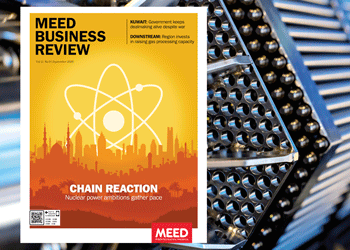
Nuclear power ambitions gather pace; Kuwait keeps dealmaking alive despite war; Region invests in raising gas processing capacity.
Distributed to senior decision-makers in the region and around the world, the September 2026 edition of MEED Business Review includes:
> AGENDA: Gulf nuclear revival takes shape> MARKET FOCUS: Kuwait keeps dealmaking alive under fire> INDUSTRY REPORT: Gas processing takes centre stage in Mena regionTo see previous issues of MEED Business Review, please click herehttps://image.digitalinsightresearch.in/uploads/NewsArticle/19461053/main.jpg -
Chinese firm to set up $300m anode facility in the UAE
8 September 2026
Beijing-headquartered Sunstone Development has signed a memorandum of understanding (MoU) with the UAE Ministry of Investment to develop an anode production facility in the UAE, with an estimated investment of about $300m.
The MoU follows Sunstone’s December 2025 joint-venture agreement with Emirates Global Aluminium (EGA) to build the project.
Upon completion, the plant is expected to replace most of EGA’s current anode imports and support the UAE’s ambition to become one of a limited number of global anode-exporting countries, aligning with the Make It In The Emirates initiative and Operation 300bn.
The ministry said the agreement reflects its role in helping strategic investors navigate the UAE’s investment ecosystem and convert commitments into long-term operations, in line with the National Investment Strategy 2031.
By localising a key stage in the aluminium value chain, the facility will reduce reliance on imported anodes, enhance the competitiveness of the UAE aluminium sector and support wider economic diversification.
The Ministry of Investment and Sunstone will establish a joint working group, chaired by the ministry, to oversee project delivery.
The project is expected to create skilled employment opportunities for UAE nationals and residents, while strengthening domestic manufacturing capacity and industrial capabilities.
READ THE SEPTEMBER 2026 MEED BUSINESS REVIEW – click here to view PDFNuclear power ambitions gather pace; Kuwait keeps dealmaking alive despite war; Region invests in raising gas processing capacity.
Distributed to senior decision-makers in the region and around the world, the September 2026 edition of MEED Business Review includes:
> AGENDA: Gulf nuclear revival takes shape> MARKET FOCUS: Kuwait keeps dealmaking alive under fire> INDUSTRY REPORT: Gas processing takes centre stage in Mena regionTo see previous issues of MEED Business Review, please click herehttps://image.digitalinsightresearch.in/uploads/NewsArticle/19461120/main.jpg -
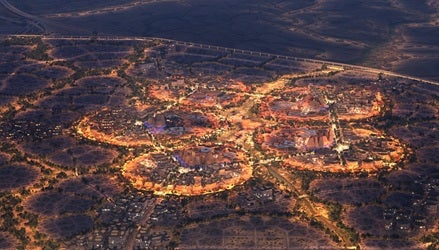
Riyadh tenders Expo 2030 Souq areas package
8 September 2026
Expo 2030 Riyadh Company (ERC), responsible for delivering the Expo 2030 Riyadh venue, has tendered a contract to deliver the Souq areas within the Expo site.
The tender was floated on 30 July, with a submission deadline of 9 October.
The Souq areas are divided into five distinct precincts, with a total development area of about 300,000 square metres (sq m).
The scope includes the five precincts and their associated vertical elements, infrastructure and public realm works.
The precincts comprise:
- Precinct 1 – The Icon: 41,417 sq m
- Precinct 2 – Place & Planet: 62,306 sq m
- Precinct 3 – Culture of Wisdom: 67,112 sq m
- Precinct 4 – Kingdom of Saudi Arabia: 45,967 sq m
- Precinct 5 – Adaptation & Innovation: 82,358 sq m
The package will interface with three public parks. It will also tie into the Natural Corridor, including bridges.
The Souq areas will form a mixed-use destination at the centre of Expo 2030 Riyadh, providing a central connection between the site’s iconic and thematic assets.
The development will include rented and partnership pavilions, alongside a range of food and beverage, retail and visitor-experience offerings.
Site progress
Construction activity at the Expo site is accelerating, with Riyadh moving to award its first major vertical contracts and advancing infrastructure works across the programme.
Earlier this month, Saudi Arabia’s Royal Commission for Riyadh City (RCRC) awarded a design-and-build contract for the construction of a new metro station catering to the Expo 2030 site.
In April, ERC awarded two contracts for the next phase of infrastructure works at the site to local firm Alyamama Company.
The scope covered the construction of road networks and infrastructure for water, sewage, electricity, telecommunications and electric vehicle charging.
These awards followed ERC’s January award of an estimated SR1bn ($267m) contract for initial infrastructure works at the site to local firm Nesma & Partners.
That scope covered about 50 kilometres of integrated infrastructure networks, including internal roads and essential utilities such as water, sewage, electrical and communications systems, and electric vehicle charging stations.
The masterplan covers 6 square kilometres, making it one of the largest sites ever designated for a World Expo event. Situated to the north of the Saudi capital, the site will be located near the future King Salman International airport and will provide direct access to landmarks within Riyadh.
The Public Investment Fund, Saudi Arabia’s sovereign wealth vehicle, launched ERC – a wholly owned subsidiary – in June 2025 to build and operate facilities for Expo 2030.
READ THE SEPTEMBER 2026 MEED BUSINESS REVIEW – click here to view PDFNuclear power ambitions gather pace; Kuwait keeps dealmaking alive despite war; Region invests in raising gas processing capacity.
Distributed to senior decision-makers in the region and around the world, the September 2026 edition of MEED Business Review includes:
> AGENDA: Gulf nuclear revival takes shape> MARKET FOCUS: Kuwait keeps dealmaking alive under fire> INDUSTRY REPORT: Gas processing takes centre stage in Mena regionTo see previous issues of MEED Business Review, please click herehttps://image.digitalinsightresearch.in/uploads/NewsArticle/19457171/main.jpg -
Powering the next chapter with nuclear energy
8 September 2026
 Commentary
Colin Foreman
EditorNuclear energy is increasingly being viewed as essential around the world. It offers a non-CO2-emitting, steady baseload at a time when governments have made net-zero commitments.
In the Gulf, the UAE has spent the past 15 years building the Middle East’s first commercial nuclear plant, now supplying about a quarter of the country’s electricity. What is new is the breadth of ambition beyond Abu Dhabi. The civil nuclear cooperation deal signed between Saudi Arabia and the US in July is the most significant step in the kingdom’s nuclear programme for several years, and it lands as the region moves decisively towards atomic power.
The logic is clear. Electricity demand from industry, desalination and digital infrastructure is climbing, and governments want reliable low-carbon supply to meet it. Saudi Arabia is targeting up to 17GW of nuclear capacity by 2040. Its first plant at Khor Duwaiheen, comprising two 1.4GW reactors, represents only about a sixth of that goal, which points to a programme rather than a one-off.
What is new is the breadth of ambition beyond Abu Dhabi
The opportunity extends well beyond reactors. The UAE’s nuclear programme shows the scale of the economic impact. More than 2,000 local firms secured contracts worth over $6.7bn supporting construction, operations and maintenance.
Saudi Arabia’s ambitions reach further still, into small modular reactors, domestic uranium and elements of the fuel cycle. At the same time, Bahrain is studying a modular plant to power its industrial base, and Egypt’s 4.8GW El-Dabaa project is already under construction, with first generation expected in 2028.
For contractors, engineers and financiers, this is the beginning of a projects market that will unfold over decades. The reactor awards will grab the headlines, but the supporting ecosystem, from regulation and fuel supply to workforce development, is where much of the value lies.
READ THE SEPTEMBER 2026 MEED BUSINESS REVIEW – click here to view PDFNuclear power ambitions gather pace; Kuwait keeps dealmaking alive despite war; Region invests in raising gas processing capacity.
Distributed to senior decision-makers in the region and around the world, the September 2026 edition of MEED Business Review includes:
> AGENDA: Gulf nuclear revival takes shape> MARKET FOCUS: Kuwait keeps dealmaking alive under fire> INDUSTRY REPORT: Gas processing takes centre stage in Mena regionTo see previous issues of MEED Business Review, please click herehttps://image.digitalinsightresearch.in/uploads/NewsArticle/19461185/main.gif