
King Salman airport signs mixed-use project agreements
11 February 2026
Register for MEED’s 14-day trial access
King Salman International Airport Development Company (KSIADC) has signed multiple memorandums of understanding with local firms to develop several mixed-use projects within King Salman International airport (KSIA) in Riyadh.
The agreements were signed on the sidelines of the Private Sector Forum 2026 in Riyadh.
The agreements involved major investment and development firms, including Sumou Holding, Mohammed Al-Habib Investment, Kinan, Ajdan, Retal, Urjuan and Osus.
The developments will comprise residential, commercial, retail, hospitality, entertainment and other related projects.
These developments will be located within the airport’s master development area, 12 square kilometres (sq km) of which are allocated for real estate development.
According to a statement published by the Saudi Press Agency, “KSIADC’s development scope also includes integrated economic and logistics zones covering approximately 3 million square metres, aligning real-estate development with economic activity and supporting services."
Project scale
The project covers an area of about 57 sq km, allowing for six parallel runways, and will include the existing terminals at King Khalid International airport.
The airport aims to accommodate up to 100 million passengers by 2030. The cargo processing goal is to reach 2 million tonnes a year by 2030.
Saudi Arabia plans to invest significantly in its aviation sector. Riyadh’s Saudi Aviation Strategy, announced by the General Authority of Civil Aviation, aims to triple Saudi Arabia’s annual passenger traffic to 330 million travellers by 2030.
It also aims to increase air cargo traffic to 4.5 million tonnes and raise the country’s total air connections to more than 250 destinations.
 READ THE FEBRUARY 2026 MEED BUSINESS REVIEW – click here to view PDF
Spending on oil and gas production surges; Doha’s efforts support extraordinary growth in 2026; Water sector regains momentum in 2025.
Distributed to senior decision-makers in the region and around the world, the February 2026 edition of MEED Business Review includes:
|
> AGENDA: Mena upstream spending set to soar
> INDUSTRY REPORT: MEED's GCC water developer ranking
> INDUSTRY REPORT: Pipeline boom lifts Mena water awards
> MARKET FOCUS: Qatar’s strategy falls into place
> CURRENT AFFAIRS: Iran protests elevate regional uncertainty
> CONTRACT AWARDS: Contract awards decline in 2025
> LEADERSHIP: Tomorrow’s communities must heal us, not just house us
> INTERVIEW: AtkinsRealis on building faster
> LEADERSHIP: Energy security starts with rethinking waste
|

Register for MEED's guest program now to access this article.
Exclusive from Meed
-
 Abu Dhabi receives four bids for Al-Nouf IPP
30 March 2026
-
 Neom cancels major desalination project
30 March 2026
-
 Construction guard undergoes a shift
30 March 2026
-
 Contractors submit bids for Aramco-backed logistics hub
30 March 2026
-
 Attack damages Kuwait power and desalination plant
30 March 2026
All of this is only 1% of what MEED.com has to offer
Subscribe now and unlock all the 153,671 articles on MEED.com
- All the latest news, data, and market intelligence across MENA at your fingerprints
- First-hand updates and inside information on projects, clients and competitors that matter to you
- 20 years' archive of information, data, and news for you to access at your convenience
- Strategize to succeed and minimise risks with timely analysis of current and future market trends

Related Articles
-
Abu Dhabi receives four bids for Al-Nouf IPP
30 March 2026
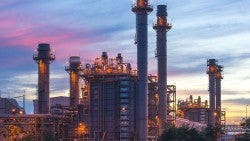
State utility Emirates Water & Electricity Company (Ewec) has announced it has received four bids for the development of the 3.3GW Al-Nouf independent power producer (IPP) project in Abu Dhabi.
Located within the newly established Al-Nouf complex, the facility will be the largest single-site, carbon-capture-ready, combined-cycle gas turbine plant in the UAE.
Ewec issued a request for proposals for the project last August. It received statements of qualifications for the contract in April 2025.
Earlier this month, MEED exclusively revealed that Aljomaih Energy & Water (Saudi Arabia) and Sumitomo (Japan) were among the bidders for the project.
The groups that submitted bids include the following three consortiums and one individual company:
- Aljomaih Energy & Water (Saudi Arabia) / Sembcorp Industries (Singapore) / EDF Power Solutions (France)
- Engie (France) / Korea Overseas Infrastructure & Urban Development Corporation (Kind) / Korea Western Power Company (Kowepo)
- Korea Electric Power Corporation (Kepco) / Etihad Water & Electricity (EtihadWE)
- Sumitomo (Japan)
As MEED previously reported, the project will follow the model of Abu Dhabi’s IPP programme, in which developers enter into a long-term agreement with Ewec as the sole procurer.
This involves the development, financing, construction, operation, maintenance and ownership of the plant, with the successful developer or developer consortium owning up to 40% of the entity. The remaining equity will be held indirectly by the Abu Dhabi government.
The project site was selected for its ability to accommodate both seawater-cooled power generation and reverse osmosis desalination technologies.
The plant will have the capacity to support several utility-scale energy and desalination projects in the future.
The facility is scheduled to begin commercial operations in the third quarter of 2029.
Taweelah C IPP
Last year, the Taweelah C IPP became the first gas-fired power plant project to be procured by Abu Dhabi since 2020, when Ewec awarded Japan’s Marubeni Corporation the contract to develop the Fujairah 3 IPP.
Ewec is procuring the 2,500MW gas-fired IPP, which will be located in the Al-Taweelah power and desalination complex, approximately 50 kilometres to the northeast of Abu Dhabi.
It is understood that three groups have submitted bids for the developer contract. These are:
- Sumitomo (Japan) / Korean Midland Power / Korea Overseas Infrastructure & Urban Development Corporation
- Aljomaih Energy & Water (Saudi Arabia) / Sembcorp (Singapore)
- Etihad Water & Electricity (UAE) / Korea Western Power (Kowepo) / Kyuden (Japan)
A team of UK-based Alderbrook Finance and US-based Sargent & Lundy is providing financial and technical advisory services to Ewec for the Taweelah C IPP.
The power purchase agreement for the project was previously expected to be signed by the end of 2025, with the project scheduled to begin commercial operations in the fourth quarter of 2028.
https://image.digitalinsightresearch.in/uploads/NewsArticle/16185238/main.jpg -
Neom cancels major desalination project
30 March 2026

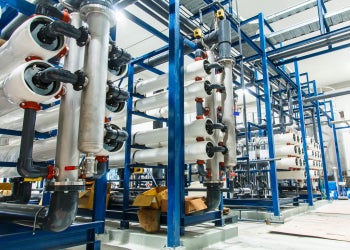
Saudi gigaproject developer Neom has cancelled plans to build a major seawater reverse osmosis (SWRO) desalination plant, according to industry sources.
The plant, due to have a capacity of 150,000 cubic metres a day (cm/d), had been tendered in 2024.
In October that year, MEED reported that Enowa, the Neom utility subsidiary, had received four bids from companies for a contract to build the plant.
These included:
- Alfanar Company (local) / Abengoa (Spain)
- China Machinery Engineering Corporation (CMEC)
- Orascom (Egypt) / Wetico (local)
- VA Tech Wabag (India)
In 2025, the project failed to reach the contract award stage. It has since been cancelled as part of a “complete restructure for Neom”, a source told MEED.
Neom did not respond to a request for comment. However, it is understood that the desalination project will not be retendered under a new scope.
The SWRO plant, previously known as the Moonlight desalination plant, was due to be built adjacent to the 125,000 cm/d desalination plant at Duba on Saudi Arabia’s Red Sea coast. It was expected to take 12 months to complete.
Previously, in May 2024, Enowa confirmed the cancellation of another project to develop a renewable-energy-powered advanced SWRO project with zero liquid discharge in Oxagon, Neom’s industrial cluster.
The scope of the cancelled project’s first phase, to be developed by a team of Japan’s Itochu Corporation and France’s Veolia, included a desalination plant with a production capacity of 500,000 cm/d of desalinated water.
In recent months, Saudi Arabia’s construction sector has been pivoting away from prestige-driven capital expenditure towards more deliverable priorities.
In March, MEED exclusively revealed that Neom had cancelled the contracts related to the construction of the tunnel sections of The Line in northwest Saudi Arabia.
The tunnels formed part of the infrastructure backbone of Neom’s 170-kilometre The Line development, launched in January 2021.
Separately, it was also announced that a contract between Neom and Malaysian contractor Eversendai Corporation had been terminated for the steel structural works on the Ski Village Trojena project.
According to media reports, the shift away from large-scale gigaprojects includes a pivot towards repositioning what remains of Neom as an industrial and data centre hub.
Such plans would leverage the Red Sea coastline’s access to seawater cooling for artificial intelligence (AI) infrastructure.
https://image.digitalinsightresearch.in/uploads/NewsArticle/16141326/main.jpg -
Construction guard undergoes a shift
30 March 2026
The 2026 GCC Construction Contractor Ranking reflects two key trends. One is a growing trend that has been steadily rising across the region for more than a decade, while the other is a more recent development, which is now followed by the added uncertainty of a war with Iran.
The long-running trend is the rise of Chinese contractors. After years of Saudi-based dominance, Beijing’s China State Construction Engineering Corporation has claimed the top spot as the region’s most active contractor, with $10.399bn of work currently at the execution stage. This represents a notable rise for the firm, which was ranked second in 2025.
China State is not the only Chinese contractor in the top three. China Harbour Engineering Company ranks third, with $8.64bn of work under execution. Both firms are among China’s largest construction companies and have a longstanding presence in the region. In recent years, their success has encouraged other Chinese contractors to enter the market and win work. This trend is reflected in the national rankings, where other Chinese players feature prominently and may follow China State and China Harbour in rising to the top of the regional rankings.
Saudi reprioritisation
The other more recent trend affecting the 2026 ranking is the reprioritisation of projects in Saudi Arabia. The reassessment of the kingdom’s capital expenditure commitments led to a sharp decrease in contract awards during 2025. Combined with contractors completing work on projects secured immediately after the Covid-19 pandemic in 2021 and 2022, this has resulted in an overall decline in the value of work at the execution stage.”
This trend is reflected in China State’s figures. Although it moved up the rankings in 2026, the total value of work at the execution stage declined from $13.5bn to $10.4bn – a drop of about 30%.
The decline was even more pronounced for Saudi Arabia-based Nesma & Partners, which, unlike China State, does not have extensive operations in other GCC markets. Nesma moved to second place with $8.844bn of work under execution.
Despite the slowdown in activity in the kingdom, Saudi contractors continue to hold four of the top 10 positions, down from six in the 2025 ranking. El-Seif Engineering Contracting, Al-Bawani and Shibh Al-Jazira dropped out of the rankings, while Modern Building Leaders entered the top 10.
The other newcomer to the list is London-headquartered Innovo, which has rapidly become one of the most active building contractors in the UAE, with projects in Dubai and Abu Dhabi.
Bahrain
The Bahraini market remains dominated by large-scale social infrastructure and residential developments. In 2026, the ranking shows that contractors that have maintained a steady amount of work at the execution stage have risen up the ranking as other contractors complete projects and drop down the listing.
China Machinery Engineering Company maintains its position at the top of the ranking, with $689m of work under execution. Its primary focus continues to be the East Sitra housing scheme, a multi-phase project for the Ministry of Housing & Urban Planning that has involved the construction of thousands of housing units since 2019.
Nass Contracting has climbed back to second position with $639m. The local contractor was ranked fourth in 2025. Its portfolio is bolstered by significant infrastructure wins, including the Busaiteen Link scheme and the expansion of the RCSI Bahrain campus. Al-Hamad Building Contracting follows in third place with $610m, continuing its work on major Manama-based projects such as the Villamar residential complex.
In fourth position is the local Saleh Abdulla Kameshki & Sons, with $237m of work at the execution stage, followed by the local Kooheji Contractors in fifth place, with $230m of work at the execution stage. Kooheji was the seventh-ranked contractor in 2025.
Another local contractor that has risen up the ranking is Cebarco, which now sits in sixth place up from eighth, with $218m of work under execution. The local Almoayyed Contracting Group now sits in seventh place, down from sixth last year.
The other companies were not in the top 10 in 2025. They are CCT Constructor Group, Dar Al-Binaa Construction and Haji Hassan Group.
Kuwait
Turkiye’s Limak remains the top-ranked contractor in Kuwait, with $6.052bn of projects at the execution stage. The firm’s ranking reflects its work on the multibillion-dollar expansion of Kuwait International airport Terminal 2 and various road maintenance contracts for the Ministry of Public Works.
Chinese contractors have significantly increased their footprint in the country. China signed a series of agreements in 2023 that covered the delivery of some of Kuwait’s immediate development goals between 2024 and 2028. These agreements positioned Chinese companies to play a leading role in the Fourth Kuwait Master Plan 2040, and this is now shown in the contractor ranking for 2026.
China Communications Construction Company (CCCC) takes the second spot with $3.625bn, while China Gezhouba Group Construction holds third with $1.670bn.
In December last year, CCCC signed a $4bn agreement to develop the next phases of Kuwait’s Grand Mubarak Port on Boubyan Island. In March 2025, China Gezhouba won two contracts worth over $557m from the Public Authority for Housing Welfare for the South Saad Al-Abdullah residential project in Al-Jahra Governorate.
While Chinese contractors are playing a growing role, local players continue to manage substantial orderbooks, including Al-Ahmadiah with $1.071bn of work under execution, Khalid Ali Kharafi & Sons with $1.017bn of work, and Mohamed Abdulmohsin Al-Kharafi & Sons with $992m.
Oman
The Omani construction sector has changed at the top as the value of projects that contractors have at the execution stage has declined. Al-Adrak Trading & Contracting Company has moved into first place with $1.423bn of work. The top-ranked contractor in 2025 had $2.4bn of projects at the execution stage.
Al-Adrak was the eighth-ranked contractor in 2025, with $700m of projects at the execution stage.
The local contractor’s recent success has been anchored by securing work on Oman’s new generation of real estate projects. In May 2025, it secured a contract with Saudi developer Dar Global to build the villas and apartments at the Aida project.
Last year’s top-ranked contractor, Galfar Engineering & Contracting, is now in second place with $1.392bn. Galfar’s portfolio is headlined by the $1.5bn Hafeet Railway project connecting Oman and the UAE.
Sarooj Construction Company follows closely in third with $1.372bn, while India’s Larsen & Toubro maintains a strong presence in fourth with $906m. Overall, the market shows further softening in 2026, with contractors across the rest of the ranking holding less work than in 2025, when the 10th-ranked contractor, PowerChina, had $500m of projects under construction. In 2026, it has $250m.
Qatar
Qatar’s market is transitioning into a post-World Cup phase, focusing on social infrastructure and utility projects. Midmac Contracting Company has moved to the top spot with $2.082bn, nearly doubling the value of projects held by the second-ranked UCC Holding, which has $1.05bn.
Midmac’s return to the top 10 and the top of the ranking is largely due to it recently securing the $2bn Amiri flight facilities project at Hamad International airport, while UCC’s work remains centred on public-private partnership school schemes and road infrastructure for Ashghal.
The contracting joint venture of Qatari Diar and Saudi Binladin Group, QD-SBG Construction, is in third position with $843m. Its largest ongoing project is Al-Rafidain Mall for Abraaj Al-Mustaqbal RealEstate.
As the Qatari market transitions, four other contractors have moved into the top 10 in 2026. They are Badr Contracting & Trading with $534m of projects under execution, Al-Masaken Trading & Contracting Company with $400m, Marbu Contracting Company with $395m and Al-Mohannadi Group with $369m. As these contractors join the ranking, Consolidated Contractors Company (CCC), Shelter Contracting, InfraRoad Trading & Contracting Company, Changda Construction and American International Contractors Incorporated have moved out of the top 10.
Saudi Arabia
Much is changing in Saudi construction, but one constant is Nesma & Partners’ position at the top of the kingdom’s contractor ranking. While its position remains the same, the value of construction work that Nesma has under execution has decreased significantly when compared to 2025. This year, the contractor tops the Saudi ranking with nearly $9bn of work; last year it led with nearly $14bn of work.
Nesma is not the only contractor that has experienced a reduction. Second-placed Almabani has $6.5bn of projects under construction this year compared with $8.5bn in 2025. Third-placed contractor Saudi Binladin Group has maintained a total of about $6.5bn over 2025 and 2026, and this has allowed the Jeddah-based contractor to jump up from seventh position last year. The company is working on several high-profile projects in the kingdom, including the world’s tallest tower in Jeddah, which will be over 1,000 metres tall.
All the other contractors in the top 10 have similar declines in the value of their projects under execution. The exception is the local Building Contracting Company, which joins the top 10 in 10th position with $3.2bn of work. The 10th-ranked contractor in 2025 was China Harbour Engineering Corporation with $5.9bn of work, a total that in 2025 would have meant it would be the fourth-ranked contractor in 2026.
The reduction in work volumes reflects the ongoing reprioritisation of projects in Saudi Arabia. Government officials have said that while some projects, such as The Line at Neom, have slowed down, other projects, such as those for Expo 2030 Riyadh and the Fifa World Cup in 2034, will be accelerated.
UAE
Contractors in the UAE are benefitting from high levels of spending across public infrastructure and real estate. Following on from 2025, Trojan General Contracting continues to lead the UAE ranking. In 2026, it has $7.59bn of projects under execution, up slightly from the $7.2bn recorded in 2025. The Abu Dhabi-based contractor has work on public infrastructure schemes for Abu Dhabi-based government agencies, and this base is supplemented by work on real estate projects across the UAE.
China State Construction is in second position with $5.618bn under execution. The Beijing-based contractor has risen up the rankings from seventh position last year when it had $4bn of work under execution thanks to a series of deals for the construction of real estate and roads.
In third position is London-headquartered Innovo with $5.443bn of work at the execution stage. Innovo is working on major real estate developments in Abu Dhabi and Dubai and has quickly grown in recent years to become one of the key players in the UAE’s construction sector.
Sobha Constructions, the construction arm of property developer Sobha, is in fourth position with just over $5bn of work under execution. It is the main contractor for Sobha’s projects, which include the $763m Sobha Reserve and the $400m Skyvue Towers at Sobha Hartland 2.
The local Dutco, with $4.43bn of work under execution, has joined the top 10 in fifth position. The contractor has picked up a wide range of work on Dubai real estate projects over the past two years. Three other contractors in the ranking, Ginco, Unec and Arabian Construction Company, also work extensively on real estate projects in Dubai and Abu Dhabi. The local Alec is active in the real estate sector too. Additionally, it is working on a large data centre project in Abu Dhabi as well as the Wynn resort in Ras Al-Khaimah.
https://image.digitalinsightresearch.in/uploads/NewsArticle/16184074/main.gif -
Contractors submit bids for Aramco-backed logistics hub
30 March 2026
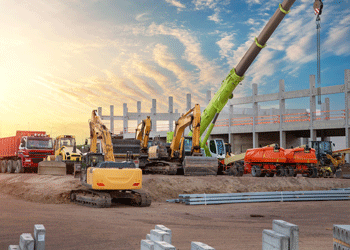
Contractors submitted bids on 18 March for a contract to build a logistics complex at King Salman Energy Park (Spark).
Asmo, the logistics joint venture of Saudi Aramco and DHL Supply Chain, tendered the estimated SR804m ($214m) contract on 7 December.
The logistics hub will span more than 100,700 square metres at Spark.
Al-Khobar-based engineering firm House of Consulting Office is the project consultant.
Last month, Asmo signed an agreement with Bahrain‑headquartered Arcapita Group Holdings to deliver the project at King Salman Energy Park (Spark).
Last month, Asmo signed an agreement with Bahrain-headquartered Arcapita Group Holdings to deliver the project.
The project will feature a 43,000 sq m temperature-controlled Grade A warehouse; more than 3,000 sq m of offices and staff amenities; 5,300 sq m dedicated to chemical storage; and an open yard spanning about 1.2 million sq m.
Planned for large-scale industrial use, the site is expected to incorporate advanced warehouse and building management systems, end-to-end digital connectivity, automation and robotics.
It will also be developed in line with internationally recognised sustainability standards, featuring solar (photovoltaic) readiness, electric-vehicle charging infrastructure and a target of LEED Gold certification.
The development is aimed at supporting the next stage of Saudi Arabia’s logistics and supply chain expansion.
Under the deal structure, Arcapita will provide funding and retain ownership of the asset, while Asmo will develop the facility and then lease and operate it under a 22-year occupational lease.
According to a statement, “the scheme will be executed via a forward-funding model, underscoring a long-term commitment to national infrastructure”.
Asmo added that this will be its first purpose-built logistics centre and one of four strategic locations planned to anchor its nationwide logistics network, aligned with the National Transport and Logistics Strategy under Saudi Vision 2030.
https://image.digitalinsightresearch.in/uploads/NewsArticle/16183461/main.gif -
Attack damages Kuwait power and desalination plant
30 March 2026
Kuwait’s Ministry of Electricity, Water & Renewable Energy (MEWRE) has confirmed that a service building at one of the country’s power generation and water desalination plants was damaged in an attack on the evening of 29 March.
According to the ministry, the incident resulted from what it described as the ongoing Iranian aggression against Kuwait.
The attack led to the death of one worker of Indian nationality and caused significant material damage to the building.
The ministry said technical teams and emergency response units began work immediately in line with approved emergency plans.
It said efforts are under way to deal with the impact of the incident and ensure continuity of operations. The ministry added that work is being carried out in full coordination with security authorities and relevant agencies to secure the affected site.
The ministry said the safety and stability of the electricity and water system remains its highest priority. It added that all technical teams are working around the clock to respond to any emergency and ensure the continuity of vital services.
The incident followed missile and drone strikes over the weekend on major aluminium plants in both Bahrain and the UAE.
In a statement carried by Iranian state broadcaster IRIB, Iran’s Revolutionary Guards said they hit an aluminium facility in the UAE and Aluminium Bahrain’s main plant, calling both sites “industries affiliated with and connected to the US military and aerospace sectors in the region”.
Aluminium Bahrain, one of the world’s largest aluminium producers, said two employees were wounded in an Iranian strike targeting its facility on Saturday. The company, also known as Alba, said the workers suffered minor injuries.
UAE-based Emirates Global Aluminium (EGA) also confirmed on 28 March that its Al-Taweelah production base at Khalifa Economic Zone in Abu Dhabi had sustained “significant damage” during missile and drone attacks.
“A number of EGA employees were injured [but] none of the injuries are life-threatening,” the company said in a statement.
Previously, US President Donald Trump had announced a 10-day extension to the pause on military strikes targeting Iranian energy infrastructure.
The decision, which delayed potential strikes until 6 April, followed what Trump described as a diplomatic gesture from Tehran involving the movement of oil tankers through the Strait of Hormuz.
https://image.digitalinsightresearch.in/uploads/NewsArticle/16184064/main.jpg