
What actually slows a gigaproject down
9 September 2026

Ask anyone delivering a major programme in the GCC what causes delays and sequencing will come up early. Utilities go in too late. Approvals lag behind construction. Stations, depots and access roads are procured as if they belong to different projects rather than one system.
“None of this is new. The industry has understood these risks for years,” says Alan Caldwell, managing director for transport and infrastructure at WSP Middle East.
For Caldwell, that is what makes the pattern worth interrogating rather than simply restating.
“The more important question is why the same issues around interfaces, approvals, stakeholder alignment and delivery sequencing continue to slow major programmes when the risks are already so well understood,” he says.
The answer, he argues, is not that these programmes are too big or too technically complex. What breaks a schedule is a wider system delivered as a set of disconnected parts; an approval sitting with an authority team with no visibility of the construction sequence downstream; or a station package proceeding without the utilities diversion it depends on.
“Infrastructure programmes do not struggle because a railway is too large or a highway network is too complex,” Caldwell says. “They encounter difficulties when interconnected elements are delivered in the wrong order.”
Sequencing decisions are rarely purely technical either, he adds. They are commercial – shaped by which assets need to unlock value first, which phases are tied to funding, and where sales or investment assumptions depend on infrastructure landing in a particular order.
Approvals sit at the centre of that logic. On many programmes, they become one of the biggest sources of lost time – not because the requirements are unreasonable, but because approvals are not planned, evidenced or owned as part of the delivery logic from day one.
Caldwell has seen the same pattern across three decades of Gulf delivery, from early work on Palm Jumeirah to today’s region-wide transport programmes.
“The decisive factor has often been the same: whether interfaces, approvals, responsibilities and delivery sequencing are aligned early enough to prevent complexity becoming delay.”
Integration needs to be well understood
“Most programme teams in the region would say they understand the need for integration,” Caldwell says. Fewer are structured to deliver it. “The harder task is turning that understanding into the way projects are actually set up and managed,” he argues.
Riyadh Metro is the reference point he returns to, precisely because engineering complexity was not the deciding factor in its delivery.
Coordinating a city-scale transport system meant aligning design, construction, systems, utilities and stakeholder interfaces across every delivery vertical.
“The lesson for the region today is clear,” Caldwell says. “Ambitious programmes need a delivery model that gives every contributor a shared view of progress, risk, decision-making and the business case driving programme priorities.”
That shared view, he argues, will be what the next phase of Gulf delivery is judged on.
Whether clients, consultants, contractors, operators and approval authorities can work to a single delivery logic will be key.
“This requires more than coordination meetings. It requires integrated ways of working, shared common data environments and governance structures that make risks, decisions and dependencies visible before they become delays,” he says.
From reporting progress to managing risk before it lands
Digital tools have a role here, Caldwell says, but not as a headline in themselves.
Digital twins, programme visualisation and data-led modelling matter only if they help teams identify and address problems before they affect the wider programme.
“The real value is not technology for its own sake,” he says. “It is the ability to see, in one place, where approvals are outstanding, where interfaces are unresolved, where programme dates are slipping, where clashes are emerging and where decisions need to be escalated."
None of it works without governance behind it, he cautions. “A dashboard will not resolve a delayed approval if nobody knows who owns the decision, when it needs to be made, or how it should be escalated.”
Data only has value if the processes and responsibilities around it are clear, which is why Caldwell frames the shift the region needs not as digitisation, but as a move “from programme management as a discipline focused mainly on reporting and coordination, and towards project and programme intelligence”.
With many of the region’s programmes running for a decade or more, he adds, delivery models also need to flex as funding assumptions, user needs and policy priorities change along the way.
“The ambition behind the Gulf’s transformation programmes is not in question,” Caldwell says.
What will determine how much of it is realised on time is whether delivery models evolve at the same pace: earlier integration, clearer approval pathways, shared data environments, and every contributor working to a delivery logic that connects technical sequencing with the funding and operational case behind it.
“The region’s next challenge is not imagining bigger projects,” he says. “It is changing the way they are delivered, operated and adapted over time.”

Register for MEED's guest program now to access this article.
Exclusive from Meed
-
 Algeria tenders 310km Tamanrasset railway
16 October 2026
-
 Joint venture wins $246m RCRC bridges contract
16 October 2026
-
 Humain tenders 100MW Riyadh AI data centre
16 October 2026
-
 Adnoc Onshore seeks bids for Bu Hasa field EOR project
16 October 2026
-
 OTTCO issues tender for Oman oil storage park expansion
16 October 2026
All of this is only 1% of what MEED.com has to offer
Subscribe now and unlock all the 153,671 articles on MEED.com
- All the latest news, data, and market intelligence across MENA at your fingerprints
- First-hand updates and inside information on projects, clients and competitors that matter to you
- 20 years' archive of information, data, and news for you to access at your convenience
- Strategize to succeed and minimise risks with timely analysis of current and future market trends
Related Articles
-
Algeria tenders 310km Tamanrasset railway
16 October 2026
Algeria’s state railway project developer, Agence Nationale d’Etudes et de Suivi de la Realisation des Investissements Ferroviaires (Anesrif), has invited national and international contractors to bid for the construction of a 310-kilometre (km) railway line between Hotel Station and Moulay Lahcen Station.
The planned line is a key segment of the proposed railway corridor connecting El-Menea, In-Salah and Tamanrasset across the southern wilayas of In-Salah and Tamanrasset.
The tender notice was issued on 12 October, with bids due by 10 November.
The tender is open to single contractors and consortiums. To qualify, single firms must have executed at least 200km of new railway lines or track-doubling works since 2010, with accepted project certificates covering sections of at least 100km, along with a cumulative 800 metres of railway bridges with individual spans exceeding 30 metres.
Bidders must also provide at least two rail-tamping machines, two ballast regulators, and a project director with an engineering degree and at least five years of railway construction management experience.
From a commercial and classification perspective, single bidders and consortium leaders must hold a category-nine (IX) professional qualification in public works.
Bidders must also demonstrate an average annual turnover in construction of at least DZ260bn ($1.96bn) across the 2023-2025 financial period.
For joint ventures, the cumulative turnover of all members must meet the $1.96bn threshold, with the consortium leader accounting for at least $1.3bn.
Offers must be accompanied by a bid bond exceeding 1% of the total bid value for submissions exceeding $7.4m, with proposals remaining valid for 90 days beyond the submission date.
https://image.digitalinsightresearch.in/uploads/NewsArticle/20665591/main.jpg -
Joint venture wins $246m RCRC bridges contract
16 October 2026
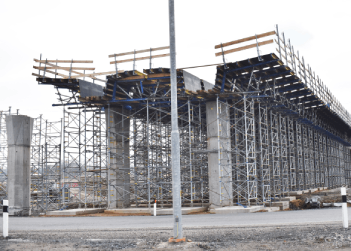
A joint venture of local contractor Mofarreh Group and Turkey-based Gulsan Holding has won an estimated SR923m ($246m) contract from the Royal Commission for Riyadh City (RCRC) to construct a series of grade-separated steel flyovers across the capital.
The contract, known as Package 2 (Groups 2 and 3), is part of RCRC’s urgent bridges programme under the wider project to build steel bridges at 10 junctions across Riyadh.
The works have a 12-month execution timeline to fast-track traffic decongestion across major arterial corridors.
The joint venture’s scope covers the engineering and construction of grade-separated steel bridge interchanges across seven key intersections:
- IC04: Al-Khair Road and King Salman Bin Abdulaziz Road
- IC05: Prince Turki Road and Imam Saud Road
- IC06: Al-Takhassosi Road and Saeed Al-Sulami Road
- IC07: Khurais Road and Al-Hareth Bin Abdullah Road
- IC08: Khurais Road and Ash-Sharq Road
- IC09: Khurais Road and Marmar Road
- IC10: Al-Kharj Road and Al-Hilla Road
The total length of the flyovers is 8.86 kilometres, excluding Junction IC10.
In addition to the structural steel superstructures, concrete bridge foundations, decks and approach ramps, the contract includes retaining walls, utility diversions, temporary phased traffic arrangements, associated roadworks, drainage networks, roadway lighting, intelligent transportation systems and landscaping.
The client received commercial proposals from several local and international contractors. Other bidders included:
- Masco
- Nesma & Partners
- Al-Omaier Trading & Contracting Company
- Yuksel Saudia
- Batco
- Modern Building Leaders
- Sapac
The urgent bridges initiative is part of Riyadh’s rapid transport infrastructure programme to improve traffic throughput, enhance safety and ease vehicular congestion across central and ring-road corridors ahead of major events, including Expo 2030 and the 2034 Fifa World Cup.
In July, Mofarreh Group and Turkiye’s Gulsan Holding formed a joint venture to bid for and deliver transport infrastructure projects in Riyadh for RCRC.
The joint venture said it will target road, bridge, viaduct and interchange projects.
Mofarreh will provide local market access and operational capacity, while Gulsan will contribute international experience in large-scale transport projects.
The companies said the new venture will support knowledge transfer and localisation, and promote the use of international engineering and construction standards aligned with Saudi Arabia’s Vision 2030 infrastructure and sustainability goals.
https://image.digitalinsightresearch.in/uploads/NewsArticle/20663255/main.png -
Humain tenders 100MW Riyadh AI data centre
16 October 2026
Register for MEED’s 14-day trial access
Saudi artificial intelligence infrastructure developer Humain has issued a request for proposals for an engineering, procurement and construction (EPC) contract to deliver a 100MW artificial intelligence (AI) data centre facility in Riyadh’s Al-Saad area.
The tender was issued on 17 September, with bids due by 8 November.
The contract includes core-and-shell works; civil works; mechanical, electrical and plumbing installation; testing and commissioning; and site infrastructure across a 350,200-square-metre plot.
The project also includes an optional expansion phase that could raise total site capacity to 200MW.
The initial 100MW development is split into two equal 50MW phases, structured across two single-storey IT buildings housing four 25MW data halls.
Phase one targets a ready-for-service date by October 2028, followed by phase two in January 2029.
Under the optional phase three, an additional 100MW facility would be brought online by July 2029.
The data centre will be designed to support high-density graphics processing unit clusters and AI-compute workloads, with rack densities of 240kW to 250kW.
The facility will be built to Uptime Institute Tier III topology and LEED Silver standards as a baseline, targeting LEED Gold.
The operational design targets an annualised power usage effectiveness below 1.35.
Power will be delivered through four 33kV connections supplied by Saudi Electricity Company from two separate high-voltage/medium-voltage primary substations. The scope requires 15 transformers, 15 static 2,250kW IT uninterruptible power supply (UPS) units, and 450kW mechanical UPS systems with lithium-ion battery storage for each 25MW block.
Backup emergency diesel generators will be provided on an owner-furnished, contractor-installed basis, with the EPC contractor handling their installation, connection and testing. Fuel storage will provide 24 hours of autonomous run-time, split between on-site underground bulk tanks and generator belly tanks.
Thermal management combines air and liquid cooling. High-density server racks will be equipped with direct-to-chip liquid cooling loops using coolant distribution units and technical water distribution, paired with air-cooled chillers operating in dual high- and low-temperature loops, alongside fan-wall units.
The total construction timeline is capped at 25 months from site handover or contract signing, with pre-execution early mobilisation scheduled to start in January 2027.
https://image.digitalinsightresearch.in/uploads/NewsArticle/20661045/main.jpg -
Adnoc Onshore seeks bids for Bu Hasa field EOR project
16 October 2026
Register for MEED’s 14-day trial access
The onshore oil and gas business of Abu Dhabi National Oil Company (Adnoc Onshore) has sought bids from contractors for a key project to increase the oil production capacity of the Bu Hasa oil field, primarily through enhanced oil recovery (EOR) techniques.
The main objective of the Bu Hasa-Shuaiba EOR Unit 1 (Phase 1) project is to achieve a targeted 70% increase in oil production, extend the Bu Hasa field development’s production plateau and maximise the field’s potential in an economical manner.
The project aims to confirm and validate the optimum EOR technology for the top-ranked reservoirs/units; assess incremental recovery on top of the improved oil recovery (IOR) wedge; extend the field plateau for as long as is economically feasible; and achieve an ultimate recovery factor of 70% from the Shuaiba reservoir. It will evaluate and execute the recommended EOR option through pattern phasing for any technology proven by Adnoc.
Adnoc Onshore is understood to have issued the tender for the project on 20 September, with an initial technical bid submission deadline of 8 October, according to sources. The client later extended the technical bid submission deadline to 17 October, sources told MEED.
The chosen contractor will execute the project under a hybrid contracting strategy comprising:
- A lump sum (turnkey) EPC scope covering the complete pipeline system from East Hub to the separation plant
- A call-out-based scope for execution of all WAG injector and WSW tie-in works
Unless otherwise specified, all activities defined under the contractor’s scope will be deemed included within the lump-sum contract price. This will cover engineering, procurement, construction, testing, pre-commissioning and support to commissioning for a complete and operable system.
At the Bu Hasa field development, three remote degassing stations (RDS-1/2/3) and two satellite stations, Bida Al-Qemzan and Huwaila, are currently in operation. Production from oil wells completed in Shuaiba, Thamama B, Thamama F, Bida Al-Qemzan and Huwaila is routed via individual flowlines to the three remote degassing stations and the Bida Al-Qemzan and Huwaila stations across different parts of the field.
Combined production from the wells at each of these stations is routed to the central degassing stations (CDS) via transfer lines ranging from 16 inches to 24 inches in diameter. In addition, some wells in the central part of the field are connected directly to the CDS.
Previous studies have identified carbon dioxide (CO2) flooding as a promising tertiary recovery mechanism in the Shuaiba reservoir, delivering incremental recovery on top of the IOR wedge (P5 project), extending the field plateau as long as economically feasible, and achieving an ultimate recovery factor of 70% from the Bu Hasa Shuaiba units.
Located 200 kilometres south of Abu Dhabi city, Bu Hasa is Adnoc Onshore’s westernmost producing field. It is one of Abu Dhabi's biggest onshore assets, with crude oil production capacity of 650,000 b/d. It is also one of the Adnoc Group’s oldest oil fields, having been discovered in 1962 and in production since May 1965.
As part of the ongoing Bu Hasa Integrated Field Development Project (BUIFDP), 13 new well pads and two pad hubs have been added to the field. Oil, gas and water produced at these sites will be collected at a central gathering facility, then sent through production headers and transfer lines to the CDS for processing.
Adnoc Onshore is the Adnoc Group’s largest oil-producing subsidiary, accounting for 2 million b/d of oil and about 7 billion cubic feet a day of associated gas production from four main onshore field developments in Abu Dhabi: Bab, Bu Hasa, North East Bab and South East.
https://image.digitalinsightresearch.in/uploads/NewsArticle/20639750/main0548.jpg -
OTTCO issues tender for Oman oil storage park expansion
16 October 2026
Register for MEED’s 14-day trial access
Oman Tank Terminal Company (OTTCO) has issued the main tender for a major project related to the expansion of the Ras Markaz crude oil storage complex at Duqm, on the sultanate’s Arabian Sea coast.
The project, titled Trade Bridge, involves the engineering, procurement and construction (EPC) of eight large storage tanks, each with a capacity of 650,000 barrels. This will increase the Ras Markaz terminal’s total storage capacity by 5.2 million barrels.
The project represents the next expansion phase (phase 1.4) of the Ras Markaz oil storage terminal within the Special Economic Zone at Duqm (Sezad).
State-owned OTTCO issued the prequalification notice for the project on 28 July, with contractors submitting initial responses by 4 August and final responses by 19 August, MEED previously reported.
According to sources, OTTCO issued the main tender for EPC works on Project Trade Bridge in the weeks following completion of the prequalification exercise.
The following contractors, among others, are understood to have been prequalified by OTTCO to bid for Project Trade Bridge:
- China Petroleum Pipeline Engineering Company (China)
- China Tianchen Engineering Corporation (China)
- Daqing Oilfield Construction Group Company (China)
- Enppi Muscat (local branch of Egypt-based Enppi)
- Gulf Petrochemical Services & Trading (Oman)
- Hualu Engineering & Technology Company (China)
- Rotary Engineering (Singapore)
- Sinopec Ningbo Engineering Company (China)
OTTCO commissioned the first phase of the Ras Markaz crude oil storage park, covering 10 square kilometres and with a capacity of 26.7 million barrels, in December 2022.
The storage facility has two parts. The first is a marine services area, which includes a floating station for crude imports and exports. This zone is about 7 kilometres offshore and is connected via two 42-inch pipelines and associated facilities.
In water depths of up to 42 metres, the floating station can accommodate very large crude carriers. It is linked to four main pumps that transfer crude oil to the storage area, which is located more than 120 metres above sea level. OTTCO could add pumps at a later stage to keep pace with future demand for oil storage.
The second part of the storage facility features oil pumping systems, water treatment facilities, reservoirs, power station networks and other associated systems.
Region’s largest oil storage park
OTTCO will build the Ras Markaz oil storage facility in five phases over several years across an area of about 40 square kilometres, for which it signed a land agreement with Sezad in July 2017.
It will be able to hold 200 million barrels of crude a year. Total investment in the scheme is understood to be $5.2bn.
The storage terminal in the first phase of the Ras Markaz facility is connected to the estimated $7bn Duqm refinery and other oil-derivatives production plants at Sezad via a pipeline that will supply crude feedstock to the refinery when required.
https://image.digitalinsightresearch.in/uploads/NewsArticle/20638090/main0749.jpg