
US–Iran deal sets Hormuz road map
17 June 2026
Register for MEED’s 14-day trial access
The US-Iran agreement, declared complete on 14 June, reopens the Strait of Hormuz, lifts the US naval blockade and ends a war that has closed the Gulf’s export artery since 28 February. The strait reopens at Friday’s signing on paper, but the recovery will take months.
US President Donald Trump announced the deal on Truth Social, authorising the "toll-free opening" of the strait and the immediate removal of the blockade, with formal signing set for Geneva on 19 June – with vice-president JD Vance to sign for Washington and parliamentary speaker Mohammad Baqer Ghalibaf for Tehran in the highest-level US-Iran meeting since 1979.
Iran’s deputy foreign minister Kazem Gharibabadi confirmed the text was finalised but said Tehran would not implement it until signing, with the strait staying closed in the interim.
Signing versus substance
The signing on 19 June is merely the starting line that will set in motion a partial reopening to traffic alongside a clearance operation to remove the mines laid by Tehran across key sections of the strait.
The memorandum gives Iranian forces 30 days from signing to clear the strait of mines. At the same time, the Pentagon’s estimates appear to suggest that a full minesweeping could take up to six months, even with three dedicated vessels in the region.
Such gaps – here a 30-day treaty obligation against a six-month operational reality – have become the running feature of the bilateral negotiations, which have been framed by mutual distrust and plagued by an absence of granular detail.
The deal is welcome for the region despite its uncertainty. Behind the mines sits a tanker backlog built over more than 100 days, and Gulf producers that throttled back production and need time and assurances to restore flow.
Before the war, roughly 100 ships transited daily; Kpler now projects around 40 a day could sail within the first month, but with an estimated 300 loaded vessels stranded on either side of the strait, and 250 more sitting empty and idle in the Gulf, it is a pressure release valve, not an immediate restoration of flow.
A total restoration of oil and trade flows is unlikely to come into view before the year’s end.
Insurance represents the second brake, with war-risk premiums standing at 1-4% of vessel value per transit, or about $8m for a $200m tanker – against less than 0.1% before the war.
Shipping associations are no less cautious, with the Baltic and International Maritime Council calling for verified mine-free routes before volume traffic resumes.
Insurance underwriters are likewise unlikely to relent on prices until clearance is confirmed.
Conditional relief
Markets have already traded the sentiment, however. Brent settled at $87.33 on 13 June – an eight-week low – and have fallen further as the deal has firmed. As of early morning trading on 16 June, the first full day of trading after the Islamic New Year, Brent was down at $78.
Yet the relief remains highly conditional: a 60-day nuclear negotiation now follows the signing, and a breakdown in either this, passage through the strait or peace in Lebanon could return the strait to crisis.
The US-touted toll-free terminology is also narrower than billed, with the Iranians instead affirming a 60-day grace period for fees but not eliminating the possibility of “fees” for navigation, environmental and insurance services after that point.
The distinction is legal, not rhetorical, with international maritime law barring tolls on passage through natural straits but permitting the imposition of service fees on vessels passing through territorial waters.
It is through this terminology that Iran is now consistently framing its plans to charge fees from passing vessels through the office of its Persian Gulf Strait Authority – established 5 May and since sanctioned by the US Treasury.
For the Gulf, a 60-day waiver that resolves into an Iranian (and possibly joint Omani) fee regime is a pause in Iran’s tollgate economy, not its end – and would represent a strategic concession for the US, the Gulf and the globe.
Levant entanglement
Lebanon is another conditional space that the deal cannot fully escape, with a flare-up on that front being the final potential trigger that could collapse the 60-day agreement.
Iran has explicitly tied a ceasefire in Lebanon to the resolution of transit in the strait, but Israel does not agree with this, and the linkage may have inadvertently handed Tel Aviv the exact tool it needs to disrupt the US–Iran ceasefire – through the simple of continuing a conflict that it already wants to continue.
Within a day of the deal, Israeli Defence Minister Israel Katz said the IDF would stay in southern Lebanon “without any time limit”, with US officials corroborating that Israeli withdrawal was never a condition of a deal.
On the ground, the ceasefire is already looking frail, with post-deal fire straying in both directions and already endangering the regional calm and Hormuz reopening the Gulf is already pricing.
For Gulf producers and shippers, the distinction and in some cases friction between what the deal declares and what it actually delivers remains a cause for uncertainty.
A declaration is easy, but the delivery requires nuclear negotiation, mine-clearance verification, insurance repricing and a 60-day political test before barrels can again move at volume.
Trump, who has been frustrated for months with the slow progress on Iran from a US perspective, is also more than likely to be distracted by other concerns on a timeline shorter than 60 days – risking the political will to peace coming up short.
In the Gulf, whether Saudi Arabia and the UAE send cabinet-level representatives to Geneva on Friday will signal whether the region’s political leaders are willing to wield the political capital necessary to keep the US on track and pursue the ceasefire to fruition.

Register for MEED's guest program now to access this article.
Exclusive from Meed
-
 Seven bid for Bahrain highway upgrade
21 September 2026
-
 Oman reveals Sohar airport and Salalah Thumrait Road plans
21 September 2026
-
 ADES completes acquisition of Saipem’s Saudi drilling business
18 September 2026
-
 SAR tenders design review consultancy for GCC rail link
18 September 2026
-
 Tender issued for Libyan gas project
17 September 2026
All of this is only 1% of what MEED.com has to offer
Subscribe now and unlock all the 153,671 articles on MEED.com
- All the latest news, data, and market intelligence across MENA at your fingerprints
- First-hand updates and inside information on projects, clients and competitors that matter to you
- 20 years' archive of information, data, and news for you to access at your convenience
- Strategize to succeed and minimise risks with timely analysis of current and future market trends

Related Articles
-
Seven bid for Bahrain highway upgrade
21 September 2026
Register for MEED’s 14-day trial access
Seven contractors have submitted bids for the next phase of the Sheikh Jaber Al-Ahmed Al-Sabah Highway upgrade project.
According to results published by the Bahrain Tender Board, the firms that have submitted bids include:
- Nass Contracting Company
- Haji Hassan Group
- Almoayyed Contracting Group
- Mohammed Abdulmohsen Al-Kharafi & Sons
- Eastern Asphalt & Concrete Production
- Cebarco Bahrain
- Kingdom Asphalt
The contract scope includes expansion works on 2 kilometres of the highway. It consists of a four-lane dual carriageway with service roads on both sides.
The scope of works also includes excavation and backfill work, construction of stormwater drainage networks, a pumping station, installation of ducts for future utilities, upgraded street lighting, traffic signs and directional signage.
The project aims to improve traffic capacity, reduce congestion and enhance safety along the transport corridor linking Manama with industrial zones.
In April, MEED reported that Bahrain had approved a financing agreement framework to fund the construction of the next phase of the Sheikh Jaber Al-Ahmed Al-Sabah Highway upgrade.
In March last year, the Kuwait Fund for Arab Economic Development and the Bahraini government signed a KD10m ($32.4m) loan agreement to fund the second phase of the project, which is expected to cost about $404m.
This was followed in September 2025 by the appointment of US-based Parsons Corporation on a $1.5m contract to provide pre-contract engineering consultancy services for the project.
According to data from regional project tracker MEED Projects, construction of the first phase was completed in 2020.
A joint venture of local firm Nass Contracting and Kuwait’s KCC Engineering & Contracting undertook the main construction works.
 READ THE SEPTEMBER 2026 MEED BUSINESS REVIEW – click here to view PDF
Nuclear power ambitions gather pace; Kuwait keeps dealmaking alive despite war; Region invests in raising gas processing capacity.
Distributed to senior decision-makers in the region and around the world, the September 2026 edition of MEED Business Review includes:
> AGENDA: Gulf nuclear revival takes shape> MARKET FOCUS: Kuwait keeps dealmaking alive under fire> INDUSTRY REPORT: Gas processing takes centre stage in Mena regionTo see previous issues of MEED Business Review, please click herehttps://image.digitalinsightresearch.in/uploads/NewsArticle/19847073/main.png -
Oman reveals Sohar airport and Salalah Thumrait Road plans
21 September 2026
Oman is planning a new passenger terminal at Sohar Airport to expand regional air connectivity and strengthen the airport’s role in the national aviation network.
According to Said Bin Hamoud Al-Maawali, Oman’s minister of transport, communications and information technology, new routes are expected to be announced before the end of the year. Potential destinations include Dammam in Saudi Arabia, Gwadar in Pakistan, and southern Iran.
The planned terminal and additional routes will give residents of northern Oman more travel options.
Al-Maawali also provided an update on the long-delayed Salalah-Thumrait truck road, saying the project will be procured through a conventional tendering model rather than a public-private partnership (PPP).
In August 2023, Oman shortlisted five of eight prequalified teams to compete for the Salalah-Thumrait truck road project, which was set to be the sultanate’s first PPP road project.
The 67-kilometre road project is specially designed for heavy vehicles.
The road is a key link in Dhofar’s transport network, connecting Thumrait with Salalah and supporting movement between the interior and the governorate’s main urban and economic centre.
READ THE SEPTEMBER 2026 MEED BUSINESS REVIEW – click here to view PDFNuclear power ambitions gather pace; Kuwait keeps dealmaking alive despite war; Region invests in raising gas processing capacity.
Distributed to senior decision-makers in the region and around the world, the September 2026 edition of MEED Business Review includes:
> AGENDA: Gulf nuclear revival takes shape> MARKET FOCUS: Kuwait keeps dealmaking alive under fire> INDUSTRY REPORT: Gas processing takes centre stage in Mena regionTo see previous issues of MEED Business Review, please click herehttps://image.digitalinsightresearch.in/uploads/NewsArticle/19794881/main.jpg -
ADES completes acquisition of Saipem’s Saudi drilling business
18 September 2026
Register for MEED’s 14-day trial access
Al-Khobar-based ADES Holding Company has completed a transaction to acquire Italian oil and gas contractor Saipem’s shallow-water drilling subsidiary based in Saudi Arabia.
Under the deal, ADES Saudi, an indirect subsidiary of Saudi Stock Exchange (Tadawul)-listed ADES Holding, will acquire Saudi Arabian Saipem, which operates a fleet of five jack-up rigs.
The fleet includes three owned rigs – Perro Negro 7, Perro Negro 8 and Perro Negro 10 – as well as two leased rigs, Perro Negro 11 and Perro Negro 13. Four of the acquired rigs operate in Saudi Arabia, while Perro Negro 10 operates in Mexico under a charter structure and retains a valid contract in Saudi Arabia.
ADES began the transaction to acquire Saudi Arabian Saipem in June, when it was estimated to be valued at about $285m. The deal was structured on a debt-free, cash-free basis, which was to be settled entirely in cash upon closing.
Following completion, ADES operates a fleet of 128 units, comprising 88 offshore units – including 51 premium units – and 40 onshore rigs.
The transaction also marks ADES’ entry into Mexico, extending the company’s international footprint to 21 countries, and adds approximately SR3.7bn ($992.9m) in backlog as of the completion date.
The purchase of Saudi Arabian Saipem by ADES Holding follows the company’s takeover of Dubai-based, Oslo-listed Shelf Drilling in November last year, in a transaction valued at $379m. Following the completion of the cash merger, Shelf Drilling was wholly delisted from the Oslo Stock Exchange.
The combined Shelf Drilling-ADES entity has been operating as a global player in shallow-water drilling in the world’s most prolific basins, with a fleet of 83 offshore jack-ups, including 46 premium jack-ups and 40 onshore rigs. The acquisition expanded ADES Holding’ global footprint from 13 to 19 countries, allowing entry and deeper operational integration into Southeast Asia, India, West Africa, the North Sea and the broader Mediterranean.
Saudi Arabian Saipem generated revenues of SR636m ($170m) in 2025, highlighting the scale of the business being transferred.
The divestment aligns with Saipem’s broader industrial strategy of reducing exposure to mature shallow-water drilling markets and concentrating resources on deepwater and harsh-environment offshore projects, where technical complexity and barriers to entry are generally higher.
These segments have attracted growing investment in recent years as operators pursue offshore developments in regions such as the North Sea, Brazil, West Africa and the US Gulf of Mexico.
For ADES, the acquisition further expands its presence in the Middle East offshore drilling market, particularly in Saudi Arabia, one of the world’s largest offshore jack-up rig markets, driven by activity from Saudi Aramco.
Saipem previously said proceeds from the transaction will be used in accordance with the objectives outlined in its industrial plan. The Milan-listed company was advised on the transaction by Moelis & Company as financial adviser and Clifford Chance, together with AS&H Clifford Chance, as legal counsel.
READ THE SEPTEMBER 2026 MEED BUSINESS REVIEW – click here to view PDFNuclear power ambitions gather pace; Kuwait keeps dealmaking alive despite war; Region invests in raising gas processing capacity.
Distributed to senior decision-makers in the region and around the world, the September 2026 edition of MEED Business Review includes:
> AGENDA: Gulf nuclear revival takes shape> MARKET FOCUS: Kuwait keeps dealmaking alive under fire> INDUSTRY REPORT: Gas processing takes centre stage in Mena regionTo see previous issues of MEED Business Review, please click herehttps://image.digitalinsightresearch.in/uploads/NewsArticle/19795697/main5616.jpg -
SAR tenders design review consultancy for GCC rail link
18 September 2026

Register for MEED’s 14-day trial access
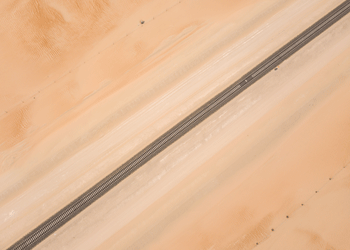
Saudi Arabia Railways (SAR) has issued a request for proposals (RFP) for a design management and review consultant to oversee engineering works on the GCC railway network, the latest step in advancing the long-delayed regional rail link.
The RFP was issued on 9 September, with a submission deadline of 18 October.
The tender seeks a consultant to manage, audit and verify deliverables produced by SAR's separately appointed design services consultant, rather than carry out the design itself. The tendering for the design services consultancy is currently in progress.
Construction will be tendered separately through competitive bidding once designs are approved.
The GCC railway will run for about 672 kilometres (km) inside Saudi Arabia, linking the kingdom's existing network to Kuwait, Qatar, the UAE and Bahrain, with four sections of about 141km, 200km, 151km and 21km, respectively.
The line is planned as a single-track, non-electrified corridor for mixed freight and passenger traffic, with a maximum axle load of 32.4 tonnes and passing loops for bidirectional working.
The appointed consultant will develop a design management and review plan covering governance, interdisciplinary coordination and stage-gate approvals, and will issue formal review and audit reports against SAR's requirements and international standards.
The scope also covers stakeholder engagement, interface management and oversight of land acquisition activity tied to the design consultant's land acquisition plan.
Key design stages are expected to take about 16 months: four months for concept design, six for preliminary design and six for issued-for-construction design, each with four weeks of contingency.
SAR has asked bidders to mobilise a core team from day one. These must include a project director, engineering and design manager, stakeholder manager and lead document controller, all based at SAR's offices, with minimum experience thresholds ranging from three years for junior operators up to 25 years, including 15 in rail, for the project director role.
GCC railway line
Under the overall plan, the railway will run from Kuwait, pass through Dammam in Saudi Arabia, reach Bahrain via a planned causeway, and continue from Dammam to Qatar, the UAE and, ultimately, Muscat via Sohar in Oman. The railway is reported to cover about 2,186km in total.
The route length within each member state is as follows:
- UAE – 684km
- Saudi Arabia – 672km
- Oman – 306km
- Qatar – 283km
- Kuwait – 145km
- Bahrain – 36km
The railway is designed for passenger trains travelling at 220 kilometres an hour (km/h) and freight trains operating at 80km/h–120km/h.
With high levels of project activity, governments in spending mode and renewed cooperation under the Al-Ula Declaration, the latest efforts to restart the GCC railway project may make more progress than previous attempts. If completed, the railway could prove transformational for a region that is globally connected but still divided by national borders.
READ THE SEPTEMBER 2026 MEED BUSINESS REVIEW – click here to view PDFNuclear power ambitions gather pace; Kuwait keeps dealmaking alive despite war; Region invests in raising gas processing capacity.
Distributed to senior decision-makers in the region and around the world, the September 2026 edition of MEED Business Review includes:
> AGENDA: Gulf nuclear revival takes shape> MARKET FOCUS: Kuwait keeps dealmaking alive under fire> INDUSTRY REPORT: Gas processing takes centre stage in Mena regionTo see previous issues of MEED Business Review, please click herehttps://image.digitalinsightresearch.in/uploads/NewsArticle/19783331/main.gif -
Tender issued for Libyan gas project
17 September 2026
An invitation to bid has been issued for a contract to conduct environmental assessments for the project to expand the Mellitah oil and gas complex in Libya.
The bid submission deadline is 2pm today (17 September) Libyan time.
The scope of the project includes provision of:
- An environmental baseline study (EBS)
- An environmental impact assessment (EIA)
- An environmental management plan (EMP)
The client is Mellitah Oil & Gas (MOG), which is a joint venture of Italy’s Eni and Libya’s National Oil Corporation (NOC).
MOG is based in Tripoli and operates both onshore and offshore oil and gas facilities.
The joint venture owns and operates six major oil and gas fields across the North African country.
According to the tender documents, the company that is awarded the contract will need to prepare environmental management measures in compliance with:
- Libyan environmental legislation
- Ministry of Environment requirements
- NOC environmental guidelines
- Applicable international environmental standards and best practices
The expansion of the Mellitah oil and gas complex is part of a project estimated to be worth $8bn.
The wider project is known as the Mellitah Complex Expansion & CO2 Management Integrated Development Project.
It has six main packages:
- Onshore package
- Offshore Structure A
- Offshore Structure E
- Subsea pipeline package
- Site preparation work
- Carbon capture and storage facility
Security issues and political instability have been a major problem for Libya’s oil and gas sector since the country’s civil war started in 2011.
Earlier this month, the Mellitah oil and gas complex was forced to shut down temporarily due to a protest over deteriorating public services.
The existing onshore complex includes housing, processing units, storage facilities and export facilities.
It also serves as the launch point for the Greenstream pipeline, which delivers Libyan gas directly to Italy.
The planned expansion of the complex will involve:
- Construction of a new fourth gas processing train
- Construction of a third condensate train
- Construction of a third natural gas liquids fractionation train
- Construction of a fourth sulphur recovery unit train
- Installation of a hydrogen sulphide enrichment unit
- Installation of a sulphur recovery unit
- Construction of other associated facilities
The Mellitah complex is located about 100 kilometres west of Tripoli and is a key energy facility in the west of the country.
https://image.digitalinsightresearch.in/uploads/NewsArticle/19748920/main.png