
US-Gulf AI deals usher new era
16 May 2025
 Commentary
Jennifer Aguinaldo
Energy & technology editor
US President Donald Trump’s first major trip of his second term of office did not disappoint, especially for the architects of artificial intelligence (AI) strategies in Saudi Arabia and the UAE.
The chief executives of the largest US chip manufacturers, Nvidia and AMD, accompanied Trump on his visit, during which the most awaited announcements were made.
The US and the UAE broke ground on the 1GW first phase of a sprawling 5GW AI campus that will eventually occupy 25 square kilometres of land in Abu Dhabi.
Abu Dhabi government-backed AI firm G42 will build the AI campus, which will be operated in partnership with “several US companies”, presumably major hyperscalers such as Amazon Web Services, Google and Microsoft.
The announcement fell short of confirming the specific volume of advanced graphics processing units (GPUs) required by the AI complex, which will be the largest outside of the US when completed. Many news outlets had bet that Nvidia would commit to supplying the UAE with 500,000 of its most advanced GPUs annually starting this year.
Using today’s average cost-per-MW in constructing data centres, the project capex could easily reach $50bn.
In Riyadh, the deals were relatively smaller, though equally significant, with more details offered than for the agreements announced in Abu Dhabi.
The newly formed AI-firm Humain, owned by the sovereign wealth vehicle the Public Investment Fund (PIF), signed preliminary deals with AMD and Nvidia to build a multibillion-dollar advanced digital infrastructure in the kingdom.
AMD said it will invest up to $10bn to deploy AI compute capacity in Saudi Arabia AND TEH us over the next five years. Nvidia agreed to develop a similar 500MW compute capacity to build AI factories in Saudi Arabia, which will require “several hundred thousand” of Nvidia’s most advanced GPUs over the next five years.
These deals help address fears that US export controls on advanced US-made GPUs could stifle both states’ ambitious programmes to use AI to help diversify their economies away from hydrocarbons, while also future-proofing the hydrocarbons sector, their main economic growth engines thus far, by lowering emissions.
Tellingly, the US State Department said the UAE facility will “leverage nuclear, solar and gas power to minimise carbon emissions and will also house a science park driving advancements in AI innovation”, a clear reference to a joint policy to alleviate these assets’ environmental impact.
Abu Dhabi is already developing an energy infrastructure – comprising solar photovoltaic, battery energy storage systems, gas-fired plants and grid infrastructure – requiring close to $10bn of investments that will cater mainly to its AI strategy. Saudi Arabia is constructing 30GW of gas-fired and 16.4GW of solar and wind capacity in line with its energy diversification and 2030 renewable energy targets. Part of this capacity may help address the energy requirements of future AI facilities.
From a certain vantage point, there is nothing not to like in these deals, with AMD and Nvidia shares trading higher over the past few days.
It provides a clear picture of what the Gulf’s two largest economies are aiming for as they seek to preserve their status as energy hubs, this time powered by clean energy and innovation, and create new revenue streams, without alienating their largest energy client, China.
Photo credit: Wam

Register for MEED's guest program now to access this article.
Exclusive from Meed
-
 Tender issued for Libyan gas project
17 September 2026
-
 Nakheel awards $218m Dubai Islands buildings deal
17 September 2026
-
 Aldar and Mubadala acquire Masdar City Square
17 September 2026
-
 Dubai announces new 80km highway corridor
16 September 2026
-
 Contractors submit Expo 2030 convention centre interest
16 September 2026
All of this is only 1% of what MEED.com has to offer
Subscribe now and unlock all the 153,671 articles on MEED.com
- All the latest news, data, and market intelligence across MENA at your fingerprints
- First-hand updates and inside information on projects, clients and competitors that matter to you
- 20 years' archive of information, data, and news for you to access at your convenience
- Strategize to succeed and minimise risks with timely analysis of current and future market trends
Related Articles
-
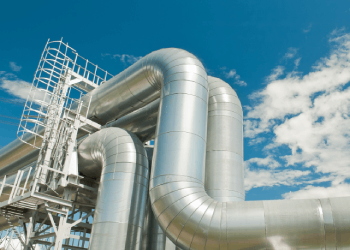
Tender issued for Libyan gas project
17 September 2026
An invitation to bid has been issued for a contract to conduct environmental assessments for the project to expand the Mellitah oil and gas complex in Libya.
The bid submission deadline is 2pm today (17 September) Libyan time.
The scope of the project includes provision of:
- An environmental baseline study (EBS)
- An environmental impact assessment (EIA)
- An environmental management plan (EMP)
The client is Mellitah Oil & Gas (MOG), which is a joint venture of Italy’s Eni and Libya’s National Oil Corporation (NOC).
MOG is based in Tripoli and operates both onshore and offshore oil and gas facilities.
The joint venture owns and operates six major oil and gas fields across the North African country.
According to the tender documents, the company that is awarded the contract will need to prepare environmental management measures in compliance with:
- Libyan environmental legislation
- Ministry of Environment requirements
- NOC environmental guidelines
- Applicable international environmental standards and best practices
The expansion of the Mellitah oil and gas complex is part of a project estimated to be worth $8bn.
The wider project is known as the Mellitah Complex Expansion & CO2 Management Integrated Development Project.
It has six main packages:
- Onshore package
- Offshore Structure A
- Offshore Structure E
- Subsea pipeline package
- Site preparation work
- Carbon capture and storage facility
Security issues and political instability have been a major problem for Libya’s oil and gas sector since the country’s civil war started in 2011.
Earlier this month, the Mellitah oil and gas complex was forced to shut down temporarily due to a protest over deteriorating public services.
The existing onshore complex includes housing, processing units, storage facilities and export facilities.
It also serves as the launch point for the Greenstream pipeline, which delivers Libyan gas directly to Italy.
The planned expansion of the complex will involve:
- Construction of a new fourth gas processing train
- Construction of a third condensate train
- Construction of a third natural gas liquids fractionation train
- Construction of a fourth sulphur recovery unit train
- Installation of a hydrogen sulphide enrichment unit
- Installation of a sulphur recovery unit
- Construction of other associated facilities
The Mellitah complex is located about 100 kilometres west of Tripoli and is a key energy facility in the west of the country.
https://image.digitalinsightresearch.in/uploads/NewsArticle/19748920/main.png -
Nakheel awards $218m Dubai Islands buildings deal
17 September 2026
Register for MEED’s 14-day trial access
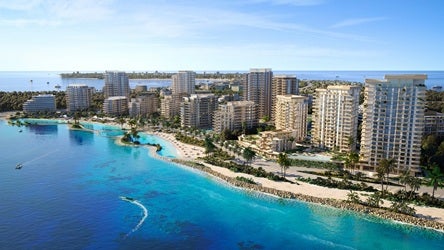
Dubai-based developer Nakheel, now part of Dubai Holding, has awarded a main construction contract worth more than AED800m ($218m) for phases one and three of Bay Grove Residences at Dubai Islands.
The contract was awarded to the local firm Metac General Contracting Company.
It covers the construction of 537 apartments, comprising one- to four-bedroom units, across seven residential buildings.
Phase one includes 296 units in four buildings, while phase three comprises 241 units across three buildings.
The works are scheduled for completion in late 2028.
Bay Grove Residences will ultimately comprise 1,154 homes across 15 buildings. Planning is under way for the remaining 617 homes in phases two and four, with further contract awards expected.
In August last year, Nakheel awarded a AED2.6bn ($708m) contract to Abu Dhabi-based Fibrex Contracting to build the Bay Villas project at Dubai Islands. The contract includes constructing 636 villas.
In April this year, another AED527m ($143m) contract was awarded to local firm Al-Nasr Contracting Company to construct the primary infrastructure and utilities works on Island B at the development.
The Dubai Islands development consists of five islands spanning 18.6 square kilometres. It features more than 59 kilometres (km) of waterfront and 20km of beaches, as well as parks, golf courses, promenades and cycling paths.
The offshore island project gained renewed momentum in 2022, when Nakheel unveiled a new masterplan and rebranded it as Dubai Islands.
The reclaimed islands were originally part of the Palm Deira project, which was partially completed before being put on hold in 2008.
 READ THE SEPTEMBER 2026 MEED BUSINESS REVIEW – click here to view PDF
Nuclear power ambitions gather pace; Kuwait keeps dealmaking alive despite war; Region invests in raising gas processing capacity.
Distributed to senior decision-makers in the region and around the world, the September 2026 edition of MEED Business Review includes:
> AGENDA: Gulf nuclear revival takes shape> MARKET FOCUS: Kuwait keeps dealmaking alive under fire> INDUSTRY REPORT: Gas processing takes centre stage in Mena regionTo see previous issues of MEED Business Review, please click herehttps://image.digitalinsightresearch.in/uploads/NewsArticle/19748850/main.jpg -
Aldar and Mubadala acquire Masdar City Square
17 September 2026
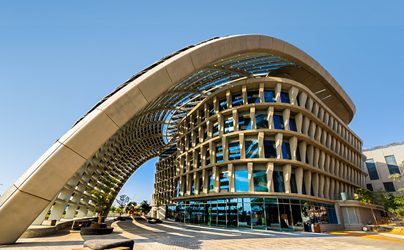
Abu Dhabi-based sovereign wealth fund Mubadala Investment Company and local developer Aldar have completed the acquisition of Masdar City Square at Masdar City, in a transaction valued at AED918m ($250m).
The deal was executed through their joint venture established in 2024.
Masdar City Square comprises more than 47,000 square metres (sq m) of net leasable area across seven office buildings.
Completed in Q1 2026, the development is 99% occupied. Tenants include Taqa, the Department of Energy, Emirates College and the Mohamed Bin Zayed University of Artificial Intelligence.
The transaction expands the joint venture’s real estate portfolio in Masdar City, which is now valued at AED4.7bn ($1.3bn).
Masdar City is one of the region’s leading hubs for clean energy, artificial intelligence, advanced research and sustainable urban development.
The joint venture acquired The Link project at Masdar City for AED654m ($178m) in April.
Comprising about 32,000 sq m of net leasable area across five buildings, The Link is fully leased to a portfolio of major tenants, including Abu Dhabi Future Energy Company (Masdar) and the Mohamed Bin Zayed University of Artificial Intelligence.
The asset includes Grade A, Leed Platinum office space, a net-zero-energy headquarters building, a multi-use hall and residential accommodation, supporting its position as a high-performing, integrated component of Masdar City.
https://image.digitalinsightresearch.in/uploads/NewsArticle/19748241/main5814.png -
Dubai announces new 80km highway corridor
16 September 2026
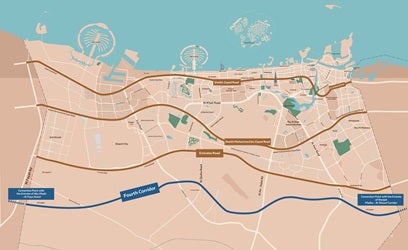
Dubai has approved the construction of the new fourth corridor, a major highway programme aimed at boosting inter-emirate connectivity, increasing road capacity and easing congestion.
The corridor will extend 80 kilometres, from Al-Faya Road in Abu Dhabi to Al-Shanouf Road in Sharjah.
It will include 12 lanes, 72 bridges and 17 tunnels.
The project is expected to reduce travel times by up to 60% and serve more than 3.1 million people, while providing links to Al-Maktoum International airport and Etihad Rail.
It will have the capacity to accommodate 24,000 vehicles per hour in each direction.
The project will be delivered in two phases. The first phase, running from Al-Shanouf Road to Dubai-Al Ain Road, will be delivered at a cost of AED3.5bn ($953m).
The second phase will stretch from Dubai-Al Ain Road to Al-Faya Road in Abu Dhabi.
Hamdan bin Mohammed: In line with the directives of His Highness Sheikh Mohammed bin Rashid Al Maktoum to boost investment in infrastructure, I approved the New Fourth Corridor to strengthen Dubai’s road network and enhance connectivity with the UAE’s federal road network.… pic.twitter.com/zlIyY2yKBN
— Dubai Media Office (@DXBMediaOffice) September 16, 2026
The scheme adds a fourth spine to a network that has long relied on three main corridors: the E11 (Sheikh Zayed Road/Al-Ittihad Road); the E311 (Sheikh Mohamed Bin Zayed Road) and the E611 (Emirates Road), which together carry more than 850,000 vehicles commuting between Dubai and the northern emirates daily.
That concentration has made the route one of the country’s most congested, with peak-hour bottlenecks a persistent problem for residents. The new corridor is designed to divert a significant share of that traffic onto a higher-capacity route, rather than add pressure to the existing network.
The project also aligns with the Dubai 2040 Urban Master Plan, which anticipates population growth to 5.8 million by 2040 and calls for the expansion of roads, railways, airports and ports to support that growth and reinforce Dubai’s position as a global trading hub. This is reflected in the corridor’s direct links to Al-Maktoum International airport and Etihad Rail.
https://image.digitalinsightresearch.in/uploads/NewsArticle/19725878/main.jpeg -
Contractors submit Expo 2030 convention centre interest
16 September 2026

Register for MEED’s 14-day trial access
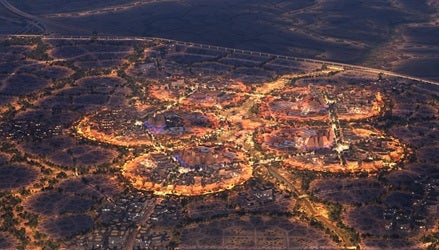
Expo 2030 Riyadh Company (ERC), responsible for delivering the Expo 2030 Riyadh venue, received contractor interest on 14 September for a contract to design and build a convention centre in the site's Collaboration District.
Construction is slated to begin in January 2027 and take 29 months. The development will cover a total gross external area of more than 28,000 square metres (sq m). The total programme area will be about 22,000 sq m and the gross floor area will be 17,000 sq m. The maximum height of the building will be 41.5 metres.
The venue will be laid out across two levels, with a mezzanine, roof terraces and a 4,030 sq m basement, in addition to mechanical, electrical and plumbing and back-of-house spaces.
Two flexible exhibition halls are planned, covering a combined 7,280 sq m, as well as 3,800 sq m of pre-function space, 650 sq m dedicated to meeting rooms and 2,200 sq m of outdoor exhibition space in the north and south plazas.
The appointed main contractor will assume responsibility for packages including the early works substructure and the lead design consultant's deliverables, while carrying out the full scope of superstructure, above-ground waterproofing, external facades, masonry, base build and specialised fit-outs for VVIP, VIP and visitor areas.
Further scope includes delivering comprehensive MEP services; vertical transportation; final infrastructure tie-points; public-realm hard and soft landscaping; testing, commissioning, handover documentation; and management of the defects liability period.
The expression of interest notice was floated on 13 September.
The unusually brief expression of interest deadline of just one day underscores a compressed procurement timeline.
This accelerated tender and evaluation schedule signals that project organisers are operating under time pressure to secure contractors and maintain the tight schedule required ahead of the event's opening.
ERC expects to award the formal contract by the end of this year and begin construction in January next year.
The project is due for completion in early 2030, in time for the main event in October of that year.
Site progress
Construction activity at the Expo site is accelerating, with Riyadh moving to award its first major vertical contracts and advancing infrastructure works across the programme.
Earlier this month, MEED exclusively reported that ERC has tendered a contract to deliver the Souq areas within the expo site.
These areas are divided into five precincts, with a total development area of about 300,000 sq m.
In September, Saudi Arabia’s Royal Commission for Riyadh City awarded a design-and-build contract for the construction of a new metro station catering to the Expo 2030 site.
In April, ERC awarded two contracts for the next phase of infrastructure works at the site to local firm Alyamama Company.
The scope covered the construction of road networks and infrastructure for water, sewage, electricity, telecommunications and electric vehicle (EV) charging.
These awards followed ERC’s January award of an estimated SR1bn ($267m) contract for initial infrastructure works at the site to local firm Nesma & Partners.
That scope covered about 50 kilometres of integrated infrastructure networks, including internal roads and essential utilities such as water, sewage, electrical and communications systems and EV charging stations.
The masterplan covers 6 square kilometres, making it one of the largest sites ever designated for a World Expo event. Situated north of the Saudi capital, the site will be located near the future King Salman International airport and will provide direct access to landmarks within Riyadh.
The Public Investment Fund, Saudi Arabia’s sovereign wealth vehicle, launched ERC – a wholly owned subsidiary – in June 2025 to build and operate facilities for Expo 2030.
READ THE SEPTEMBER 2026 MEED BUSINESS REVIEW – click here to view PDFNuclear power ambitions gather pace; Kuwait keeps dealmaking alive despite war; Region invests in raising gas processing capacity.
Distributed to senior decision-makers in the region and around the world, the September 2026 edition of MEED Business Review includes:
> AGENDA: Gulf nuclear revival takes shape> MARKET FOCUS: Kuwait keeps dealmaking alive under fire> INDUSTRY REPORT: Gas processing takes centre stage in Mena regionTo see previous issues of MEED Business Review, please click herehttps://image.digitalinsightresearch.in/uploads/NewsArticle/19716287/main.jpg