
Seven advances entertainment projects across Saudi cities
26 August 2025

Saudi Entertainment Ventures (Seven), a subsidiary of Qiddiya Investment Company, is spending more than SR50bn ($13bn) to create 14 entertainment destinations in 13 Saudi cities.
The company, which is backed by Saudi Arabia’s sovereign wealth vehicle, the Public Investment Fund, has achieved 70% completion on most of its sites that are scheduled to open this year.
Speaking to MEED, Seven’s chief operating officer Essam Al-Jubair outlines the ambitions behind the projects, which are part of the government’s wider Vision 2030 strategy, and reviews the progress that has been made to date.
“We’ve seen meaningful progress on all fronts,” he says. “Seven is well into advanced delivery at several of the key sites, including Abha, Tabuk, Yanbu, Al-Hamrah and Medina, where facade works and ride installations are nearing completion. Final fit-outs, theming works and systems commissioning are well under way.”
Economic goals
Beyond entertainment, Seven’s developments are being positioned as a driver of regional economic growth. Each site is expected to generate jobs during both construction and operations, while boosting tourism spending and strengthening local supply chains.
“By spreading developments across various cities, Seven expects to have a direct impact on regional economies through job creation, tourism and local supply chains,” says Al-Jubair.
The geographical reach of the projects is particularly important, as it places entertainment hubs outside of the main cities of Riyadh and Jeddah, giving smaller urban centres such as Tabuk, Abha and Yanbu their own share of investment. This, in turn, supports Vision 2030’s wider aim of balanced regional development.
The spending power created by these new destinations is also expected to benefit nearby businesses such as hotels, restaurants and transport operators, amplifying their impact on local economies.
Developing local talent
The scale of investment is not just about buildings and rides. A major part of Seven’s approach is building an entirely new workforce for the sector.
“People are the heartbeat of everything we’re doing,” Al-Jubair says.
By spreading developments across various cities, Seven expects to have a direct impact on regional economies
The company refers to its staff as “fun-gineers”, tasked with designing and delivering entertainment experiences that are unique to the kingdom.
To support this, Seven has launched training schemes and leadership programmes, including a future leaders course run in partnership with the International Institute for Management Development. More than half of its staff are currently undergoing training in entertainment management, operations and guest services.
Beyond entertainment
Seven’s projects are designed not only as leisure destinations, but also as community gathering places. “Our entertainment destinations are unlike anything the kingdom has seen before,” says Al-Jubair.
About 80% of each site will be dedicated to attractions and experiences, while the remaining 20% is for food and beverage and retail outlets.
The company has also been involving local residents in shaping what is on offer.
“We actively engage local communities in the development process. For example, using local surveys to help design attractions and offerings that reflect the preferences and interests of the people who will enjoy them,” he says.
One example of this collaborative approach is Seven’s work with electric motorsport series Formula E, which has led to the creation of an e-karting experience. The attraction is intended both as entertainment and as a way to inspire and train Saudi Arabia’s next e-karting champions.
Technology is another area where Seven hopes to differentiate its offer. Attractions will mix immersive storytelling with digital interactivity. Al-Jubair gives the example of a bowling experience that allows players to create avatars and project them onto lanes, blending the physical and digital worlds.
To bring in international expertise and content, Seven has signed partnerships with Warner Bros, Discovery, Mattel, Hasbro, Formula E and Clip 'n Climb. At the same time, the company is creating original Saudi content.
“We are developing our own original Saudi entertainment concepts, rooted in local culture and storytelling, to create experiences that can stand alongside the best in the world and offer something uniquely homegrown,” says Al-Jubair.
Achieving its goals
Al-Jubair notes that Seven's operations are designed to be guest-focused from the outset. Feedback will be collected in real-time via kiosks, QR codes and mobile applications, as well as through surveys, social media and mystery shoppers.
“This continuous loop will enable us to address issues instantly, track trends over time, and shape new attractions and services around what guests truly want,” he says.
Seven is also making efforts to ensure that its projects are built and operated sustainably. Al-Jubair says: “All sites are targeting at least Leed Silver certification, while during 2024 the company recorded 80% water savings, 20% energy savings and recycling of more than 75% of construction waste. Emissions were also cut by 15%-20% each month.”
Ultimately, Seven aims to help establish a sustainable entertainment ecosystem that is global in ambition yet rooted in Saudi culture.
“Guided by Vision 2030, Seven is contributing to the government’s ambition of building a thriving entertainment sector that enriches lives and diversifies the economy,” says Al-Jubair.
“By 2030 and beyond, our ambition is to set new benchmarks for entertainment across Saudi Arabia and abroad.”


Register for MEED's guest program now to access this article.
Exclusive from Meed
-
 Brent hits $112 a barrel following Saudi oil field attack
22 October 2026
-
 Riyadh awards $301m Sheikh Jaber Road contract
22 October 2026
-
 Dewa International signs energy and infrastructure MoUs
22 October 2026
-
 QatarEnergy and TotalEnergies to develop Lebanon solar plant
22 October 2026
-
 Deal signed for 1,620-home Baghdad residential scheme
22 October 2026
All of this is only 1% of what MEED.com has to offer
Subscribe now and unlock all the 153,671 articles on MEED.com
- All the latest news, data, and market intelligence across MENA at your fingerprints
- First-hand updates and inside information on projects, clients and competitors that matter to you
- 20 years' archive of information, data, and news for you to access at your convenience
- Strategize to succeed and minimise risks with timely analysis of current and future market trends

Related Articles
-
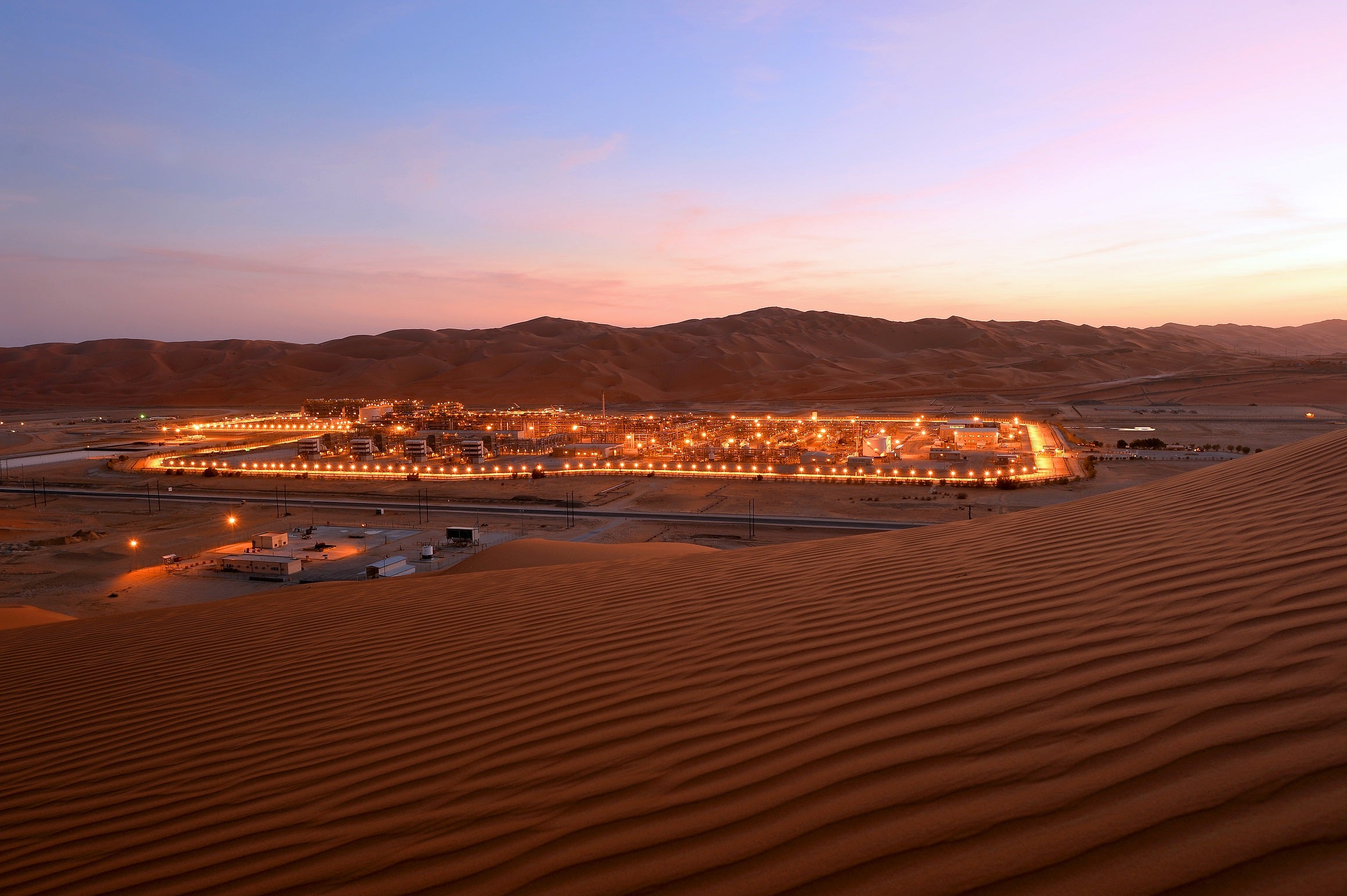
Brent hits $112 a barrel following Saudi oil field attack
22 October 2026
Oil prices climbed more than 3% on 22 October after a drone targeting Saudi Aramco’s Shaybah oil field development killed two people and injured two others a day earlier, adding to concerns over energy supplies as attacks on Saudi energy infrastructure intensified.
Global benchmark Brent crude hit $112.30 in early trading on 22 October, but later pared gains and was trading at $111.52 a barrel as of 11am GST.
Three residents and a Saudi citizen were killed in two separate incidents in Saudi Arabia’s Eastern Province on 21 October, authorities said, as attacks on the kingdom accelerated following an escalation of hostilities with the Iran-backed Houthi group in neighbouring Yemen.
Overnight, the Saudi-led coalition fighting the Houthis in Yemen announced that it had intercepted and destroyed four drones in the Eastern Province.
Saudi air defences intercepted a drone attempting to target a processing facility at Saudi Aramco’s Shaybah oil field development on the morning of 21 October, the Saudi Ministry of Energy said.
The official Saudi Press Agency (SPA) carried a statement quoting an energy ministry official as saying the attempted attack resulted in the deaths of two residents – a Filipino and a Nepali – and injuries to two others – an Indian and a Pakistani – after debris fell due to the interception.
Following the interception, a fire broke out in a vehicle belonging to a contractor at the Shaybah oil field, outside the facility’s perimeter, with no impact on operations.
Dammam airport attack
Separately, a Houthi attack on King Fahd International airport in Dammam on the evening of 21 October killed an Indian resident and a Saudi citizen.
Eight people were also injured in the attack, including a Saudi national, a Nepali, and two nationals each from India, Yemen and Bangladesh. Injuries ranged from minor to critical, the Saudi General Authority of Civil Aviation (Gaca) said the next day.
“The attack also caused property damage, the extent of which is currently being assessed. Further updates will be provided,” Gaca said, adding that operations had since resumed at Dammam airport.
Saudi Arabia has come under sustained attack from the Iran-aligned Houthi rebel group in October, including strikes on Riyadh’s international airport in what authorities described as the kingdom’s deadliest incidents in years, as the war with the group escalates.
The Houthi militias also struck an administrative building at Aramco’s headquarters in Dhahran, in the Eastern Province, on 13 October, resulting in a limited fire.
The Houthi rebels opened a new front in the regional war between Iran and the US in mid-July, when they breached a four-year truce with Saudi Arabia in Yemen’s civil war, which began in 2014, and started attacking Saudi vessels and Aramco energy assets along the Red Sea, including repeated strikes on the Jizan refinery.
The 1,200-kilometre East-West pipeline operated by Aramco was also hit by Houthi missiles in September, and once directly by Iran in April.
The East-West pipeline transports crude from Saudi Arabia’s Eastern Province oil fields to the Red Sea port city of Yanbu on the kingdom’s west coast. It has a pumping capacity of 7 million barrels a day.
Saudi Arabia relies heavily on the East-West pipeline to bypass the volatile Strait of Hormuz maritime chokepoint and ship crude from its Red Sea coast. Riyadh has increasingly used the line to route exports away from Hormuz since the US-Iran conflict began on 28 February – a tactical advantage most of its Gulf neighbours lack.
Aramco resumed crude exports via the pipeline at the start of October.
https://image.digitalinsightresearch.in/uploads/NewsArticle/20841984/main.jpg -
Riyadh awards $301m Sheikh Jaber Road contract
22 October 2026
Register for MEED’s 14-day trial access
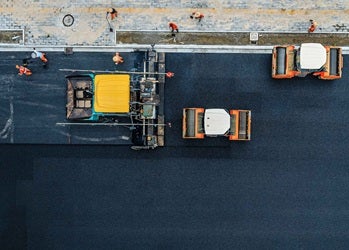
The Royal Commission for Riyadh City (RCRC) has awarded an estimated SR1.13bn ($301m) contract to local firm Alomaier Trading & Contracting Company to upgrade a section of Sheikh Jaber Al-Ahmad Al-Sabah Road in the capital.
The project covers the construction of an urban road about 3 kilometres (km) long, with a right-of-way width of about 120 metres.
The scope of work includes the delivery of three interchanges featuring post-tensioned, voided-slab concrete bridges; a cut-and-cover tunnel; and three box culverts designated IC02, IC03 and IC04.
The contract also encompasses pumping and lifting stations, stormwater drainage and irrigation networks, earthworks, asphalt paving, roadway lighting, power distribution systems, mechanically stabilised earth retaining walls and landscaping works.
The award forms part of RCRC’s wider programme to upgrade Riyadh’s arterial road network, decongest critical bottlenecks and expand transportation capacity in the city ahead of Expo 2030 and the 2034 Fifa World Cup.
The contract award follows RCRC’s appointment in May of a joint venture of Riyadh-based Al-Rashid Trading & Contracting Company and Turkiye’s IC Ictas for an estimated SR5bn ($1.3bn) contract to construct another section of Sheikh Jaber Al-Sabah Road.
That project covers 12km from Khurais Road to Al-Thumama Road and is a component of Riyadh’s Second Eastern Ring Road scheme.
Alomaier Trading & Contracting Company has secured several contracts in recent months.
In August, Saudi Arabian Railways awarded the contractor an estimated SR4bn-plus ($1.1bn) contract to add a second track to the first section of the existing phosphate railway in the kingdom’s Eastern Province.
The railway package covers about 100km between AZ1/Nariyah Yard and Ras Al-Khair. Works include track doubling, alignment modifications, utility bridges, culvert widening, hydrological structures, conversion of the AZ1 siding into a mainline track, and enabling works for signalling and telecommunications systems.
 READ THE OCTOBER 2026 MEED BUSINESS REVIEW – click here to view PDF
Industry and logistics drive development at Neom; Saudi Arabia’s investment priorities realign amid conflict; MEED’s 2026 power developer ranking.
Distributed to senior decision-makers in the region and around the world, the October 2026 edition of MEED Business Review includes:
> AGENDA: Oxagon takes centre stage at Neom> MARKET FOCUS: Saudi projects hold steady> INDUSTRY REPORT: MEED’s 2026 GCC power developer ranking> LEADERSHIP: The future city does not need to hang above the groundTo see previous issues of MEED Business Review, please click herehttps://image.digitalinsightresearch.in/uploads/NewsArticle/20833960/main.jpg -
Dewa International signs energy and infrastructure MoUs
22 October 2026
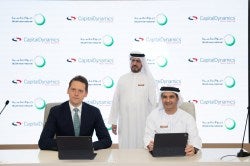
Dubai Electricity & Water Authority’s (Dewa) new development arm, Dewa International, has signed four memorandums of understanding (MoUs) with international partners to explore investment and project development opportunities in the energy, water and infrastructure sectors.
The agreements, signed during Dubai’s Water, Energy, Technology and Environment Exhibition (Wetex 2026), follow the launch of the wholly owned subsidiary in June, as reported by MEED.
At the time, the utility said the arm would be used to export Dubai’s energy and water infrastructure model, with a focus on developing conventional and clean energy projects for global markets.
At Wetex, Dewa International signed an MoU with France’s EDF Power Solutions to explore potential joint participation in solar, wind, battery energy storage and pumped-storage hydropower projects.
A separate agreement with China Energy International Group explores the company’s potential role as an engineering, procurement and construction (EPC) partner for major energy, water and infrastructure projects. The MoU also covers cooperation in project development and EPC services.
A further agreement with UK-based Capital Dynamics focuses on potential joint investments in operational clean energy assets in Europe. The parties will also explore establishing an investment vehicle for future clean energy infrastructure investments.
Dewa International also signed a fourth agreement with Mumbai-Headquartered Tata Consultancy Services, exploring the company’s potential role as a technical consultancy partner. The scope covers technology strategy, information technology and operational technology integration, and asset performance management solutions.
Dewa currently has almost $7bn-worth of power and water projects under execution across the UAE, according to regional projects tracker MEED Projects.
Its flagship Mohammed Bin Rashid Al-Maktoum Solar Park is the largest single-site solar park in the world. The utility is currently advancing the project’s seventh phase, with Abu Dhabi Future Energy Company (Masdar) recently submitting the lowest bid for the project, as exclusively reported by MEED.
https://image.digitalinsightresearch.in/uploads/NewsArticle/20828111/main0128.jpg -
QatarEnergy and TotalEnergies to develop Lebanon solar plant
22 October 2026
Register for MEED’s 14-day trial access
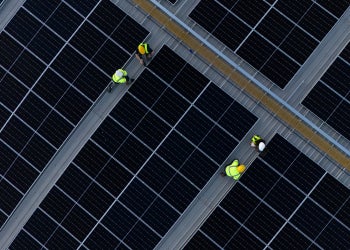
State-owned QatarEnergy and France’s TotalEnergies have agreed to jointly develop a solar power plant in Lebanon.
The agreement was announced on 16 October during the Qatari prime minister’s official visit to Beirut, where he held a joint press conference with Lebanese Prime Minister Nawaf Salam.
According to a statement published by the Lebanese Prime Minister's Office, the plant will be an initial project under a broader framework for energy cooperation between Qatar and Lebanon. Its capacity, location, investment value and implementation schedule have yet to be disclosed.
Qatar’s Prime Minister Sheikh Mohammed Bin Abdulrahman Bin Jassim Al-Thani said: “The aim is to develop a major investment project that benefits the Lebanese economy, as well as the Qatari companies and entities participating in it.”
Separately, Salam said the Lebanese and Qatari governments were “close to reaching an agreement” to rehabilitate, develop and modernise Lebanon’s electricity-generation infrastructure.
The proposed project would cover the country’s various electricity-generation sources and associated infrastructure, aiming to improve the reliability of electricity supplies and reduce costs.
The project would use a build, operate and transfer model, under which Qatari entities would finance, implement and operate the facilities without upfront investment costs for the Lebanese treasury, Salam said.
Salam also said the proposal was being prepared with support from the International Finance Corporation, and that he hoped to present it to the Lebanese government soon.
The wider initiative is intended to address Lebanon’s longstanding electricity-generation shortfall and overcome financing constraints that have delayed infrastructure projects in the sector.
As MEED previously reported, the Lebanese government continues to advance broader reforms to the country’s electricity sector.
In August, Lebanon’s Electricity Regulatory Authority invited private sector companies to submit expressions of interest (EoIs) for several upcoming power-generation projects.
The EoIs cover up to five grid-connected solar photovoltaic projects with a combined installed capacity of 350 megawatts-peak. The projects are also expected to include battery energy storage systems with a combined capacity of 1,000 megawatt-hours.
The regulator is also seeking proposals for distributed dual-fired thermal power plants with net capacities of 20MW-100MW.
READ THE OCTOBER 2026 MEED BUSINESS REVIEW – click here to view PDFIndustry and logistics drive development at Neom; Saudi Arabia’s investment priorities realign amid conflict; MEED’s 2026 power developer ranking.
Distributed to senior decision-makers in the region and around the world, the October 2026 edition of MEED Business Review includes:
> AGENDA: Oxagon takes centre stage at Neom> MARKET FOCUS: Saudi projects hold steady> INDUSTRY REPORT: MEED’s 2026 GCC power developer ranking> LEADERSHIP: The future city does not need to hang above the groundTo see previous issues of MEED Business Review, please click herehttps://image.digitalinsightresearch.in/uploads/NewsArticle/20827458/main.jpg -
Deal signed for 1,620-home Baghdad residential scheme
22 October 2026
Iraq’s National Investment Commission (NIC) has signed an investment contract with local developer Al-Ab’ad Al-Dhahabiya for Investment & Real Estate Development to construct the Abraaj Al-Ameriya residential project in Baghdad.
The development will comprise 1,620 housing units in the Ameriya district of the capital, located behind the American University of Baghdad.
Al-Ab’ad Al-Dhahabiya is a subsidiary of Iraq-based Al-Kamil Holding Group.
The signing was attended by NIC chairman Adel Dakhil Muhammad Al-Yasiri and deputy chairman Salar Muhammad Amin, in addition to a delegation from Al-Kamil Holding Group led by chairman Mustafa Kamil Abboud and Al-Ab’ad Al-Dhahabiya managing director Muhannad Kamil Abboud.
The project forms part of Iraq’s broader programme to engage private sector developers and international investors to address a nationwide housing deficit of an estimated 3 million units through new residential compounds and masterplanned satellite cities.
READ THE OCTOBER 2026 MEED BUSINESS REVIEW – click here to view PDFIndustry and logistics drive development at Neom; Saudi Arabia’s investment priorities realign amid conflict; MEED’s 2026 power developer ranking.
Distributed to senior decision-makers in the region and around the world, the October 2026 edition of MEED Business Review includes:
> AGENDA: Oxagon takes centre stage at Neom> MARKET FOCUS: Saudi projects hold steady> INDUSTRY REPORT: MEED’s 2026 GCC power developer ranking> LEADERSHIP: The future city does not need to hang above the groundTo see previous issues of MEED Business Review, please click herehttps://image.digitalinsightresearch.in/uploads/NewsArticle/20809147/main.jpg