
Saudi Arabia sets July nuclear plant bid deadline
3 June 2024

Register for MEED's guest programme
Four nuclear technology providers are expected to submit their bids by 1 July for a contract to build Saudi Arabia’s Duwaiheen nuclear power plant, according to an industry source.
Saudi Arabia tendered the contract in 2022 with an initial deadline of 31 December of the same year. The tender closing date has since been postponed several times, with the previous deadline set for 30 April.
An industry source said four bidders have submitted bid bonds for the contract.
These companies are understood to be:
- China National Nuclear Corporation (China)
- EDF (France)
- Korea Electric Power Corporation (Kepco, South Korea)
- Rosatom (Russia)
The Duwaiheen nuclear power plant will be procured using a traditional design-and-build model. The power plant's electricity generation capacity has not been disclosed, although a previous study indicated a capacity of 2.8GW was being considered.
“The understanding is that the tendering process requires a level of [political] stability in the region. This seems like an automatic postponement for the project tendering process,” one source told MEED in early May.
Saudi Arabia plans to build a large-scale nuclear power plant facility as part of its energy diversification agenda.
However, the ongoing conflict between Israel, Gaza and other neighbouring countries appears to be a major contributing factor in the extended procurement timeline of the Duwaiheen nuclear plant project.
In October, an industry source said the ongoing conflict in Gaza will not likely advance negotiations between the countries with a key stake in the project.
It is understood that Riyadh is using its nuclear power plant project, along with its plan to enrich uranium sources as part of its industrial strategy, as a bargaining chip with the US government. The White House is pushing for the normalisation of relations between Israel and Saudi Arabia, and is opposed to uranium enrichment.
A month before the latest conflict between Israel and Hamas started, it was reported that senior Palestinian officials were in Riyadh for talks with senior Saudi and US officials.
According to a BBC report in September 2023, the Palestinians were negotiating for hundreds of millions of dollars and more control of land in the occupied West Bank in the event of a three-way deal between Israel, Saudi Arabia and the US.
On 14 October, Saudi Arabia suspended the talks on potentially normalising ties with Israel, which it never officially recognised as an independent state.
Consultants
Duwaiheen Nuclear Energy Company received three bids for the project management consultancy package of the nuclear plant project last year.
MEED understands the following companies submitted proposals for the contract:
- Atkins (UK/Canada)
- Worley (Australia)
- Assystems (France)
Two of the three bidders have had previous engagements with the Saudi nuclear energy project.
In March 2022, Saudi Arabia announced the establishment of a holding company – understood to be the Duwaiheen Nuclear Energy Company – to develop nuclear power projects in the country to produce electricity, desalinate seawater and support thermal energy applications.
 MEED's April 2024 special report on Saudi Arabia includes:
> GVT & ECONOMY: Saudi Arabia seeks diversification amid regional tensions
> BANKING: Saudi lenders gear up for corporate growth
> UPSTREAM: Aramco spending drawdown to jolt oil projects
> DOWNSTREAM: Master Gas System spending stimulates Saudi downstream sector
> POWER: Riyadh to sustain power spending
> WATER: Growth inevitable for the Saudi water sector
> CONSTRUCTION: Saudi gigaprojects propel construction sector
> TRANSPORT: Saudi Arabia’s transport sector offers prospects

Register for MEED's guest program now to access this article.
Exclusive from Meed
All of this is only 1% of what MEED.com has to offer
Subscribe now and unlock all the 153,671 articles on MEED.com
- All the latest news, data, and market intelligence across MENA at your fingerprints
- First-hand updates and inside information on projects, clients and competitors that matter to you
- 20 years' archive of information, data, and news for you to access at your convenience
- Strategize to succeed and minimise risks with timely analysis of current and future market trends
Related Articles
-
 Oman’s Barka 5 IWP solar plant begins full operations
1 May 2026
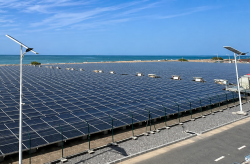
Spain’s GS Inima has begun permanent operations at the solar photovoltaic (PV) plant serving the Barka 5 independent water project (IWP) in Oman.
The solar facility is the third of its kind in Oman to power a large-scale desalination facility through a self-supply model.
In a statement, GS Inima said it will provide up to 50% of the desalination plant’s electricity needs during daytime operations, improving efficiency and reducing reliance on external power sources.
The PV plant has an installed capacity of 6.5MWp. It is designed to optimise energy consumption at the adjacent reverse osmosis desalination facility.
The project was developed by GS Inima in collaboration with local firm Nafath Renewable Energy as the engineering, procurement and construction (EPC) contractor. China-based OCA Global provided owner’s engineering services.
The Barka 5 IWP has a desalination capacity of approximately 100,000 cubic metres a day.
GS Inima won the contract to develop the Barka 5 IWP project in November 2020. As previously reported, financial close was reached in 2022, and construction of the facility was completed in 2024.
The self-supply solar PV plant is equipped with 10,504 bifacial modules supplied by China’s Jinko Solar. These are mounted on fixed structures provided by Mibet Energy.
Power is managed through 18 Sungrow inverters with a total capacity of 320kWac each, while electricity is fed into the desalination plant through an 11kV connection.
The integration of solar power supports the efficiency of the Barka 5 facility, which has an energy consumption rate of 2.7kWh per cubic metre.
https://image.digitalinsightresearch.in/uploads/NewsArticle/16645971/main.jpg -
 Qiddiya receives high-speed rail PPP prequalifications
1 May 2026
Register for MEED’s 14-day trial access
Saudi Arabia’s Royal Commission for Riyadh City, in collaboration with Qiddiya Investment Company (QIC) and the National Centre for Privatisation & PPP, received prequalification statements from firms on 30 April for the public-private partnership (PPP) package of the Qiddiya high-speed rail project in Riyadh.
This follows the submission of prequalification statements for the engineering, procurement, construction and financing (EPCF) package on 16 April, as reported by MEED.
The prequalification notice was issued on 19 January, and a project briefing session was held on 23 February at Qiddiya Entertainment City.
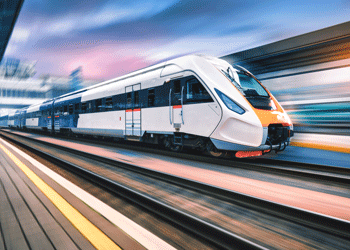
The Qiddiya high-speed rail project, also known as Q-Express, will connect King Salman International airport and the King Abdullah Financial District (KAFD) with Qiddiya City. The line will operate at speeds of up to 250 kilometres an hour, reaching Qiddiya in 30 minutes.
The line is expected to be developed in two phases. The first phase will connect Qiddiya with KAFD and King Khalid International airport.
The second phase will start from a development known as the North Pole and travel to the New Murabba development, King Salman Park, central Riyadh and Industrial City in the south of the city.
In November last year, MEED reported that more than 145 local and international companies had expressed interest in developing the project, including 68 contracting companies, 23 design and project management consultants, 16 investment firms, 12 rail operators, 10 rolling stock providers and 16 other services firms.
In November 2023, MEED reported that French consultant Egis had been appointed as the technical adviser for the project. UK-based consultancy Ernst & Young is acting as the transaction adviser, and Ashurst is the legal adviser.
Qiddiya is one of Saudi Arabia’s five official gigaprojects and covers a total area of 376 square kilometres (sq km), with 223 sq km of developed land.
 https://image.digitalinsightresearch.in/uploads/NewsArticle/16641057/main.gif
 -
 Bid deadline extensions hint at tighter project market
1 May 2026
 Commentary
Mark Dowdall
Power & water editorThere has been a steady run of bid deadline extensions across major power and water projects in recent weeks.
The latest is the Al-Dibdibah and Al-Shagaya solar independent power producer (IPP) plant in Kuwait, where the submission date has been moved again to 31 May, following an earlier shift from February to the end of April. Similarly, bidding for the first phase of the Al-Khairan IWPP has also been extended.
In Bahrain, bidding for the 1.2GW Sitra IWPP has been pushed back by another month to 17 May, having already been under main contract tender since last August.
Meanwhile, in Dubai, contractors have been given additional time to submit bids for both the Jebel Ali sewage treatment plant expansion and a dams rehabilitation project in Hatta.
Individually, these shifts are not unusual, and extensions are a routine part of the procurement cycle, especially with large, capital-intensive schemes.
However, amid regional tensions and increasingly complex risk profiles, stakeholders are having to weigh up how much they can absorb, whether that is performance guarantees, financing exposure or delivery risk.
For contractors and developers, this could mean looking more closely at supply chains, insurance costs and the potential for disruption. Lenders, too, are likely taking a more measured view on long-term exposure.
This caution can show up in the bid process. More internal approvals, more conservative pricing, and in some cases, perhaps a hesitation to commit altogether.
At the same time, strong pipelines across the GCC mean contractors are not short of work. Firms can afford to be selective, focusing on projects where risk and return are better aligned.
Clients, in turn, face a choice. Push ahead with more limited competition or extend and try to draw in stronger participation. Most appear to be opting for the latter.
https://image.digitalinsightresearch.in/uploads/NewsArticle/16640998/main.jpg -
 Saudi Arabia launches $2bn Jawharat Al-Arous project
1 May 2026
Saudi Arabia has launched Jawharat Al-Arous, an SR8bn ($2bn) private-sector-led residential development in north Jeddah.
The scheme covers 107 million square metres and comprises 18 residential neighbourhoods planned to accommodate more than 700,000 residents. It will provide more than 80,000 residential and commercial plots.
The masterplan also includes 41 government-backed infrastructure and service zones to support large-scale urban expansion.
The project was unveiled by Mecca Region Governor Khalid Al-Faisal and will be overseen by Saud Bin Mishaal Bin Abdulaziz.
According to a recent report by real estate firm Cavendish Maxwell, Jeddah’s residential stock stood at about 1.09 million units at the end of 2025, following the completion of around 4,000 units that year.
An expanding pipeline of about 18,000 units in 2026 and 22,000 units in 2027 is expected to bring total stock to around 1.14 million units by 2027, gradually adding supply without destabilising market equilibrium.
GlobalData expects the Saudi construction industry to grow by 3.6% in real terms in 2026, supported by increased foreign direct investment (FDI) and investment in the housing and manufacturing sectors.
The residential construction sector is forecast to grow by 3.8% in real terms in 2026 and to record an average annual growth rate of 4.7% between 2027 and 2030, supported by Saudi Vision 2030’s goal of increasing homeownership from 65.4% in 2024 to 70% by 2030, including through the delivery of 600,000 homes by 2030.
MEED’s April 2026 report on Saudi Arabia includes:
> COMMENT: Risk accelerates Saudi spending shift
> GVT &: ECONOMY: Riyadh navigates a changed landscape
> BANKING: Testing times for Saudi banks
> UPSTREAM: Offshore oil and gas projects to dominate Aramco capex in 2026
> DOWNSTREAM: Saudi downstream projects market enters lean period
> POWER: Wind power gathers pace in Saudi Arabia
> WATER: Sharakat plan signals next phase of Saudi water expansion
> CONSTRUCTION: Saudi construction enters a period of strategic readjustment
> TRANSPORT: Rail expansion powers Saudi Arabia’s infrastructure pushTo see previous issues of MEED Business Review, please click herehttps://image.digitalinsightresearch.in/uploads/NewsArticle/16640863/main.png -
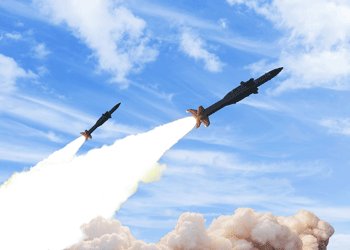 Damage to US bases in region expected to cost more than $15bn
1 May 2026
The $25bn estimate a Pentagon official gave US lawmakers on 29 April did not include the cost of repairing damage to US bases in the Middle East, and the real cost of the war is likely to be between $40bn and $50bn, according to CNN.
That would put the cost of repairing bases and replacing destroyed assets at between $15bn and $25bn.
Jules Hurst III, the Pentagon official serving as the agency’s comptroller, told the House Armed Services Committee that “most” of the $25bn he cited had been spent on munitions. Defence Secretary Pete Hegseth declined to say whether the figure included repairs to damaged US bases.
Iranian strikes across the Gulf in the early days of the war significantly damaged at least nine US military sites in 48 hours, hitting facilities in Bahrain, Kuwait, Iraq, the UAE and Qatar.
Six US servicemembers were killed in an attack on a command post in Kuwait, and 20 more were injured.
Three sources told CNN that the figure provided to the House Armed Services Committee did not include the cost of rebuilding US military installations and replacing destroyed assets.
One source said the true cost would likely be between $40bn and $50bn.
US contractors such as KBR and Fluor, as well as local firms, are likely to be among the leading contenders for contracts to repair and rebuild US bases in the region.
https://image.digitalinsightresearch.in/uploads/NewsArticle/16638663/main.gif