
Saudi Arabia’s private sector picks up the baton
2 March 2026

Ten years of ambitious construction project launches ended on 25 January 2026, when the Olympic Council of Asia and the Saudi Olympic & Paralympic Committee released a joint statement saying that they had agreed to indefinitely postpone the 2029 Asian Winter Games. In early February, it was announced that Almaty in Kazakhstan will host the event.
The Trojena mountain resort at Neom in northwest Saudi Arabia was selected in 2022 as the venue for the games, and despite significant construction work on the project, rumours had been circulating throughout most of 2025 that the greenfield venue would not be ready by the 2029 deadline.
Project reprioritisation
Trojena is not the only project in the kingdom that has been subject to scrutiny. There have been reports of other projects, including The Line and the Mukaab, either being scaled back, delayed or put on hold as Riyadh reassesses its priorities. This has created an air of uncertainty over Saudi Arabia’s upcoming project pipeline.
Speaking at the Private Sector Forum (PSF), held in Riyadh in early February, Khalid Al-Falih, then Saudi Arabia’s investment minister and now minister of state, said that much has changed since Vision 2030 was launched in 2016, and that this has naturally warranted a reprioritisation.
Al-Falih, who also sits on the Public Investment Fund’s (PIF’s) board of directors, said that with Saudi Arabia having been chosen to host football’s Fifa World Cup in 2034 and Expo 2030 Riyadh – and as the global economy is evolving rapidly with the rise of artificial intelligence (AI) – some projects such as The Line at Neom have slowed down. However, other projects related to the World Cup, Expo 2030, technology and AI have accelerated.
PIF strategy
In his speech at the PSF, Yasir Al-Rumayyan, governor of the PIF, also alluded to changing priorities and said that this is a pivotal moment for Saudi Arabia’s economy.
Launched in 2016, Saudi Arabia’s Vision 2030 is described as “a transformative and ambitious blueprint to unlock the potential of its people and create a diversified, innovative and world-leading nation”.
 The agency charged with delivering many of the objectives outlined in the strategy is the PIF. Established in 1971, it was moved from the Finance Ministry in 2015 to the Council of Economic & Development Affairs, where it was given a more active mandate. It then grew from a staff of about 50 in 2015 to almost 3,000 in 2024, according to the most recently published annual report.
Over the past 10 years, the PIF has helped drive the development of key sectors with direct capital spending on projects. The Red Sea Project and the Qiddiya entertainment city development aim to position the kingdom as a leisure tourism destination, while Roshn’s portfolio of residential communities has helped transform the housing market.
The PIF had $913bn of assets under management in 2024. Its activities are too varied to list, but they include developing the kingdom’s five official gigaprojects; holding investments in Saudi companies including Saudi Aramco and Maaden; owning stakes in electric vehicle manufacturers Lucid and Ceer, and gaming companies Nintendo and Electronic Arts; and owning UK Premier League football team Newcastle United.
In 2026, the role of the PIF is changing. Speaking at the PSF, Al-Rumayyan extended an invitation to the private sector to play a bigger role in achieving the kingdom’s economic ambitions.
“Today, in line with the objectives of the third phase of Saudi Vision 2030 and the PIF’s strategy for the coming five years, we are moving from building sectors to integrating ecosystems, and from launching opportunities to accelerating growth – through an open invitation to the private sector to invest and partner in shaping a diversified and resilient economy,” he said.
Having raised the bar, PIF officials say that sectors such as tourism and real estate are now ready for the private sector to take over. They describe sectors reaching what they call ‘escape velocity’, which is the point where a sufficient level of maturity has been reached for the private sector to come in and take the lead.
[In 2026, the PIF is] moving from building sectors to integrating ecosystems, and from launching opportunities to accelerating growth
Financial considerations
The decision to pass the baton to the private sector comes at a time when Saudi Arabia’s ability to finance all its project commitments directly has been questioned amid lower-than-desired oil prices.
Reflecting the constrained backdrop, the Ministry of Finance’s final budget statement for 2026 projects a deficit of SR165bn ($44bn), equivalent to about 3.3% of GDP.
The private sector has a tough act to follow. While the PIF has embarked on some of the world’s most ambitious projects in recent years, it has also introduced international standards that it hopes will lead to ways of doing business in Saudi Arabia that are more in tune with international best practices.
“The fund will continue to enable ecosystems and lay the foundations for growth. At the same time, the next phase requires a higher level of readiness and ambition from the private sector, alongside the ability to scale and innovate – a phase in which the role of the private sector evolves from execution to contributing to economic building and value creation,” Al-Rumayyan said.
Whether the private sector is ready to take over is the critical question in 2026.
According to PIF subsidiary development companies (devcos) that engage with private sector investors, the tide is turning. They say that five years ago, the appetite to invest was limited and devcos had to step in and deliver a greater proportion of project masterplans. As these investors complete their first projects, however, confidence is building.

Deals signed
This growing appetite could be seen at the PSF, where agreements were signed by private sector investors and devcos.
Rua Al-Madinah, which is responsible for Medina’s tourism and cultural development, signed a memorandum of understanding (MoU) with Indonesian sovereign wealth fund, Danantara Indonesia. It covers identifying and assessing investment opportunities in the Rua Al-Madinah and Dar Al-Hijrah projects.
King Salman International Airport Development Company signed several MoUs with local firms to develop mixed-use projects within its airport masterplan. The agreements were signed with Sumou Holding, Mohammed Al-Habib Investment, Kinan, Ajdan, Retal, Urjuan and Osus and comprise residential, commercial, retail, hospitality, entertainment and other related projects.
Roshn Group also signed an agreement with Kuwait’s Agility Logistics Parks to establish a joint venture that will develop a Grade A logistics hub.
In mid-February, two further deals were signed. PIF-backed Smart Accommodation for Residential Complexes Company (Sarcc) signed an agreement with Dammam-based Tamimi Global Company to develop a 4,000-bed worker accommodation project in North Riyadh. The development is expected to cost over SR1.5bn ($400m).
Sarcc also signed a separate agreement with Riyadh-based Mawref Company to develop another North Riyadh worker accommodation project. This deal involves building a 12,000-bed facility with a development cost of over SR669m ($178m).
The first phases of both projects are expected to be completed in 2029.
While momentum continues to build and deals are signed, some private sector players remain to be convinced. In the kingdom’s real estate sector, for example, recent amendments to legislation, which include a white land tax and a rent freeze, have created a level of uncertainty that some potential investors say makes it difficult to sign off on investment commitments.
Much will depend on the success of the deals already signed. If these agreements result in positive outcomes, then the fear of missing out will kick in and other private sector players will be keen to invest.
The risk is that, should deals turn sour and fail to produce the expected results, then attracting future investments from the private sector will be challenging.
Main image: Yasir Al-Rumayyan, governor of the PIF, inaugurates the PSF 2026. Credit: Saudi Press Agency


Register for MEED's guest program now to access this article.
Exclusive from Meed
-
-
 Kuwait tenders major infrastructure packages
23 March 2026
-
 Qiddiya tenders new infrastructure package
23 March 2026
-
 Kuwait’s Mina Al-Ahmadi refinery attacked
23 March 2026
-
All of this is only 1% of what MEED.com has to offer
Subscribe now and unlock all the 153,671 articles on MEED.com
- All the latest news, data, and market intelligence across MENA at your fingerprints
- First-hand updates and inside information on projects, clients and competitors that matter to you
- 20 years' archive of information, data, and news for you to access at your convenience
- Strategize to succeed and minimise risks with timely analysis of current and future market trends

Related Articles
-
Chinese firm announces $1.9bn Abu Dhabi renewables contract
23 March 2026
China Power Construction Corporation (PowerChina) has announced details of a contract signed for the engineering, procurement and construction (EPC) works on part of Abu Dhabi’s $6bn round-the-clock solar and battery storage project.
The independent power project (IPP) will combine 5.2GW of solar photovoltaic (PV) capacity with 19GWh of battery storage. Last October, Emirates Water & Electricity Company (Ewec) and Abu Dhabi Future Energy Company (Masdar) broke ground on what will be the world’s largest combined solar and battery energy storage system (bess), designed to supply 1GW of round-the-clock power.
India’s Larsen & Toubro and Beijing-headquartered PowerChina were awarded the EPC contract for the project last year, with PwC Middle East advising Ewec on financial structuring.
According to the Chinese firm, the full project has been divided into two blocks, north and south, indicating at least two major packages.
PowerChina’s contract, valued at about $1.9bn, covers the northern block of the project, which includes 2.1GW of DC-side PV installations and a 7.75GWh bess. The scope includes the design, procurement and construction of substations, PV facilities and battery energy storage systems.
Located in the Mshayrif area of Abu Dhabi, the wider project is designed to supply steady delivery of power between April and October each year, the UAE’s peak electricity demand season due to cooling loads.
This includes serving large energy users that require 24/7 clean electricity, such as fast-growing data centre operators and technology firms driving artificial intelligence deployment in the region.
Ewec will act as the offtaker under a long-term power purchase agreement.
MEED previously reported that China’s CATL (Contemporary Amperex Technology Co), Jinko Solar and JA Solar will supply the bess and PV modules, with Jinko and JA each providing 2.6GW of modules.
The project will avoid 5.7 million tonnes of CO₂ emissions annually and provide enough clean energy to power nearly half a million homes.
Construction is expected to be completed in 2028.
https://image.digitalinsightresearch.in/uploads/NewsArticle/16083288/main.jpg -
Kuwait tenders major infrastructure packages
23 March 2026
Kuwait’s Ministry of Public Works (MPW) has tendered several contracts for infrastructure works across various parts of the country.
The first tender covers the construction of rainwater drainage systems in the Sabah Al-Ahmad South, Sabah Al-Ahmad, Al-Khairan and Al-Wafra residential areas.
The second tender includes the construction of a treated water system in Kuwait’s southern region.
The third tender covers the construction of a treated water system in Kuwait’s northern region.
The final tender covers the construction of roads, bridges, stormwater drainage, sewage and other services for a section of the Kabd-Sulaibiya Road, as well as a section of the Kabd-Sulaibiya industrial road link.
MPW issued all of these tenders on 22 March, with a bid submission deadline of 21 April.
UK analytics firm GlobalData expects Kuwait’s construction industry to grow by 5.1% in 2026-29, supported by government investment in the oil and gas sector aimed at raising production, as well as investment in the infrastructure sector.
In the short term, growth will be boosted by planned expenditure under the 2025-26 budget, which was approved in March 2025.
The construction industry in Kuwait is expected to record an annual average growth rate of 4.9% in 2026-29, supported by investments in renewable energy, transport, and oil and gas projects.
The commercial construction sector is expected to grow by 4.8% in 2026-29, supported by public and private sector investment in the construction of hotels, retail outlets and office buildings.
 READ THE MARCH 2026 MEED BUSINESS REVIEW – click here to view PDF
Riyadh urges private sector to take greater role; Chemical players look to spend rationally; Economic uptick lends confidence to Cairo’s reforms.
Distributed to senior decision-makers in the region and around the world, the March 2026 edition of MEED Business Review includes:
> RAMADAN: Data disproves the Ramadan slowdown story> INDUSTRY REPORT: Chemicals producers look to cut spending> INDUSTRY REPORT: Global petrochemical project capex set to rise until 2030> MARKET FOCUS: Egypt’s crisis mode gives way to cautious revival> LEADERSHIP: Delivering Saudi Arabia’s next phase of rail growth> INTERVIEW: Abu Dhabi’s Enersol charts acquisitions pathTo see previous issues of MEED Business Review, please click herehttps://image.digitalinsightresearch.in/uploads/NewsArticle/16083252/main.jpg -
Qiddiya tenders new infrastructure package
23 March 2026
Saudi Arabian gigaproject developer Qiddiya Investment Company (QIC) has tendered a contract inviting firms to bid for new infrastructure works in Qiddiya Entertainment City.
The scope covers two infrastructure development packages in District 0 of Qiddiya Entertainment City, including the construction of four event park-and-ride facilities.
The tender was issued on 11 March, with a bid submission deadline of 22 April.
Lebanese firm Dar Al-Handasah and Saudi-based Sets International are serving as project consultants.
QIC is accelerating plans to develop additional assets at Qiddiya City. Earlier this month, the company set a 16 April deadline for firms to submit prequalification statements for the Qiddiya high-speed rail project in Riyadh.
Previously, MEED reported that QIC had received bids from contractors on 23 February for a SR980m ($261m) contract covering the construction of staff accommodation at Qiddiya Entertainment City.
The project will cover an area of more than 105,000 square metres (sq m).
Last month, QIC started the main construction works on its performing arts centre at Qiddiya Entertainment City.
The Qiddiya City performing arts centre is one of several major projects within the greater Qiddiya development. Other projects include an e-games arena, Prince Mohammed Bin Salman Stadium, a motorsports track, the Dragon Ball and Six Flags theme parks, and Aquarabia.
In December last year, QIC officially opened the Six Flags theme park to the public.
The theme park covers an area of 320,000 sq m and features 28 rides and attractions, 10 of which are thrill rides and 18 designed for families and young children.
The Qiddiya project is a key part of Riyadh’s strategy to boost leisure tourism in the kingdom. According to UK analytics firm GlobalData, leisure tourism in Saudi Arabia has experienced significant growth in recent years.
The kingdom’s tourism sector posted record-breaking numbers last year, with over 130 million domestic and international visitors entering the kingdom, representing a 6% increase over 2024.
 https://image.digitalinsightresearch.in/uploads/NewsArticle/16083013/main.jpg
 -
Kuwait’s Mina Al-Ahmadi refinery attacked
23 March 2026
Register for MEED’s 14-day trial access
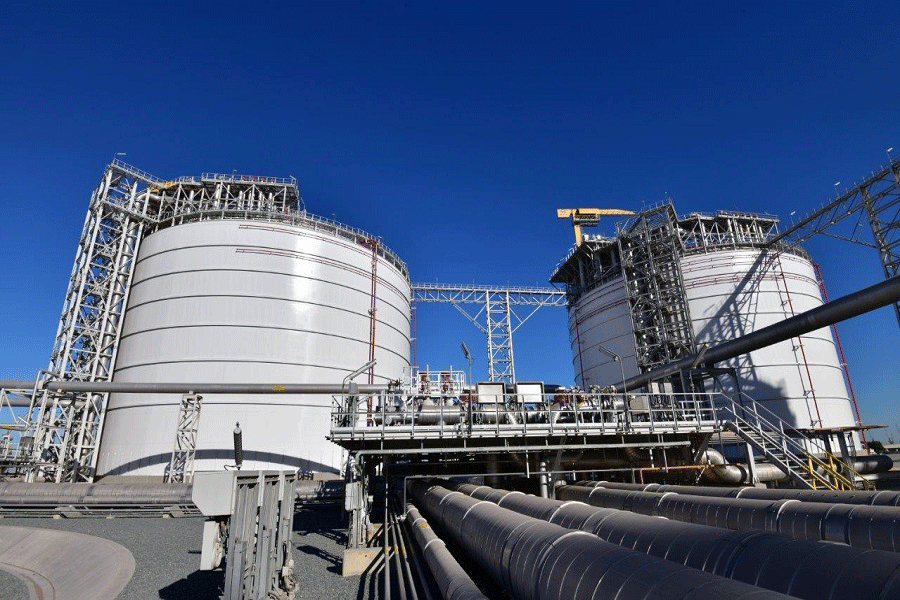
Several units were shut down at Kuwait’s largest oil refinery after it was hit by drones as Iran targeted energy infrastructure across the Gulf, according to a statement from state-owned Kuwait Petroleum Corporation (KPC).
Fires broke out across multiple units at the Mina Al-Ahmadi refinery in the morning of 20 March 2026 following the attack.
The refinery normally processes about 730,000 barrels of oil a day.
There were no casualties as a result of the attack, according to KPC.
Kuwait’s oil and gas sector has been severely disrupted by the ongoing regional conflict.
On 10 March, MEED revealed that the state-owned upstream operator Kuwait Oil Company (KOC) was operating with just 30% of its total workforce in their normal workplaces.
Earlier in the month, KPC also declared force majeure due to difficulties transporting oil and gas through the Strait of Hormuz caused by the conflict.
Force majeure, a French term meaning “superior force”, is a clause included in many international commercial contracts. It allows companies to suspend contractual obligations when extraordinary events occur beyond their control.
https://image.digitalinsightresearch.in/uploads/NewsArticle/16067425/main.gif -
Iraq declares force majeure on foreign-operated oil fields
23 March 2026
Register for MEED’s 14-day trial access
Iraq has declared force majeure on all oil fields developed by foreign oil companies as the US and Israel’s war with Iran disrupts navigation through the Strait of Hormuz.
The initial attack and Iran’s response have slashed Iraq’s exports.
Prior to the war starting on 28 February, Iraq was exporting between 3.3 and 3.5 million barrels a day of crude oil.
Oil sales account for nearly 90% of Iraq’s government revenues.
Earlier this month, two drone strikes hit infrastructure at Iraq’s Majnoon oil field, increasing security concerns in the country’s energy sector.
One of the drones hit a communications tower, and the other hit the office of the US engineering company KBR.
There were no casualties as a result of the attacks.
Foreign workers were evacuated from the site days after the US and Israel’s war with Iran started, and only Iraqi staff are currently working at the site.
Shortly before the war started, KBR announced that it had been awarded a “major contract” by Iraq’s state-owned Basra Oil Company to provide integrated field management services for the Majnoon oil field.
https://image.digitalinsightresearch.in/uploads/NewsArticle/16067302/main.png