
Sabic awards $3.47bn contract for ammonia and urea complex
10 September 2026
Register for MEED’s 14-day trial access
Sabic Agri-Nutrients, an affiliate of chemicals giant Saudi Basic Industries Corporation (Sabic), has awarded the main engineering, procurement and construction (EPC) contract for its seventh project in Saudi Arabia’s Jubail Industrial City, which will significantly expand its ammonia and urea production capacity.
South Korea’s Samsung E&A has won the contract for the project known as San VII, valued at $3.465bn, Sabic Agri-Nutrients said in a filing with the Saudi Exchange (Tadawul) on 10 September. It added that its board approved the final investment decision on the project on 9 September.
The San VII project in Jubail Industrial City, in the kingdom’s Eastern Province, will have a production capacity of about 1.2 million metric tonnes a year (t/y) of conventional ammonia and 2.6 million metric t/y of urea. The complex will also feature a post-combustion carbon capture unit.
Sabic had earlier announced receiving approval for feedstock allocation from the Saudi Ministry of Energy in March for the project, which will expand Sabic Agri-Nutrients’ urea production capacity by 54%, from approximately 4.8 million metric t/y to 7.4 million metric t/y.
The San VII project replaces a previously planned low-carbon or blue ammonia project with a conventional ammonia and urea facility. The project, which was previously known as San VI, was slated to produce 1.2 million metric t/y of low-carbon ammonia and 1.1 million metric t/y of urea and specialised agri-nutrients.
Before being restructured into its current form, MEED reported in March last year that Samsung E&A was the frontrunner to win the main EPC contract for the project.
Sabic Agri-Nutrients expects construction on the San VII project to begin in Q4 2026, with commissioning scheduled to start in Q3 2030. The commissioning period will last four months, ahead of the start of commercial production and completion of the project in Q4 2030.
The San VII project “is also expected to represent a significant step toward enhancing the company’s competitiveness and sustainability through the integration of advanced carbon capture technologies and the reduction of emissions intensity across its operations. This will contribute to reducing the carbon footprint of its products, supporting the company’s sustainability and carbon neutrality ambitions”, Sabic Agri-Nutrients said in its Tadawul filing.
“The project is considered one of the key pillars of the company’s 2040 strategy, which aims to strengthen the kingdom’s position in the agricultural nutrients export market and contribute to global food security, in line with the objectives of Saudi Vision 2030,” it added.
Sabic Agri-Nutrients
Formerly Saudi Arabian Fertiliser Company (Safco), Sabic Agri-Nutrients was the first petrochemicals company to be established in Saudi Arabia in 1965.
Sabic Agri-Nutrients, in which Sabic owns the majority 50.1% share, is one of the leading global fertiliser producers, with a portfolio that includes urea, ammonia, phosphate and other specialised products.
For the second quarter of 2026, the company reported a sharp decline in profitability, primarily driven by a drop in revenue and lower sales volumes compared with both the previous quarter and the same period last year.
Sabic Agri-Nutrients saw its net profit fall by 64.25% to $101m, compared with $282.66m in the second quarter of last year, and by 69.11% on a quarter-on-quarter basis.
The company’s Q2 revenues were down by 26.65% year-on-year at $643m, and by 16.11% quarter-on-quarter. Earnings before interest, taxes, depreciation and amortisation (Ebitda) in Q2 stood at $165m, a drop of 51% year-on-year and 55% quarter-on-quarter.
Sabic Agri-Nutrients further said its profitability suffered from a 31% quarterly decline in agri-nutrient sales volumes, recorded at 960,000 metric tonnes. Although global supply chain disruptions triggered a 27% price increase for agri-nutrients during the second quarter, the short-lived macro-driven bump was not enough to fully offset the slide in sales volumes.
In December 2022, Saudi Aramco and Sabic Agri-Nutrients delivered the world’s first commercial-grade blue ammonia cargo to South Korea. Locally based Lotte Fine Chemicals received the shipment of 25,000 metric tonnes of independently certified blue ammonia in the southern city of Ulsan.
Following that milestone, the company struck several deals in 2023 with customers worldwide to supply low-carbon ammonia and urea.
In April 2023, Sabic Agri-Nutrients shipped the first independently certified low-carbon ammonia from Saudi Arabia to Japan, where it is being used as fuel for power generation. The ammonia cargo was produced with feedstock from Saudi Aramco, sold by Aramco Trading Company to Fuji Oil Company and transported by Mitsui OSK Lines.
After that, Sabic Agri-Nutrients shipped 5,000 metric tonnes of low-carbon ammonia in May 2023 to a customer in India, Indian Farmers Fertiliser Cooperative.
The company then shipped 5,000 metric tonnes of low-carbon ammonia to Taiwan Fertiliser Company in June 2023.
Sabic Agri-Nutrients’ latest shipment is believed to have been in July 2023, when it shipped a 2,700-tonne cargo of low-carbon urea to Ravensdown, a New Zealand farmer-owned agricultural co-operative company.
Separately, Sabic Agri-Nutrients announced signing a memorandum of understanding (MoU) with Maaden Integrated Fertiliser Company (MIFC) on 18 August to explore potential collaboration opportunities.
The non-binding MoU, which is valid for three years, “aims to establish a general framework for cooperation between the two parties in developing and investing in opportunities within the integrated value chain of agri-nutrients, including the production and manufacturing of value-added products”, Sabic Agri-Nutrients said in a Tadawul disclosure.
MIFC is a limited liability company wholly owned by Saudi Arabian Mining Company (Maaden). MIFC serves as the holding entity for all subsidiaries within Maaden’s phosphate business vertical.

Register for MEED's guest program now to access this article.
Exclusive from Meed
-
 Al-Maktoum airport is key to Dubai’s aviation hub status
27 November 2026
-
 Emaar tenders Dubai Creek Harbour mall
27 November 2026
-
 Contractor wins Arabian Beauty Horses Village in Qatar
27 November 2026
-
 King Salman airport sets new infrastructure bid deadline
27 November 2026
-
 PIF secures inaugural A+ rating from S&P
26 November 2026
All of this is only 1% of what MEED.com has to offer
Subscribe now and unlock all the 153,671 articles on MEED.com
- All the latest news, data, and market intelligence across MENA at your fingerprints
- First-hand updates and inside information on projects, clients and competitors that matter to you
- 20 years' archive of information, data, and news for you to access at your convenience
- Strategize to succeed and minimise risks with timely analysis of current and future market trends
Related Articles
-
Al-Maktoum airport is key to Dubai’s aviation hub status
27 November 2026
 Commentary
Colin Foreman
EditorDubai’s position as a global aviation hub is central to its economy, and the expansion of Al-Maktoum International airport is critical to maintaining that role.
On 26 November, Dubai awarded AED56.5bn ($15bn) of contracts for the airport expansion, taking the total value of contracts awarded to more than AED80bn ($21.8bn). A workforce of 14,000 is working on the project, which will provide capacity for more than 260 million passengers a year when complete.
The economic stakes are high. A study published by Emirates Group and Dubai Airports in October 2024 found that aviation accounted for 27% of Dubai’s GDP in 2023. The sector contributed AED137bn ($37.3bn) in gross value added and supported 631,000 jobs – about one in five jobs in the emirate. The study forecast that aviation’s share of GDP would rise to 32% by 2030, contributing AED196bn in gross value added and supporting 816,000 jobs.
This year has demonstrated both the vulnerability and resilience of Dubai’s aviation model. Regional conflict has disrupted commercial air traffic across the Gulf since 28 February. Emirates Group’s profit before tax fell 66% year on year to AED4.1bn in the six months to 30 September, while Emirates carried 21.8 million passengers, down 22% on the prior-year period.
However, the network recovered quickly. By 30 September, Emirates was operating 91% of its pre-disruption network, serving 150 airports in 78 countries and territories. Emirates SkyCargo revenue rose 52%, the fleet increased to 289 aircraft, and the airline broke ground in May on a $5.1bn maintenance facility at Al-Maktoum International airport.
Maintaining that connectivity will require additional capacity. If aviation accounts for almost one-third of Dubai’s economy by 2030, as Emirates Group and Dubai Airports forecast, Al-Maktoum International airport will be central to the emirate’s ability to retain its position in global air travel.
https://image.digitalinsightresearch.in/uploads/NewsArticle/21894329/main.jfif -
Emaar tenders Dubai Creek Harbour mall
27 November 2026

Register for MEED’s 14-day trial access
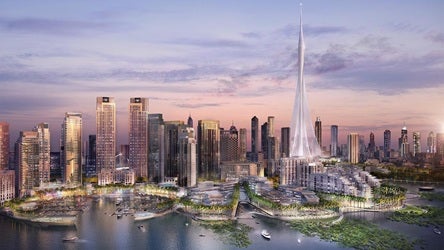
Dubai developer Emaar Properties has invited contractors to submit bids by 9 December for the main construction package of the Dubai Creek Harbour mall, known as Dubai Square.
The development covers a total retail, hospitality and commercial area of 2.6 million square metres, and is scheduled to open within three years.
Emaar unveiled Dubai Square in December 2025 as the anchor of its AED180bn ($49bn) Dubai Creek Harbour development.
The scheme has undergone several redesigns. MEED first reported on Emaar’s plans for a major retail centre at Dubai Creek Harbour in 2016. At the time, the project was envisioned to surpass Dubai Mall as the world’s largest retail destination, though its scale and layout have since evolved.
The mall will connect directly to the planned Dubai Creek Tower at the centre of the development.
UK-headquartered Brewer Smith Brewer Group is the project’s lead consultant, executive architect, architect of record and structural engineer. It is also the construction supervision consultant.
Dubai-based contractor Dutco Construction began mobilising last year for early site works.
In March last year, MEED reported that Emaar was preparing to relaunch development of both the tower and the mall. The developer had earmarked roughly AED14bn ($3.81bn) for the two assets as part of a wider AED65bn ($18bn), five-year capital expenditure programme.
Progress on the tower has been slower. First launched in 2015, it was promoted as the world’s tallest structure, designed to exceed the 828-metre Burj Khalifa. The original design was led by Spanish architect Santiago Calatrava and UK-based RMJM. The project stalled after concrete pile-cap works were completed in 2018.
In 2023, Emaar founder Mohamed Alabbar confirmed design works were continuing following an international design competition. In January 2026, Alabbar stated that a tender for the redesigned tower would be issued within three months. He later said the tender would be deferred until regional geopolitical tensions ease.
 READ THE NOVEMBER 2026 MEED BUSINESS REVIEW – click here to view PDF
Gulf projects keep moving amid conflict; UAE's state spending and oil output flexibility cushion Iran war shock; Project finance lenders weigh risk against infrastructure needs.
Distributed to senior decision-makers in the region and around the world, the November 2026 edition of MEED Business Review includes:
> AGENDA: GCC projects market holds its nerve> MARKET FOCUS: UAE economy shows resilience> INDUSTRY REPORT: Project financiers hold the line> STADIUMS: Stadium spending set to jump 39% in 2027> CONFLICT: Hormuz closure wipes out growth in 2026> INTERVIEW: WSP regional president Dean McGrail> INTERVIEW: UAE Ministry of Energy & InfrastructureTo see previous issues of MEED Business Review, please click herehttps://image.digitalinsightresearch.in/uploads/NewsArticle/21892263/main.jpg -
Contractor wins Arabian Beauty Horses Village in Qatar
27 November 2026
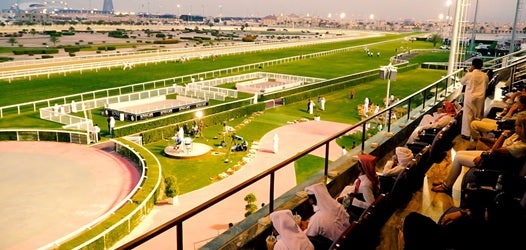
Qatar’s Culture Village Foundation (Katara) has awarded Qatar Trading & Contracting Group a QR574m ($158m) contract to build the Arabian Beauty Horses Village in Al-Uqdah Zone 74, in the Al-Khor area.
The project will include supporting infrastructure and public facilities designed for Arabian show horses and equestrian operations in the Al-Uqdah district.
Zone 74 is already an important centre for Qatar’s equestrian sector, anchored by the Al-Uqdah Equestrian Complex. The Qatar Racing & Equestrian Club began operating the complex in 2020 in coordination with Qatar’s Ministry of Culture and Sports.
The Arabian Beauty Horses Village is part of a broader, multistage state strategy to develop Al-Uqdah, on the outskirts of Al-Khor, as Qatar’s second major equestrian hub, alongside Al-Rayyan and Al-Shaqab in Doha.
According to UK analytics firm GlobalData, Qatar’s commercial construction sector is expected to grow at an average annual rate of 4.5% between 2025 and 2028, supported by investment in hotels, logistics facilities and data centres.
READ THE NOVEMBER 2026 MEED BUSINESS REVIEW – click here to view PDFGulf projects keep moving amid conflict; UAE's state spending and oil output flexibility cushion Iran war shock; Project finance lenders weigh risk against infrastructure needs.
Distributed to senior decision-makers in the region and around the world, the November 2026 edition of MEED Business Review includes:
> AGENDA: GCC projects market holds its nerve> MARKET FOCUS: UAE economy shows resilience> INDUSTRY REPORT: Project financiers hold the line> STADIUMS: Stadium spending set to jump 39% in 2027> CONFLICT: Hormuz closure wipes out growth in 2026> INTERVIEW: WSP regional president Dean McGrail> INTERVIEW: Ministry of Energy & InfrastructureTo see previous issues of MEED Business Review, please click herehttps://image.digitalinsightresearch.in/uploads/NewsArticle/21890026/main.jpg -
King Salman airport sets new infrastructure bid deadline
27 November 2026
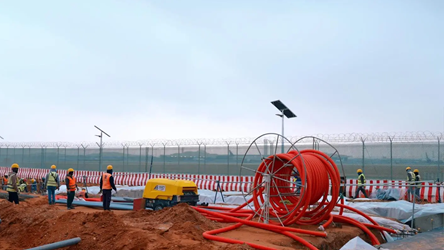
Saudi Arabia’s King Salman International Airport Development Company (KSIADC) has set a 10 January deadline for bids for the Zone C1+C2 roads, bridges and utility networks package for King Salman International airport (KSIA) in Riyadh.
The tender was issued on 26 October, with an initial bid-submission deadline of 6 December.
The request for proposals covers the procurement, construction, testing and commissioning of civil infrastructure supporting Terminal 6, alongside the existing Terminals 1-5.
The scope includes upgrades to Airport Road 539, which runs west of Terminals 1-5, and part of Mohamed bin Faraj Road 5333, west of Junction 6.
It also includes new roads, ramps, service roads and signalised at-grade junctions. An additional access road will connect the Terminal 6 site offices to Road 5333.
Structures will include the Junction 6 and Terminal 6 bridges, retaining walls and reinforced-soil structures.
The contractor will also construct the central ground services equipment (GSE) bridge. Before construction begins, the contractor must validate the design, complete any outstanding elements – including mechanically stabilised earth walls, approach slabs, drainage and lighting – and secure the required authority approvals.
Dry utilities will comprise high- and extra-high-voltage containment, a 13.8kV medium-voltage network with package substations, low-voltage distribution and street lighting, and security-surveillance systems.
Wet utilities will include potable water, fire water, irrigation water, treated sewage effluent, district cooling and wastewater networks. Wastewater pipes will range from 200mm u-PVC gravity lines to 1,700mm glass-reinforced plastic mains.
The stormwater network will include channels, culverts, ponds and pipes ranging from 400mm to 1,400mm in diameter. Crossings will be constructed using open-cut excavation, horizontal directional drilling or microtunneling.
Utilities serving the operational terminals will be diverted on a design-and-build basis. Enabling works will include earthworks and the relocation of the security fence and trees. The contractor will also demolish a temporary car park, existing bridges and a sewage pumping station.
Optional works comprise two design-and-build elements that will proceed only at the client’s instruction.
The first is the south GSE bridge. The second is an approximately 1,400-metre, multi-lane access road to the Terminal 6 Transportation Hub, including bridges, underpasses, ramps and tunnels, as well as provisions for future Wadi Loop utilities and structures.
READ THE NOVEMBER 2026 MEED BUSINESS REVIEW – click here to view PDFGulf projects keep moving amid conflict; UAE's state spending and oil output flexibility cushion Iran war shock; Project finance lenders weigh risk against infrastructure needs.
Distributed to senior decision-makers in the region and around the world, the November 2026 edition of MEED Business Review includes:
> AGENDA: GCC projects market holds its nerve> MARKET FOCUS: UAE economy shows resilience> INDUSTRY REPORT: Project financiers hold the line> STADIUMS: Stadium spending set to jump 39% in 2027> CONFLICT: Hormuz closure wipes out growth in 2026> INTERVIEW: WSP regional president Dean McGrail> INTERVIEW: Ministry of Energy & InfrastructureTo see previous issues of MEED Business Review, please click herehttps://image.digitalinsightresearch.in/uploads/NewsArticle/21887157/main3955.png -
PIF secures inaugural A+ rating from S&P
26 November 2026
Saudi Arabia’s Public Investment Fund (PIF) has received an inaugural A+ long-term foreign and local currency issuer credit rating from S&P Global Ratings, with a stable outlook.
The fund’s existing A-1 short-term rating from S&P is unchanged. PIF said its ratings are in line with those of Saudi Arabia.
PIF said S&P’s assessment cited its diversified funding profile, moderate leverage and its focus on value realisation under its 2026-30 strategy. The agency also pointed to the fund’s role in driving the kingdom’s economic transformation.
“The inaugural A+ long-term rating from S&P marks an important milestone in the continued development of PIF’s credit profile and our long-term funding plan,” said Ziyad Alfawzan, head of capital finance strategy at PIF.
The new rating makes PIF one of a small number of sovereign wealth funds with long-term credit ratings from all three leading agencies.
Moody’s Ratings confirmed PIF’s Aa3 long-term issuer rating and aa3 baseline credit assessment in September after a periodic review, with a stable outlook. In October, Fitch Ratings affirmed the fund’s long-term foreign and local currency issuer default ratings at A+, also with a stable outlook.
The Moody’s rating is one notch higher than the A+ grades from S&P and Fitch.
Debt is an increasingly important source of funding for PIF as it pays for domestic investment programmes and gigaprojects.
The fund raised $2bn in January from a 10-year sukuk, its first debt sale of 2026. In May, it raised $7bn from a three-tranche bond, its first hard-currency public issuance since the Iran conflict disrupted regional capital markets.
A full set of long-term ratings is likely to widen PIF’s investor base for future bond and sukuk issuance. The fund also borrows through loans and other debt instruments as part of its funding mix.
PIF is entering what it calls the value realisation phase of its strategy, covering 2026 to 2030. Over this period, it aims to deliver sustainable financial returns while continuing to drive the diversification of the Saudi economy.
MEED’s latest report on Saudi Arabia includes:
> COMMENT: Saudi projects hold steady
> GOVERNMENT: Riyadh looks to reset its regional defence outlook
> ECONOMY: Conflict bolsters case for Saudi economic diversification
> BANKING: Saudi lenders readjust to lower lending and deposit climate
> UPSTREAM: Aramco upstream spending gathers pace
> DOWNSTREAM: Sabic steps up Saudi petchems investment
> POWER: Saudi Arabia’s power award activity slows
> WATER: Saudi water sector hits sharp slowdown
> CONSTRUCTION: Saudi construction defies the headwinds
> TRANSPORT: Saudi infrastructure pushes forward amid conflict
> DATABANK: Saudi data indicates project spending shiftTo see previous issues of MEED Business Review, please click herehttps://image.digitalinsightresearch.in/uploads/NewsArticle/21868102/main.gif