
Regional war boosts oil and gas pipeline project activity
1 May 2026
There has been a surge of interest in oil and gas pipeline projects in the Middle East and North Africa (Mena) region as a result of the US and Israel’s attack on Iran on 28 February and the subsequent disruption to shipping through the Strait of Hormuz.
Projects collectively worth more than $43bn are being accelerated as countries that normally export oil and gas from the Gulf through the Strait seek alternative routes, and other countries seek to boost profits amid high energy prices.
Some of the key pipelines that have advanced in recent weeks involve Iraq, Algeria and Morocco.
Due to the current high-price environment and a new awareness of the importance of diversifying export routes, it is likely that other pipeline projects in the region will also see milestones announced over the coming weeks.
Iraqi oil
One of the projects seeing accelerated progress is Iraq’s planned $5bn Basra-Haditha crude oil pipeline.
Last month, Iraq announced it was setting up a high-level commission to oversee the development of the project.
The decision was made at a meeting held on 26 April, attended by Prime Minister Mohammed Shia Al-Sudani and the Minister of Petroleum Hayyan Abdul Ghani Al-Sawad, as well as other officials and consultants.
The commission will be chaired by the undersecretary of the Oil Ministry and include advisers to the prime minister, along with director-generals from the Oil Ministry and the Industry & Minerals Ministry.
Al-Sudani said the pipeline project will increase flexibility in transporting crude oil to the Turkish port of Ceyhan, as well as the Syrian port of Baniyas and Jordan’s port of Aqaba.
The pipeline is also expected to strengthen supply to refineries in central and northern Iraq and support higher domestic refining output.
The meeting also approved allocating $1.5bn to the project this year, with funding provided through the Iraq-China oil-for-infrastructure mechanism, according to a statement issued by the Petroleum Ministry.
Earlier this month, Iraq’s Council of Ministers approved amendments allowing the Oil Ministry to directly invite specialised companies to bid for the 685-kilometre pipeline.
The pipeline is expected to have a capacity of up to 2.25 million barrels a day.
Iraq’s oil and gas sector has been devastated by the disruption to shipping through the Strait of Hormuz, with oil exports collapsing by about 80%.
As well as the Basra-Haditha crude oil pipeline project, Iraqi officials have also discussed other potential pipeline projects to help the country diversify export routes.
These include a pipeline from Basra to the port of Duqm in Oman that would bypass the Strait of Hormuz.
This project would entail significant logistical challenges and remains at an early conceptual stage.
Morocco and Algeria
While neither Morocco nor Algeria is reliant on the Strait of Hormuz as an export route for oil and gas, both countries are using the current period of high prices as an opportunity to push ahead with ambitious gas pipeline plans.
Speaking at the end of last month at a conference in Ethiopia, the Algerian Minister of Energy and Renewable Energy, Mourad Adjal, said that Algeria was accelerating the development of the planned Trans-Saharan Gas Pipeline (TSGP) project, which is estimated to be worth $13bn.
“Algeria is working alongside its partners Nigeria and Niger to advance the Trans-Saharan Gas Pipeline project, which is expected to play a key role in consolidating energy integration at both the regional and continental levels,” he said.
Adjal told the conference that Algeria’s president, Abdelmadjid Tebboune, places importance on continental cooperation and sees Africa as “a priority focus” within Algeria’s national strategy for developing international partnerships.
In March this year, Algeria’s Sonatrach sent a delegation to Niger to advance the TSGP project.
At the time, officials said that the visit was focused on technical and operational details ahead of the pipeline project’s launch.
The project will connect Nigeria’s gas fields in Warri to Algeria’s Hassi RMel, linking into existing pipelines that supply European markets.
In March last year, UK-based Penspen was awarded a contract to provide a feasibility study update for the TSGP.
Spanning more than 4,000km from Nigeria to Algeria, the pipeline is jointly sponsored by Nigerian National Petroleum Company, Algeria’s Sonatrach and Niger’s Sonidep.
The planned project will facilitate the transportation of up to 30 billion cubic metres of natural gas a year across West and North Africa, ultimately linking to European markets.
The TSGP project was initiated by the collaborative efforts of Nigeria and Algeria in 2002, with Niger admitted in 2008 as a co-sponsor.
In 2006, Penspen delivered the original feasibility study for the project, finding the pipeline to be technically and economically feasible and reliable.
African rivals
Rabat’s plans for the Nigeria-Morocco Gas Pipeline (NMGP), estimated to be worth $25bn, are seen by some as a rival to the TSGP.
Under current plans, the proposed gas pipeline will extend for 6,900km, including onshore and offshore segments.
The Nigeria-Morocco Gas Pipeline (NMGP) will link gas deposits in Nigeria, Senegal and Mauritania to 10 neighbouring African nations.
According to the plan, the project’s northern terminus will connect to the existing Maghreb-Europe Gas Pipeline, which links Morocco and Spain.
Late last month, Morocco’s state-owned agency for oil, gas and mineral resources said it was preparing to launch a fundraising campaign for the pipeline, which will transport West African gas to the coast of the Mediterranean.
This will be the first time the Office National Des Hydrocarbures & Des Mines (Onhym) has sought to raise capital since it was restructured as a joint-stock company in February.
While Algeria’s TSGP would connect Nigerian fields to European markets via a shorter desert route, crossing fewer countries, Moroccan authorities have stated that they believe their planned coastal route would offer benefits.
Onhym has said that the longer route would boost electrification and energy access for the participating West African nations.
Pipeline logistics
All three of the major pipeline projects that have seen renewed interest over recent weeks have a long history of delays and setbacks.
These delays have clearly illustrated that planning long pipeline projects, especially when they cross multiple countries, can be logistically complex.
While the current period of elevated energy prices and the prospect of high returns on investment should motivate cooperation on these projects, it remains to be seen whether the problems that have previously created delays can be overcome.

Register for MEED's guest program now to access this article.
Exclusive from Meed
-
 Miral commits $3.2bn Yas Island investments
14 September 2026
-
 Contractors prepare bids for Oxagon wastewater plant
14 September 2026
-
 Saudi Arabia shuts East-West oil pipeline after drone strikes
14 September 2026
-
 WSP wins Dammam airport expansion design works
14 September 2026
-
 Dubai seeks contractors for multibillion-dollar road scheme
14 September 2026
All of this is only 1% of what MEED.com has to offer
Subscribe now and unlock all the 153,671 articles on MEED.com
- All the latest news, data, and market intelligence across MENA at your fingerprints
- First-hand updates and inside information on projects, clients and competitors that matter to you
- 20 years' archive of information, data, and news for you to access at your convenience
- Strategize to succeed and minimise risks with timely analysis of current and future market trends

Related Articles
-
Miral commits $3.2bn Yas Island investments
14 September 2026
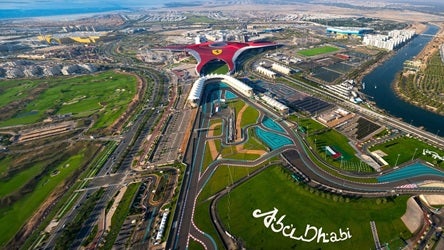
Abu Dhabi’s Miral has announced plans to invest over AED12bn ($3.2bn) in Yas Island over the next five years.
According to a statement, the investment will fund a pipeline of new projects, as well as expansions and enhancements to existing attractions, supporting Abu Dhabi’s Tourism Strategy 2030.
The next phase of development will focus on expanding Yas Island’s theme parks and attractions, while introducing new immersive rides and experiences that reflect changing visitor expectations.
The investment will also strengthen the island’s hospitality offering through additional hotel rooms and enhancements to its overall accommodation portfolio.
The investment is separate from the previously announced Disney project.
Miral recently started the expansion works of its Harry Potter-themed expansion at the Warner Bros World Yas Island entertainment destination in Abu Dhabi.
The scope of the Warner Bros World phase two expansion includes adding 63,000 square metres (sq m) to the existing theme park.
This will include a Harry Potter-themed zone with three new rides called Diagon Alley, Hogwarts Castle and The Forbidden Forest, along with retail outlets and food and beverage facilities.
Yas Waterworld
Miral has developed a series of theme parks and other entertainment-related attractions on Yas Island, working with several local and international contractors.
In July last year, Miral opened a new 16,900 sq m expansion of its Yas Waterworld park to the public.
The expansion added 3.3 kilometres of slide sections to the park. The addition of 18 new rides and attractions, bringing the total number of rides to more than 60, is expected to increase visitor capacity by 20%.
Construction was carried out by local contractor Alec.
Disney park
The Walt Disney Company and Miral signed an agreement in May to build a Disney theme park resort on Yas Island.
Disney, which is based in the US, said the Abu Dhabi site will be its seventh theme park resort. The others are in California and Florida in the US, Paris in France, Hong Kong and Shanghai in China, and Tokyo in Japan.
In a statement, Disney noted that the UAE is located within a four-hour flight of one-third of the world’s population, making it a significant gateway for tourism. It is also home to one of the world’s busiest airline hubs, with 120 million passengers travelling through Abu Dhabi and Dubai each year.
The Disney theme park resort in Abu Dhabi will include entertainment areas, themed accommodations, dining venues and retail experiences.
In 2023, Miral opened SeaWorld Abu Dhabi, also on Yas Island. Alec was the contractor for the estimated $565m project.
In 2018, Miral opened the Warner Bros theme park on Yas Island. Belgium’s Besix was the contractor for the estimated $531m project.
Other Miral projects have included the Etihad Arena and the indoor climbing and skydive centre Clymb. Bam International of the Netherlands was the contractor for the arena and Germany’s Zublin was the contractor for Clymb.
Yas Island was launched as a project in 2006 by local developer Aldar Properties. The original centrepiece attractions were the Yas Marina Circuit, which hosts Formula 1 motor racing’s annual Abu Dhabi Grand Prix, and the Ferrari World theme park.
https://image.digitalinsightresearch.in/uploads/NewsArticle/19645816/main.jpg -
Contractors prepare bids for Oxagon wastewater plant
14 September 2026

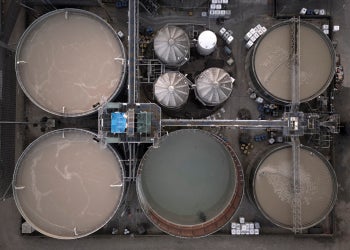
Contractors are preparing to submit bids to build a wastewater treatment plant for Oxagon, Neom’s industrial cluster.
The industrial wastewater treatment package will have an initial capacity of 35,000 cubic metres a day (cm/d), supplied in modular trains of 5,000 cm/d each. A separate sanitary wastewater treatment package will have a capacity of 1,000 cm/d.
The contract is structured as a design-build-operate project and covers the supply, installation and commissioning of industrial and sanitary wastewater treatment packages, as well as three years of operation and maintenance.
Bids are due on 2 October, a source close to the project told MEED.
It is understood that Neom’s water utility Enowa issued the request for proposals earlier this year. The plant is designed to provide “interim wastewater treatment” capacity for Neom’s Oxagon Industrial Quarter as industrial development in the area progresses.
Enowa has described the treatment systems as interim and de-mountable, allowing them to be installed and subsequently removed or relocated as requirements at Oxagon develop. The plant can be expanded to a maximum of 45,000 cm/d.
The tender documents also state that Neom may consider export credit agency (ECA) financing for the project, with the strength of bidders’ ECA financing proposals forming part of the commercial evaluation.
The project follows an earlier tender for the Oxagon Village Water Recycling Plant, which was cancelled despite contractors submitting bids in 2024.
MEED reported at the time that Beijing-based PowerChina, the local Alfanar Company and Cairo-headquartered Orascom had submitted bids for the project. It is understood that these firms are also likely to participate in the latest tender.
The earlier scheme included truck receiving facilities, pretreatment, biological treatment using food chain reactor technology, tertiary treatment, sludge handling and recycled-water storage.
The latest procurement appears to represent a reworked approach to wastewater treatment at Oxagon Industrial Quarter, with the previous engineering, procurement and construction scheme replaced by an interim, modular and de-mountable facility.
https://image.digitalinsightresearch.in/uploads/NewsArticle/19640903/main.jpg -
Saudi Arabia shuts East-West oil pipeline after drone strikes
14 September 2026
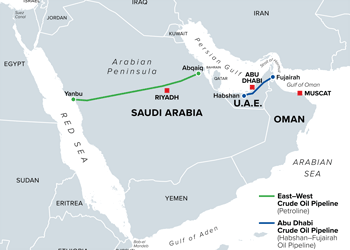
Saudi Arabia has temporarily closed its 1,200-kilometre East-West pipeline after it was targeted by multiple drones launched from Iraq, disrupting one of the kingdom’s most critical energy export routes and threatening global oil supplies already strained by conflict across the region.
The Ministry of Energy said the pipeline, which connects the Abqaiq oil field in the east to the Red Sea port of Yanbu, was hit in the Riyadh and Medina regions on 12 September. Specialised teams have begun securing the facility and assessing damage. A Foreign Ministry statement said the attack resulted in injuries and “some damage that is currently being addressed”.
The closure removes about 4 million barrels a day from the global market, representing 4% of world oil supply. The pipeline’s role has become increasingly critical since the US-Iran conflict forced a near-complete shutdown of flows through the Strait of Hormuz in March.
Saudi Arabia has been using the East-West route to bypass the chokepoint, but the assault has left the kingdom dependent on substantially reduced Hormuz exports and Red Sea shipping routes now threatened by Iran-backed Houthi forces in Yemen.
Iraqi Prime Minister Ali Al-Zaidi’s office confirmed the drone strike on the East-West Pipeline originated in the Maysan province, which borders Iran. The government formally condemned the attack, announced an investigation into the Maysan operations command and dismissed its commander. No armed group has claimed responsibility, but security analysts attribute the strike to Iran-backed militias operating from Iraqi territory.
Riyadh said it was not retaliating “at this stage”, choosing instead to support Iraqi efforts to prevent further strikes from its territory.
The attack comes amid wider regional upheaval. Houthi forces have rapidly advanced along Yemen’s coast, seizing the strategic Mokha port and the Zuqar Island in the southern Red Sea, moving closer to the Bab El-Mandab strait. Saudi authorities said the group simultaneously launched dozens of drones and missiles at the southern kingdom on 11 September, striking civilian and economic targets and injuring 73 people.
Oil analysts and traders reported that Yanbu’s storage capacity, estimated at around 35 million barrels, now holds supplies sufficient for only five to seven days of exports without pipeline operations. Storage facilities at Egypt’s Ain Sokhna and Sidi Kerir ports have similar constraints. Repair timelines remain uncertain, with sources citing estimates ranging from days to five or six weeks.
The dual disruption of both the pipeline and Red Sea shipping has compressed global energy supplies. Energy analysts warned that without pipeline repairs, oil prices could return to the $120-a-barrel peak reached earlier in the regional conflict.
https://image.digitalinsightresearch.in/uploads/NewsArticle/19641513/main.gif -
WSP wins Dammam airport expansion design works
14 September 2026
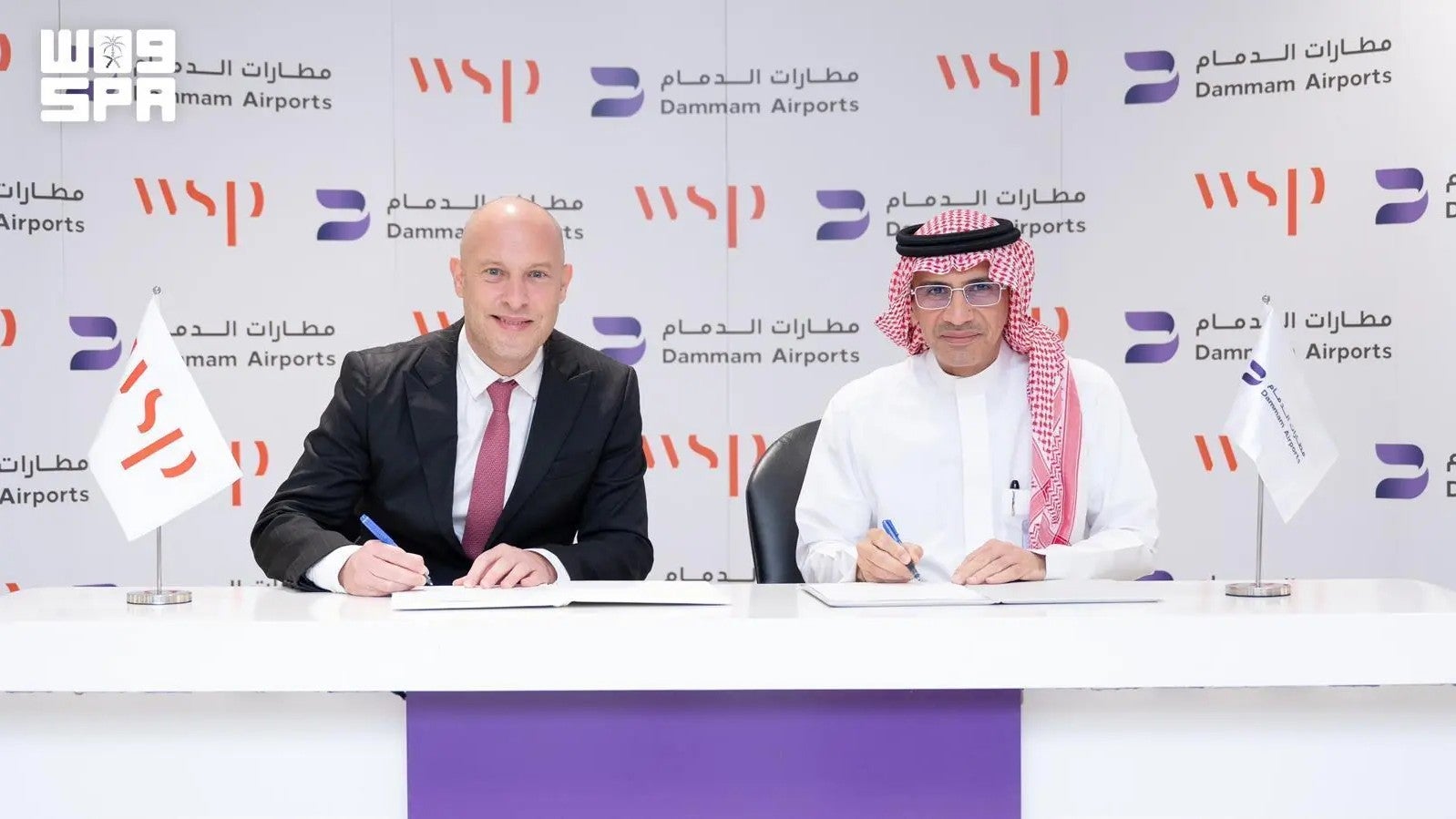
WSP Middle East, the regional arm of Canadian engineering firm WSP, has won a design contract to expand King Fahd International airport in Dammam, Saudi Arabia.
Dammam Airports Company (DACO) awarded the contract.
The scope includes designing passenger terminal expansions, facility upgrades, and improvements to airport entrances and access roads.
It also covers the development of baggage-handling systems, digital services and other associated infrastructure.
The expansion works will be carried out in line with the airport’s approved masterplan, which targets serving more than 19 million passengers a year by 2030.
The plan also aims to increase air cargo capacity to more than 600,000 tonnes a year and raise aircraft operational capacity to 77 movements per hour, supported by comprehensive expansions to infrastructure, runways and general aviation facilities.
This contract forms part of DACO’s ongoing efforts to strengthen the airport ecosystem, enhance operational efficiency, and support the Aviation Programme and Saudi Vision 2030 objectives.
King Fahd International airport is the kingdom’s third-largest airport by annual passenger traffic, behind Jeddah’s King Abdulaziz International and Riyadh’s King Khaled International.
DACO was formed in July 2017 to manage, operate and develop King Fahd International airport in Saudi Arabia’s Eastern Province.
It was established as part of the broader Saudi Vision 2030 privatisation and economic reform programme to corporatise the aviation sector, increase operational efficiency, upgrade infrastructure, and transition state-run airports into commercially viable, world-class regional aviation hubs.
https://image.digitalinsightresearch.in/uploads/NewsArticle/19639910/main.jpg -
Dubai seeks contractors for multibillion-dollar road scheme
14 September 2026
Register for MEED’s 14-day trial access
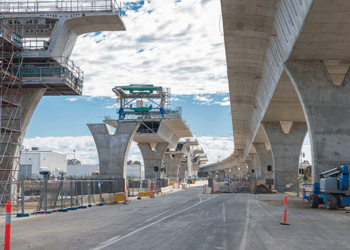
Dubai’s Roads & Transport Authority (RTA) is seeking contractors to design and build a multibillion-dollar new road that will run parallel to Sheikh Zayed Road.
MEED understands that the scope covers the construction of about 30 kilometres (km) of works.
These include about 15km of viaduct along First Al-Khail Street and more than 14.5km of bridge ramps, along with other associated infrastructure works.
The RTA floated the expression of interest notice to contractors in early September, with a submission deadline of 10 October.
The project is another significant initiative aimed at alleviating pressure on the existing Sheikh Zayed Road section from Hadiqa Street to Hessa Street.
Dubai has previously explored bold concepts to expand capacity on Sheikh Zayed Road, including proposals to introduce double-decker sections to add extra lanes without widening the existing corridor.
The idea was discussed in the context of rising congestion and limited right-of-way along one of the city’s busiest arterial roads, with elevated decks potentially carrying through-traffic while the existing at-grade lanes served local access.
The plans ultimately progressed as standalone schemes, with subsequent efforts focusing instead on corridor-wide upgrades, interchange improvements and complementary public transport expansions to manage demand more sustainably.
The latest project aligns with Dubai’s continued investment in upgrading and expanding its road network to keep pace with rapid population growth and rising commuting demand.
Planning for growth
Dubai launched the 2040 Urban Master Plan in March 2021, referencing studies indicating that the emirate’s population will reach 5.8 million by 2040, up from 3.3 million in 2020. The daytime population is set to increase from 4.5 million in 2020 to 7.8 million in 2040.
In December 2022, Sheikh Mohammed Bin Rashid Al-Maktoum, Vice President and Prime Minister of the UAE and Ruler of Dubai, approved the 20-Minute City Policy as part of the second phase of the Dubai 2040 Urban Master Plan.
In addition to the road projects, the RTA’s Dubai Metro Blue Line extension and Dubai Metro Gold Line form part of Dubai’s plans to improve residents’ quality of life by cutting journey times, as outlined in the policy.
The policy aims for residents to have 80% of their daily requirements within a 20-minute journey, on foot or by bicycle. This goal will be achieved by developing integrated service centres with all necessary facilities and increasing population density around mass transit stations.
https://image.digitalinsightresearch.in/uploads/NewsArticle/19639621/main.gif