
Red Sea crisis raises Saudi construction costs
13 March 2024
Register for MEED’s guest programme
While the severity of the disruption caused by the Red Sea crisis to international shipping, global supply chains and logistics is evident, country and sector-specific impacts have taken longer to become apparent.
For Saudi Arabia, the burning question for several months has been whether the disruption has the potential to impact the supply of construction materials on route to the country’s west coast gigaprojects, including the Oxagon port and The Line at Neom, as well as the Red Sea Project.
Riyadh-based Jadwa Investment has now estimated that disruption to commercial shipping in the Red Sea and Gulf of Aden has contributed to a 25-50% construction material price rise in recent weeks.
This steep rise comes amid renewed escalation in the Red Sea following a start to the year characterised more by falling risk perceptions due to the heavy build-up of the US-led naval coalition in the area.
All of this changed on 18 February with the holing of the Belize-registered Rubymar, which sank on 3 March. That ship had been carrying Saudi fertiliser from Dammam to Bulgaria.
However, perhaps a more direct concern for the Saudi construction sector is the strike on 6 March of the bulk carrier True Confidence, which came from China loaded with steel and commercial vehicles.
The attack led to a fire on board, three fatalities and the abandonment of the vessel by its crew. It was also a telling indicator of the rising risk to the delivery of construction materials – much of it headed from Asia – specifically to the western coast of Saudi Arabia.
Weighing risk
Industry suppliers, shippers and logistics firms will need to make increasingly difficult choices as they work to keep the booming Saudi construction sector supplied.
Transiting the Gulf of Aden route now holds not just hypothetical but very much proven risk. War risk insurance premiums have skyrocketed – at the last count, rising to around tenfold the normal cost and equivalent to up to 1% of vessel value, depending on the build.
The alternative – overlanding material from Asia from the safe harbour of Saudi Arabia’s eastern coast – carries less risk, but higher transport overheads given the inefficiency of conveying bulky construction materials in large volumes by road – the only option at present.
The scenario makes an excellent, if belated, business case for the $7bn Saudi Landbridge, a west-to-east railroad scheme that unfortunately will only be be completed half a decade from now
As it stands, some tough decisions lie ahead. Suppliers and contractors locked into fixed pricing assumptions for construction materials will be rapidly onboarding financial risk. Projects under tender potentially face the prospect of contractors revising their bid submissions with sharply rising cost projections.
And the worst may be yet to come. While spot market prices for shipping reflect the costs incurred by the Red Sea disruption, with two to five-fold price rises for some global routes, many short-term contracts have not yet absorbed the price rises and could be set to be renegotiated in the coming months.
This raises the prospect of further price rises if the conflict and its impacts continue.
 MEED’s April 2024 special report on Saudi Arabia includes:
> GVT & ECONOMY: Saudi Arabia seeks diversification amid regional tensions
> BANKING: Saudi lenders gear up for corporate growth
> UPSTREAM: Aramco spending drawdown to jolt oil projects
> DOWNSTREAM: Master Gas System spending stimulates Saudi downstream sector
> POWER: Riyadh to sustain power spending
> WATER: Growth inevitable for the Saudi water sector
> CONSTRUCTION: Saudi gigaprojects propel construction sector
> TRANSPORT: Saudi Arabia’s transport sector offers prospects

Register for MEED's guest program now to access this article.
Exclusive from Meed
-
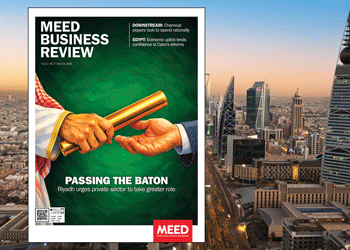 Saudi Arabia’s private sector steps up
4 March 2026
-
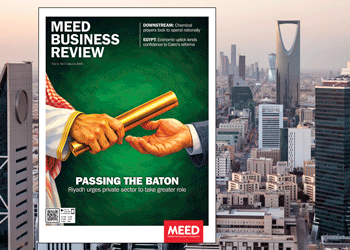 Read the March 2026 MEED Business Review
3 March 2026
-
 Firms prepare Port of Duqm consultancy bids
3 March 2026
-
 Diriyah awards Pendry superblock package
3 March 2026
-
 Local firm to develop $598m Muscat tourism project
3 March 2026
All of this is only 1% of what MEED.com has to offer
Subscribe now and unlock all the 153,671 articles on MEED.com
- All the latest news, data, and market intelligence across MENA at your fingerprints
- First-hand updates and inside information on projects, clients and competitors that matter to you
- 20 years' archive of information, data, and news for you to access at your convenience
- Strategize to succeed and minimise risks with timely analysis of current and future market trends

Related Articles
-
Saudi Arabia’s private sector steps up
4 March 2026
 Commentary
Colin Foreman
EditorRead the March issue of MEED Business Review
At the Future Investment Initiative (FII) in Riyadh in 2019, a head of a regional family business voiced a guarded concern. The worry was that the scale and speed of the Public Investment Fund’s (PIF’s) projects were crowding out the private sector, leaving little space for traditional players to compete.
 Fast forward more than six years and much has changed. In 2026, the era of the PIF acting as the principal driver for development is giving way to a new phase where the private sector is taking a more active role.
At February’s Private Sector Forum (PSF), officials acknowledged that the kingdom’s priorities have evolved since 2016. This has led to reprioritisation, including the indefinite postponement of the 2029 Asian Winter Games in Trojena and the scaling back of projects such as The Line – moves framed as strategic adjustments amid global economic uncertainty.
With the 2034 Fifa World Cup and Expo 2030 on the horizon, alongside the rapid ascent of artificial intelligence, Riyadh is right to realign its capital. It is far more reassuring to see a government adapt its strategy to a changing global economy than to blindly pursue an outdated plan. The PIF, now managing $913bn in assets, is seeking ‘escape velocity’, allowing sectors such as tourism and real estate to stand independently.
The private sector is beginning to respond. Recent agreements signed at the PSF – ranging from King Salman International airport’s mixed-use developments to Roshn’s logistics partnership with Agility – show that local and regional firms are rising to the challenge.
There is still work to be done. Some sectors are more ready for investment than others, and scaling back projects has dented the confidence of some investors.
But overall, the tide is turning. The crowding out fears of 2019 have been replaced by a drive to get the private sector more involved, and while it will take time for momentum to fully develop, the process of passing the baton has already begun.
 READ THE MARCH 2026 MEED BUSINESS REVIEW – click here to view PDF
Riyadh urges private sector to take greater role; Chemical players look to spend rationally; Economic uptick lends confidence to Cairo’s reforms.
Distributed to senior decision-makers in the region and around the world, the March 2026 edition of MEED Business Review includes:
> RAMADAN: Data disproves the Ramadan slowdown story> INDUSTRY REPORT: Chemicals producers look to cut spending> INDUSTRY REPORT: Global petrochemical project capex set to rise until 2030> MARKET FOCUS: Egypt’s crisis mode gives way to cautious revival> LEADERSHIP: Delivering Saudi Arabia’s next phase of rail growth> INTERVIEW: Abu Dhabi’s Enersol charts acquisitions pathTo see previous issues of MEED Business Review, please click herehttps://image.digitalinsightresearch.in/uploads/NewsArticle/15842555/main.gif -
Read the March 2026 MEED Business Review
3 March 2026
Download / Subscribe / 14-day trial access Saudi Arabia’s priorities have shifted over the past decade, with officials at February’s Private Sector Forum confirming a reprioritisation since 2016 that includes postponing the 2029 Asian Winter Games in Trojena and scaling back projects such as The Line in response to global economic uncertainty.
In 2026, the Public Investment Fund’s role as the main driver of development is shifting towards greater private sector involvement, a transition examined by MEED editor Colin Foreman in the latest issue of MEED Business Review.March’s market focus is on Egypt, where the country’s crisis mode is giving way to a cautious revival.
This edition also reports that the region’s downstream sector may face subdued project spending in 2026 due to flattening demand and weak margins.
In the latest issue, we disprove the Ramadan slowdown story, present exclusive leadership insight from Jacobs on delivering Saudi Arabia’s next phase of rail growth and outline some important lessons learnt from a power plant decommissioning. We also talk to senior executives at Enersol, Lamar Holding and Metito.
We hope our valued subscribers enjoy the March 2026 issue of MEED Business Review.

Must-read sections in the March 2026 issue of MEED Business Review include:
 > AGENDA: Saudi Arabia’s private sector picks up the baton
> RAMADAN: Data disproves the Ramadan slowdown story
INDUSTRY REPORT:
Downstream
> Chemicals producers look to cut spending
> Global petrochemical project capex set to rise until 2030> LEADERSHIP: Delivering Saudi Arabia’s next phase of rail growth
> POWER: Lessons learnt from a power plant decommissioning
> INTERVIEW: Abu Dhabi’s Enersol charts acquisitions path
> INTERVIEW: Lina Noureddin, CEO of Lamar Holding, on the evolving PPP landscape
> INTERVIEW: Contract award marks Metito’s return to municipal projects
> MARKET FOCUS EGYPT:
> COMMENT: Egypt’s crisis mode gives way to cautious revival
> GOVERNMENT: Egypt adapts its foreign policy approach
> ECONOMY & BANKING: Egypt nears return to economic stability
> OIL & GAS: Egypt’s oil and gas sector shows bright spots
> POWER & WATER: Egypt utility contracts hit $5bn decade peak
> CONSTRUCTION: Coastal destinations are a boon to Egyptian construction> MEED COMMENTS:
> Winter Games delay raises uncertainty for Saudi construction
> Duqm petrochemicals revival provides fillip to Gulf projects market
> Solar deals signal Saudi Arabia’s energy ambitions
> Hydrogen bridge awaits bankable contracts> GULF PROJECTS INDEX: Gulf index leaps upward in 2026
> JANUARY 2025 CONTRACTS: Middle East contract awards
> ECONOMIC DATA: Data drives regional projects
> OPINION: The war that (almost) no one wants
> BUSINESS OUTLOOK: Finance, oil and gas, construction, power and water contracts
To see previous issues of MEED Business Review, please click herehttps://image.digitalinsightresearch.in/uploads/NewsArticle/15839736/main.gif -
Firms prepare Port of Duqm consultancy bids
3 March 2026
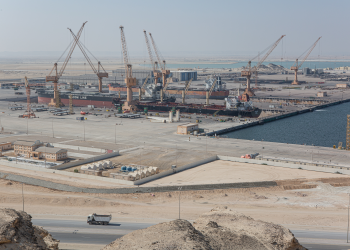
Oman’s Port of Duqm has issued tender notices inviting consultants to bid for two packages by mid-March.
The scope of the first tender covers the consultancy services for inspection, scope preparation and supervision of the sewage treatment plant.
The bid submission deadline is 18 March.
The scope of the other tender includes the consultancy services for port marine traffic assessment/simulation and impact study.
The bid submission deadline for this package is on 17 March.
Both tenders were floated late last month.
The Port of Duqm is a deepwater, multipurpose port on Oman’s Arabian Sea coast, developed within the Special Economic Zone at Duqm (Sezad).
Its location outside the Strait of Hormuz is a key advantage, positioning Duqm as a strategic alternative gateway for cargo moving between the Gulf, the Indian subcontinent and East Africa, and supporting Oman’s push to grow non-oil trade and port-led industry.
Designed to handle a mix of cargoes, including containers, dry bulk, breakbulk and liquid bulk, the port forms part of a wider Duqm complex that also includes a major dry dock and large industrial land allocations for energy, manufacturing and logistics projects.
As the port and SEZ expand in phases, consultancy tenders typically reflect the next steps in delivery and operations, covering engineering and technical studies, commercial assessments, and readiness planning tied to new terminals and industrial tie-ins.
 https://image.digitalinsightresearch.in/uploads/NewsArticle/15840397/main.jpg
 -
Diriyah awards Pendry superblock package
3 March 2026
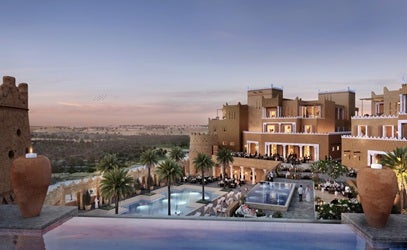
Saudi Arabian gigaproject developer Diriyah Company has awarded an estimated SR2.5bn ($666m) contract to build the Pendry superblock package in the second phase of the Diriyah Gate development (DG2).
The contract was awarded to the local firm Saudi Constructioneers.
The Pendry superblock encompasses the construction of a hotel, known as the Pendry Hotel, along with residential and commercial assets.
The project will cover an area of 75,365 square metres (sq m) and is located in the northwestern district of the DG2 area.
Contractors had submitted final proposals for a contract in September last year, as MEED reported.
The tender was issued in June last year.
The latest contract follows the Diriyah Company’s award of a SR717m ($192m) contract for the construction of the One Hotel, located in the Diriyah Two area of the masterplan.
The contract was awarded to the joint venture of local firm BEC Arabia and Indian contractor Ashoka Buildcon.
The project has a gross floor area of over 31,000 sq m.
The Diriyah masterplan envisages the city as a cultural and lifestyle tourism destination. Located northwest of Riyadh’s city centre, it will cover 14 square kilometres and combine 300 years of history, culture and heritage with hospitality facilities.
https://image.digitalinsightresearch.in/uploads/NewsArticle/15778187/main.jpg -
Local firm to develop $598m Muscat tourism project
3 March 2026
Oman’s Ministry of Heritage & Tourism has signed an agreement with local firm Sorouh Al-Qurm Real Estate Company to build an integrated tourism complex in the Al-Qurm area of Muscat.
The project will be developed with a total investment estimated at RO230m ($598m).
Planned across more than 165,000 square metres (sq m), the development will include two four-star hotels offering over 400 rooms, alongside leisure components such as an indoor games hall and trampoline attractions.
The site will also incorporate commercial spaces and freehold residential units, among other amenities.
The agreement was signed by Sayyid Ibrahim Bin Said Al-Busaidi, minister of heritage and tourism, and Khaled Khudair Mashaan, chairman of Al-Argan International Real Estate Company, who signed as the authorised representative for Sorouh Al-Qurm Real Estate Company.
GlobalData forecasts that the Omani construction industry will expand at an average annual growth rate of 4.2% from 2025 to 2028.
Growth in the country will be supported by rising government investments in renewable energy and transport infrastructure, as well as in the housing sector, as part of the Oman Vision 2040 plan.
https://image.digitalinsightresearch.in/uploads/NewsArticle/15839476/main.jpg