
Qatar banks on infrastructure for Olympic bid
28 August 2025
This package also includes:
> Olympics bid aims to extend tourism gains

Qatar officially launched its bid to host the 2036 Olympic and Paralympic Games in July 2025. It is the latest step in a decades-long national strategy that uses global events to build international influence, accelerate economic diversification and stimulate the projects market.
If Doha’s bid is successful, it will become the first city in the Middle East and North Africa to host the games, reinforcing its position as a global hub for major sporting events.
Unlike Qatar’s previous bids, this bid is not centred on an ambitious building programme. Instead, it is focused on demonstrating how the legacy of the 2022 Fifa World Cup and other major competitions can be leveraged to host future events.
 Sports diplomacy
Qatar’s strategy of positioning itself as an international sporting hub began long before the World Cup. The first global test came in December 2006, when Doha staged the 15th Asian Games, which, at the time, was the largest multi-sport event ever held in the region.
More than 8,000 athletes competed across 39 sports over two weeks, while the opening ceremony attracted an estimated global television audience of 1.5 billion viewers. Qatar invested approximately $2.8bn in staging the competition.
That experience not only put Doha on the map, but also left behind key infrastructure that underpinned its bids for subsequent events.
Using the infrastructure built for the Asian Games, Qatar launched a $48m bid in 2007 to stage the 2016 Summer Olympics. At the time, organisers proposed an Olympic Village costing nearly $2bn, designed to host 18,000 athletes, and emphasised that 70% of the necessary venues already existed thanks to the Asian Games.
Despite gaining more International Olympic Committee (IOC) votes than Rio de Janeiro in the preliminary round, and ranking joint third with Chicago on technical merit, Doha did not make the final shortlist.
In June 2008, the IOC selected Chicago, Madrid, Rio de Janeiro and Tokyo as candidate cities, while Doha, Baku and Prague fell short of the candidature phase.
This may have been a setback for Qatar, but it was also a valuable lesson that would shape its long-term approach to sports diplomacy.
Qatar’s Olympic Committee says that 95% of the necessary infrastructure for 2036 is already in place
World Cup legacy
Since then, Doha has hosted an array of major international sporting events. The largest was the Fifa World Cup 2022, the first ever staged in the Arab world. The tournament required billions of dollars of investment in stadiums, transport networks, hotels and urban infrastructure, which is widely regarded as the largest project spend in the history of global sport.
Eight purpose-built and upgraded stadiums formed the backbone of the football tournament, supported by the new Doha Metro and extensive road and airport expansions along with many other associated facilities, including hotels and retail centres.
The World Cup not only demonstrated Qatar’s ability to deliver a logistically complex global tournament, but also left behind a more world-class infrastructure that now forms the cornerstone of its 2036 Olympic bid.

Qatar intends to build on the legacy of the Fifa World Cup 2022 with its Olympic bid
Other major sporting events have also reinforced Doha’s credentials. The 2019 World Athletics Championships were held at the renovated Khalifa International Stadium, attracting 1,772 athletes from 206 teams across 49 events.
The stadium, scaled to 21,000 available seats, and the Doha Corniche, which hosted marathon and racewalking events, demonstrated the city’s ability to manage large and logistically complex competitions.
The 2024 World Aquatics Championships further underscored this capability, drawing the world’s top swimmers, divers and water polo teams to Doha after the event was postponed from its original 2023 date due to pandemic-related scheduling issues.
Looking ahead, Doha will once again host the Asian Games in 2030, after it was selected by the Olympic Council of Asia in late 2019.
Qatar’s Olympic Committee says that 95% of the necessary infrastructure for 2036 is already in place, a declaration that speaks directly to the IOC’s “New Norm” framework, which emphasises sustainability and financial prudence.
The country’s World Cup stadiums, including Khalifa International, Lusail and Al-Bayt, provide ready-made facilities that are adaptable to Olympic disciplines. Khalifa International already has a running track and a history of hosting athletics competitions, while aquatics, handball and other sports are also well catered for.
Beyond venues, the transport and urban infrastructure developed for the World Cup, including the Doha Metro, expanded highways, airport upgrades and new hospitality capacity, gives Qatar a logistical advantage few prospective hosts can match.
Despite the scale of its existing assets, the games will still require the construction of new facilities such as an Olympic Village, along with an international broadcast centre and main press centre. Repurposing the 2022 World Cup stadiums will also create opportunities for the construction sector.
Opportunities in Qatar are needed. There has been a significant slump in spending on construction and transport projects in the years that followed the country’s World Cup building programme.
After Qatar secured the rights to host the World Cup in 2010, there was a sharp uptick in contract awards and cash spend on projects. According to regional projects tracker MEED Projects, contract awards peaked in 2014, when there was nearly $27bn of contract awards. Cash spent on projects, which lags behind awards, peaked in 2016 and 2017 at nearly $21bn.
In 2025, there have been $1.3bn-worth of construction and transport awards, while cash spent totals nearly $4bn.
Qatar offers the IOC a compelling proposition. The infrastructure is ready, the finances are secure
New challenges
Before attention turns to the possible revival of the construction sector, there are other issues to address, one of which will be climate.
Just as the 2022 World Cup was moved to November and December to avoid summer heat, the Olympics would almost certainly need to be shifted away from the traditional July and August window.
While the IOC has shown flexibility on scheduling, the prospect of moving the games to the winter requires global consensus and complicates broadcasting arrangements.
Reputational risk is another major hurdle. Qatar has faced sustained criticism over labour rights, gender equality and wider social inclusion issues, with human rights organisations highlighting the treatment of migrant workers during the World Cup preparations. Although Doha has introduced reforms, the IOC may be mindful that international scepticism remains.
The competitive field for 2036 is another consideration. India has proposed a multi-city Olympics centred on Ahmedabad, with plans for extensive new construction. The cost could reach more than $7bn, making it one of the most expensive Olympic Games in history.
While India’s bid highlights its vast market and growing global stature, it is in direct contrast with the IOC’s push for sustainability and reliance on existing infrastructure.
Istanbul is also a contender, leveraging Turkiye’s position as a cultural and geographical bridge between Europe and Asia, and highlighting the forthcoming 2027 European Games. Yet Istanbul’s repeated failures in past bids, coupled with security and transport concerns, cast uncertainty over its chances.
Germany’s possible candidacy brings experience and economic stability, but as Paris hosted in 2024, another European games is unlikely so soon.
Saudi Arabia, while not yet officially in the race, has also been mooted as a possible candidate, although Riyadh is likely to focus its efforts of delivering the Fifa World Cup 2034.
Egypt has also signalled its Olympic intent. In January 2022, Sports Minister Ashraf Sobhi announced Cairo’s plans to submit a formal application to host the games, which would make Egypt the first African country to do so.
The IOC has previously expressed interest in awarding the Olympics to Africa, making Cairo’s candidacy significant.
The host city for 2036 is expected to be announced in 2026 or 2027. On paper, Qatar offers the IOC a compelling, low-risk proposition. The infrastructure is ready, the finances are secure and the operational record is proven. The question is not whether Qatar is able to host the games, but whether the IOC is prepared to endorse a model that prioritises sustainability and logistics over reputational concerns.
Since losing out in its bid for the 2016 Olympics, Qatar has repeatedly demonstrated that it has learnt how to successfully bid for global events. If successful again, the Olympics will be the driving force behind Qatar’s economic development over the next decade.
 Olympics bid aims to extend tourism gains


Register for MEED's guest program now to access this article.
Exclusive from Meed
-
 SAR tenders design review consultancy for GCC rail link
18 September 2026
-
 Tender issued for Libyan gas project
17 September 2026
-
 Nakheel awards $218m Dubai Islands buildings deal
17 September 2026
-
 Aldar and Mubadala acquire Masdar City Square
17 September 2026
-
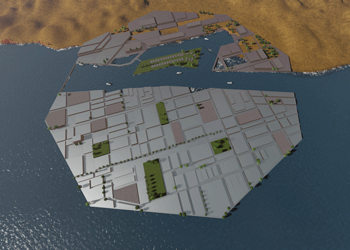 Neom tenders Oxagon highway contract
17 September 2026
All of this is only 1% of what MEED.com has to offer
Subscribe now and unlock all the 153,671 articles on MEED.com
- All the latest news, data, and market intelligence across MENA at your fingerprints
- First-hand updates and inside information on projects, clients and competitors that matter to you
- 20 years' archive of information, data, and news for you to access at your convenience
- Strategize to succeed and minimise risks with timely analysis of current and future market trends
Related Articles
-
SAR tenders design review consultancy for GCC rail link
18 September 2026
Register for MEED’s 14-day trial access
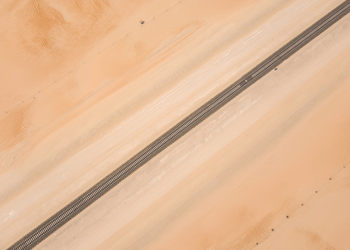
Saudi Arabia Railways (SAR) has issued a request for proposals (RFP) for a design management and review consultant to oversee engineering works on the GCC railway network, the latest step in advancing the long-delayed regional rail link.
The RFP was issued on 9 September, with a submission deadline of 18 October.
The tender seeks a consultant to manage, audit and verify deliverables produced by SAR's separately appointed design services consultant, rather than carry out the design itself. The tendering for the design services consultancy is currently in progress.
Construction will be tendered separately through competitive bidding once designs are approved.
The GCC railway will run for about 672 kilometres (km) inside Saudi Arabia, linking the kingdom's existing network to Kuwait, Qatar, the UAE and Bahrain, with four sections of about 141km, 200km, 151km and 21km, respectively.
The line is planned as a single-track, non-electrified corridor for mixed freight and passenger traffic, with a maximum axle load of 32.4 tonnes and passing loops for bidirectional working.
The appointed consultant will develop a design management and review plan covering governance, interdisciplinary coordination and stage-gate approvals, and will issue formal review and audit reports against SAR's requirements and international standards.
The scope also covers stakeholder engagement, interface management and oversight of land acquisition activity tied to the design consultant's land acquisition plan.
Key design stages are expected to take about 16 months: four months for concept design, six for preliminary design and six for issued-for-construction design, each with four weeks of contingency.
SAR has asked bidders to mobilise a core team from day one. These must include a project director, engineering and design manager, stakeholder manager and lead document controller, all based at SAR's offices, with minimum experience thresholds ranging from three years for junior operators up to 25 years, including 15 in rail, for the project director role.
GCC railway line
Under the overall plan, the railway will run from Kuwait, pass through Dammam in Saudi Arabia, reach Bahrain via a planned causeway, and continue from Dammam to Qatar, the UAE and, ultimately, Muscat via Sohar in Oman. The railway is reported to cover about 2,186km in total.
The route length within each member state is as follows:
- UAE – 684km
- Saudi Arabia – 672km
- Oman – 306km
- Qatar – 283km
- Kuwait – 145km
- Bahrain – 36km
The railway is designed for passenger trains travelling at 220 kilometres an hour (km/h) and freight trains operating at 80km/h–120km/h.
With high levels of project activity, governments in spending mode and renewed cooperation under the Al-Ula Declaration, the latest efforts to restart the GCC railway project may make more progress than previous attempts. If completed, the railway could prove transformational for a region that is globally connected but still divided by national borders.
 READ THE SEPTEMBER 2026 MEED BUSINESS REVIEW – click here to view PDF
Nuclear power ambitions gather pace; Kuwait keeps dealmaking alive despite war; Region invests in raising gas processing capacity.
Distributed to senior decision-makers in the region and around the world, the September 2026 edition of MEED Business Review includes:
> AGENDA: Gulf nuclear revival takes shape> MARKET FOCUS: Kuwait keeps dealmaking alive under fire> INDUSTRY REPORT: Gas processing takes centre stage in Mena regionTo see previous issues of MEED Business Review, please click herehttps://image.digitalinsightresearch.in/uploads/NewsArticle/19783331/main.gif -
Tender issued for Libyan gas project
17 September 2026
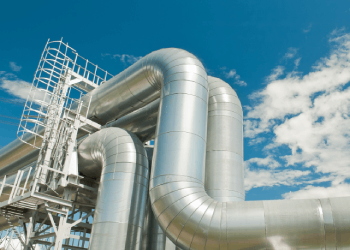
An invitation to bid has been issued for a contract to conduct environmental assessments for the project to expand the Mellitah oil and gas complex in Libya.
The bid submission deadline is 2pm today (17 September) Libyan time.
The scope of the project includes provision of:
- An environmental baseline study (EBS)
- An environmental impact assessment (EIA)
- An environmental management plan (EMP)
The client is Mellitah Oil & Gas (MOG), which is a joint venture of Italy’s Eni and Libya’s National Oil Corporation (NOC).
MOG is based in Tripoli and operates both onshore and offshore oil and gas facilities.
The joint venture owns and operates six major oil and gas fields across the North African country.
According to the tender documents, the company that is awarded the contract will need to prepare environmental management measures in compliance with:
- Libyan environmental legislation
- Ministry of Environment requirements
- NOC environmental guidelines
- Applicable international environmental standards and best practices
The expansion of the Mellitah oil and gas complex is part of a project estimated to be worth $8bn.
The wider project is known as the Mellitah Complex Expansion & CO2 Management Integrated Development Project.
It has six main packages:
- Onshore package
- Offshore Structure A
- Offshore Structure E
- Subsea pipeline package
- Site preparation work
- Carbon capture and storage facility
Security issues and political instability have been a major problem for Libya’s oil and gas sector since the country’s civil war started in 2011.
Earlier this month, the Mellitah oil and gas complex was forced to shut down temporarily due to a protest over deteriorating public services.
The existing onshore complex includes housing, processing units, storage facilities and export facilities.
It also serves as the launch point for the Greenstream pipeline, which delivers Libyan gas directly to Italy.
The planned expansion of the complex will involve:
- Construction of a new fourth gas processing train
- Construction of a third condensate train
- Construction of a third natural gas liquids fractionation train
- Construction of a fourth sulphur recovery unit train
- Installation of a hydrogen sulphide enrichment unit
- Installation of a sulphur recovery unit
- Construction of other associated facilities
The Mellitah complex is located about 100 kilometres west of Tripoli and is a key energy facility in the west of the country.
https://image.digitalinsightresearch.in/uploads/NewsArticle/19748920/main.png -
Nakheel awards $218m Dubai Islands buildings deal
17 September 2026
Register for MEED’s 14-day trial access
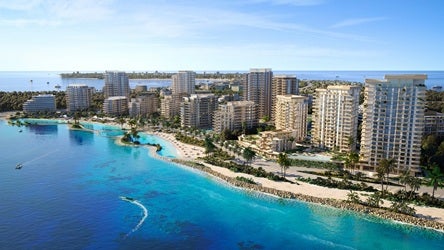
Dubai-based developer Nakheel, now part of Dubai Holding, has awarded a main construction contract worth more than AED800m ($218m) for phases one and three of Bay Grove Residences at Dubai Islands.
The contract was awarded to the local firm Metac General Contracting Company.
It covers the construction of 537 apartments, comprising one- to four-bedroom units, across seven residential buildings.
Phase one includes 296 units in four buildings, while phase three comprises 241 units across three buildings.
The works are scheduled for completion in late 2028.
Bay Grove Residences will ultimately comprise 1,154 homes across 15 buildings. Planning is under way for the remaining 617 homes in phases two and four, with further contract awards expected.
In August last year, Nakheel awarded a AED2.6bn ($708m) contract to Abu Dhabi-based Fibrex Contracting to build the Bay Villas project at Dubai Islands. The contract includes constructing 636 villas.
In April this year, another AED527m ($143m) contract was awarded to local firm Al-Nasr Contracting Company to construct the primary infrastructure and utilities works on Island B at the development.
The Dubai Islands development consists of five islands spanning 18.6 square kilometres. It features more than 59 kilometres (km) of waterfront and 20km of beaches, as well as parks, golf courses, promenades and cycling paths.
The offshore island project gained renewed momentum in 2022, when Nakheel unveiled a new masterplan and rebranded it as Dubai Islands.
The reclaimed islands were originally part of the Palm Deira project, which was partially completed before being put on hold in 2008.
READ THE SEPTEMBER 2026 MEED BUSINESS REVIEW – click here to view PDFNuclear power ambitions gather pace; Kuwait keeps dealmaking alive despite war; Region invests in raising gas processing capacity.
Distributed to senior decision-makers in the region and around the world, the September 2026 edition of MEED Business Review includes:
> AGENDA: Gulf nuclear revival takes shape> MARKET FOCUS: Kuwait keeps dealmaking alive under fire> INDUSTRY REPORT: Gas processing takes centre stage in Mena regionTo see previous issues of MEED Business Review, please click herehttps://image.digitalinsightresearch.in/uploads/NewsArticle/19748850/main.jpg -
Aldar and Mubadala acquire Masdar City Square
17 September 2026
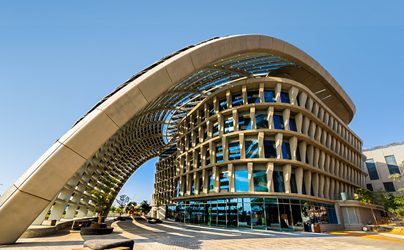
Abu Dhabi-based sovereign wealth fund Mubadala Investment Company and local developer Aldar have completed the acquisition of Masdar City Square at Masdar City, in a transaction valued at AED918m ($250m).
The deal was executed through their joint venture established in 2024.
Masdar City Square comprises more than 47,000 square metres (sq m) of net leasable area across seven office buildings.
Completed in Q1 2026, the development is 99% occupied. Tenants include Taqa, the Department of Energy, Emirates College and the Mohamed Bin Zayed University of Artificial Intelligence.
The transaction expands the joint venture’s real estate portfolio in Masdar City, which is now valued at AED4.7bn ($1.3bn).
Masdar City is one of the region’s leading hubs for clean energy, artificial intelligence, advanced research and sustainable urban development.
The joint venture acquired The Link project at Masdar City for AED654m ($178m) in April.
Comprising about 32,000 sq m of net leasable area across five buildings, The Link is fully leased to a portfolio of major tenants, including Abu Dhabi Future Energy Company (Masdar) and the Mohamed Bin Zayed University of Artificial Intelligence.
The asset includes Grade A, Leed Platinum office space, a net-zero-energy headquarters building, a multi-use hall and residential accommodation, supporting its position as a high-performing, integrated component of Masdar City.
https://image.digitalinsightresearch.in/uploads/NewsArticle/19748241/main5814.png -
Neom tenders Oxagon highway contract
17 September 2026
Saudi Arabia’s Neom has tendered a design-and-build contract covering permanent upgrade works on Highway 55 in the kingdom’s Oxagon region.
The first phase of the project includes constructing 14 kilometres of road, with two lanes in each direction. It also covers one bridge and three interchanges.
The project duration is 22 months.
Contractors have been given until 21 September to submit their proposals.
Highway 55 connects the Red Sea coast with the mainland in northwestern Saudi Arabia. It is currently the only road providing north-south connectivity between Duba and the Neom region.
MEED exclusively reported in August 2025 that contractors had submitted responses to the expressions of interest notice that Neom had issued earlier that month.
The project is expected to support the movement of cargo vehicles from Duba Port to other parts of the country and the wider region.
Neom tested a pilot initiative last year by handling a shipment that travelled from Cairo via the Port of Safaga, across the Red Sea to the Port of Neom, and then inland to Erbil, Iraq.
In a statement, Neom said: “The shipment travelled through an intermodal corridor spanning over 900 kilometres, marking a significant milestone in the kingdom’s transformation into a regional and global logistics hub.”
The Port of Neom is located on the Red Sea near the Arar border, a key entry point into Iraq.
READ THE SEPTEMBER 2026 MEED BUSINESS REVIEW – click here to view PDFNuclear power ambitions gather pace; Kuwait keeps dealmaking alive despite war; Region invests in raising gas processing capacity.
Distributed to senior decision-makers in the region and around the world, the September 2026 edition of MEED Business Review includes:
> AGENDA: Gulf nuclear revival takes shape> MARKET FOCUS: Kuwait keeps dealmaking alive under fire> INDUSTRY REPORT: Gas processing takes centre stage in Mena regionTo see previous issues of MEED Business Review, please click herehttps://image.digitalinsightresearch.in/uploads/NewsArticle/19746896/main.gif