
Oman prepares for wave of IPP awards
3 December 2025

Contract activity in Oman’s power sector slowed in 2025, yet the sultanate is entering the new year with its diversification plans advancing and procurement for independent power projects (IPPs) gathering pace.
In the renewables segment, progress continued in September with the award of the sultanate’s fourth large-scale solar IPP. The 500MW Ibri 3 solar IPP was awarded to a consortium of Abu Dhabi Future Energy Company (Masdar), Korea Midland Power and local firms Al-Khadra Partners and OQ Alternative Energy.
The project also incorporates a 100MWh battery system, making it Oman’s first utility-scale solar-and-storage development.
Ibri 3 accounted for almost 60% of the power contract awards in 2025. While this reflects a quieter year for investment, it also highlights the transition taking place in the market, with attention shifting towards grid reinforcement and preparations for a series of IPPs expected to advance over the coming period.
The inauguration of the 500MW Manah 1 and Manah 2 solar IPPs earlier in the year added further capacity, building on the operational Ibri 2 plant, which came online in 2021.
Wind procurement also continues to advance. In November, Nama Power & Water Procurement Company (Nama PWP) signed a 20-year power purchase agreement with a joint venture of Singapore’s Sembcorp Utilities and OQ Alternative Energy for the Dhofar 2 wind IPP.
The 125MW plant is scheduled to begin operations in the third quarter of 2027 and will add capacity to the Dhofar Power System (DPS), where Oman’s first commercial wind farm, the 50MW Dhofar project, already operates.
In the DPS, peak demand is anticipated to grow by 5% a year, from 612MW in 2022 to 837MW in 2029. The Sadah wind IPP, which will add around 99MW to the system once operational, is expected to move forward in the coming months.
Overall, the direction of the sector remains aligned with national plans to increase renewable energy’s share of electricity generation to 30% by 2030 and expand steadily thereafter.
Oman’s renewable energy programme is expected to expand considerably by 2030, with about 4.5GW of solar IPPs and around 1GW of wind farms planned across multiple sites.
Increasing wind power
The wider wind programme includes the Duqm and Mahoot wind IPPs, which are moving forward and will have a combined generation capacity of more than 600MW. In October, Nama PWP issued a supervisory consultancy services tender for the Duqm project.
Several awards are expected in the near term. Jalan Bani Bu Ali, a wind IPP of about 100MW, and the 280MW Al-Kamil Wal Wafi solar photovoltaic IPP are among four IPPs currently under bid evaluation.
While Oman continues to scale up renewable capacity, the need for firm generation remains. Peak demand in Oman’s Main Interconnection System (MIS) is expected to grow at an average of 3.4% a year over the current planning period, reaching about 8,350MW in 2029, up from 6,628MW in 2022.
Demand in the MIS is likely to continue rising through the decade, supported by industrial growth, population increases and development in economic zones such as Duqm.
Nama PWP aims to meet this requirement with two major thermal schemes: the $1.53bn gas-fired Misfah IPP and the $753m Duqm IPP. The state offtaker has received three bids for the development and operation of the plants, which together will supply 2,400MW and are scheduled to begin delivering early power by April 2028.
Developing the grid
Similar to previous planning cycles, grid development remains a priority. In September, the GCC Interconnection Authority signed a $500m interim financing agreement with Sohar International Bank to support the development of the direct Oman-GCC electricity interconnection.
The project involves constructing a 400-kilovolt double-circuit line stretching approximately 530km between the Al-Sila station in the UAE and a new Ibra substation in Oman.
Once completed, the link will enhance regional power exchange capability, improve reserve margins and support the integration of intermittent renewable power.
These regional works complement domestic transmission upgrades, including the continued expansion of the Rabt North-South Interconnection. The first phase, completed in 2023, connected the MIS with the Duqm Power System.
Construction works are ongoing on the second phase, which is expected to reinforce the 400kV backbone southwards toward Dhofar.
New technologies are also emerging in Oman’s power programme. Ibri 3 represents the first deployment of utility-scale battery storage in the sultanate, setting a precedent for integrating storage with future renewable projects.
In parallel, Nama PWP and Oman Environmental Services Holding Company (Beah) are preparing to tender the main contract for a 100MW waste-to-energy (WTE) project in Barka.
Estimated to cost almost $1bn, the scheme would be Oman’s first major WTE facility and reflects broader efforts to embed circular-economy principles into the national infrastructure programme.
Water sector
The water sector recorded a solid year, with about $1bn in contract awards, although activity remained below 2024 levels.
In March, China National Electric Engineering Corporation (CNEEC) won the main contract for a $200m deep-sea desalination project, heading a list of smaller wastewater and transmission packages awarded across 2025.
Following the commissioning of the Barka 5 independent water project (IWP) and continued construction on the Ghubrah 3 IWP, planning attention has shifted to the next cycle of capacity.
The next major scheme expected to move forward is a $150m desalination plant in Dhofar, with a planned capacity of 22 million imperial gallons a day.
Rising water demand in Sharqiyah and Dhofar continues to guide long-term planning with more than $800m-worth of water transmission and treatment schemes set to be awarded in the near to medium terms.

Register for MEED's guest program now to access this article.
Exclusive from Meed
-
 Daewoo pulls out of Libya upstream tender
3 March 2026
-

-
 Saudi Arabia’s private sector picks up the baton
2 March 2026
-
 Algiers moves on new railway project
2 March 2026
-
 Saudi developer Acwa names new CEO
2 March 2026
All of this is only 1% of what MEED.com has to offer
Subscribe now and unlock all the 153,671 articles on MEED.com
- All the latest news, data, and market intelligence across MENA at your fingerprints
- First-hand updates and inside information on projects, clients and competitors that matter to you
- 20 years' archive of information, data, and news for you to access at your convenience
- Strategize to succeed and minimise risks with timely analysis of current and future market trends
Related Articles
-
Daewoo pulls out of Libya upstream tender
3 March 2026
South Korea’s Daewoo has pulled out of the tender process for Libya’s 6J North Gialo oil field development project, increasing uncertainty over its future, according to industry sources.
Daewoo had formed a partnership with Egypt’s Petrojet to participate in the tender process.
The only other company to submit a bid for the project was UK-based Petrofac, which filed for administration in October last year.
In September last year, MEED revealed that two bids had been submitted for the project and were under evaluation.
Contractors now believe that the client on the project, Libya’s Waha Oil Company, may cancel the existing tender and retender the project due to problems with the two bidders.
Waha is a joint venture of Libya’s National Oil Corporation (NOC), France’s TotalEnergies and US-based ConocoPhillips.
The 6J North Gialo field development project is part of a series of tenders that are collectively expected to be worth $1bn.
The three projects are:
- NC98
- Gialo 3
- 6J North Gialo
All three projects will develop Libyan reservoirs that have not yet been tapped.
The 6J North Gialo project was the first to be tendered and it is expected to be followed by NC98, with the Gialo 3 project likely to be tendered last.
Together, the projects are expected to double Waha’s production from about 300,000 barrels a day (b/d) of oil to 600,000 b/d. The Waha concession covers 13 million acres.
 https://image.digitalinsightresearch.in/uploads/NewsArticle/15836218/main.png
 -
Iraq oil field stops production due to Israel-Iran conflict
3 March 2026
The Shaikan field in northern Iraq’s semi-autonomous Kurdistan region has stopped production due to security concerns related to the US and Israel’s conflict with Iran.
The field is operated by London-listed Gulf Keystone Petroleum, which has said in a statement that it had “temporarily shut-in production operations and has taken measures to protect staff in light of the developing regional security environment”.
The company also said that it was closely monitoring the situation and would provide updates as appropriate.
Shaikan is one of Iraqi Kurdistan’s largest producing fields and produced more than 41,500 barrels a day in 2025.
The production stoppage at Shaikan comes days after gas production was halted at Iraqi Kurdistan’s Khor Mor field on 28 February.
UAE-based Dana Gas stopped supplying power plants from the field due to the “abnormal situation and war taking place in the area”, according to a joint statement from the Kurdistan region’s natural resources and electricity ministries.
The gas halt is expected to cut electricity generation capacity by 2,500-3,000MW, with authorities seeking alternative supply to limit the shortfall, the ministries said.
https://image.digitalinsightresearch.in/uploads/NewsArticle/15836217/main.png -
Saudi Arabia’s private sector picks up the baton
2 March 2026
Ten years of ambitious construction project launches ended on 25 January 2026, when the Olympic Council of Asia and the Saudi Olympic & Paralympic Committee released a joint statement saying that they had agreed to indefinitely postpone the 2029 Asian Winter Games. In early February, it was announced that Almaty in Kazakhstan will host the event.
The Trojena mountain resort at Neom in northwest Saudi Arabia was selected in 2022 as the venue for the games, and despite significant construction work on the project, rumours had been circulating throughout most of 2025 that the greenfield venue would not be ready by the 2029 deadline.
Project reprioritisation
Trojena is not the only project in the kingdom that has been subject to scrutiny. There have been reports of other projects, including The Line and the Mukaab, either being scaled back, delayed or put on hold as Riyadh reassesses its priorities. This has created an air of uncertainty over Saudi Arabia’s upcoming project pipeline.
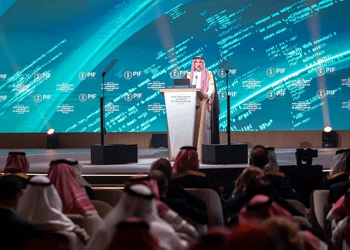
Speaking at the Private Sector Forum (PSF), held in Riyadh in early February, Khalid Al-Falih, then Saudi Arabia’s investment minister and now minister of state, said that much has changed since Vision 2030 was launched in 2016, and that this has naturally warranted a reprioritisation.
Al-Falih, who also sits on the Public Investment Fund’s (PIF’s) board of directors, said that with Saudi Arabia having been chosen to host football’s Fifa World Cup in 2034 and Expo 2030 Riyadh – and as the global economy is evolving rapidly with the rise of artificial intelligence (AI) – some projects such as The Line at Neom have slowed down. However, other projects related to the World Cup, Expo 2030, technology and AI have accelerated.
PIF strategy
In his speech at the PSF, Yasir Al-Rumayyan, governor of the PIF, also alluded to changing priorities and said that this is a pivotal moment for Saudi Arabia’s economy.
Launched in 2016, Saudi Arabia’s Vision 2030 is described as “a transformative and ambitious blueprint to unlock the potential of its people and create a diversified, innovative and world-leading nation”.
 The agency charged with delivering many of the objectives outlined in the strategy is the PIF. Established in 1971, it was moved from the Finance Ministry in 2015 to the Council of Economic & Development Affairs, where it was given a more active mandate. It then grew from a staff of about 50 in 2015 to almost 3,000 in 2024, according to the most recently published annual report.
Over the past 10 years, the PIF has helped drive the development of key sectors with direct capital spending on projects. The Red Sea Project and the Qiddiya entertainment city development aim to position the kingdom as a leisure tourism destination, while Roshn’s portfolio of residential communities has helped transform the housing market.
The PIF had $913bn of assets under management in 2024. Its activities are too varied to list, but they include developing the kingdom’s five official gigaprojects; holding investments in Saudi companies including Saudi Aramco and Maaden; owning stakes in electric vehicle manufacturers Lucid and Ceer, and gaming companies Nintendo and Electronic Arts; and owning UK Premier League football team Newcastle United.
In 2026, the role of the PIF is changing. Speaking at the PSF, Al-Rumayyan extended an invitation to the private sector to play a bigger role in achieving the kingdom’s economic ambitions.
“Today, in line with the objectives of the third phase of Saudi Vision 2030 and the PIF’s strategy for the coming five years, we are moving from building sectors to integrating ecosystems, and from launching opportunities to accelerating growth – through an open invitation to the private sector to invest and partner in shaping a diversified and resilient economy,” he said.
Having raised the bar, PIF officials say that sectors such as tourism and real estate are now ready for the private sector to take over. They describe sectors reaching what they call ‘escape velocity’, which is the point where a sufficient level of maturity has been reached for the private sector to come in and take the lead.
[In 2026, the PIF is] moving from building sectors to integrating ecosystems, and from launching opportunities to accelerating growth
Financial considerations
The decision to pass the baton to the private sector comes at a time when Saudi Arabia’s ability to finance all its project commitments directly has been questioned amid lower-than-desired oil prices.
Reflecting the constrained backdrop, the Ministry of Finance’s final budget statement for 2026 projects a deficit of SR165bn ($44bn), equivalent to about 3.3% of GDP.
The private sector has a tough act to follow. While the PIF has embarked on some of the world’s most ambitious projects in recent years, it has also introduced international standards that it hopes will lead to ways of doing business in Saudi Arabia that are more in tune with international best practices.
“The fund will continue to enable ecosystems and lay the foundations for growth. At the same time, the next phase requires a higher level of readiness and ambition from the private sector, alongside the ability to scale and innovate – a phase in which the role of the private sector evolves from execution to contributing to economic building and value creation,” Al-Rumayyan said.
Whether the private sector is ready to take over is the critical question in 2026.
According to PIF subsidiary development companies (devcos) that engage with private sector investors, the tide is turning. They say that five years ago, the appetite to invest was limited and devcos had to step in and deliver a greater proportion of project masterplans. As these investors complete their first projects, however, confidence is building.

Deals signed
This growing appetite could be seen at the PSF, where agreements were signed by private sector investors and devcos.
Rua Al-Madinah, which is responsible for Medina’s tourism and cultural development, signed a memorandum of understanding (MoU) with Indonesian sovereign wealth fund, Danantara Indonesia. It covers identifying and assessing investment opportunities in the Rua Al-Madinah and Dar Al-Hijrah projects.
King Salman International Airport Development Company signed several MoUs with local firms to develop mixed-use projects within its airport masterplan. The agreements were signed with Sumou Holding, Mohammed Al-Habib Investment, Kinan, Ajdan, Retal, Urjuan and Osus and comprise residential, commercial, retail, hospitality, entertainment and other related projects.
Roshn Group also signed an agreement with Kuwait’s Agility Logistics Parks to establish a joint venture that will develop a Grade A logistics hub.
In mid-February, two further deals were signed. PIF-backed Smart Accommodation for Residential Complexes Company (Sarcc) signed an agreement with Dammam-based Tamimi Global Company to develop a 4,000-bed worker accommodation project in North Riyadh. The development is expected to cost over SR1.5bn ($400m).
Sarcc also signed a separate agreement with Riyadh-based Mawref Company to develop another North Riyadh worker accommodation project. This deal involves building a 12,000-bed facility with a development cost of over SR669m ($178m).
The first phases of both projects are expected to be completed in 2029.
While momentum continues to build and deals are signed, some private sector players remain to be convinced. In the kingdom’s real estate sector, for example, recent amendments to legislation, which include a white land tax and a rent freeze, have created a level of uncertainty that some potential investors say makes it difficult to sign off on investment commitments.
Much will depend on the success of the deals already signed. If these agreements result in positive outcomes, then the fear of missing out will kick in and other private sector players will be keen to invest.
The risk is that, should deals turn sour and fail to produce the expected results, then attracting future investments from the private sector will be challenging.
Main image: Yasir Al-Rumayyan, governor of the PIF, inaugurates the PSF 2026. Credit: Saudi Press Agency
https://image.digitalinsightresearch.in/uploads/NewsArticle/15827282/main.gif -
Algiers moves on new railway project
2 March 2026
Algeria’s state railway company Agence Nationale d’Etudes et de Suivi de la Realisation des Investissements Ferroviaires (Anesrif) has formally started the procurement process for its multibillion-dollar Laghouat-Ghardaia-El-Meniaa railway project.
International and local firms have been given until 8 March to submit expressions of interest for the overall client’s engineer role on the 495-kilometre-long railway development.
Consultancies have also been given until 12 March for two separate contracts covering the project supervision and control of the first 265km-long element between Laghouat and Ghardaia, and the 230km-long line between Ghardaia and El-Meniaa.
This Laghouat-Ghardaia section, which is estimated to cost about $1.4bn, will comprise 21 viaducts, one tunnel, 55 pipe crossings and five stations.
The 230km-long Ghardaia to El-Meniaa second section will start at Metlili station and extend south to El-Meniaa. It will comprise six viaducts, 35 railway structures and three stations, and have an estimated total construction cost of about $1.2bn.
The speed of passenger trains on the railway will be 220 kilometres an hour (km/h) and 100km/h for freight trains.
The solicitations of interest for the construction of the two sections were originally scheduled for February, but to date have not been released.
READ MORE: Algeria prepares 495km railway construction tender
https://image.digitalinsightresearch.in/uploads/NewsArticle/15826676/main.gif -
Saudi developer Acwa names new CEO
2 March 2026
Saudi Arabia’s Acwa has appointed Samir J Serhan as CEO, effective 1 March 2026.
Serhan joined Acwa, formerly Acwa Power, last year as president for Saudi Arabia and the Middle East. He previously served as chief operating officer of US-based Air Products, where he had global responsibility for operational business and project execution across the Americas, Asia, Europe, Africa, the Middle East and India.
Earlier in his career, he was president of hydrogen at Praxair and held senior leadership roles at Linde Group in the US and Germany, including managing director of Linde Engineering.
Outgoing CEO Marco Arcelli will remain as an adviser to the chairman to ensure continuity.
Arcelli said: “Over the past three years, Acwa’s portfolio has doubled in size, and we are on track to double it again by 2030, scaling both our footprint and our impact. Acwa now produces around 25% of the world’s desalinated seawater.”
He added: “We have expanded into new markets, including Azerbaijan, China, Kuwait and Senegal, while advancing energy export opportunities from Saudi Arabia.”
Acwa recently extended its lead at the top of the GCC Water Developer Ranking, adding 265,925 cubic metres a day (cm/d) in net capacity from new contract awards in 2025.
The biggest of these involves a contract to develop the Ras Mohaisen independent water plant, awarded by the Saudi Arabian state offtaker Sharakat, formerly Saudi Water Partnership Company.
The project is located on the kingdom’s Red Sea coast and will have the capacity to treat 300,000 cm/d of seawater using reverse osmosis technology.
MEED reported last September that Acwa’s net power generation capacity in the GCC was 28.1GW, with the company holding more equity than the rest of the region’s top 10 private power developers combined.
https://image.digitalinsightresearch.in/uploads/NewsArticle/15823921/main.jpg