
Middle East banks embrace ESG strategies
27 February 2023
Financial institutions in the Middle East and North Africa (Mena) are scaling up environmental, social and governance (ESG) principles in their business models, according to insights from US-based consultancy Arthur D. Little.
This is evidenced by a growing number of banks moving from defining ESG strategies towards implementation.
The region recorded $24.55bn worth of green and sustainable finance issuances in 2021, a 532 per cent year-on-year increase compared to $3.8bn raised in 2020.
Notable transactions included a $3bn green loan issued by Egypt; Etihad Airways raising $1.2bn through a sustainability-linked loan in October; and a $100m revolving green loan signed by Masdar in December.
The tail end of 2022 saw $1.25bn raised by retail conglomerate Majid al-Futtaim (MAF). Led by First Abu Dhabi Bank, the revolving credit facility is linked to MAF's ESG goals, such as reducing scope 1 and 2 emissions; implementing LEED certification for its buildings; and improving gender diversity.
Meanwhile, at the outset of 2023, Qatar said that it was eyeing $75bn worth of investments in sustainable finance.
Institutions, however, find that the complexity of ESG data has not been entirely captured and addressed by current data governance frameworks, leaving these banks to resort to ad hoc solutions for collecting, managing and governing ESG data.
"Banks in the Middle East have embraced the importance of a well-defined ESG strategy," says Nael Amin, senior manager, financial services practice at Arthur D. Little.
"During the next step, implementation and frameworks such as data governance are vitally necessary. The shift from strategy to implementation is complex and detail-oriented. Different use cases of ESG have different data requirements and multiple stakeholders who add to the complexity. Thus, there is no standard “one size fits all” in regard to ESG data.”
1. Dynamic ESG data requirements
2. Lack of data availability and transparency
3. Inconsistent data quality
Related reads:

Register for MEED's guest program now to access this article.
Exclusive from Meed
-
-
 Momentum builds for Syrian projects
25 May 2026
-
 Alec confirms Sphere Abu Dhabi contract award
25 May 2026
-
 Expo Riyadh tenders Saudi Arabia pavilion
22 May 2026
-
 Consultant wins Jeddah metro design
22 May 2026
All of this is only 1% of what MEED.com has to offer
Subscribe now and unlock all the 153,671 articles on MEED.com
- All the latest news, data, and market intelligence across MENA at your fingerprints
- First-hand updates and inside information on projects, clients and competitors that matter to you
- 20 years' archive of information, data, and news for you to access at your convenience
- Strategize to succeed and minimise risks with timely analysis of current and future market trends

Related Articles
-
Egypt prepares to tender five water treatment plants
25 May 2026
Egypt is preparing to tender five seawater desalination and industrial wastewater treatment plants under its public-private partnership (PPP) programme.
The projects will be offered to local and international investors through competitive PPP tenders, Atter Hannoura, head of the PPP unit at the Finance Ministry, has told a local Arabic news channel.
The first of these involves a plant in the Suez Canal Economic Zone, which will be launched “immediately after the Eid Al-Adha holiday”, Hannoura said.
In January 2025, MEED exclusively reported that SCZone Istithmar had invited interested firms to prequalify to bid for a contract to develop a seawater desalination plant in the Suez Canal Economic Zone.
SCZOne Istithmar is wholly owned by the General Authority for Suez Canal Economic Zone.
The Finance Ministry’s PPP Central Unit, along with the European Bank for Reconstruction & Development, is supporting SCZone Isthithmar in the project’s tender proceedings.
The opportunity entails a long-term water-purchase agreement to design, finance, build, operate, maintain and transfer the plant’s ownership.
It was previously reported that this planned seawater desalination plant will have a capacity of 250,000 cubic metres a day (cm/d).
Hannoura added that the government is in negotiations with several companies, including Saudi Arabia-based Acwa, regarding large-scale desalination projects.
Additionally, the government plans to tender four industrial wastewater treatment plants, with the first two projects expected to be launched “within 45 days”.
One of these will be located in the Amreya industrial area in Alexandria, while the other will be in the Abu Rawash area in Giza, Hannoura said. Details of the other projects were not disclosed.
Alexandria wastewater treatment plant
The Authority for Potable Water and Wastewater is planning to build a wastewater treatment plant in eastern Alexandria.
The $150m facility will have a water treatment capacity of 300,000 cm/d.
In June 2025, Egypt’s government approved a financing and grant agreement for the project, with financing from the French Development Agency amounting to €68m and a grant of €2m.
Expression of interest documents were previously submitted in September 2024.
The main contract for this plant had been expected to be released in June.
Wastewater upgrades
Separately, the Construction Authority for Potable Water & Wastewater retendered the phase four expansion of the Abu Rawash wastewater treatment plant in Giza Governorate in January.
The $157m scheme will be developed under a design, build, operate and maintain contract.
The plant will have a treatment capacity of 400,000 cm/d, rising to peak flows of 520,000 cm/d. The authority issued the initial main contract tender last August.
It is unconfirmed whether this has moved beyond the bidding stage.
Egypt currently produces between 1.5 million cm/d and 2 million cm/d of desalinated water. The country aims to increase capacity to between 8 million cm/d and 9 million cm/d by 2050.
In March, Egypt’s cabinet approved a $1.2m grant agreement with the European Investment Bank to support wastewater treatment upgrades in Alexandria and Damietta.
Part of the funding will support plans to expand the Hanovil wastewater treatment plant in Alexandria Governorate.
The project will add 50,000 cm/d of treatment capacity in two phases within the plant’s existing footprint. Once completed, the facility will reach a total capacity of 100,000 cm/d.
The grant will also support expansion works at the Kafr El-Battikh wastewater treatment plant in Damietta Governorate.
The facility currently receives more than 7,000 cm/d of wastewater, while its treatment capacity is 3,000 cm/d.
 https://image.digitalinsightresearch.in/uploads/NewsArticle/16980726/main.jpg
 -
Momentum builds for Syrian projects
25 May 2026

Support from the US, as well as the closure of the Strait of Hormuz, has increased expectations about the development of infrastructure projects in Syria.
On 22 May, the US published guides to investing in Syria, funded by the US Department of State, that pointed investors towards 590 planned projects in the country.
The permanent removal of US sanctions in December last year, combined with fallout from the closure and disruption to shipping through the Strait of Hormuz, has boosted interest in planned projects in the country.
Shipping through the Strait of Hormuz has been disrupted since the US and Israel attacked Iran on 28 February.
The route normally transports about 11 million barrels a day of oil and around 20% of the world’s liquefied natural gas, as well as a range of other key materials and consumer goods.
The disruption to shipping through the strait has left nations in the Middle East scrambling to find new routes for imports and exports – and Syria plays a role in many of these new plans.
This has bolstered the country’s plans to become a regional trade hub.
Energy corridors
Already, Iraq is moving a large volume of oil by truck across the country to export it from Syria’s Mediterranean ports, such as Latakia or Tartous.
In April, Iraq’s state-owned oil marketing company, Somo, said it had awarded contracts to supply about 650,000 metric tonnes of fuel oil per month for overland trucking across Syria.
On top of this, Iraq is currently looking into reestablishing a pipeline route that transported oil from Kirkuk to the port of Baniyas in Syria.
The pipeline originally went into operation in April 1952.
During the 2003 invasion of Iraq, the pipeline was damaged by US air strikes and has remained out of operation since then.
There have been repeated attempts to either refurbish the existing pipeline or build a new one along the same route, but none has been successful.
In December 2007, Syria and Iraq agreed to rehabilitate the pipeline. The pipeline was to be reconstructed by Stroytransgaz, a subsidiary of Russia’s Gazprom.
However, Stroytransgaz failed to start the rehabilitation, and the contract was nullified in April 2009.
The disruption to shipping through the Strait of Hormuz has added a new urgency to the project to reestablish pipeline flows from Iraq to Baniyas.
Syria could also play a role in plans for a pipeline to transport gas from Qatar to Europe via Syria and Turkiye.
The country could additionally form part of plans to rehabilitate and expand the Arab Gas Pipeline.
The pipeline connects Egypt, Jordan, Syria and Lebanon, although the Lebanese section is not currently operational.
Trade routes
Beyond oil and gas, Syria is emerging as a key part of other plans for new trade routes.
Earlier this month, Syria’s Transport Minister Yarub Badr said the country was seeking to restore its role as a regional transit corridor linking Europe and the Gulf by reviving cross-border trucking and rehabilitating railway connections with neighbouring countries.
He said the overland corridor between the Turkish and Jordanian borders handled between 100,000 and 115,000 trucks annually in both directions before 2011. Freight rail services also operated between Tartous port and Iraq’s Umm Qasr port via Baghdad in 2009, he added.
He said Syria was coordinating with Turkiye, Jordan and Saudi Arabia to simplify customs and border-crossing procedures and facilitate freight movement.
Railway rehabilitation is expected to take longer due to extensive infrastructure damage and the suspension of cross-border rail links over the past decade.
Badr said Syria is working with the World Bank to secure grants ranging between $65m and $200m to support railway rehabilitation and restore Syria’s role as a regional transit route linking Turkiye, Syria, Jordan and Iraq.
Earlier this month, Syria’s state-owned railway company, the General Establishment for Syrian Railways, and the operator of Syria’s Latakia International Container Terminal signed a memorandum of understanding to coordinate container traffic between the Mediterranean port of Latakia and inland freight hubs.
The framework covers feasibility studies for moving containers by rail from Latakia to dry ports in Adra, Hasiya and Aleppo.
The feasibility studies are expected to take four months to complete.
Tartous port
Also this month, executives from the UAE’s DP World and Syria’s General Authority for Borders and Customs (GABC) met to discuss accelerating the development of Syria’s Port of Tartous.
Essa Kazim, chairman of DP World, met with Qutaiba Ahmed Badawi, chairman of GABC, to discuss opportunities to enhance infrastructure and logistics efficiency, ensuring the Port of Tartous is well-equipped to handle the anticipated rise in trade and cargo volume.
DP World’s plans to develop the Port of Tartous form part of a 30-year concession agreement signed in July 2025 with the Syrian government.
Under the agreement, DP World committed to invest $800m to upgrade infrastructure, expand capacity, and introduce modern cargo-handling and advanced digital systems.
DP World has said that, by fast-tracking the development of the Port of Tartous, it aims to boost its operational efficiency and capacity to handle diverse cargo types, including general cargo, containers, breakbulk and roll-on/roll-off traffic.
Rizwan Soomar, DP World’s chief executive and managing director for Central Asia, the Levant and Egypt, said: “The Port of Tartous development marks a defining moment in Syria’s journey of economic recovery and modernisation of its trade infrastructure. We are proud to contribute to this vital phase of growth.”
Located on Syria’s Mediterranean coast, the Port of Tartus is the country’s second-largest port and a key maritime gateway to trade routes across Europe, the Levant and North Africa.
Beyond the port itself, DP World is exploring other opportunities to develop infrastructure in Syria with local stakeholders. These include logistics zones, inland freight hubs and transit corridors.
US interest
US-based companies are also showing significant interest in participating in new projects in the country.
On 19 May, a delegation from the Houston-headquartered engineering company KBR travelled to Damascus to discuss road networks and infrastructure projects in Syria.
During one meeting, Syria’s transport minister outlined strategic projects currently underway, including north-south and east-west corridor projects, the Damascus-Aleppo highway and railway initiatives.
Badr said that companies were needed to update economic and technical studies for some projects.
While Syria and the US both have bold ambitions to expand Syria into a regional trade and logistics hub, the poor state of the country’s infrastructure is likely to be a key challenge.
It is likely that billions of dollars will need to be invested to rehabilitate the country so that its capacity to transport goods returns to levels seen prior to the civil war that began in March 2011.
https://image.digitalinsightresearch.in/uploads/NewsArticle/16975219/main.jpg -
Alec confirms Sphere Abu Dhabi contract award
25 May 2026
Alec Holdings has confirmed that its subsidiary Alec Engineering & Contracting has received a letter of award for the construction contract for the $1.7bn Sphere Abu Dhabi project.
MEED had previously reported that Alec was the selected contractor and had been working on the project during the pre-construction phase. The construction is due to be completed in the third quarter of the financial year 2029.
Abu Dhabi’s Department of Culture & Tourism (DCT Abu Dhabi) and US-based Sphere Entertainment announced earlier in May that they have selected Yas Island as the location for the project.
The venue will be built on a plot between Yas Mall and SeaWorld Abu Dhabi, close to Yas Island’s theme parks and attractions. The project will be the first Sphere venue outside the US. It is expected to echo the scale of Sphere Las Vegas, with a capacity of up to 20,000 depending on configuration.
DCT and Sphere Entertainment finalised an agreement last year for the construction, development and operation of the Sphere entertainment venue in Abu Dhabi. According to the agreement, Sphere Entertainment granted DCT the exclusive rights to build and operate the Sphere Abu Dhabi entertainment venue.
> Be recognised among the best in the industry at the MEED Projects Awards 2026 …
 https://image.digitalinsightresearch.in/uploads/NewsArticle/16973522/main.jpg
 -
Expo Riyadh tenders Saudi Arabia pavilion
22 May 2026
Expo 2030 Riyadh Company (ERC), tasked with delivering the Expo 2030 Riyadh venue, has tendered a contract to build the Saudi Arabia pavilion at the site.
The tender was issued on 19 May, with a bid submission deadline of 26 August.
The pavilion is a major asset located within the KSA District on the eastern side of the Expo 2030 Riyadh masterplan, within the Loop of Nations district.
The tendering of the pavilion structure follows swift progress on the site’s infrastructure development works.
In April, ERC awarded two contracts for the next phase of infrastructure works at the site to local firm Al-Yamama Company.
The scope covers the construction of road networks and infrastructure for water, sewage, electricity, telecommunications and electric vehicle charging.
These awards followed ERC’s January award of an estimated SR1bn ($267m) contract for initial infrastructure works at the site to local firm Nesma & Partners. That scope covers about 50 kilometres of integrated infrastructure networks, including internal roads and essential utilities such as water, sewage, electrical and communication systems, and electric vehicle charging stations.
The overall infrastructure works – covering the construction of main utilities and civil works at Expo 2030 Riyadh – are split into three packages:
- Lot 1 covers the main utilities corridor
- Lot 2 includes the northern cluster of the nature corridor
- Lot 3 comprises the southern cluster of the nature corridor
The masterplan encompasses an area of 6 square kilometres, making it one of the largest sites designated for a World Expo event. Situated to the north of the Saudi capital, the site will be located near the future King Salman International airport, and will provide direct access to various landmarks within Riyadh.
The Public Investment Fund (PIF), Saudi Arabia’s sovereign wealth fund, launched ERC – a wholly owned subsidiary – in June last year to build and operate facilities for Expo 2030.
MEED’s April 2026 report on Saudi Arabia includes:
> COMMENT: Risk accelerates Saudi spending shift
> GVT &: ECONOMY: Riyadh navigates a changed landscape
> BANKING: Testing times for Saudi banks
> UPSTREAM: Offshore oil and gas projects to dominate Aramco capex in 2026
> DOWNSTREAM: Saudi downstream projects market enters lean period
> POWER: Wind power gathers pace in Saudi Arabia
> WATER: Sharakat plan signals next phase of Saudi water expansion
> CONSTRUCTION: Saudi construction enters a period of strategic readjustment
> TRANSPORT: Rail expansion powers Saudi Arabia’s infrastructure pushTo see previous issues of MEED Business Review, please click herehttps://image.digitalinsightresearch.in/uploads/NewsArticle/16949696/main.jpg -
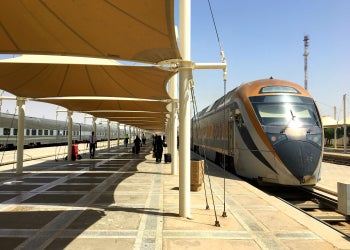
Consultant wins Jeddah metro design
22 May 2026
French engineering firm Egis has been appointed to undertake the preliminary design consultancy for the Jeddah Metro Blue Line project.
The project client, Jeddah Development Authority, issued the tender in early January, when MEED exclusively reported that Saudi Arabia had restarted plans to build the Jeddah Metro.
Engineering consulting firms submitted bids in April, as MEED reported.
The Blue Line will run from King Abdulaziz International airport and connect to the Haramain high-speed railway station.
The line will be 35 kilometres (km) long and will include 15 stations.
Project history
Plans for the Jeddah Metro were first publicly floated in the early 2010s and were formally packaged into a wider Jeddah public transport programme around 2013-14.
In 2014, French engineering firm Systra was appointed to complete preliminary engineering for the Jeddah Metro, as MEED reported at the time.
In the same year, US-based engineering firm Aecom was awarded a SR276m ($74m) contract to provide pre-programme management consultancy services.
Under its 18-month contract, Aecom was expected to provide staff to support preliminary planning and design work for various phases of the metro project.
This was followed by the appointment of UK-based architectural firm Foster + Partners in 2015 to design the metro stations.
The project then stalled as government spending priorities were reset and major capital programmes were reviewed following the fall in oil prices in 2015, with the metro’s scope, cost and delivery model coming under reassessment.
Early concept designs envisaged a multi-line network integrated with buses and, later, other city-wide mobility upgrades.
Route details
According to Jeddah Transport Company’s website, the scheme comprises 81 stations and 197 trains serving more than 161km. The network will have four lines:
- Orange Line: a 44.8km line running along Al-Madinah Road and Old Makkah Road, with 29 stops including one at Obhur Bridge
- Blue Line: a 35km line running from King Abdulaziz International airport to the Haramain high-speed railway station, with 15 stations
- Green Line: a 17km line running through the city centre, from the downtown area to the Haramain railway station, with nine stops
- Red Line: A 59.7km line running from King Abdullah Stadium north to Old Makkah Street through King Abdulaziz Road and King Abdullah Road, with 25 stops
> Be recognised among the best in the industry at the MEED Projects Awards 2026 …
https://image.digitalinsightresearch.in/uploads/NewsArticle/16949416/main.jpg