
Libya oil project shut down after just days of operation
27 March 2025
The new early production facility (EPF) at Libya’s North Hamada field was brought online for several days in early January before being shut down, according to industry sources.
It is unclear exactly why the facility was taken offline.
One source said: “Installation and commissioning was completed in early January this year and the project was brought online, only to be taken offline after a couple of days of operation.
“Everything worked perfectly and the producing wells produced oil. The pipeline was connected. There were no problems from a technical perspective.”
Industry sources believe it could be brought back online sometime in the next few months.
Last year, Nafusah Oil Operations, a joint-operating company formed by Libya’s state-owned National Oil Company (NOC) and Indonesia’s PT Medco Energi, was under a lot of pressure from NOC to bring the project online quickly, according to industry sources.
NOC was putting pressure on Nafusah to bring the project online before September 2024, a target that was missed by several months.
The project experienced significant delays before the September deadline was set by NOC.
Once the EPF is reconnected and operational for an extended period, it will lead to the first commercial oil production from the field, which is located in exploration area 47 in the Ghadames basin.
On 28 August 2023, Nafusah Oil Operations began test production of 1,500-2,000 barrels a day (b/d) from the well, which was initially drilled in late 2021.
The EPF development project has an estimated investment value of about $60m-$70m and Nafusah is targeting oil production of 10,000 b/d via the facility.
Under the contract model being used, Nafusah does not need to pay high upfront fees for the development project.
According to the original plans, it was to lease the EPF facilities from SLB for 36 months, after which ownership would be transferred to Nafusah.
When operational, the EPF units will separate produced crude oil from water and gasses.
In January 2024, Schlumberger SLB announced the contract award for the North Hamada field in its full-year earnings report.
It said that the contract used its “Production Express rapid production response solutions” and the project will be capable of processing up to 10,000 barrels of fluid a day.
It also said that the contract was “a three-year contract for the engineering, procurement and commissioning (EPC), as well as startup and operations of an early production facility … located in North Hamada area 47”.
It added: “The Production Express design is a fit-for-purpose mobile and efficient solution that will allow Nafusah to acquire additional reservoir information and fast-track hydrocarbon production with a reduced [capital expenditure] over the additional EPC project’s design while preserving cash flow and continuous well deliverability.”

Register for MEED's guest program now to access this article.
Exclusive from Meed
-
 Dubai awards $15bn Al-Maktoum airport contracts
26 November 2026
-
 Contractors submit Mecca residential tower bids
26 November 2026
-
 Contractor wins Dubai’s Eden House Zabeel tower
26 November 2026
-
 Libya oil licensing rounds to be launched in 2027 and 2028
26 November 2026
-
 Aramco inaugurates $7bn South Korea petrochemicals project
25 November 2026
All of this is only 1% of what MEED.com has to offer
Subscribe now and unlock all the 153,671 articles on MEED.com
- All the latest news, data, and market intelligence across MENA at your fingerprints
- First-hand updates and inside information on projects, clients and competitors that matter to you
- 20 years' archive of information, data, and news for you to access at your convenience
- Strategize to succeed and minimise risks with timely analysis of current and future market trends
Related Articles
-
Dubai awards $15bn Al-Maktoum airport contracts
26 November 2026
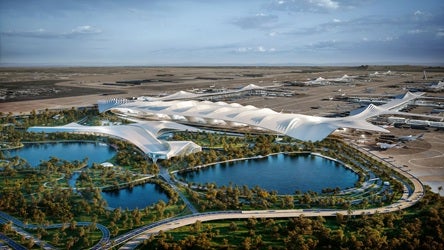
Dubai has announced contract awards worth over AED56.5bn ($15bn) for several packages under the first phase of the $35bn expansion of Al-Maktoum International airport.
In a social media post published on X, the Dubai Media Office said that the latest awards bring the total value of contracts awarded for the project to over AED80bn.
“A team of 14,000 people is working on the project. Once fully completed, Al-Maktoum International airport will have the capacity to handle more than 260 million passengers annually,” the statement added.
Hamdan bin Mohammed: Under the directives of His Highness Sheikh Mohammed bin Rashid Al Maktoum, today we announce the award of new contracts worth AED 56.5 billion for the development of Al Maktoum International Airport, bringing the total value of contracts awarded for this strategic project to more than AED 80 billion. The award of these contracts marks a new phase in the development of the world’s largest and best airport. A team of 14,000 people is working on the project. Once fully completed, Al Maktoum International Airport will have the capacity to handle more than 260 million passengers annually, reinforcing Dubai’s position as a leading global aviation gateway and one of the world’s most sought-after destinations.
— Dubai Media Office (@DXBMediaOffice) November 26, 2026
In June 2026, DAEP confirmed plans to award construction deals worth over AED55bn for the hub by year-end.
MEED previously reported that Dubai-based Binladin Contracting Group has begun mobilising for the substructure works covering the West Terminal and Concourse 1.
For the remaining concourses, DAEP recently selected a joint venture of UK-headquartered Innovo Group and China Harbour Engineering Company for superstructure works on concourses two and three, while a consortium of China Civil Engineering Construction Corporation and Abu Dhabi-based Tristar Engineering & Construction was appointed for substructure works on Concourse 4.
The client is also executing airside and transit infrastructure. In July, MEED exclusively reported that DAEP awarded a contract to a joint venture of Japan’s Mitsubishi Corporation and India’s Larsen & Toubro to deliver the automated people mover system. The subterranean network will feature four stations in its initial phase, expanding to 14 stations across the full masterplan.
The awards follow formal approval in April 2024 of updated masterplans designed by lead consultants Coop Himmelb(l)au and Dar Al-Handasah.
The airport’s construction is planned in three phases. Once complete, the airport will cover 70 square kilometres south of Dubai and include five parallel runways and 430 aircraft gates.
It will be five times the size of Dubai International airport and is planned to have a passenger-handling capacity of 260 million passengers a year – the largest in the world. For cargo, it is planned to have the capacity to handle 12 million tonnes a year.
https://image.digitalinsightresearch.in/uploads/NewsArticle/21854532/main.jpg -
Contractors submit Mecca residential tower bids
26 November 2026

Contractors have submitted bids for the main construction package for the Ajyad residential tower, a 365-metre high-rise development in Mecca’s central area near the Grand Mosque.
Rua Al-Haram Al-Makki tendered the contract in July, with an initial bid submission deadline of 30 September, which was later extended to mid-November, as MEED reported.
The project team includes US-based Marriott International as residential operator, Hanmi Global Saudi as project management consultant, Saudi Diyar Consultants as construction supervision consultant, and PLP Architecture as lead design consultant and construction-stage design guardian.
The tower will rise 84 floors with four basement levels. It will comprise 212 units, including 82 three-bedroom apartments, 85 four-bedroom units, 29 penthouses and 16 duplex villas.
The scheme has a gross floor area of 209,231 square metres (sq m) and a built-up area of 242,976 sq m.
A demolition contractor is currently clearing the site, with the existing mat foundation and retaining walls to be handed over to the main contractor, who will build the new superstructure on the retained raft.
Rua Al-Haram Al-Makki Company was established in October 2017 and is a wholly owned subsidiary of the Saudi sovereign wealth vehicle, the Public Investment Fund.
 READ THE NOVEMBER 2026 MEED BUSINESS REVIEW – click here to view PDF
Gulf projects keep moving amid conflict; UAE's state spending and oil output flexibility cushion Iran war shock; Project finance lenders weigh risk against infrastructure needs.
Distributed to senior decision-makers in the region and around the world, the November 2026 edition of MEED Business Review includes:
> AGENDA: GCC projects market holds its nerve> MARKET FOCUS: UAE economy shows resilience> INDUSTRY REPORT: Project financiers hold the line> STADIUMS: Stadium spending set to jump 39% in 2027> CONFLICT: Hormuz closure wipes out growth in 2026> INTERVIEW: WSP regional president Dean McGrail> INTERVIEW: Ministry of Energy & InfrastructureTo see previous issues of MEED Business Review, please click herehttps://image.digitalinsightresearch.in/uploads/NewsArticle/21845812/main.jpg -
Contractor wins Dubai’s Eden House Zabeel tower
26 November 2026
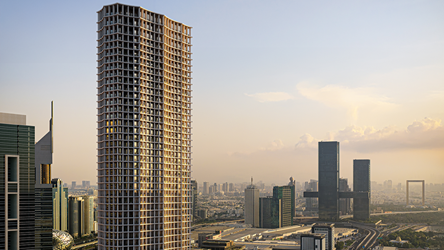
Dubai Contracting Company has been appointed as the main contractor for the Eden House Zabeel project in the Dubai International Financial Centre (DIFC) area.
The scope covers construction of a 45-storey mixed-use tower comprising three basements, a ground floor, 45 upper floors and a roof level. The development will contain 242 units, including one- to three-bedroom apartments and two penthouses.
Local firm Fay Developments is the project developer, with H&H Investment and Development acting as the development manager.
Another local firm, DXB Lab Architecture, is the design architect, and Lebanese firm Erga Progress is the project consultant.
Local contractor Swissboring undertook the enabling works.
Earlier this year, Dubai announced a AED100bn ($27bn) expansion of DIFC through the creation of the DIFC Zabeel District.
A statement from the Government of Dubai Media Office said the new district will add more than 7 million square feet (sq ft), bringing total gross floor area to 17.7 million sq ft.
The Zabeel District is expected to more than double DIFC’s capacity to more than 42,000 businesses, support a workforce exceeding 125,000, and allocate more than 1 million sq ft for future technologies and artificial intelligence.
Planned in six phases, the expansion is scheduled to open to the public in 2030, with the masterplan due for completion in 2040.
A bridge will link the DIFC Zabeel District to the existing DIFC Gate District.
READ THE NOVEMBER 2026 MEED BUSINESS REVIEW – click here to view PDFGulf projects keep moving amid conflict; UAE's state spending and oil output flexibility cushion Iran war shock; Project finance lenders weigh risk against infrastructure needs.
Distributed to senior decision-makers in the region and around the world, the November 2026 edition of MEED Business Review includes:
> AGENDA: GCC projects market holds its nerve> MARKET FOCUS: UAE economy shows resilience> INDUSTRY REPORT: Project financiers hold the line> STADIUMS: Stadium spending set to jump 39% in 2027> CONFLICT: Hormuz closure wipes out growth in 2026> INTERVIEW: WSP regional president Dean McGrail> INTERVIEW: Ministry of Energy & InfrastructureTo see previous issues of MEED Business Review, please click herehttps://image.digitalinsightresearch.in/uploads/NewsArticle/21817603/main.png -
Libya oil licensing rounds to be launched in 2027 and 2028
26 November 2026
Libya is preparing to launch a public bidding round for discovered, undeveloped and marginal oil fields next year, according to Masoud Suleman, chairman of the National Oil Corporation (NOC).
This will be followed by a separate exploration bidding round set for early 2028, Suleman told a conference in Tripoli.
Suleman stated that NOC has entered into an agreement with US engineering firm KBR to draft an upstream production expansion plan. The state oil company has also hired US advisory firm K2 Integrity to carry out monitoring, auditing and gap analysis across NOC’s financial systems.
During the conference, NOC signed a memorandum of understanding (MoU) with Honeywell to collaborate on technical training, workforce development and industrial modernisation. A separate MoU was signed with US energy technology firm Baker Hughes, focusing on strategic training and project execution, coinciding with the opening of Baker Hughes’ new regional office in Tripoli.
On downstream infrastructure, Suleman said Libya is seeking approximately $5bn in phased investment to modernise the Zawiya and Ras Lanuf refineries. NOC is courting external investors while exploring self-financing options to upgrade facilities and reduce reliance on imported refined products. Libya currently imports around 80% of its fuel requirements.
Subject to securing capital, upgrading the Zawiya plant would allow it to meet roughly 70% of domestic gasoline demand within two to 2.5 years, Suleman said. He added that rehabilitation work is already underway at Ras Lanuf to lift domestic gasoline and diesel yields. By contrast, Libya has achieved self-sufficiency in liquefied petroleum gas (LPG) and aviation fuel, leaving surplus volumes available for export.
Beyond refining, NOC is targeting an increase in crude oil production to 2 million barrels a day, alongside raising natural gas output to 4 billion cubic feet a day (cf/d), from the current 2.5 billion cf/d.
Licensing rounds
Earlier this year, MEED reported that consultations with London-headquartered international oil companies (IOCs) were playing a key role in shaping plans for Libya’s next licensing round.
Representatives from Shell and BP travelled to Libya in September as part of a Libyan British Business Council delegation.
During the trip, the oil companies’ representatives met with officials from Libya’s NOC.
Masoud Suleman was formally appointed chairman in October last year, having served as acting head since January 2025. Shortly after his interim appointment, NOC announced the results of its previous licensing round – the country’s first in 17 years – awarding five of the 22 blocks on offer.
Amid the US and Israel’s ongoing conflict with Iran and the ongoing war between Russia and Ukraine, oil assets in North Africa have become increasingly appealing to IOCs.
Disruptions to oil and gas exports through the Strait of Hormuz have severely affected a range of countries, including Qatar, the UAE, Saudi Arabia, Iraq and Kuwait.
Some North African officials have promoted their oil and gas sectors as reliable alternative suppliers.
In August, Libya’s Oil and Gas Minister Khalifa Abdel Sadig told a conference in Norway that Libya could be a “key player in providing energy security solutions” to the European Union.
READ THE NOVEMBER 2026 MEED BUSINESS REVIEW – click here to view PDFGulf projects keep moving amid conflict; UAE's state spending and oil output flexibility cushion Iran war shock; Project finance lenders weigh risk against infrastructure needs.
Distributed to senior decision-makers in the region and around the world, the November 2026 edition of MEED Business Review includes:
> AGENDA: GCC projects market holds its nerve> MARKET FOCUS: UAE economy shows resilience> INDUSTRY REPORT: Project financiers hold the line> STADIUMS: Stadium spending set to jump 39% in 2027> CONFLICT: Hormuz closure wipes out growth in 2026> INTERVIEW: WSP regional president Dean McGrail> INTERVIEW: Ministry of Energy & InfrastructureTo see previous issues of MEED Business Review, please click herehttps://image.digitalinsightresearch.in/uploads/NewsArticle/21817509/main.jpg -
Aramco inaugurates $7bn South Korea petrochemicals project
25 November 2026
Register for MEED’s 14-day trial access
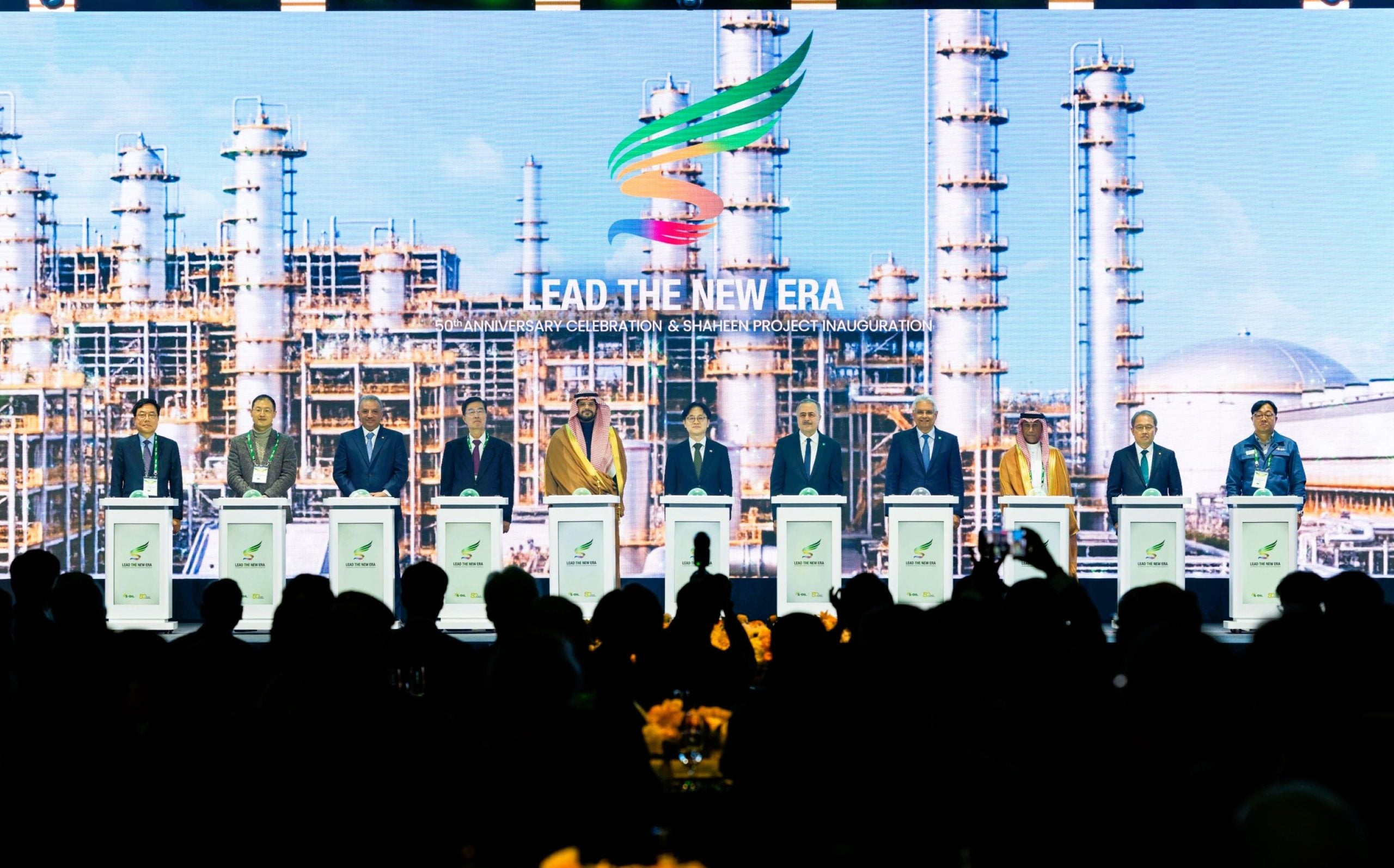
Saudi Aramco and subsidiary S-Oil have held an inauguration ceremony in Seoul to mark progress on the $7bn Shaheen integrated refinery and petrochemical development, the Saudi company’s largest capital investment in South Korea.
The Shaheen complex is engineered to add approximately 3.2 million tonnes a year of petrochemical production capacity for S-Oil. The expansion will more than double the share of petrochemicals in the refiner’s total output from 12% to 25% by volume, positioning the company as a major supplier of high-value polymers and advanced materials.
Aramco holds a 63.4% controlling interest in S-Oil on a non-diluted basis via its subsidiary, Aramco Downstream Asia. The remaining equity trades on the Korea Exchange.
Located in Ulsan, the Shaheen facilities will integrate directly with S-Oil’s existing refining and chemical units. Via dedicated pipeline links, the plant will supply basic petrochemical feedstocks to neighbouring producers across the broader Ulsan industrial cluster, lowering logistics overheads and cutting regional reliance on imported feedstocks.
Shaheen complex
Commercial operations are scheduled to begin in 2027 following completion of plant commissioning.
At the centre of the project is what Aramco describes as the world’s largest single steam cracker. Designed to run on mixed feedstocks, including refinery off-gas and naphtha, the cracker will produce ethylene alongside propylene, butadiene and other primary chemicals with higher thermal efficiency than conventional naphtha-only crackers.
Shaheen also marks the first commercial deployment of Aramco’s proprietary thermal crude-to-chemicals (TC2C) technology, developed jointly with US-based Lummus Technology. The process directly converts crude oil into chemicals without intermediate refining stages, lowering unit operating costs and carbon intensity per tonne of product. In addition to the mixed-feed cracker and TC2C unit, the site includes a propylene fractionator and polymer production lines.
Engineering, procurement and construction (EPC) commenced in 2023 following a March groundbreaking. A South Korean consortium led by Hyundai Engineering & Construction, alongside Hyundai Engineering Company and Lotte Engineering & Construction, is executing the main EPC contract. Aramco had previously targeted mechanical completion by 2026.
The 25 November event coincided with S-Oil’s 50th anniversary and marked 35 years of partnership between Aramco and the South Korean refiner, dating back to the state oil firm’s initial equity purchase in 1991.
A preliminary investment framework for Shaheen was formalised on 17 November 2022 during an official state visit to Seoul by Saudi Crown Prince and Prime Minister Mohammed bin Salman bin Abdulaziz Al-Saud, forming part of a broader $30bn package of bilateral commercial agreements. The $7bn project builds on a prior $4bn investment in S-Oil’s Phase 1 petrochemical expansion, completed in 2018.
https://image.digitalinsightresearch.in/uploads/NewsArticle/21814683/main.jpg