
Iraq leads non-GCC project finance activity
28 October 2025
This package also includes: Region sees evolving project finance demand

Iraq’s first airport public-private partnership (PPP) project is making steady progress, with bids submitted for the contract to redevelop the country’s main aviation hub, Baghdad International airport.
The project, which could cost up to $600m, involves rehabilitating, expanding, financing, operating and maintaining the airport and increasing its capacity to around 15 million passengers a year. It is emblematic of Iraq’s growing position in the PPP market in the wider Middle East and North Africa (Mena) region outside of the GCC, where the country now outpaces the likes of Egypt and Morocco.
Iraq’s Transport Ministry and General Company for Airport & Air Navigation Services released a tender for the airport project in July. In early October, bids were submitted for the scheme by three international consortiums.
The bidders were a UK/Turkish group of ERG International, Terminal Yapi and ERG Insaat; a Luxembourg/Iraq pairing of Corporacion America Airports and Amwaj International; and a larger consortium of five companies drawn from Saudi Arabia, Turkiye and Ireland, made up of Asyad Holding, Top International Engineering Corporation, Lamar Holding, YDA Insaat and Dublin Airport Authority.
The International Finance Corporation (IFC), part of the World Bank Group, signed an agreement with the Iraqi government in September 2023 to be the lead transaction adviser on the project – in what was its first PPP mandate in Iraq.
Prominent sectors and frameworks
Transport is one of the key sectors for project finance outside of the busy markets of the GCC, with $69bn-worth of schemes planned or under way across the 11 other countries of the region, according to regional project tracker MEED Projects.
 The only sector that sees more activity is power, with $120bn-worth of projects in total. Between them, the wider region’s power and transport sectors account for more than half of the total market of $332bn of projects and more than 60% of the schemes by number.
A few other areas have also been seeing significant amounts of activity, including the oil and gas sector with $57bn; chemicals projects, valued at $39bn; and construction, at $33bn. Most schemes are still in the planning rather than the execution phase, however, with around $118bn-worth of projects currently being built, or 36% of the total.
In geographic terms, Iraq is the most active market, with $117bn-worth of project finance schemes in the works. It is followed by Egypt with $79bn, Morocco with $39bn and Iran with $38bn.
Almost all countries have developed a project finance market of some description, although in the war-ravaged countries of Syria, Libya and Yemen the amount of activity is very limited.
By far the most popular model for project finance deals in the region is build-operate- transfer (BOT) contracts, which account for $182bn-worth of all project finance activity under way or planned, equivalent to 55% of the total.
BOT contracts are particularly prevalent in the power sector, with $65bn of deals, but they are also the most popular option in the chemicals, construction, transport and water sectors. In the oil sector, there is a slight preference for build-own-operate-transfer (BOOT) models over BOT contracts, although the latter are also widely used.
Project finance trends
There has been something of a slowdown in PPP activity in 2025 across the Mena region, excluding the GCC states – at least in valuation terms.
There was a particularly strong market performance in 2024, when more than $39bn-worth of schemes using project finance were awarded.
In contrast, $19.2bn-worth of awards are expected to have been made by the end of December this year – down on 2024, but still well ahead of the figures for the years prior to that.
By other measures, activity is picking up, however. In 2025, the number of PPP contract awards is expected to rise to 32 by the end of the year. This compares to 18 contracts in 2024, which was itself twice as many as the year before.
Seven of the awards in 2025 are worth $1bn or more, for projects in Egypt, Iraq, Jordan and Morocco.
The largest is the $3.5bn Aqaba-Amman Water Desalination and Conveyance project, the main contract for which was awarded to a joint venture of Orascom Construction and Vinci in January. It is due to be completed by 2029.
In the same market, the $1bn Al-Shidiya to Aqaba phosphate railway line is due to be awarded in December by National Infrastructure Construction Company, a subsidiary of the UAE’s Etihad Rail.
The Iraqi projects include the $2bn, 1GW solar independent power project (IPP) in Najaf that is being developed by Saudi Arabia’s Acwa Power; and the $1.5bn first phase of the Najaf-Karbala metro, which has yet to be awarded.
Egypt’s leading PPP project this year is the $1.5bn, 1.1GW Suez wind farm IPP, which was awarded in January to Power China. Further west, two large renewable power plants are the biggest PPP contracts in Morocco, with phases two and three of the Noor Midelt solar complex. Each phase comprises a 400MW solar power plant and a battery energy storage system, and each is valued at an estimated $1bn, with Acwa Power undertaking both projects.
None of these are on the scale of the largest PPP projects awarded last year, however, which was led by the $14bn Southern Refineries Company’s Al-Faw Investment Refinery project in Iraq.
Indeed, the six largest projects awarded in the non-GCC markets last year were all in Iraq. The country’s reliable tendering of clearly bankable projects as it steadily rebuild its infrastructure after decades of violence and economic stagnation is a success story to watch – and for many countries, one to emulate.
 Region sees evolving project finance demand
Register for MEED's guest program now to access this article.
Exclusive from Meed
-
 Renewables projects in Oman near completion
9 March 2026
-
 Dubai’s real estate faces a hard test
9 March 2026
-
 Bahrain’s Bapco Energies declares force majeure
9 March 2026
-
 Wade Adams wins more work in Dubai
9 March 2026
-
All of this is only 1% of what MEED.com has to offer
Subscribe now and unlock all the 153,671 articles on MEED.com
- All the latest news, data, and market intelligence across MENA at your fingerprints
- First-hand updates and inside information on projects, clients and competitors that matter to you
- 20 years' archive of information, data, and news for you to access at your convenience
- Strategize to succeed and minimise risks with timely analysis of current and future market trends

Related Articles
-
Renewables projects in Oman near completion
9 March 2026
Three Oman-based renewable energy projects are nearing completion, according to OQ Alternative Energy (OQAE), part of Oman’s state-backed energy group OQ.
The Riyah 1, Riyah 2 and North Solar projects have a combined capacity of 330MW and are expected to be operational by the end of the year, the renewable energy firm said in a statement.
The Riyah 1 and Riyah 2 wind power plants are located in the Amin and West Nimr fields in southern Oman, while the North Solar project is located in northern Oman.
OQAE owns a 51% share in the three projects, which are being developed in partnership with France’s TotalEnergies for state-backed firm Petroleum Development Oman (PDO).
The schemes have a combined investment of more than $230m.
Once commissioned, PDO will purchase the electricity from the plants through long-term power-purchase agreements with the developer team, whose 49% shares are owned by TotalEnergies.
According to OQAE, the North Oman Solar project is approaching mechanical completion. About 95% of tracker and photovoltaic (PV) module installation has been completed, with full PV module installation expected by mid-March.
Construction is also progressing on the Riyah wind projects. Seven wind turbines with a tip height of 200 metres have been erected and installation works are continuing on the remaining units.
All 36 wind turbine generators have arrived in Oman and 19 have been transported from the port to the site. All wind turbine foundations have also been completed, allowing installation works to accelerate.
OQAE said the projects have achieved about 30% in-country value, with several local companies involved in the supply chain.
These include Voltamp, Oman Cables, Al-Kiyumi Switchgear and Al-Hassan Switchgear, which supplied electrical equipment and infrastructure components.
Substation engineering design was carried out by Worley Oman. Muscat-based business conglomerate Khimji Ramdas handled logistics and customs management for turbine components.
https://image.digitalinsightresearch.in/uploads/NewsArticle/15910036/main.jpg -
Dubai’s real estate faces a hard test
9 March 2026
 Commentary
Yasir Iqbal
Construction writerRegister for MEED’s 14-day trial access
Dubai entered 2026 from a position of historic strength. Dubai Land Department figures show AED917bn ($250bn) in real estate transactions in 2025 across more than 270,000 deals, with residential prices up 60%-75% since 2021.
In January 2026, the surge extended. Residential transaction values jumped 44% year-on-year to AED55bn. By most measures, it was Dubai’s strongest property cycle on record.
Then the drones and missiles arrived.
Iran has reportedly launched more than 1,000 drones and missiles towards UAE targets in recent days. Most of these attacks were neutralised, but debris struck its major assets, such as the Burj Al-Arab hotel and Dubai International airport. Explosions were also reported near the Fairmont the Palm hotel, the US Consulate and in Dubai Marina. These are not shocks that can be quietly absorbed by a market whose value proposition rests on being “safe”.
Dubai property has been stress-tested before. In 2008, prices fell 50%-60% and took six years to recover. A 2014-19 correction knocked off another 25%-30%. Covid-19 was sharper but shorter, with the market stabilising within 12-18 months. Dubai tends to correct hard, then rebound quickly once confidence returns.
What’s different now is the nature of the shock, which is the physical damage to the city itself. The core question is whether Dubai’s safe-harbour identity, which is what drew thousands of millionaires and billions in personal wealth last year, can survive missiles landing across the city for long.
Markets have reacted negatively, as expected. Emaar and Aldar shares fell about 5% in a few days. Developer bond markets are largely shut to new issuance. Off-plan sales, which are about 65% of 2025 transactions, are most exposed because buyers must commit capital years ahead of planned delivery dates amid uncertainty.
Fitch had already projected a correction of up to 15% in late 2025-26; UBS ranked Dubai fifth out of 21 cities for bubble risk.
There are offsets, however. Regional capital flight has historically flowed into Dubai, and a large expatriate base provides steady demand. But it is unwise to assume past recovery patterns will repeat amid the unprecedented times, and a 2026 delivery pipeline of over 131,000 units, which is already running ahead of population growth.
Dubai now faces two risks at once: a structural correction and a reputational shock. The outcome hinges less on the data than on one variable: how long the conflict lasts, and how close it stays.
https://image.digitalinsightresearch.in/uploads/NewsArticle/15910169/main.jpg -
Bahrain’s Bapco Energies declares force majeure
9 March 2026
Register for MEED’s 14-day trial access
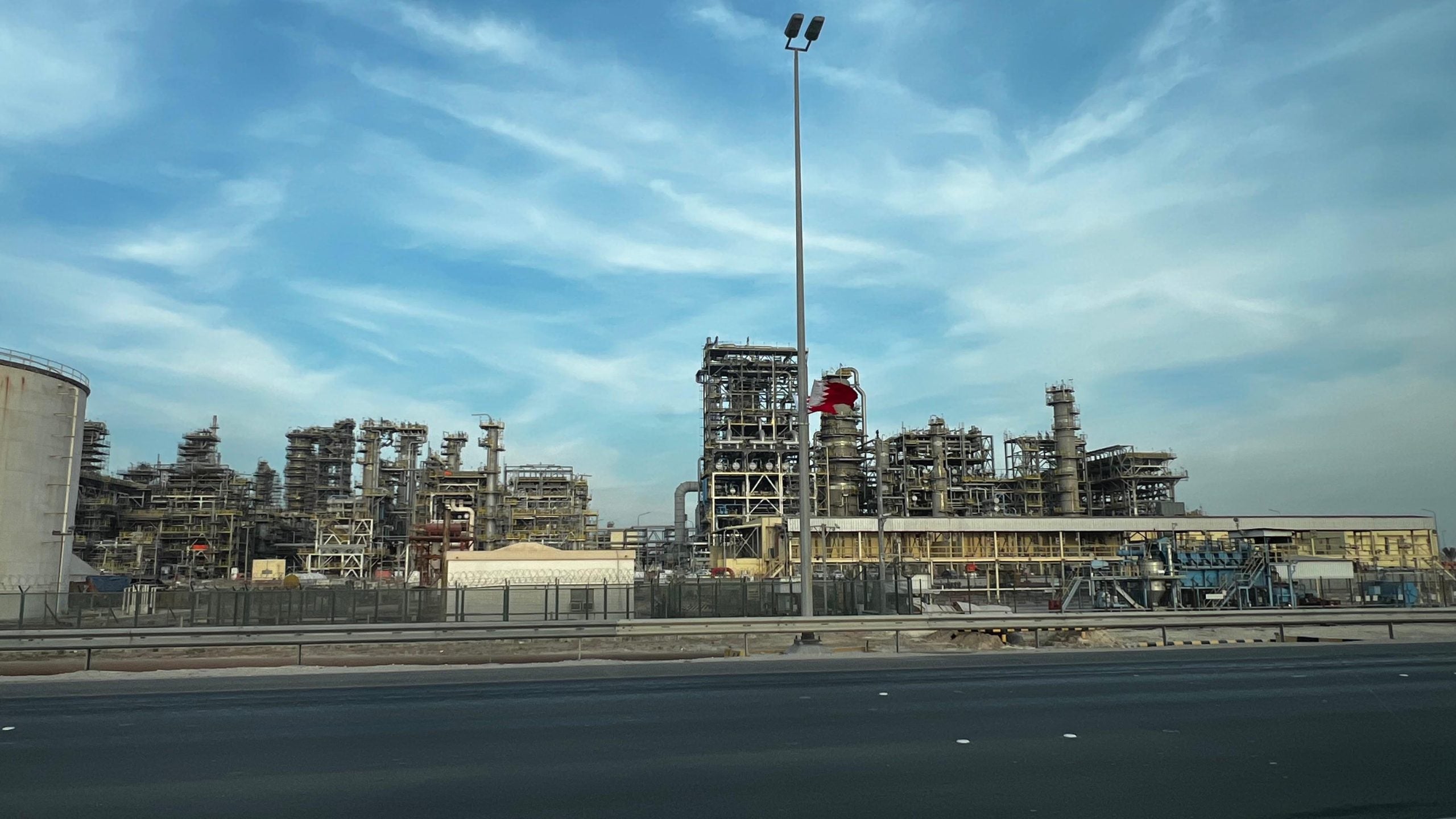
Bahrain’s state energy conglomerate Bapco Energies has declared force majeure on its group-wide operations following attacks on the Sitra oil refinery in the country.
In a statement on 9 March, Bapco Energies said its decision to issue the force majeure notice follows “the recent attack on its refinery complex”, without providing details.
Earlier in the day, Bahrain’s National Communication Centre announced that “the facility in Ma’ameer” – an apparent reference to the refining facility in near Sitra – had been targeted in an Iranian attack, causing a fire to break out. The fire was contained, and “the incident resulted in material damage but caused no injuries or fatalities”, said the statement carried by the official Bahrain News Agency.
“The company clarified that all local market needs are fully secured according to the proactive plans in place, ensuring the continuity of supplies and meeting local demand without impact,” Bapco Energies said in its statement.
“Bapco Energies values its relationships with all of its stakeholders and will continue to communicate the latest available information,” it said.
The Monday morning attack on the Sitra refinery was the second strike on the complex in days. Iranian missiles hit the facility on 5 March, resulting in parts of the refinery being engulfed in flames, although that fire was also put out quickly.
ALSO READ: Oil prices soar above $100 a barrel as conflict intensifies
QatarEnergy has also issued force majeure to customers that have been affected by its decision to stop production and shipments of liquefied natural gas (LNG) and associated products.
“QatarEnergy values its relationships with all of its stakeholders and will continue to communicate the latest available information,” the state enterprise said in a statement on 4 March.
QatarEnergy announced its decision to halt production of LNG and associated products on 2 March due to military attacks on the company’s operating facilities in Ras Laffan Industrial City and Mesaieed Industrial City in Qatar.
The following day, the company said it was stopping output of products in the downstream energy value chain, including urea, polymers, methanol, aluminium and other products.
The state enterprise did not blame Iran for the attacks in either of its statements, but it is understood that its facilities have been hit by drones or missiles launched by Tehran, as it retaliates against Israel, the US and their military bases in the GCC states, further escalating the ongoing conflict.
ALSO READ:
https://image.digitalinsightresearch.in/uploads/NewsArticle/15910429/main.jpeg -
Wade Adams wins more work in Dubai
9 March 2026
Dubai-based Wade Adams Contracting has been awarded two contracts covering infrastructure works in the Nad Al-Sheba and Villanova communities in Dubai.
The first contract, which was awarded by local real estate developer Dubai Holding, covers roads and infrastructure works for the spine road at its Nad Al-Sheba residential development.
The scope of work includes the development of the road network, service reservation, storm water drainage, street lighting, traffic control, potable water system and sewage collection system.
The work also covers the main irrigation system, fire-fighting system, electrical power ducts, telecommunications, spare ducts, irrigation pump station, storm pump station and all utility tie-in connections to adjacent packages.
The project area covers 2,800 square metres (sq m).
The other contract covers the infrastructure works for the La Tilia cluster at the Villanova development.
The scope of work includes ground investigation, demolition and site clearance, earthworks, road network, Dubai Electricity & Water Authority-related works, street lighting, telecommunications, irrigation, drainage, sewerage and spare ducts.
In August last year, Wade Adams Contracting was awarded a contract to carry out infrastructure works within the Nad Al-Sheba Gardens development in Dubai, as MEED reported.
The contract includes enabling works, roads and utility services in Zones C, D and H of the development.
The project spans an area of over 550,000 sq m within Nad Al-Sheba Gardens.
This latest contract adds to the work awarded to Wade Adams in January, which included two contracts for grading and enabling works in clusters D and H of Nad Al-Sheba Gardens, as well as infrastructure works in Zone E.
https://image.digitalinsightresearch.in/uploads/NewsArticle/15909803/main.jpg -
Roshn signs $177m investment deal with local developer
9 March 2026
Saudi gigaproject developer Roshn Group has signed an investment agreement worth over SR650m ($177) with Riyadh-based developer Miskan Real Estate Development Company.
The agreement will allow the firm to develop a project spanning more than 68,000 square metres (sq m) of land within the Warefa community in Riyadh.
The latest agreement follows Roshn Group's signing of several land sale and development deals with local developers, worth over SR2bn ($570m).
The agreements were signed on the sidelines of the recently concluded Restatex Real Estate Exhibition in Riyadh.
The signed agreements cover residential and commercial projects at Roshn’s Sedra and Warefa communities in Riyadh.
The client signed three agreements worth over SR1.3bn ($363m) related to its Sedra residential community. These include a SR1bn ($293m) agreement with Jeddah-based developer Arabian Dyar for a 55,000 sq m plot.
Another agreement was signed with Riyadh-based firm Tiraz Al-Arabia to build integrated commercial facilities within the Sedra development. The value of this deal has yet to be disclosed.
In a separate announcement, Alramz Real Estate Company said it has signed a SR262m ($70m) agreement to acquire and develop a plot spanning over 14,000 sq m for a 240-unit residential project in Sedra.
In Warefa, Roshn signed two agreements totalling SR781m ($208m).
It signed a SR548m ($146m) deal with Sateaa Altameer for Real Estate to develop a site spanning an area of over 108,000 sq m.
Another SR233m ($62m) agreement was signed with Fayziyya for Real Estate Development for a plot covering 46,000 sq m.
https://image.digitalinsightresearch.in/uploads/NewsArticle/15909425/main.png