
Five project megatrends to watch in 2023
4 January 2023

High oil prices, the journey to net zero and Cop28 in the UAE, property markets, Saudi gigaprojects and deepening regional integration will all be key themes in 2023 that will have a strong bearing on some of the region’s largest projects and programmes of construction work.
These are five of the key megatrends to watch in 2023:
| 1. Neom |
Neom will be a focus of attention for the global construction sector in 2023.
Announced by Saudi Crown Prince Mohammed bin Salman in 2017 with a project value of $500bn, the project arguably failed to live up to expectations following its launch as efforts focused on preparing concepts and designs with little onsite construction activity.
That changed dramatically in 2022 as contractors signed major contracts across the project’s key components. One key development was the signing of construction contracts for the $6.5bn Neom green hydrogen project, which involves building a hydrogen-based ammonia production facility powered by renewable energy.
Other large construction contracts were signed for tunnelling works for The Line, which is a 170-kilometre infrastructure corridor with a highspeed rail system and two rows of interconnected 500-metre-tall-mirrored buildings. Crucially these contracts were won by joint ventures comprising some of the world’s leading names in construction, indicating a shift of opinion within the international community towards the project and its opportunities.
There are plenty more contracts to be tendered and awarded in 2023. There is high-level political pressure for progress to be made on the project, and last year the mountain resort of Trojena was selected to host the 2029 Asian Winter Games giving the project a hard deadline.
As onsite activity gathers momentum, Neom will finally deliver on its promise of being the region’s largest project by far.
| 2. Hydrogen |
Some say hydrogen will follow a similar story to the one experienced by solar power over the past decade, while others say it is reminiscent of the early days of liquefied natural gas (LNG).
The Middle East will play a leading role in deploying this relatively new technology following a slew of project announcements in recent years. The value of all announced hydrogen plants in the Middle East and Africa is now estimated to exceed $70bn. This total rises to more than $120bn if other elements, such as air separation units, export facilities and renewable energy complexes, are included.
These projects are already resulting in contract awards for contractors, and as more schemes move into the construction phase, hydrogen will become an increasingly important industry for the region.
| 3. Rail |
Rail is back. After years of stalled projects, momentum has finally returned to the rail sector as regional governments press ahead with rail projects.
The data shows the impact of these efforts. With $10.7bn of contract awards, 2022 was the best year for the region’s rail sector since 2013, according to data from regional projects tracker MEED Projects.
READ MORE: Railway diplomacy
Even more encouraging is that headway is being made on planned projects expected to be tendered and awarded in the coming two years. The progress is across the region, but most noticeable in the GCC, where there has been a top-down drive to get the GCC Rail Project moving again following the Al-Ula declaration in 2021.
In 2022, design work started and progressed on a series of major rail schemes that should move towards tendering for construction contracts by the end of 2023. Once that happens, the region will be well on course to finally surpass its 2013 peak.
| 4. Dubai real estate |
 Dubai’s property market was in rude health in 2022 with double-digit gains in values across multiple asset classes, including residential and commercial space. There was also a wide variety of new project launches, ranging from villa communities to tall towers and offshore islands (again).
The Covid-19 pandemic allowed Dubai to position itself as a home for the wealthy. Compared to other global cities such as London, New York, Paris and Hong Kong, property valuations in the emirate remain highly competitive, even after a year of strong growth.
Prices are also still below the 2014 peak, which suggests the market has the potential to go even higher in 2023. Strong sales and rising prices due to limited supply have meant developers are launching new projects to satisfy demand.
As projects become more daring and ambitious, a key question will be whether Dubai’s construction sector still has the appetite for major projects. Over the past five years, international players have left the market and, in 2020, the UAE’s largest general contractor, Arabtec Construction, filed for bankruptcy.
The plight of these companies is a reminder that Dubai’s property market is cyclical, and while there may be good times today, things may not be so good in the future.
READ MORE: Real Estate Returns
| 5. Saudi nuclear |
It takes years to prepare the regulations and designs for nuclear power plants. Saudi Arabia is no different. It has been pursuing its nuclear strategy since 2016. While progress may appear slow, experience from other markets has shown that nuclear power plants become significant undertakings once they move into construction. For example, the contract to build Abu Dhabi's nuclear reactors, signed by a South Korean consortium in late 2009, was valued at $20bn.
In Saudi Arabia, preparatory work is proceeding for its nuclear power programme, which is being pursued with a three-pronged strategy. Most of the nuclear power capacity will be developed through conventional, large-scale nuclear facilities, such as the one being studied by major consultants.
READ MORE: Nuclear power's strategic importance grows
The kingdom also plans to develop atomic energy through a series of smaller, system-integrated modular advanced reactor technology (Smart) nuclear power plants. The third pillar involves mining uranium resources to fuel the plants, as highlighted earlier this year by the kingdom's energy minister.
In March 2022, it was reported that Saudi Arabia had established a holding company to develop nuclear power projects in the country. Also over the past year, the King Abdullah City for Atomic & Renewable Energy (KA-Care) awarded three separate contracts for the legal, technical and financial advisory works for the project.
As these plans progress towards the tender of contracts, contractors are preparing themselves for the construction phase. For example, in late 2021, MEED reported that local contracting company Nesma & Partnerships had signed a memorandum of understanding with France’s Bouygues Travaux Publics to jointly execute civil works for a potential nuclear power plant project in Saudi Arabia.

Register for MEED's guest program now to access this article.
Exclusive from Meed
-
 Qatar’s new $8bn investment spices up global LNG race
13 March 2026
-
 Bahrain opens bids for first solar IPP project
13 March 2026
-
-
 Frontrunner emerges for Saudi sewage treatment project
13 March 2026
-
 Medina tenders Sikkah Al-Hadid PPP project
13 March 2026
All of this is only 1% of what MEED.com has to offer
Subscribe now and unlock all the 153,671 articles on MEED.com
- All the latest news, data, and market intelligence across MENA at your fingerprints
- First-hand updates and inside information on projects, clients and competitors that matter to you
- 20 years' archive of information, data, and news for you to access at your convenience
- Strategize to succeed and minimise risks with timely analysis of current and future market trends

Related Articles
-
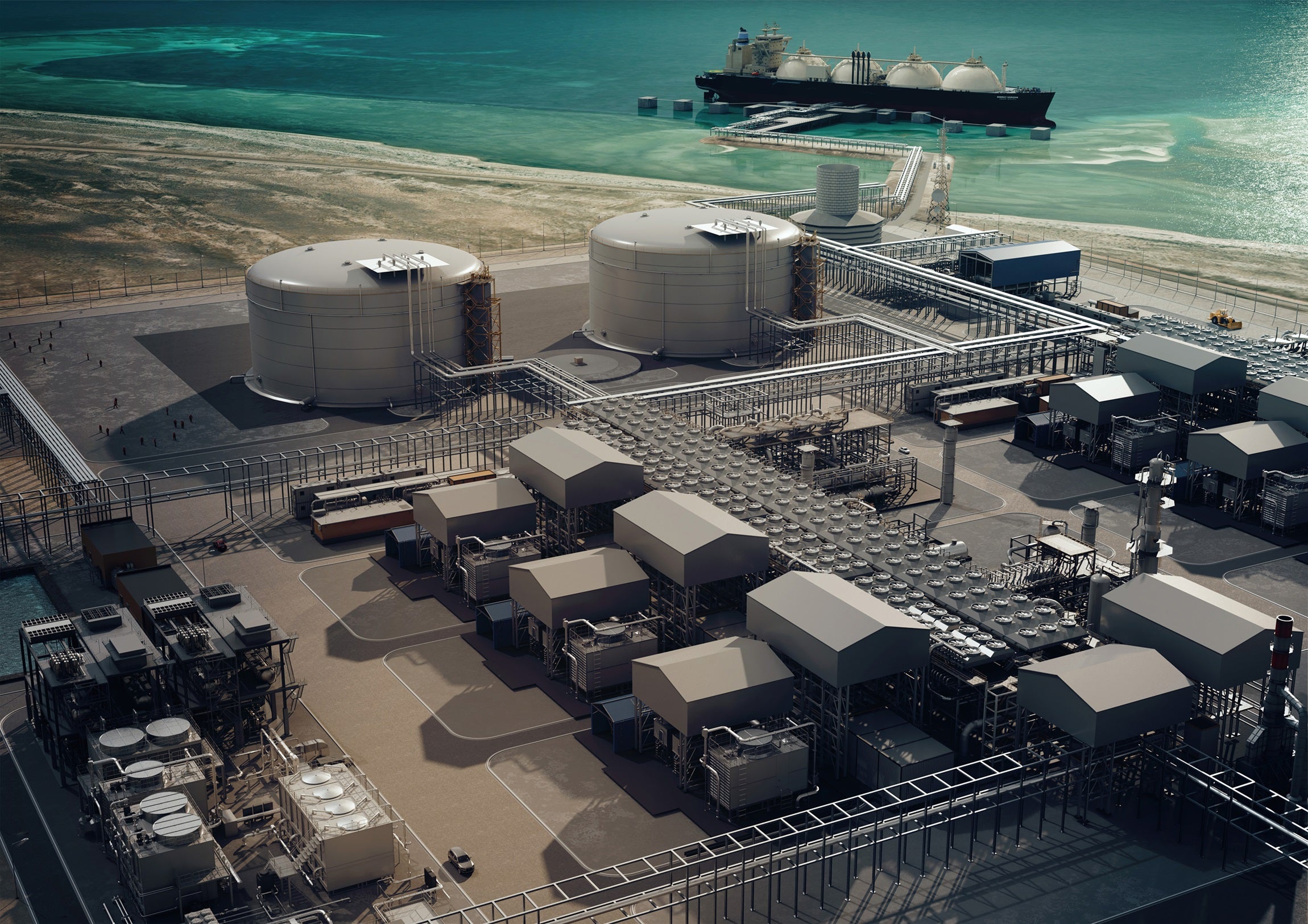
Qatar’s new $8bn investment spices up global LNG race
13 March 2026
In the midst of the conflict between Iran and the US and Israel, which has spilled over into the GCC region, QatarEnergy has temporarily halted production of liquefied natural gas (LNG) in the country and declared force majeure on LNG shipments after its energy assets came under attack.
When the fog of war clears, however, and the Strait of Hormuz reopens to oil and gas flows, the global economy will look to QatarEnergy to swiftly restore regular LNG cargoes in order to bring gas prices down from record highs.
Beyond that short-term role, the recent $8bn investment the Qatari giant has committed to building two new LNG processing trains will also cement its position as a reliable long-term supplier, while further intensifying the race among global LNG producers to carve out larger market shares in an increasingly gas-hungry world.
North Field West – a game changer
The state-owned company has progressed from the front-end engineering and design (feed) phase to the engineering, procurement and construction (EPC) stage of its North Field West LNG project at pace.
It awarded the main EPC contract for the scheme – covering two LNG processing trains with a total capacity of 16 million tonnes a year (t/y) – to a joint venture comprising France’s Technip Energies, Greece/Lebanon-based Consolidated Contractors Company (CCC) and Gulf Asia Contracting on 25 February.
The contract, estimated to be worth $8bn, was awarded just a month after Japan-based Chiyoda Corporation won the project’s feed contract.
Such a short interval between the feed and EPC phases for a project as large as North Field West LNG would typically be considered improbable. Industry sources suggest QatarEnergy may have been in discussions with Chiyoda and the Technip Energies-CCC consortium for at least a year regarding the feed and EPC contracts, respectively – particularly given the two-year gap between the project’s announcement in February 2024 and the start of the EPC phase.
Chiyoda, Technip Energies and CCC are also involved in the first two phases of QatarEnergy’s $40bn North Field LNG expansion project. A consortium of Chiyoda and Technip Energies is executing EPC works on the North Field East project, which involves the construction of four LNG trains with a combined capacity of 32 million t/y, following the award of a $13bn contract in February 2021. Meanwhile, a Technip Energies-CCC consortium is carrying out EPC works on two 7.8 million t/y LNG trains as part of the North Field South project, having secured a $10bn contract in May 2023.
More significant, however, is the speed with which QatarEnergy is advancing its strategic objective of reaching a total LNG production capacity of 142 million t/y by the end of the decade, from 77.5 million t/y at present.
With all three phases of the North Field LNG expansion programme now under EPC execution – and North Field East scheduled for commissioning later this year – QatarEnergy appears firmly on track to become one of the world’s largest LNG suppliers over the long term, reinforcing Qatar’s economic future in the process.
US domination
While QatarEnergy is on course to increase its LNG production capacity by 83% by 2030 through the overall North Field LNG expansion programme, it is still some way behind the US, which is set to account for over half of the total global LNG liquefaction projects by 2030.
There are 40 new-build and expansion LNG liquefaction projects planned or under way in the US, according to UK analytics firm GlobalData. Among these, two projects stand out.
The first is the Rio Grande LNG production project, being developed by NextDecade in Texas, on the US Gulf of Mexico coast. Up to 10 processing trains are planned for the complex, the first three of which are in the EPC phase.
NextDecade achieved the final investment decision on the fourth and fifth trains at the facility, estimated to cost $6.7bn each, in September and October last year. The company has awarded EPC contracts to build all five trains at the Rio Grande facility to US-based Bechtel.
On the investments front, the overseas-focused energy investment vehicle of Abu Dhabi National Oil Company (Adnoc), XRG, acquired an indirect 11.7% stake in the first phase of the project from Global Infrastructure Partners (GIP), part of US asset manager BlackRock, in September last year. In February 2026, XRG entered into another transaction with GIP to raise its overall participation in the Rio Grande LNG project by acquiring additional 7.6% equity interests in trains four and five of the scheme.
Additionally, as part of that transaction, another Adnoc Group subsidiary, Adnoc Trading, entered into a 20-year offtake agreement with NextDecade last year to purchase 1.9 million t/y of LNG from Rio Grande train four, on a free-on-board basis at a Henry Hub-indexed price. France’s TotalEnergies and Saudi Aramco are the other LNG offtakers for train four.
Separately, the Commonwealth LNG facility in the US state of Louisiana has also received backing from Abu Dhabi. Expected to start operations in 2030, the facility is designed to produce up to 9.5 million metric t/y of LNG.
Commonwealth LNG is a project of US-based alternative asset manager Kimmeridge Energy Management Company and Abu Dhabi’s sovereign wealth fund Mubadala Investment Company through their joint venture Caturus.
Caturus was formed in August 2025 when Kimmeridge announced a rebranding that saw Commonwealth LNG and Kimmeridge’s upstream operations combined under a new integrated platform. At the same time, Mubadala acquired a 24.1% equity stake in Caturus, providing financial backing for the new entity to proceed with the Commonwealth LNG project.
Also in August, Caturus awarded Technip Energies the contract for EPC works on the Commonwealth LNG project. The French contractor had previously performed the project’s feed work.
Moreover, Aramco subsidiary Aramco Trading signed a 20-year agreement to buy 1 million metric t/y of LNG from the Commonwealth LNG facility in February, increasing offtake deals secured by Caturus to cover 8 million metric t/y of the project’s total planned output capacity.
Positive outlook
The growth in LNG production capacity in the US, as well as in wider North America, is driven by several factors, including abundant natural gas reserves, the shale gas revolution and advancements in hydraulic fracturing and horizontal drilling.
While it might be a challenge for QatarEnergy to compete with US players in combined liquefaction capacity, its strength and success will lie in clinching long-term offtake deals with customers in Asia, where the bulk of global LNG demand growth is expected.
https://image.digitalinsightresearch.in/uploads/NewsArticle/15954252/main3511.jpg -
Bahrain opens bids for first solar IPP project
13 March 2026
Two companies have made offers for a contract to develop Bahrain’s first solar photovoltaic (PV) independent power project (IPP).
Bahrain’s Electricity & Water Authority (EWA) opened bids for the Bilaj Al-Jazayer solar IPP project on 12 March.
The bidders include Saudi Arabia’s Acwa, formerly Acwa Power, and UAE-headquartered Yellow Door Energy.
The 150 MWac Bilaj Al-Jazayer solar IPP project will be Bahrain’s first grid-connected solar PV power plant developed under a public-private partnership (PPP) framework on a build-own-operate basis. It will be delivered as a long-term concession and is intended to come online by 2027.
The proposed site covers more than 1 square kilometre, with the private sector responsible for end-to-end development, including financing, design, construction and operation.
Last August, EWA held a market consultation event during which it outlined plans for the country’s first solar PV IPP. The main contract was then tendered in October.
EWA said Yellow Door Energy’s proposal was “accepted with conditions”, but did not disclose further details.
The local KPMG Fakhro is the financial consultant, the US’ WSP Parsons Brinckerhoff is the technical consultant, and the UK’s Trowers & Hamlins is the legal consultant.
Bahrain’s clean energy targets, as set by its national plans, include 20% renewables by 2035, and net-zero emissions by 2060.
 https://image.digitalinsightresearch.in/uploads/NewsArticle/15968088/main.jpg
 -
DP World sees Red Sea port volumes rising as Hormuz shuts
13 March 2026
Register for MEED’s 14-day trial access
Dubai-based ports operator DP World is preparing for higher throughput at its Red Sea terminals as the Iran conflict approaches its second week, CEO Yuvraj Narayan said on Thursday.
With the Strait of Hormuz effectively closed and tanker attacks escalating, shipping movements into Gulf ports have fallen.
The disruption began after US and Israeli strikes on Iran, rattling energy and freight markets and cutting access through what is widely seen as the world’s most critical oil corridor.
Since most major Gulf ports rely on the narrow Strait of Hormuz, the shutdown is weighing on regional trade flows.
Narayan said Jebel Ali, DP World’s main hub in Dubai, has not suffered any infrastructure damage and is operating normally, but inbound vessel arrivals are down. Some cargo is still moving through terminals on the eastern side of the strait, he added.
Ports in the UAE that sit outside Hormuz have limited headroom to absorb the shortfall. Khorfakkan can handle about 5 million 20-foot equivalent units (TEUs) and Fujairah under 1 million TEUs, which Narayan indicated would not be enough to offset lost volume from Jebel Ali or Abu Dhabi’s Khalifa Port.
Jebel Ali alone processed 15.6 million TEUs last year, out of DP World’s 56.1 million TEUs globally.
DP World is rolling out rerouting options and other operational measures to keep supply chains moving. Narayan said the company’s Red Sea assets, such as Jeddah in Saudi Arabia and Sokhna in Egypt, are likely to see increased traffic, though he did not quantify the additional volumes or specify cargo types.
He cautioned that logistical and security risks remain elevated.
Earlier this week, DP World announced record financial results for 2025, with revenue up 22% to $24.4bn and adjusted earnings before interest, taxes, depreciation and amortisation (Ebitda) up 18% to $6.4bn, delivering a 26.3% margin, as MEED reported.
DP World said that this performance was driven by strong momentum across its ports and terminals and logistics business.
The group’s gross throughput rose 5.8% to 93.4 million TEUs.
Profit for the year increased 32.2% to $1.96bn, and operating cash flow grew 14% to $6.3bn.
Return on capital employed increased to 9.9% in 2025, up from 8.9% in 2024, reflecting stronger earnings despite ongoing geopolitical and trade uncertainty.
https://image.digitalinsightresearch.in/uploads/NewsArticle/15968045/main.jpg -
Frontrunner emerges for Saudi sewage treatment project
13 March 2026
A consortium led by China’s Jiangsu United Water Technology has emerged as the frontrunner for a contract to build and upgrade two sewage treatment plants in Saudi Arabia, according to sources.
The contract covers the North Western A Cluster Sewage Treatment Plants Package 11 (LTOM11), part of the next phase of National Water Company’s (NWC) long-term operations and maintenance (LTOM) sewage treatment programme.
The consortium comprising United Water, Prosus Energy (UAE) and Armada Holding (Saudi Arabia) offered “the lowest tariff” for the project, sources told MEED.
It is understood that Turkey’s Kuzu has made the next-lowest bid.
The development, estimated to cost about $211m, will have a combined capacity of about 440,000 cubic metres a day (cm/d).
In February, MEED exclusively reported that six bidders were competing for the contract.
The other companies that have submitted proposals include:
- Alkhorayef Water & Power Technologies (Saudi Arabia)
- Civil Works Company (Saudi Arabia)
- VA Tech Wabag (India)
- Aguas de Valencia (Spain)
LTOM11, also known as the North Western A Cluster, forms part of the second phase of NWC’s rehabilitation of sewage treatment plants programme.
The scheme is being procured on an engineering, procurement and construction (EPC) basis with a long-term operations component.
The main contract was tendered last year, with an award initially expected by the end of 2025.
It is now understood that NWC is preparing to offer the main contract in the second quarter.
As previously reported, Saudi Arabia’s NWC is also evaluating five bids for package 12 of its long-term operations and maintenance (LTOM12) sewage treatment programme.
Known as the North Western B Cluster, LTOM12 forms part of the second phase of NWC’s rehabilitation of sewage treatment plants programme.
In January, the same United Water-led consortium won the main contract for the Northern Cluster Sewage Treatment Plants Package 10 (LTOM10).
That project includes the rehabilitation and operation of nine sewage treatment plants located across the Hail, Qassim, Al-Jouf and Northern Borders provinces
NWC is also preparing to tender a contract for the construction of 10 sewage treatment plants as part of package 14 of the programme.
The final details of the Eastern A Cluster (LTOM14) package are being finalised, with a tender likely to be issued in March or April, sources told MEED.
 READ THE MARCH 2026 MEED BUSINESS REVIEW – click here to view PDF
Riyadh urges private sector to take greater role; Chemical players look to spend rationally; Economic uptick lends confidence to Cairo’s reforms.
Distributed to senior decision-makers in the region and around the world, the March 2026 edition of MEED Business Review includes:
> RAMADAN: Data disproves the Ramadan slowdown story> INDUSTRY REPORT: Chemicals producers look to cut spending> INDUSTRY REPORT: Global petrochemical project capex set to rise until 2030> MARKET FOCUS: Egypt’s crisis mode gives way to cautious revival> LEADERSHIP: Delivering Saudi Arabia’s next phase of rail growth> INTERVIEW: Abu Dhabi’s Enersol charts acquisitions pathTo see previous issues of MEED Business Review, please click herehttps://image.digitalinsightresearch.in/uploads/NewsArticle/15968035/main.jpg -
Medina tenders Sikkah Al-Hadid PPP project
13 March 2026
Saudi entities including Al-Madinah Regional Municipality, in collaboration with the Ministry of Municipalities & Housing and the National Centre for Privatisation & PPP (NCP), have floated a request for proposal (RFP) notice for the development of the Sikkah Al-Hadid project.
The project will be procured through build-own-operate-transfer contracts with a 50-year duration, using a public-private partnership (PPP) model.
The deadline for bid submission is 23 June.
The project will be located to the west of Medina on an 84,657-square-metre (sq m) site.
It includes a four-storey medical centre with a capacity of up to 200 beds and a shopping mall offering retail, food and beverage, and other entertainment facilities.
In January last year, NCP asked firms to express their interest and prequalify for a contract to develop two mixed-use developments in Medina, which included the Sikkah Al-Hadid project and the Dhul Hulaifah project.
The Dhul Hulaifah project will be built on a 30,112 sq m site located six kilometres from the Prophet’s Mosque.
The development will consist of a four-star hotel integrated with retail and healthcare facilities.
MEED previously reported that Saudi Arabia had announced a P&PPP pipeline comprising 200 projects across 16 sectors.
This pipeline aims to attract local and international investors and ensure their readiness to participate in the schemes tendered to the market.
The initiative comes as the kingdom strives to increase the attractiveness of its economy and raise the private sector’s contribution to GDP.
https://image.digitalinsightresearch.in/uploads/NewsArticle/15968021/main.jpg