
Contractors submit gaming resort prequalifications
29 September 2022
Contractors have submitted prequalification documents for the contract to build the integrated resort at Al-Marjan Island in Ras al-Khaimah planned by the local Rak Hospitality Holding and US-based casino and hotel operator Wynn Resorts.
The project involves the construction of a 1,000-key luxury hotel, retail and convention areas, and gaming facilities. It covers an area of 250,000 sq m and is expected to open in 2026.
US firm HKS Architects is the design consultant. The project manager is UK-based Mace.
The project’s January launch coincided with Ras al-Khaimah Tourism Development Authority’s (Raktda) announcement about establishing a division to centralise regulations for integrated resorts.
The newly formed department of entertainment and gaming regulation will set the framework for licensing, taxation, operational procedures and consumer safeguards in the city, prioritising the creation of measures to ensure responsible gaming.

Its rules will reportedly cover hotel operations, convention space, entertainment, restaurants and lounges, spas, and retail and gaming facilities in integrated resorts.
The Wynn project’s developers will apply for Raktda’s integrated resort licence for the scheme.
READ MORE: Gaming debate against the odds

Register for MEED's guest program now to access this article.
Exclusive from Meed
-
 Gulf builds supply beyond the strait
26 November 2026
-
 Dubai awards $15bn Al-Maktoum airport contracts
26 November 2026
-
 Contractors submit Mecca residential tower bids
26 November 2026
-
 Contractor wins Dubai’s Eden House Zabeel tower
26 November 2026
-
 Libya oil licensing rounds to be launched in 2027 and 2028
26 November 2026
All of this is only 1% of what MEED.com has to offer
Subscribe now and unlock all the 153,671 articles on MEED.com
- All the latest news, data, and market intelligence across MENA at your fingerprints
- First-hand updates and inside information on projects, clients and competitors that matter to you
- 20 years' archive of information, data, and news for you to access at your convenience
- Strategize to succeed and minimise risks with timely analysis of current and future market trends
Related Articles
-
Gulf builds supply beyond the strait
26 November 2026

> This package also includes: Localisation keeps Gulf projects on schedule
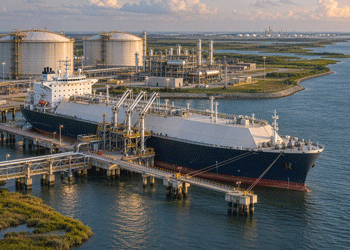
QatarEnergy agreed to buy up to 7 million tonnes a year (t/y) of US liquefied natural gas (LNG) in the space of eight days. On 22 October, the company signed two sale and purchase agreements with US firm Cheniere Energy for up to 4 million t/y from its Sabine Pass and Corpus Christi terminals in Texas. On 30 October, it agreed to take 3 million t/y for 20 years from Woodside Energy’s under-construction Louisiana LNG project.
 None of that gas will pass through the Strait of Hormuz. Deliveries are on a free-on-board basis, so QatarEnergy takes ownership of the cargoes at the US terminals and can ship them directly to customers.
The deals address the damage done to Qatar’s standing as a supplier after Doha declared force majeure on LNG deliveries when the strait was blocked following the outbreak of the US-Iran conflict on 28 February. Qatar built its LNG business over three decades on the promise of reliable, on-schedule deliveries, and the suspension undermined that reputation.
QatarEnergy is not alone. Saudi Aramco has agreed to store crude in Singapore while Abu Dhabi investment firm XRG has bought into Australian LNG. Aluminium Bahrain (Alba) is preparing to complete the acquisition of a smelter in France.
The Gulf’s national champions have invested abroad for decades. What has changed in 2026 is the purpose of those investments. Overseas assets, previously bought for growth, market access and returns, are now also valued for their ability to keep supply flowing when production at home cannot reach the market.
US supply
Qatar’s US position predates the conflict. QatarEnergy owns 70% of the Golden Pass LNG project in Texas, with ExxonMobil holding the remaining 30%. The 18 million t/y, three-train facility’s first train started producing on 30 March and the first export cargo was loaded in April.
Once all three trains are running, QatarEnergy’s share of Golden Pass output will be about 12.6 million t/y. Together with the Cheniere and Woodside volumes, this will give the company access to almost 20 million t/y of US LNG by the early 2030s.
When Golden Pass loaded its first cargo, Saad Sherida Al-Kaabi, Minister of State for Energy Affairs and president and CEO of QatarEnergy, said the project affirmed QatarEnergy’s reputation as “a reliable provider and a trusted partner of choice”.
For buyers in Asia and Europe, the origin of the gas matters less than the certainty that it will arrive. A supplier that can meet a contract from Texas or Louisiana when Ras Laffan is cut off offers greater security than one that relies on a single export route, however low its production costs.
Crude held in Asia can reach refiners within days, regardless of conditions in the Gulf
Storage network
Aramco is pursuing the same goal through storage. On 26 October, the Saudi and Singaporean governments announced that Saudi crude will be held at the Jurong Rock Caverns on Jurong Island from the second half of 2027. The volume and commercial terms have yet to be disclosed.
The caverns’ first phase provides 1.47 million cubic metres of storage, equivalent to about 9.2 million barrels. The two governments said the oil will support Singapore’s energy needs during supply disruptions and strengthen the resilience of Saudi Arabia’s crude supply chain in Southeast Asia.
The deal extends an approach Aramco has used in Northeast Asia since 2011, when it began a crude storage arrangement in Okinawa, Japan, that allows it to hold up to 6.3 million barrels. In 2023, it also signed a five-year agreement to store 5.3 million barrels at Ulsan in South Korea. Crude held in Asia can reach refiners within days, regardless of conditions in the Gulf.
Saudi Arabia has continued exporting since the strait closed by routing crude through the East-West pipeline to the Red Sea, which has reached its maximum capacity of 7 million barrels a day (b/d). Overseas storage adds a further buffer.
Aramco also has a large refining footprint overseas. It owns the Motiva refinery in Texas, holds a majority stake in South Korea’s S-Oil and paid $3.4bn in 2023 for 10% of China’s Rongsheng Petrochemical, a deal that included a commitment to supply 480,000 b/d of crude. These investments were designed to secure outlets for Saudi crude, while the Singapore arrangement is intended to protect delivery.
Gas portfolio
XRG, the international investment company set up by Abu Dhabi National Oil Company (Adnoc) in 2024, announced on 3 November that it has agreed to buy Shell’s interest in the North West Shelf project in Western Australia for $1.45bn, subject to regulatory approvals.
It is XRG’s first investment in Australian LNG and “advances XRG’s strategy to build a leading international gas business serving growing demand across Asia-Pacific”, according to Mohamed Al-Aryani, president of XRG International Gas.
The acquisition came after a consortium led by XRG withdrew its $18.7bn offer for Santos, Australia’s second-largest gas producer.
XRG has built gas positions on several continents. It holds stakes in NextDecade’s Rio Grande LNG project in Texas, the Area 4 concession off Mozambique and Argentina’s LNG project. In December 2025, it completed a €14.7bn ($15.8bn) takeover of German chemicals producer Covestro.
Adnoc’s own LNG exports leave from Das Island, inside the Gulf. Its international portfolio, mostly assembled before the conflict began, gives the group gas it can sell without using the strait.
Smelter platform
The trend extends beyond hydrocarbons. Alba signed a $2.2bn agreement to buy Aluminium Dunkerque from US private equity firm American Industrial Partners on the day the US conflict with Iran began. The deal awaits one final approval from the EU.
The Loon-Plage smelter produces about 300,000 t/y and is the biggest primary aluminium smelter in the EU. Alba’s Bahrain smelter, which had a capacity of about 1.6 million t/y before the conflict, is operating at about 80% capacity because alumina cannot reach it by sea. The company is now receiving 300-350 trucks a day of bagged alumina routed through Oman and Saudi Arabia.
Chairman Khalid Al-Rumaihi tells MEED the timing of the deal was coincidental. Alba’s board decided in early 2025 that growth would have to be inorganic because of constraints on energy, gas supply and land in Bahrain. The war has nonetheless changed the value of the asset. “It was not intended this way, but this acquisition has put us in a more resilient position,” he says.
Alba plans to centralise its European warehousing at Dunkirk, which has a deep-sea port, and supply European customers from France. Al-Rumaihi adds that further deals are likely to be in Europe and could include bolt-on acquisitions or recycling assets.
Gulf NOCs still hold some of the world’s largest and lowest-cost reserves, and their overseas assets serve the home base
Changing identity
The moves raise the question of whether the Gulf’s national oil companies (NOCs) are becoming international oil companies (IOCs). In some respects, the distinction has been narrowing for years. Aramco, Adnoc and QatarEnergy hold minority stakes in foreign projects, trade third-party volumes and compete with Western majors for upstream acreage and corporate acquisitions. QatarEnergy Trading will market QatarEnergy’s share of Golden Pass output, and Adnoc launched an LNG marketing and trading platform in July.
Their motives remain different. IOCs invest abroad because their home reserves are limited or depleted. Gulf NOCs still hold some of the world’s largest and lowest-cost reserves, and their overseas assets serve the home base. They secure demand, add trading flexibility and provide a way to deliver when the home export route is shut. Their shareholders are governments, which judge investments on national as well as commercial grounds.
That also shapes how they are received abroad. Alba’s Al-Rumaihi says the company must demonstrate that it is a responsible owner of its French asset to secure future international investments.
Gulf buyers face growing scrutiny of state-backed ownership in Europe, Australia and the US. XRG’s Covestro takeover, for example, required clearance under the EU’s Foreign Subsidies Regulation.
The international investments complement the Gulf’s localisation drive. Local manufacturing has kept materials flowing into Gulf projects while imports were disrupted. Overseas assets keep supply flowing out to customers when Gulf exports are blocked.
These positions take years to build. Golden Pass loaded its first cargo seven years after its final investment decision. QatarEnergy’s purchases from Woodside and Cheniere will not start delivering until 2030 and 2031. Buyers will have formed their view of which suppliers kept their commitments in 2026 long before then.
Main image is AI-generated
 READ THE NOVEMBER 2026 MEED BUSINESS REVIEW – click here to view PDF
Gulf projects keep moving amid conflict; UAE's state spending and oil output flexibility cushion Iran war shock; Project finance lenders weigh risk against infrastructure needs.
Distributed to senior decision-makers in the region and around the world, the November 2026 edition of MEED Business Review includes:
> AGENDA: GCC projects market holds its nerve> MARKET FOCUS: UAE economy shows resilience> INDUSTRY REPORT: Project financiers hold the line> STADIUMS: Stadium spending set to jump 39% in 2027> CONFLICT: Hormuz closure wipes out growth in 2026> INTERVIEW: WSP regional president Dean McGrail> INTERVIEW: Ministry of Energy & InfrastructureTo see previous issues of MEED Business Review, please click herehttps://image.digitalinsightresearch.in/uploads/NewsArticle/21858990/main.gif -
Dubai awards $15bn Al-Maktoum airport contracts
26 November 2026
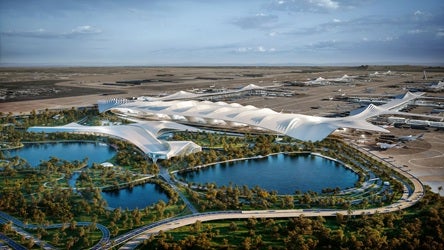
Dubai has announced contract awards worth over AED56.5bn ($15bn) for several packages under the first phase of the $35bn expansion of Al-Maktoum International airport.
In a social media post published on X, the Dubai Media Office said that the latest awards bring the total value of contracts awarded for the project to over AED80bn.
“A team of 14,000 people is working on the project. Once fully completed, Al-Maktoum International airport will have the capacity to handle more than 260 million passengers annually,” the statement added.
Hamdan bin Mohammed: Under the directives of His Highness Sheikh Mohammed bin Rashid Al Maktoum, today we announce the award of new contracts worth AED 56.5 billion for the development of Al Maktoum International Airport, bringing the total value of contracts awarded for this strategic project to more than AED 80 billion. The award of these contracts marks a new phase in the development of the world’s largest and best airport. A team of 14,000 people is working on the project. Once fully completed, Al Maktoum International Airport will have the capacity to handle more than 260 million passengers annually, reinforcing Dubai’s position as a leading global aviation gateway and one of the world’s most sought-after destinations.
— Dubai Media Office (@DXBMediaOffice) November 26, 2026
In June 2026, DAEP confirmed plans to award construction deals worth over AED55bn for the hub by year-end.
MEED previously reported that Dubai-based Binladin Contracting Group has begun mobilising for the substructure works covering the West Terminal and Concourse 1.
For the remaining concourses, DAEP recently selected a joint venture of UK-headquartered Innovo Group and China Harbour Engineering Company for superstructure works on concourses two and three, while a consortium of China Civil Engineering Construction Corporation and Abu Dhabi-based Tristar Engineering & Construction was appointed for substructure works on Concourse 4.
The client is also executing airside and transit infrastructure. In July, MEED exclusively reported that DAEP awarded a contract to a joint venture of Japan’s Mitsubishi Corporation and India’s Larsen & Toubro to deliver the automated people mover system. The subterranean network will feature four stations in its initial phase, expanding to 14 stations across the full masterplan.
The awards follow formal approval in April 2024 of updated masterplans designed by lead consultants Coop Himmelb(l)au and Dar Al-Handasah.
The airport’s construction is planned in three phases. Once complete, the airport will cover 70 square kilometres south of Dubai and include five parallel runways and 430 aircraft gates.
It will be five times the size of Dubai International airport and is planned to have a passenger-handling capacity of 260 million passengers a year – the largest in the world. For cargo, it is planned to have the capacity to handle 12 million tonnes a year.
https://image.digitalinsightresearch.in/uploads/NewsArticle/21854532/main.jpg -
Contractors submit Mecca residential tower bids
26 November 2026
Contractors have submitted bids for the main construction package for the Ajyad residential tower, a 365-metre high-rise development in Mecca’s central area near the Grand Mosque.
Rua Al-Haram Al-Makki tendered the contract in July, with an initial bid submission deadline of 30 September, which was later extended to mid-November, as MEED reported.
The project team includes US-based Marriott International as residential operator, Hanmi Global Saudi as project management consultant, Saudi Diyar Consultants as construction supervision consultant, and PLP Architecture as lead design consultant and construction-stage design guardian.
The tower will rise 84 floors with four basement levels. It will comprise 212 units, including 82 three-bedroom apartments, 85 four-bedroom units, 29 penthouses and 16 duplex villas.
The scheme has a gross floor area of 209,231 square metres (sq m) and a built-up area of 242,976 sq m.
A demolition contractor is currently clearing the site, with the existing mat foundation and retaining walls to be handed over to the main contractor, who will build the new superstructure on the retained raft.
Rua Al-Haram Al-Makki Company was established in October 2017 and is a wholly owned subsidiary of the Saudi sovereign wealth vehicle, the Public Investment Fund.
READ THE NOVEMBER 2026 MEED BUSINESS REVIEW – click here to view PDFGulf projects keep moving amid conflict; UAE's state spending and oil output flexibility cushion Iran war shock; Project finance lenders weigh risk against infrastructure needs.
Distributed to senior decision-makers in the region and around the world, the November 2026 edition of MEED Business Review includes:
> AGENDA: GCC projects market holds its nerve> MARKET FOCUS: UAE economy shows resilience> INDUSTRY REPORT: Project financiers hold the line> STADIUMS: Stadium spending set to jump 39% in 2027> CONFLICT: Hormuz closure wipes out growth in 2026> INTERVIEW: WSP regional president Dean McGrail> INTERVIEW: Ministry of Energy & InfrastructureTo see previous issues of MEED Business Review, please click herehttps://image.digitalinsightresearch.in/uploads/NewsArticle/21845812/main.jpg -
Contractor wins Dubai’s Eden House Zabeel tower
26 November 2026
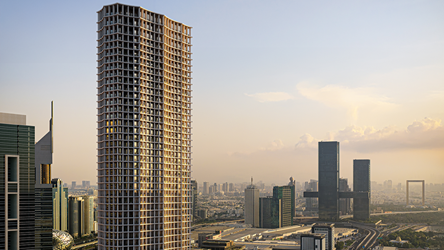
Dubai Contracting Company has been appointed as the main contractor for the Eden House Zabeel project in the Dubai International Financial Centre (DIFC) area.
The scope covers construction of a 45-storey mixed-use tower comprising three basements, a ground floor, 45 upper floors and a roof level. The development will contain 242 units, including one- to three-bedroom apartments and two penthouses.
Local firm Fay Developments is the project developer, with H&H Investment and Development acting as the development manager.
Another local firm, DXB Lab Architecture, is the design architect, and Lebanese firm Erga Progress is the project consultant.
Local contractor Swissboring undertook the enabling works.
Earlier this year, Dubai announced a AED100bn ($27bn) expansion of DIFC through the creation of the DIFC Zabeel District.
A statement from the Government of Dubai Media Office said the new district will add more than 7 million square feet (sq ft), bringing total gross floor area to 17.7 million sq ft.
The Zabeel District is expected to more than double DIFC’s capacity to more than 42,000 businesses, support a workforce exceeding 125,000, and allocate more than 1 million sq ft for future technologies and artificial intelligence.
Planned in six phases, the expansion is scheduled to open to the public in 2030, with the masterplan due for completion in 2040.
A bridge will link the DIFC Zabeel District to the existing DIFC Gate District.
READ THE NOVEMBER 2026 MEED BUSINESS REVIEW – click here to view PDFGulf projects keep moving amid conflict; UAE's state spending and oil output flexibility cushion Iran war shock; Project finance lenders weigh risk against infrastructure needs.
Distributed to senior decision-makers in the region and around the world, the November 2026 edition of MEED Business Review includes:
> AGENDA: GCC projects market holds its nerve> MARKET FOCUS: UAE economy shows resilience> INDUSTRY REPORT: Project financiers hold the line> STADIUMS: Stadium spending set to jump 39% in 2027> CONFLICT: Hormuz closure wipes out growth in 2026> INTERVIEW: WSP regional president Dean McGrail> INTERVIEW: Ministry of Energy & InfrastructureTo see previous issues of MEED Business Review, please click herehttps://image.digitalinsightresearch.in/uploads/NewsArticle/21817603/main.png -
Libya oil licensing rounds to be launched in 2027 and 2028
26 November 2026
Libya is preparing to launch a public bidding round for discovered, undeveloped and marginal oil fields next year, according to Masoud Suleman, chairman of the National Oil Corporation (NOC).
This will be followed by a separate exploration bidding round set for early 2028, Suleman told a conference in Tripoli.
Suleman stated that NOC has entered into an agreement with US engineering firm KBR to draft an upstream production expansion plan. The state oil company has also hired US advisory firm K2 Integrity to carry out monitoring, auditing and gap analysis across NOC’s financial systems.
During the conference, NOC signed a memorandum of understanding (MoU) with Honeywell to collaborate on technical training, workforce development and industrial modernisation. A separate MoU was signed with US energy technology firm Baker Hughes, focusing on strategic training and project execution, coinciding with the opening of Baker Hughes’ new regional office in Tripoli.
On downstream infrastructure, Suleman said Libya is seeking approximately $5bn in phased investment to modernise the Zawiya and Ras Lanuf refineries. NOC is courting external investors while exploring self-financing options to upgrade facilities and reduce reliance on imported refined products. Libya currently imports around 80% of its fuel requirements.
Subject to securing capital, upgrading the Zawiya plant would allow it to meet roughly 70% of domestic gasoline demand within two to 2.5 years, Suleman said. He added that rehabilitation work is already underway at Ras Lanuf to lift domestic gasoline and diesel yields. By contrast, Libya has achieved self-sufficiency in liquefied petroleum gas (LPG) and aviation fuel, leaving surplus volumes available for export.
Beyond refining, NOC is targeting an increase in crude oil production to 2 million barrels a day, alongside raising natural gas output to 4 billion cubic feet a day (cf/d), from the current 2.5 billion cf/d.
Licensing rounds
Earlier this year, MEED reported that consultations with London-headquartered international oil companies (IOCs) were playing a key role in shaping plans for Libya’s next licensing round.
Representatives from Shell and BP travelled to Libya in September as part of a Libyan British Business Council delegation.
During the trip, the oil companies’ representatives met with officials from Libya’s NOC.
Masoud Suleman was formally appointed chairman in October last year, having served as acting head since January 2025. Shortly after his interim appointment, NOC announced the results of its previous licensing round – the country’s first in 17 years – awarding five of the 22 blocks on offer.
Amid the US and Israel’s ongoing conflict with Iran and the ongoing war between Russia and Ukraine, oil assets in North Africa have become increasingly appealing to IOCs.
Disruptions to oil and gas exports through the Strait of Hormuz have severely affected a range of countries, including Qatar, the UAE, Saudi Arabia, Iraq and Kuwait.
Some North African officials have promoted their oil and gas sectors as reliable alternative suppliers.
In August, Libya’s Oil and Gas Minister Khalifa Abdel Sadig told a conference in Norway that Libya could be a “key player in providing energy security solutions” to the European Union.
READ THE NOVEMBER 2026 MEED BUSINESS REVIEW – click here to view PDFGulf projects keep moving amid conflict; UAE's state spending and oil output flexibility cushion Iran war shock; Project finance lenders weigh risk against infrastructure needs.
Distributed to senior decision-makers in the region and around the world, the November 2026 edition of MEED Business Review includes:
> AGENDA: GCC projects market holds its nerve> MARKET FOCUS: UAE economy shows resilience> INDUSTRY REPORT: Project financiers hold the line> STADIUMS: Stadium spending set to jump 39% in 2027> CONFLICT: Hormuz closure wipes out growth in 2026> INTERVIEW: WSP regional president Dean McGrail> INTERVIEW: Ministry of Energy & InfrastructureTo see previous issues of MEED Business Review, please click herehttps://image.digitalinsightresearch.in/uploads/NewsArticle/21817509/main.jpg