
Contractors get more time to prepare bids for Taziz’s Project Salt
10 June 2025

Abu Dhabi National Oil Company (Adnoc) has allowed contractors more time to prepare technical bids for a project to build a cluster of three chemical-producing plants in the Taziz Industrial Chemicals Zone in Ruwais.
The three chemicals plants will produce ethylene dichloride, chlor alkali and polyvinyl chloride, and are part of a scheme known as Project Salt.
The project is among the main investments in the first phase of development for the upcoming petrochemicals derivatives complex by Taziz.
Adnoc has set a deadline of 15 July for contractors to submit technical bids for engineering, procurement and construction (EPC) works on Project Salt, according to sources.
The following contractors, among others, are understood to be bidding for Project Salt, sources told MEED:
- CAT Group (Lebanon)
- China National Chemical Engineering Company
- Larsen & Toubro Energy Hydrocarbon (India)
- Samsung E&A (South Korea)
The previous deadlines for contractors to submit technical and commercial bids for the project were 15 June and 23 July, respectively.
MEED reported in June last year on the award of front-end engineering and design (feed) contracts for the three chemicals production plants.
Germany-headquartered Thyssenkrupp Uhde won feed contracts for the ethylene dichloride and chlor alkali plants. France-based Technip Energies won the feed contract for the polyvinyl chloride facility.
The planned ethylene dichloride plant will utilise chlorine from the associated chlor alkali plant as its main feedstock, and will have a production capacity of up to 1.2 million tonnes a year (t/y).
Part of the ethylene dichloride output will, in turn, be used as feedstock by the planned polyvinyl chloride plant, which is planned to have a production capacity of 350,000 t/y.
Surplus quantities of ethylene dichloride and caustic soda from the chlor alkali plant are intended to be exported.
Taziz – a 60:40 joint venture of Abu Dhabi National Oil Company (Adnoc) and Abu Dhabi’s industrial holding company ADQ – first announced the EDC, chlor alkali and PVC plants in December 2021. India’s Reliance Industries was named as the main investor in the chemicals plants at the time.
Reliance is understood to have pulled out of Project Salt and has been replaced by France-based Kem One, MEED previously reported.
Taziz Industrial Chemicals Zone
Since 2021, Taziz has attracted investments from several foreign investors for its planned chemicals projects in the under-construction Taziz Industrial Chemicals Zone in Abu Dhabi’s Ruwais.
Taziz has planned seven petrochemicals derivatives projects as part of the first phase of its industrial chemicals zone.
UK-headquartered Wood Group has performed the feed works on the seven projects, which are:
|
Anchor product |
End use |
|---|---|
|
Chlor alkali |
Water treatment, metallurgy and textiles |
|
Ethylene dichloride |
Housing, infrastructure and consumer goods |
|
Maleic anhydride |
Piping, construction and heavy transport |
|
Methanol |
Energy, consumer goods and pharmaceuticals |
|
Blue ammonia |
Agriculture, apparel and energy |
|
Isopropyl alcohol |
Healthcare and cosmetics |
|
Elastomers |
Automobiles, adhesives, food production and storage |
Chemicals production is a priority sector for Operation 300bn, the UAE’s industrial growth strategy.
The industrial strategy is being overseen by the Industry & Advanced Technology Ministry, which aims to raise the UAE industrial sector’s contribution to the national GDP to AED300bn ($81.7bn) by 2031.
In December 2021, Taziz secured agreements from eight UAE-based entities for investments in its planned chemicals projects in Ruwais. The agreements marked the first domestic public-private partnership in Abu Dhabi’s downstream oil, gas and petrochemicals sector.
ALSO READ: Local firms invest in Taziz industrial complex
In addition to the three chemicals plants planned under Project Salt, a joint venture of UAE-based Fertiglobe, South Korea’s GS Energy Corporation (GS Energy) and Japanese investment firm Mitsui & Company (Mitsui) has invested in a “world-scale” blue ammonia production facility in the Ruwais petrochemical derivatives complex.
The joint venture of Fertiglobe/GS Energy/Mistui awarded Italian contractor Tecnimont the EPC contract for the project last May. Construction on the facility started last June.
Separately, in February, Taziz awarded South Korean contractor Samsung E&A the main EPC contract to build the UAE’s first methanol plant in the Taziz Industrial Chemicals Zone. The value of the EPC contract won by Samsung E&A is $1.7bn, and the duration of works is 44 months.
The nameplate production capacity of the planned methanol complex is 5,000 metric tonnes a day, or 1.8 million metric t/y. Switzerland-based energy and chemicals company Proman is a joint investor in the methanol project.
Regarding infrastructure to support the various projects, Taziz awarded three EPC contracts totalling $2bn, in November, for infrastructure works at the industrial chemicals zone in Ruwais.
Abu Dhabi government-owned NMDC Group was awarded the EPC contract to build a chemicals port. Once complete, the port will facilitate the export of chemicals and fuels.
Singapore-based Rotary Engineering won the EPC contract for a chemicals terminal, known as Project Landing. The contract includes developing storage facilities, tank-to-jetty pipelines, jetty-to-tank pipelines, inter-site pipelines and liquid product storage. Taziz is building the chemicals handling terminal in partnership with the Netherlands-based midstream energy company Advario.
Abu Dhabi-based Al-Geemi Contracting was awarded the EPC contract to develop essential infrastructure for the 17-square-kilometre Taziz chemicals production site, including internal roads, security fencing and buildings.
Contracts have also been awarded for developing a centralised utilities facility for the Taziz Industrial Chemicals Zone, which will include power transmission, steam, cooling water and water units.
Adnoc signed an agreement with Abu Dhabi National Energy Company (Taqa) in June 2021 to develop the cogeneration power facility in Ruwais. In December, the partners awarded a $1bn contract to Kuwait-based Alghanim International for the project, and the contractor recently started construction of the facility in February this year.
Alghanim International, in turn, awarded a $67m sub-contract to Riyadh-based water utility developer Water & Environment Technologies Company (Wetico) for the comprehensive water facilities package of the cogeneration power facility, which includes the construction of a seawater desalination plant, demineralisation plant, condensate polishing unit and effluent treatment plant.
ALSO READ: Fertiglobe expects Rabdan final investment decision in 2026

Register for MEED's guest program now to access this article.
Exclusive from Meed
-
 Safety and security matters
3 April 2026
-
 Saudi forecast remains one of growth
3 April 2026
-

-
-
 Oman’s Nama PWP tenders consultancy contract
3 April 2026
All of this is only 1% of what MEED.com has to offer
Subscribe now and unlock all the 153,671 articles on MEED.com
- All the latest news, data, and market intelligence across MENA at your fingerprints
- First-hand updates and inside information on projects, clients and competitors that matter to you
- 20 years' archive of information, data, and news for you to access at your convenience
- Strategize to succeed and minimise risks with timely analysis of current and future market trends

Related Articles
-
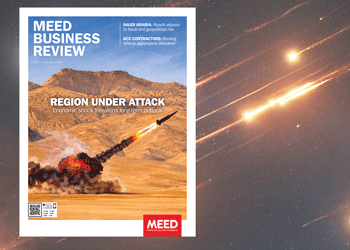
Safety and security matters
3 April 2026
 Commentary
Colin Foreman
EditorRead the April issue of MEED Business Review
Employment and investment opportunities in a low or no-tax environment have been key attractions for people and businesses located in the GCC for decades. Another crucial factor has been safety and security.
That reputation has been tested by the missile and drone attacks that began on 28 February. Whether the GCC’s safe haven status has been damaged depends on perspective.
 For some, the fact that attacks occurred fundamentally changes how the region is viewed. For others, the ability to absorb a serious shock, respond quickly, and keep daily life and businesses functioning demonstrates resilience.
Any assessment of safety is also relative. Many people and businesses that relocate in the GCC do so not only for opportunity, but because of dissatisfaction elsewhere. Common reasons include limited economic prospects, high taxation, distrust in political leadership and concerns about personal safety. Even with the recent conflict, the GCC may still compare favourably for those considering these factors.
There is no doubt that missile and drone attacks are extremely dangerous, and the fear of further incidents can linger. Even if attacks are infrequent, the uncertainty matters. It can influence personal decisions, travel advice, and the cost of insurance and risk management. These perceptions will shape the region’s attractiveness.
Safety concerns vary. In many parts of the world, higher levels of crime are an everyday worry for residents and businesses. For some, the GCC may still feel like the better option, provided the current tensions do not become the new normal.
How this question is answered will play an important role in how the region’s economies perform in the period ahead. If confidence returns quickly and the risk is seen as contained and manageable, investment and hiring will likely rebound faster than many expect. If uncertainty persists or escalates, the road to recovery will be a long one.
 READ THE APRIL 2026 MEED BUSINESS REVIEW – click here to view PDF
Economic shock threatens long-term outlook; Riyadh adjusts to fiscal and geopolitical risk; GCC contractor ranking reflects gigaprojects slowdown.
Distributed to senior decision-makers in the region and around the world, the April 2026 edition of MEED Business Review includes:
> AGENDA: Gulf economies under fire> GCC CONTRACTOR RANKING: Construction guard undergoes a shift> MARKET FOCUS: Risk accelerates Saudi spending shift> QATAR LNG: Qatar’s new $8bn investment heats up global LNG race> LEADERSHIP: Shaping the future of passenger rail in the Middle EastTo see previous issues of MEED Business Review, please click here https://image.digitalinsightresearch.in/uploads/NewsArticle/16250747/main.gif
 -
Saudi forecast remains one of growth
3 April 2026

MEED’s April 2026 report on Saudi Arabia includes:
> COMMENT: Risk accelerates Saudi spending shift
> GVT &: ECONOMY: Riyadh navigates a changed landscape
> BANKING: Testing times for Saudi banks
> UPSTREAM: Offshore oil and gas projects to dominate Aramco capex in 2026
> DOWNSTREAM: Saudi downstream projects market enters lean period
> POWER: Wind power gathers pace in Saudi Arabia
> WATER: Sharakat plan signals next phase of Saudi water expansion
> CONSTRUCTION: Saudi construction enters a period of strategic readjustment
> TRANSPORT: Rail expansion powers Saudi Arabia’s infrastructure pushTo see previous issues of MEED Business Review, please click herehttps://image.digitalinsightresearch.in/uploads/NewsArticle/16250096/main.gif -
Dubai seeks consultants for Al-Khawaneej stormwater project
3 April 2026
Dubai Municipality has issued a consultancy tender to assess and upgrade the stormwater drainage system serving the Al-Khawaneej First residential district in northeastern Dubai.
The project, listed as TF-22-E1, covers the upgrading and rehabilitation of the stormwater system in the area. The tender has been issued by the municipality’s Sewerage and Recycled Water Projects Department.
The bid submission deadline is 23 April.
The works form part of Dubai’s wider efforts to strengthen flood resilience and support sustainable urban infrastructure development.
Two separate consultancy tenders were issued in March as part of a broader review of the emirate’s water and wastewater infrastructure to support future population growth.
One involves a study to develop a sustainable urban drainage systems strategy across the emirate. The other covers a review of the emirate’s sewage treatment and recycled water distribution strategy.
The Al-Khawaneej First consultancy role will include data collection, site investigations and an assessment of existing drainage conditions.
Additionally, the consultant will be required to identify flooding hotspots and evaluate the performance of the current system.
The project covers the preparation of preliminary and detailed designs, tender documents and construction packages as well as construction supervision through to project handover.
The municipality added that integrated drainage solutions are to be developed as part of the package, including sustainable drainage systems (SuDS) and nature-based approaches to address current and future stormwater demand.
READ THE APRIL 2026 MEED BUSINESS REVIEW – click here to view PDFEconomic shock threatens long-term outlook; Riyadh adjusts to fiscal and geopolitical risk; GCC contractor ranking reflects gigaprojects slowdown.
Distributed to senior decision-makers in the region and around the world, the April 2026 edition of MEED Business Review includes:
> AGENDA: Gulf economies under fire> GCC CONTRACTOR RANKING: Construction guard undergoes a shift> MARKET FOCUS: Risk accelerates Saudi spending shift> QATAR LNG: Qatar’s new $8bn investment heats up global LNG race> LEADERSHIP: Shaping the future of passenger rail in the Middle EastTo see previous issues of MEED Business Review, please click herehttps://image.digitalinsightresearch.in/uploads/NewsArticle/16249098/main.jpg -
Developer plans two residential schemes in Saudi Arabia
3 April 2026
Saudi developer Alramz Real Estate is planning two new residential developments in Jeddah and Riyadh.
In a Tadawul filing on 31 March, Alramz said it had signed an agreement with Oud Capital to establish a sharia-compliant real estate investment fund to develop the Alramz Front project in Jeddah’s Al-Firdous district.
The fund is targeting approximately SR650m ($173m), with Alramz committing about SR81.6m. The company will also contribute land totalling around 47,800 square metres, valued at SR215m, as an in-kind contribution.
The project is expected to deliver nearly 900 residential units. Alramz will serve as developer and exclusive marketer under a development contract valued at about SR269m.
Separately, Alramz said it had acquired mixed-use plots in Riyadh’s Al-Malqa district for SR94.6m. The 8,600 sq m site will be developed into a residential scheme comprising approximately 135 apartments.
READ THE APRIL 2026 MEED BUSINESS REVIEW – click here to view PDFEconomic shock threatens long-term outlook; Riyadh adjusts to fiscal and geopolitical risk; GCC contractor ranking reflects gigaprojects slowdown.
Distributed to senior decision-makers in the region and around the world, the April 2026 edition of MEED Business Review includes:
> AGENDA: Gulf economies under fire> GCC CONTRACTOR RANKING: Construction guard undergoes a shift> MARKET FOCUS: Risk accelerates Saudi spending shift> QATAR LNG: Qatar’s new $8bn investment heats up global LNG race> LEADERSHIP: Shaping the future of passenger rail in the Middle EastTo see previous issues of MEED Business Review, please click herehttps://image.digitalinsightresearch.in/uploads/NewsArticle/16249064/main.jpg -
Oman’s Nama PWP tenders consultancy contract
3 April 2026
Oman’s Nama Power & Water Procurement Company (Nama PWP) has opened a tender for the provision of environmental, social and governance (ESG) reporting consultancy services.
The tender seeks proposals from interested parties to support the utility in assessing its ESG maturity and identifying gaps against the Oman Investment Authority’s ESG guidelines.
The deadline for firms to submit offers is 10 May.
According to the tender notice, the selected consultant will develop the required ESG policies, strategy, report and implementation roadmap.
Nama PWP, part of Nama Group, said the scope of work is intended to support the company’s wider ESG framework as it continues to procure new power and water capacity in Oman.
The utility also recently opened a tender seeking proposals from qualified law firms to provide legal consultancy services in Oman.
The selected firms will be included on a panel and engaged on an as-needed basis. They will deliver legal advisory services across a range of matters relevant to Nama PWP’s business.
The deadline for firms to submit offers is 21 April.
In March, the state utility released its latest seven-year plan outlining the rapid expansion of solar and wind projects.
It expects the renewable energy share of Oman’s power generation mix to increase steadily across the period, reaching 16% in 2028 and 21% in 2029 before rising to 30% in 2030. This compares to about 4% in 2024.
The pipeline includes a series of large-scale independent power projects scheduled for delivery between 2027 and 2031.
Solar photovoltaic capacity in the sultanate is projected to rise from 1.54GW in 2024 to 23.26GW by 2031. Wind capacity is expected to grow from 120MW to 6.75GW,
READ THE APRIL 2026 MEED BUSINESS REVIEW – click here to view PDFEconomic shock threatens long-term outlook; Riyadh adjusts to fiscal and geopolitical risk; GCC contractor ranking reflects gigaprojects slowdown.
Distributed to senior decision-makers in the region and around the world, the April 2026 edition of MEED Business Review includes:
> AGENDA: Gulf economies under fire> GCC CONTRACTOR RANKING: Construction guard undergoes a shift> MARKET FOCUS: Risk accelerates Saudi spending shift> QATAR LNG: Qatar’s new $8bn investment heats up global LNG race> LEADERSHIP: Shaping the future of passenger rail in the Middle EastTo see previous issues of MEED Business Review, please click herehttps://image.digitalinsightresearch.in/uploads/NewsArticle/16249021/main.jpg