
Contract award nears for Abha airport expansion PPP
10 February 2026

Saudi Arabia’s Civil Aviation Holding Company (Matarat) and the National Centre for Privatisation & PPP (NCP) are said to be close to awarding a contract to develop and operate a new passenger terminal building and related facilities at Abha International airport.
MEED understands that the negotiations are in the final stages and the contract will be awarded within a few weeks.
The companies prequalified to bid for the contract are:
- GMR Airports (India)
- Mada TAV: Mada International Holding (local) / TAV Airports Holding
- Touwalk Alliance: Skilled Engineers Contracting (local) / Limak Insaat (Turkiye) / Incheon International Airport Corporation (South Korea) / Dar Al-Handasah Consultants (Shair & Partners, Lebanon) / Obermeyer Middle East (Germany/Abu Dhabi)
- VI Asyad DAA: Vision International Investment Company (local) / Asyad Holding (local) / DAA International (Ireland)
Located in Asir Province, the first phase of the Abha International airport public-private partnership (PPP) project will expand the terminal area from 10,500 square metres (sq m) to 65,000 sq m.
In March last year, the clients held one-on-one meetings with prospective bidders in Riyadh.
The contract scope includes a new rapid-exit taxiway on the existing runway, a new apron to serve the new terminal, access roads to the new terminal building and a new car park area.
Additionally, the scope includes support facilities, such as an electrical substation expansion and a new sewage treatment plant.
Construction is scheduled for completion in 2028.
The project will be developed under a build-transfer-operate (BTO) model and will involve designing, financing, constructing and operating a greenfield terminal.
This will be the kingdom’s third airport PPP project, following the Hajj terminal at Jeddah’s King Abdulaziz International airport and the $1.2bn Prince Mohammed Bin Abdulaziz International airport in Medina.
Higher capacity
According to Matarat, Abha airport’s capacity will increase to accommodate over 13 million passengers annually – a 10-fold rise from its current 1.5 million capacity.
Once completed, the airport will handle more than 90,000 flights a year, up from 30,000.
The new terminal is also expected to feature 20 gates and 41 check-in counters, including seven new self-service check-in kiosks.
The BTO contract duration is 30 years.
The existing terminal, which served 4.4 million passengers in 2019, will be closed once the new terminal becomes operational.
Matarat’s transaction advisory team for the project comprises UK-headquartered Deloitte as financial adviser, ALG as technical adviser and London-based Ashurst as legal adviser.
ALSO READ: Saudi Arabia seeks Qassim airport PPP interest


Register for MEED's guest program now to access this article.
Exclusive from Meed
-
 Remaking construction in Saudi Arabia
27 March 2026
-

-
 March 2026: Data drives regional projects
27 March 2026
-
 Redefining the region’s arbitration landscape
27 March 2026
-
 Algeria tenders multibillion-dollar railway construction
27 March 2026
All of this is only 1% of what MEED.com has to offer
Subscribe now and unlock all the 153,671 articles on MEED.com
- All the latest news, data, and market intelligence across MENA at your fingerprints
- First-hand updates and inside information on projects, clients and competitors that matter to you
- 20 years' archive of information, data, and news for you to access at your convenience
- Strategize to succeed and minimise risks with timely analysis of current and future market trends

Related Articles
-
Remaking construction in Saudi Arabia
27 March 2026
As the Public Investment Fund (PIF) took a leading role in developing projects following the launch of Vision 2030, it quickly realised that Saudi Arabia’s construction sector needed support if the kingdom was to achieve its broader economic ambitions.
The PIF’s National Development Division (NDD) is the entity tasked with building capacity and capability in the construction sector to support PIF projects and other strategically important schemes in the kingdom.
“Our job is to facilitate the development of the local value chains, which are essential to support the development and operations of PIF portfolio companies,” says Leyla Abdimomunova, head of real estate and construction, National Development Division, PIF.
The scale of this undertaking requires a multi-front strategy, targeting everything from consultancy services and contracting capacity to raw materials and advanced technologies.
“The focus is on design and construction services, building materials, construction equipment and the value chain for all things in construction technology. This work requires engagements with stakeholders within the PIF portfolio: development and contracting companies where PIF has a share,” says Abdimomunova. “We also work closely with governmental stakeholders – including the Ministry of Municipalities & Housing, the Ministry of Investment and the Ministry of Industry & Mineral Resources – alongside our private sector partners, to ensure alignment across the ecosystem.
“This collaboration approach is essential to addressing market challenges holistically and creating an environment where businesses can invest, grow and participate more effectively in Saudi Arabia’s development,” she notes.
Unified strategy
The integrated approach was born out of necessity.
“When we started this work five years ago, the initial challenge we dealt with was the shortage of the local supply of construction services and materials,” says Abdimomunova.
To bridge the gap, the NDD looked to both support local players and attract international firms.
“The focus was on the localisation of the supply chain, bringing the manufacturing capacity into the kingdom by either expanding the existing capacities of local players or installing new capacity together with local players, but also bringing foreign investments into the country to set up factories,” she says.
On the services side, the challenge was reputational. Riyadh had to convince the world’s best builders that the Saudi market had fundamentally changed. While courting global giants, the NDD also had to address the fragmentation of the domestic market.
“We found that there were two primary obstacles in our portfolio: a high concentration of contractors on one hand, and underutilised capabilities of the local contractors on the other hand.”
The challenge was moving the large number of small and medium-sized enterprises (SMEs) from the periphery to the core of the PIF’s portfolio of projects.
“In order to overcome these obstacles, a lot of focus was on attracting international contractors – those that were not working in the kingdom at the time – in order to expand and diversify the pool of contractors, while also putting a lot of effort into building up the capabilities within the local market,” Abdimomunova notes.
“The local contracting market is very fragmented. A large proportion of contractors are SMEs, and only the large Saudi contractors are predominantly known inside the kingdom.
“We put in place programmes to support the development of the medium-sized contractors and increase their visibility to our development companies,” she says.
A lot of effort went into making sure contractors have access to financing
Leyla Abdimomunova, National Development Division, PIFThe NDD has also introduced practical upskilling and financial tools. “We put in place a few tools, working together with ecosystem partners. For example, the Prequalification Platform, which was launched and is being operated with the Saudi Contractors Authority, [and] contractor upskilling bootcamps that have been delivered by our development companies to provide contractors with the basic understanding needed to be able to bid for projects.
“A lot of effort went into making sure contractors have access to financing,” Abdimomunova adds.
Indeed, addressing the finances of the construction sector was another critical area for the NDD.
 By moving beyond traditional methods and practices, it has introduced more flexible liquidity options for the industry.
 “We launched the Contractor Financing Programme to expand access to financing and strengthen liquidity for contactors supporting Saudi Arabia’s development pipeline.
“In partnership with the National Infrastructure Fund, we introduced guarantee mechanisms to unlock additional bank lending capacity, alongside a new product for the region: surety bonds – as an insurance alternative to traditional bank guarantees,” says Abdimomunova.
“Since receiving regulatory approval last year, 34 surety bonds have already been issued, helping contractors participate more effectively in large-scale projects.”
Adjusting priorities
With the foundational work established, the NDD is now shifting its focus towards streamlining the experience for international companies and tackling the sector’s long-standing structural hurdles.
Looking ahead, the NDD intends to tackle the perennial problems of the industry – payment delays and productivity – to ensure that the transformation of the sector is permanent.
“Going forwards, our work will go one level deeper, focusing on resolving structural challenges and strengthening the underlying enablers that support private sector participation.
“We are working closely with our partners across Saudi Arabia to ensure these improvements are sustainable, scalable and embedded not only within the PIF’s ecosystem, but across the broader national economy,” Abdimomunova concludes.
https://image.digitalinsightresearch.in/uploads/NewsArticle/16160974/main.gif -
Contractor appointed for Morocco grand stadium rail station
27 March 2026
Moroccan construction firm Jet Contractors has won a contract to build a railway station at the Grand Stade Hassan II stadium in Benslimane, as part of the Kenitra-Marrakech high-speed rail project.
The estimated $45m deal was awarded by the Moroccan National Railways Office (ONCF).
The new station will serve the 115,000-seat Grand Stade Hassan II and will allow passengers to travel from Casablanca and Rabat in 20 minutes using the high-speed rail network.
It is expected to handle around 12 million passengers a year. Construction of the station is scheduled for completion in 2028.
Construction work on the main stadium started in June last year, when a joint venture of local contractors Travaux Generaux de Construction de Casablanca and Societe Generale des Travaux du Maroc was awarded a $320m contract for the next stage of works on the stadium. The venue will be one of the hosts for the 2030 Fifa World Cup.
The stadium is being built on a 100-hectare site in the El-Mansouria area of Benslimane Province, 38 kilometres north of Casablanca.
Morocco has been investing heavily in upgrading its infrastructure for the football World Cup, which it is co-hosting with Spain and Portugal.
Morocco was effectively confirmed as a host country alongside Spain and Portugal in October 2023, after the group emerged as the sole bidder for the event. The official selection was announced in December last year.
Along with building a stadium in Benslimane, the Moroccan government plans to revamp six existing stadiums in Agadir, Casablanca, Fez, Marrakech, Rabat and Tangier, and upgrade air, road and rail projects.
Last year, Morocco’s transport and logistics minister unveiled a MD96bn ($9.5bn) investment plan to transform the country’s rail infrastructure by 2030.
The announcement followed the award of about MD20bn-worth of contracts in November 2024 – mostly to local and Chinese firms – for civil works packages on the Marrakech-Kenitra high-speed rail line.
The link will extend the Al-Boraq railway, a high-speed rail line between Tangier, Rabat and Casablanca. The line started operating in 2018 and was Africa’s first high-speed railway system.
https://image.digitalinsightresearch.in/uploads/NewsArticle/16159882/main.jpg -
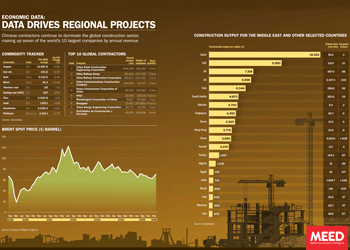
March 2026: Data drives regional projects
27 March 2026
Click here to download the PDF
Includes: Commodity tracker | Top 10 global contractors | Brent spot price | Construction output
MEED’s April 2026 report on Saudi Arabia includes:
> GVT &: ECONOMY: Riyadh navigates a changed landscape
> BANKING: Testing times for Saudi banks
> UPSTREAM: Offshore oil and gas projects to dominate Aramco capex in 2026
> DOWNSTREAM: Saudi downstream projects market enters lean period
> POWER: Wind power gathers pace in Saudi Arabia
> WATER: Sharakat plan signals next phase of Saudi water expansion
> CONSTRUCTION: Saudi construction enters a period of strategic readjustment
> TRANSPORT: Rail expansion powers Saudi Arabia’s infrastructure pushTo see previous issues of MEED Business Review, please click herehttps://image.digitalinsightresearch.in/uploads/NewsArticle/16146608/main.gif -
Redefining the region’s arbitration landscape
27 March 2026
In the midst of increasing international investments and commercial transactions in the Middle East, arbitration remains a key component for the resolution of complex commercial disputes. Its effectiveness, however, depends not only on arbitral tribunals, but also on how national courts define their roles in oversight and enforcement.
Recent trends in the Middle East have shown a more disciplined judicial approach with a clearer delineation of roles between courts and arbitral tribunals.
Enforcement: a narrower approach
Enforcement of foreign awards has been a key area of development.
In the UAE, the Committee for the Unification of Federal and Local Judicial Principles ruled in Petition No. 1 of 2025 that an award shall be valid and enforceable provided the arbitrators sign only the final page. Referring to earlier Dubai Court of Cassation decisions (1), the Committee noted that procedural rules should not be used to defeat substantive rights and that legal procedures are meant to serve justice, not to create technical barriers.
The Dubai Court of Cassation adopted the same approach, confirming that arbitrators are not required to sign every page of the award and that issues already examined during arbitration, including signatory capacity, cannot be reopened at the enforcement stage. (2)
A similar emphasis on clarity can be seen in Saudi Arabia, where the Arbitration Law is currently under review, with the aim of modernising the legislative framework and enhancing predictability. The draft reform includes clearer provisions regarding court–tribunal interaction, permits courts to stay annulment proceedings or enforcement challenges for up to 60 days to enable tribunals to cure defects, and confirms that partial and interim awards have the authority of a final judgment and are directly enforceable.
The ADGM and Dubai Courts have also introduced a system of reciprocal enforcement of ratified arbitral awards without the need to re-examine the underlying award.
These developments therefore suggest a narrower approach and a reduced scope for expansive review at the enforcement stage.
Recent trends have shown a more disciplined judicial approach with a clearer delineation of roles between courts and arbitral tribunals
Judicial intervention: limits of review
Courts have also refined the scope of annulment and supervisory review.
The Abu Dhabi Court of Cassation clarified that annulment is not an appeal on the merits. Courts may not reweigh evidence or revisit a tribunal’s interpretation of the law. The grounds of annulment remain limited to the statutory grounds set out in the Federal Arbitration Law. (3)
Egyptian courts likewise limit grounds for annulment to exhaustively listed statutory grounds, excluding reassessment of the merits.
In the wider regional landscape, Morocco’s arbitration reform demonstrates a similar trajectory. The updated framework modernises the regime and clarifies the supportive role of domestic courts, reinforcing a structured balance between oversight and arbitral autonomy.
Across these jurisdictions, review powers are increasingly exercised within defined legal parameters rather than through re-examination of arbitral reasoning.
Public policy: a limited exception
Public policy continues to be a ground for refusing enforcement, but recent decisions suggest it is applied with greater restraint. For instance, in the UAE, the imposition of compound interest is not considered to be in contravention of public policy. (4) At the DIFC level, the Court specified that the refusal on public policy grounds is subject to a high standard and is only justified where enforcement would “violate the forum state’s most basic notions of morality and justice”. (5)
Saudi Arabia recognises sharia compliance and public policy as potential grounds for refusal. While rooted in the foundations of its legal system, they operate within defined statutory boundaries.
Public policy therefore functions as a defined safeguard rather than a vehicle for broad review.
Implications for cross-border activity
Where enforcement review is confined to the grounds set out in the New York Convention and annulment remains limited to statutory bases, the interaction between tribunals and courts becomes more predictable. In disputes involving assets across multiple states, this delineation contributes to greater certainty at the post-award stage.
The complementary role of the ICC
Institutional practice operates alongside these developments.
The ICC Court and its Secretariat ensure proceedings are conducted with care, independence, impartiality and integrity, in strict compliance with the Court’s obligations and duties under its rules. In doing so, the Court and the Secretariat monitor cases to safeguard due process and procedural fairness.
One of the distinctive features of ICC arbitration and a cornerstone of the Rules is the Court’s scrutiny of all draft awards. Such a process serves to enhance the quality of the award, improve its general accuracy and persuasiveness; and maximise its legal effectiveness by identifying any defects that could be used in an attempt to have it set aside at the place of arbitration or resist its enforcement elsewhere.
In complex, multi-contract and multi-jurisdictional disputes, this scrutiny plays an important role in safeguarding enforceability across different jurisdictions.
As courts continue to define the limits of intervention, institutional discipline and judicial oversight increasingly operate side by side, reinforcing confidence in arbitration across the Middle East.
1. Dubai Court of Cassation – Cases No. 109/2022 and No. 403/2020 2. Dubai Court of Cassation – Appeals Nos. 778 and 887 of 2025 3. Abu Dhabi Court of Cassation – Cases Nos. 1115/2024 and No. 166/2024 4. Dubai Court of Cassation – Appeals Nos. 778 and 887 of 2025 5. DIFC Court of Appeal’s decision dated 9 January 2025
About the author
Laetitia Rabbat is deputy counsel, ICC International Court of Arbitration, Abu Dhabihttps://image.digitalinsightresearch.in/uploads/NewsArticle/16145450/main.gif -
Algeria tenders multibillion-dollar railway construction
27 March 2026
Algeria’s state railway company, the Agence Nationale d’Etudes et de Suivi de la Realisation des Investissements Ferroviaires (Anesrif), has tendered two contracts worth more than $2.5bn for the construction of the Laghouat-Ghardaia-El-Meniaa railway line.
The contract scope covers the construction of 495 kilometres (km) of railway in two sections, the acquisition of rolling stock and other associated works.
The tenders were issued on 25 March, with bids due by 24 May.
The first line will run between Laghouat and Ghardaia, covering 265km. It will include 21 viaducts, one tunnel, 55 pipe crossings and five stations.
The project is split into four sections:
- Section A: Laghouat-Bellil (72.6km)
- Section B: Bellil-Bouzbier (40.4km)
- Section C: Bouzbier-Oued N’chou (69km)
- Section D: Oued N’chou-Metlili (47km)
Passenger trains will operate at up to 220 kilometres per hour (km/h), and freight trains at up to 100km/h. The railway will largely follow national road RN01.
The construction cost of this section is expected to be about $1.4bn.
The second line will run from Ghardaia to El-Meniaa. The 230km railway will start at Metlili station and extend south to El-Meniaa.
The line will serve Mansourah, Hassi Lefhel and El-Meniaa, as well as the planned new town of Hassi El-Gara.
It will comprise six viaducts, 35 railway structures and three stations.
Passenger trains will operate at up to 220km/h, while freight trains will run at up to 100km/h.
This section is expected to cost $1.2bn.
Earlier this month, MEED reported that Anesrif had formally started the procurement process for its multibillion-dollar Laghouat-Ghardaia-El-Meniaa railway project.
International and local firms were given until 8 March to submit expressions of interest for the overall client’s engineer role on the 495km development.
Consultancies were also given until 12 March to bid for two separate contracts covering project supervision and control of the first 265km section between Laghouat and Ghardaia, and the 230km line between Ghardaia and El-Meniaa.
The project received major backing in December last year when the African Development Bank approved a €747.32m ($870m) loan to finance it.
In September last year, MEED reported that Algeria’s Prime Minister, Nadir Larbaoui, had signed an executive decree that “formalised the declaration of public utility of two strategic sections of the future Algiers-Tamanrasset railway line”.
.gif) https://image.digitalinsightresearch.in/uploads/NewsArticle/16156750/main.jpg
https://image.digitalinsightresearch.in/uploads/NewsArticle/16156750/main.jpg