
Chinese firm wins 2.6GW Saudi inverter deals
21 November 2024
The engineering, procurement and construction (EPC) contractors implementing two of Saudi Arabia Public Investment Fund’s (PIF) cluster-four solar photovoltaic (PV) projects have awarded contracts for the supply of inverters to China’s Sineng Electric.
The Jiangsu-headquartered company secured an order for 1GW of inverters from China Energy Engineering Group Consortium for the Haden solar PV project and 1GW from Indian contracting firm Larsen & Toubro for the Al-Khushaybi solar PV project.
Sineng will provide its 8.8MW MV turnkey stations, each comprising two units of 4.4MW central inverters, a transformer and a ring main unit (RMU) for the solar projects.
Designed to “withstand extreme temperatures [of] up to 51ºC … and strong sand-laden winds”, the 8.8MW MV turnkey stations are expected to deliver consistent and reliable performance throughout the solar PV plants’ operational lifespan.
The PIF awarded the contracts to develop three cluster-four solar PV projects to a consortium led by Saudi utility developer Acwa Power earlier this year.
The developer consortium, which includes PIF-backed Water & Electricity Holding Company (Badeel) and Saudi Aramco Power Company (Sapco), reached financial close in September for the three projects, which have a total combined capacity of 5,500MW.
The solar PV projects and their capacities are:
- Haden solar PV (Mecca): 2,000MW
- Muwayh (Mecca): 2,000MW
- Al-Khushaybi (Qassim): 1,500MW
The respective project companies formed for the three projects are Buraiq Renewable Energy Company, Moya Renewable Energy Company and Nabah Renewable Energy Company.
Acwa Power’s effective shareholding in each of the three projects is 35.1%. Badeel owns 34.9% and Sapco, a subsidiary of state majority-owned oil giant Saudi Aramco, owns the remaining shares.
The project companies signed financing documents amounting to SR9.7bn ($2.6bn), Acwa Power previously announced. The financing duration is 27.3 years.
The three projects are being procured under the National Renewable Energy Programme’s (NREP) Price Discovery Scheme, which the PIF is implementing.
Under this scheme, the projects are directly negotiated with Acwa Power and its selected partners.
The three new solar PV facilities have a combined value of SR12.3bn ($3.3bn) and are expected to become operational in the first half of 2027.
The PIF and its partners are developing several solar PV projects with a total capacity of 13.6GW, involving over $9bn in investments. These joint projects – including Sudair, Shuaibah 2, Ar Rass 2, Al-Kahfah and Saad 2 – aim to support the local private sector through domestic supply-chain participation.

Register for MEED's guest program now to access this article.
Exclusive from Meed
-
-
-
 Contractor wins Qiddiya Speed Park package deal
3 July 2026
-
 Local contractor wins DIFC tower contract
3 July 2026
-
 Iraq and Turkiye discuss oil pipeline deal
3 July 2026
All of this is only 1% of what MEED.com has to offer
Subscribe now and unlock all the 153,671 articles on MEED.com
- All the latest news, data, and market intelligence across MENA at your fingerprints
- First-hand updates and inside information on projects, clients and competitors that matter to you
- 20 years' archive of information, data, and news for you to access at your convenience
- Strategize to succeed and minimise risks with timely analysis of current and future market trends
Related Articles
-
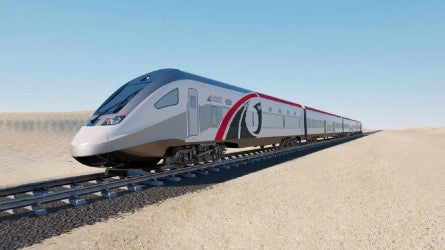
UAE to add Ajman to its Etihad Rail passenger network
3 July 2026

Register for MEED’s 14-day trial access
As part of ongoing procurement for the UAE’s national passenger rail rollout, Abu Dhabi’s Etihad Rail is adding Ajman to the planned network, extending coverage to five of the seven emirates.
Etihad Rail tendered a design-and-build contract in late June to construct a section of the network to Hamriyah in Ajman, branching off from its existing freight network.
The scope includes civil and track works, the construction of a passenger station and other associated infrastructure.
Contractors have until 27 July to submit their proposals.
The extension to Ajman brings Etihad Rail’s passenger network closer to the wider Northern Emirates, where Umm Al-Quwain and Ras Al-Khaimah still sit outside the current rollout, despite lying along the existing freight corridor, which currently terminates at Al-Ghail dry port in Ras Al-Khaimah.
The sequencing of the Ajman section could pave the way for further extensions if this section proves successful.
The latest development follows Etihad Rail’s start of passenger rail operations on 30 June 2026, with an introductory operational phase on the Abu Dhabi-Fujairah route.
The passenger roll-out marked a major milestone for Etihad Rail, which was established in 2009 and tasked with delivering a roughly 900-kilometre railway linking key cities, ports and industrial hubs from Ghuwaifat to Fujairah on the eastern coast.
The launch came less than five years after the UAE announced its ambition to create a national passenger railway under the country’s “Projects of the 50” programme, aiming to support economic diversification and sustainable development.
According to Etihad Rail, passenger services will be introduced in planned phases through 2026 and 2027:
- 23 June 2026: Passenger tickets went on sale via the Etihad Rail app and a dedicated booking website (as well as the contact centre for certain fares)
- 30 June 2026: Introductory operational phase begins with services between Abu Dhabi and Fujairah only
- 30 September 2026: Passenger rail services formally commence and expand to include Abu Dhabi, Dubai, Al-Dhaid and Fujairah
- 30 December 2026: Services extend to Al-Dhafra stations
- 30 March 2027: Services expand further to include Sharjah
In response to MEED’s request for comment on the Ajman section, Etihad Rail said:
“Etihad Rail remains committed to supporting the UAE’s vision for an integrated, efficient and sustainable transport network that enhances connectivity between communities and supports the nation’s long-term economic and social development.
“As previously announced, Etihad Rail’s passenger services are being introduced in phases, with further expansion planned over time. We do not comment on market speculation, commercial discussions, procurement activity, or projects that have not been formally announced.
“Any updates regarding future developments will be communicated through official channels in due course.”

Passenger rail operations
Tickets for the Abu Dhabi-Fujairah route are already on sale through the operator’s digital platforms.
Customers can book tickets up to four weeks before travel. Tickets for new destinations will be released in line with the phased roll-out.
At this point, Etihad Rail’s passenger service will officially connect 11 cities and regions across the UAE, supported by a station network that links key urban and economic centres. The station list includes:
- Abu Dhabi – Mohamed Bin Zayed City Station
- Dubai – Al-Yalayis Station
- Sharjah – University City Station
- Fujairah Station
- Al-Dhaid Station
- Al-Dhannah Station
- Madinat Zayed Station
- Liwa Station
- Al-Mirfa Station
- Al-Sila Station
- Al-Faya Station
Construction history
The first phase of Etihad Rail comprised a 264-kilometre freight line spanning Shah, Habshan and Ruwais. This was primarily delivered by a consortium of Italy’s Saipem and Maire Technimont, alongside UAE-based Dodsal Engineering & Construction.
Stage 2 of Etihad Rail comprises four major packages.
India’s Larsen & Toubro worked with Chinese state-owned PowerChina International on the design and construction of freight facilities for Stage 2 under a AED1.87bn contract.
A joint venture comprising China State Construction Engineering Corporation and South Korea’s SK Engineering worked on the first of four civil and track works packages for the 139km line between Ghuwaifat and Ruwais. The contract, worth AED1.5bn, was confirmed in March 2019.
Packages B and C of Stage 2 were awarded to a joint venture of Beijing-based China Railway Construction Corporation and local Ghantoot Transport & General Contracting in June 2019.
Both packages are understood to have a combined value of AED4.4bn and cover 310km of the rail network.
In December 2019, a joint venture of CRCC and local National Projects & Construction was formally confirmed for the AED4.6bn Package D.
Package D will link the ports of Fujairah and Khorfakkan to the network at the Dubai-Sharjah border and stretches over a distance of 145km.
https://image.digitalinsightresearch.in/uploads/NewsArticle/17525193/main.jpg -
IHC deepens India links with $11.5bn aluminium venture
3 July 2026
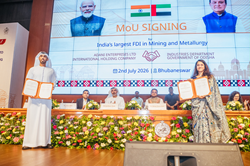
Abu Dhabi’s International Holding Company (IHC) has struck its third major partnership with India’s Adani Group in a year, signing an agreement to co-develop an $11.5bn greenfield aluminium complex in the eastern Indian state of Odisha.
Under a memorandum of understanding signed with the Odisha state government on 2 July, Adani Enterprises (AEL) and International Resources Holding (IRH), the natural resources investment platform IHC operates through its 2PointZero subsidiary, will form a 50:50 joint venture to build an integrated alumina and aluminium complex. The project comprises a 4-million-tonne-a-year (t/y) alumina refinery, a 2 million t/y aluminium smelter, a 4,000MW captive power plant and a 1 million t/y downstream manufacturing park.
The deal marks Odisha’s largest foreign direct investment proposal to date and what the partners describe as India’s largest single foreign investment in the metallurgy sector. It is expected to create about 53,500 jobs, split between roughly 35,000 during construction and 18,500 in ongoing mining, refining, smelting and manufacturing operations once the complex is running.
The tie-up extends a fast-growing relationship between IHC and Adani that began with a renewable energy joint venture between IHC subsidiary ePointZero and Adani Green Energy earlier this year. For IHC, which has built a $233bn portfolio spanning more than 1,300 subsidiaries across technology, infrastructure, financial services and consumer sectors, the Odisha project deepens a strategy of using IRH as a vehicle to secure positions across the minerals value chain underpinning the energy transition, moving beyond passive investment into direct industrial development.
Odisha holds some of India’s largest bauxite reserves and is already a significant alumina and aluminium producer. State officials cast the project as central to plans to position the region as a global manufacturing hub, tying it to the state’s Samruddha Odisha 2036 development programme and the national Viksit Bharat 2047 agenda.
The project will proceed in two phases. Following the MoU signing, AEL and IRH said they would move to land acquisition, statutory approvals and infrastructure planning alongside the Odisha government.
https://image.digitalinsightresearch.in/uploads/NewsArticle/17539363/main.png -
Contractor wins Qiddiya Speed Park package deal
3 July 2026
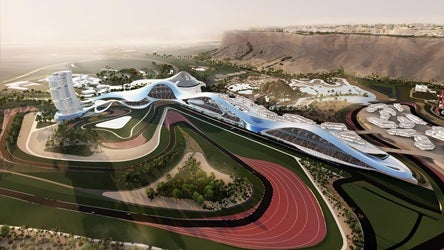
Riyadh-based contractor El-Seif Engineering Contracting has won a contract to build the Exclusive Viewing Lounge (EVL) project in Qiddiya Entertainment City.
Saudi gigaproject developer Qiddiya Investment Company (QIC) awarded the contract.
The EVL comprises a four-storey structure designed for race-day viewing and guest hospitality. It will include dedicated spectator viewing areas, indoor lounge spaces, guest amenities and back-of-house service areas to support operations.
Local firm Ammico Contracting carried out the project’s enabling works.
The EVL is part of the Speed Park project at Qiddiya, which El-Seif Engineering Contracting and UAE-based Alec are jointly executing, as previously reported by MEED. The wider scope includes the construction of buildings around the racetrack.
The racetrack is being delivered by local United Maintenance & Contracting Company (Unimac). In February 2024, MEED exclusively reported that QIC had awarded an estimated SR1.8bn ($480m) contract for the racetrack and associated infrastructure at Qiddiya’s Speed Park.
The contract scope includes the track build and all infrastructure works, including electrical networks, storm drainage systems, water and sewer networks, landscaping, and associated underground and above-ground structures, along with related civil works.
The Speed Park is being built around a Federation Internationale de l’Automobile (FIA) Grade 1 racetrack as part of the resort core in Qiddiya Entertainment City. Once complete, the circuit will be capable of hosting Formula 1 Grand Prix and motorcycling MotoGP races.
The Speed Park is one of several major projects within the greater Qiddiya development. Other projects include an e-games arena, the Prince Mohammed Bin Salman Stadium, a horse race venue, a performing arts centre, the Dragon Ball and Six Flags theme parks, and Aquarabia.
The project is a key part of Riyadh’s strategy to boost leisure tourism in the kingdom. According to GlobalData, leisure tourism in Saudi Arabia has experienced significant growth in recent years.
https://image.digitalinsightresearch.in/uploads/NewsArticle/17538940/main.jpg -
Local contractor wins DIFC tower contract
3 July 2026
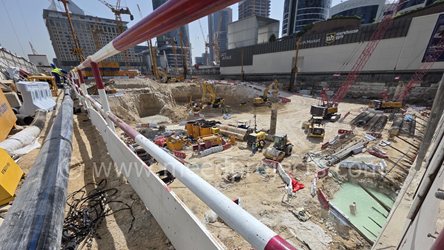
Dubai-based contractor Al-Basti & Muktha has been awarded a contract to build the DIFC Heights Tower mixed-use development.
The state-backed Dubai International Financial Centre (DIFC) awarded the contract.
The project comprises a 43-storey building with 366 residential units, office space, and retail and food-and-beverage outlets. Construction is expected to commence shortly, with completion slated for 2029.
Enabling works are under way and are being undertaken by Germany’s Bauer.
Lebanese engineering firm Dar Al-Handasah is the lead and supervision consultant, while UAE-based Time is the project manager. Canadian engineering firm AtkinsRealis is the architect and concept designer, and local firm Omnium is the cost consultant.
In a statement, DIFC said the project is being developed on the final remaining plot within its original land bank in the Gate District.
Earlier this year, Dubai announced a AED100bn ($27bn) expansion of DIFC through the creation of the DIFC Zabeel District. A statement from the Government of Dubai Media Office said the new district will add more than 7 million square feet (sq ft), bringing total gross floor area to 17.7 million sq ft.
The Zabeel District is expected to more than double DIFC’s capacity to more than 42,000 businesses, support a workforce exceeding 125,000, and allocate more than 1 million sq ft for future technologies and artificial intelligence. Planned in six phases, the expansion is scheduled to open to the public in 2030, with the masterplan due for completion in 2040.
A bridge will link the DIFC Zabeel District to the existing DIFC Gate District.
 READ THE JULY 2026 MEED BUSINESS REVIEW – click here to view PDF
Stress test for Gulf aviation; Mixed performance as country outlooks diverge in the Levant; GCC tourism sector pivots from crisis to recovery mode.
Distributed to senior decision-makers in the region and around the world, the July 2026 edition of MEED Business Review includes:
> AIRPORTS: Dubai and Riyadh reaffirm airport ambitions> INDUSTRY REPORT: Dubai eyes tourism sector recovery> DATA CENTRES: Big Tech falls short on data centre promise> LEADERSHIP: Aramco’s citizen developers accelerate digital changeTo see previous issues of MEED Business Review, please click herehttps://image.digitalinsightresearch.in/uploads/NewsArticle/17538278/main.jpg -
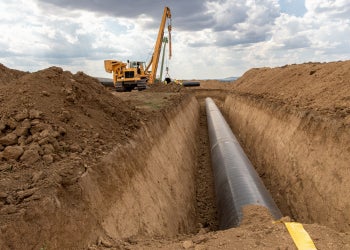
Iraq and Turkiye discuss oil pipeline deal
3 July 2026
Turkiye’s Energy Minister Alparslan Bayraktar has met with senior Iraqi oil and foreign ministry officials to discuss energy cooperation, including on the Iraq-Turkiye Pipeline (ITP) that runs from Kirkuk to Ceyhan, according to a statement.
In a post on social media, Bayraktar said that Turkiye aims to work closely with the new Iraqi government on more effective use of existing energy infrastructure.
The decades-old agreement, which governs crude oil exports through the pipeline, is due to expire on 27 July.
Baghdad and Ankara are still discussing a new draft agreement.
Turkiye is also seeking to support existing infrastructure with new connections, Bayraktar said.
Baghdad last month asked Ankara to extend the pipeline agreement for at least a year to allow time for more talks, but Ankara said it does not want an extension under current conditions.
If the existing pipeline deal expires without Turkiye agreeing to an extension, it would be a major blow to Iraq, which has recently seen a large drop in crude exports due to disruption to shipping through the Strait of Hormuz.
At the moment, in addition to transporting oil from northern Iraq, the ITP is also transporting crude from southern Iraq, which is brought to the north by truck and then injected into the pipeline network.
At the end of March, Amer Khalil, the director-general of Iraq’s state-run North Oil Company, said that Iraq was exporting 200,000 barrels a day through the ITP.
https://image.digitalinsightresearch.in/uploads/NewsArticle/17538073/main.jpg