
Chevron yet to agree terms for Iraq oil field takeover
12 March 2026

US-based oil company Chevron is yet to agree terms with Iraqi state-owned Basra Oil Company (BOC) for its potential takeover of Iraq’s West Qurna-2 oil field, according to industry sources.
Last month, Chevron signed a preliminary agreement with BOC to explore taking control of the West Qurna-2 oil field.
Until recently, West Qurna-2 was operated by Russia’s Lukoil, which faces a 28 February deadline to divest its assets in Iraq under sanctions.
One industry source said: “Chevron is yet to agree terms, and it has made it clear that it wants different terms to the contract that Lukoil had.”
In January, Iraq’s cabinet approved temporarily nationalising petroleum operations at the West Qurna-2 oil field until a new operator was found.
Lukoil declared force majeure at the West Qurna-2 oil field in November, after sanctions by the UK, EU and US were announced in October.
The Russian company had a 75% stake in the asset.
Prior to Russia’s Lukoil declaring force majeure, Iraq’s state oil authorities froze all cash and crude payments to Lukoil in compliance with the sanctions.
In a statement released on 1 December 2025, Iraq’s Oil Ministry said that it had extended “direct and exclusive invitations to a number of major American oil companies”.
Awarded to Lukoil in 2009, West Qurna-2 lies about 65 kilometres northwest of Basra in southern Iraq and produces about 480,000 barrels a day (b/d) of oil, accounting for roughly 10% of the country’s total oil output.
At the same meeting on 23 February, Chevron also signed a deal relating to the development of the Nasiriyah field, four exploration sites in the province of Dhi Qar and a field in the province of Salahaddin.
Chevron signed an agreement in principle with Iraq in August 2025 to develop the Nasiriyah oil project in the province of Dhi Qar.
At the time, Iraq said it expected the Nasiriyah project to reach a production capacity of 600,000 b/d within seven years.
 READ THE MARCH 2026 MEED BUSINESS REVIEW – click here to view PDF
Riyadh urges private sector to take greater role; Chemical players look to spend rationally; Economic uptick lends confidence to Cairo’s reforms.
Distributed to senior decision-makers in the region and around the world, the March 2026 edition of MEED Business Review includes:
|
> RAMADAN: Data disproves the Ramadan slowdown story
> INDUSTRY REPORT: Chemicals producers look to cut spending
> INDUSTRY REPORT: Global petrochemical project capex set to rise until 2030
> MARKET FOCUS: Egypt’s crisis mode gives way to cautious revival
> LEADERSHIP: Delivering Saudi Arabia’s next phase of rail growth
> INTERVIEW: Abu Dhabi’s Enersol charts acquisitions path
|

Register for MEED's guest program now to access this article.
Exclusive from Meed
-
 Oil tankers attacked in Iraqi waters
12 March 2026
-
 Chevron yet to agree terms for Iraq oil field takeover
12 March 2026
-
 Egyptian/Saudi firms to invest $1.4bn in Cairo project
12 March 2026
-

-
 Wynn resumes construction on Ras Al-Khaimah project
12 March 2026
All of this is only 1% of what MEED.com has to offer
Subscribe now and unlock all the 153,671 articles on MEED.com
- All the latest news, data, and market intelligence across MENA at your fingerprints
- First-hand updates and inside information on projects, clients and competitors that matter to you
- 20 years' archive of information, data, and news for you to access at your convenience
- Strategize to succeed and minimise risks with timely analysis of current and future market trends

Related Articles
-
Oil tankers attacked in Iraqi waters
12 March 2026
Register for MEED’s 14-day trial access
Two tankers carrying Iraqi oil products were set on fire after being attacked in Iraq’s territorial waters near the country’s southern export terminals, increasing concerns about global energy supplies.
After the attack, the country’s Oil Ministry said that it saw the attacks as “a worrying indicator of escalating tensions in a vital area of the global economy and energy supply”.
It added that “the safety and safety of navigation in international sea corridors and energy supply routes should be kept away from regional conflicts”.
The Oil Ministry said the attacks had a direct impact on the stability of the global economy and energy markets, as well as putting the lives of civilians and workers in the maritime transport sector at risk.
Farhan Al-Fartousi, from Iraq’s General Company for Ports, told state television that one crew member had been killed in the attack and that 38 crew members had been rescued.
Iraq’s state-owned oil marketing company Somo said that the Maltese-flagged oil tanker Zefyros was attacked as it was preparing to enter the port of Khor Al-Zoubair, where it would have taken on board an additional 30,000 tonnes of liquid naphtha.
The second targeted vessel, Safesea Vishnu, was sailing under the Marshall Islands flag and was chartered by an Iraqi company, according to Somo.
Iraq’s oil production has fallen steeply since the conflict began, from 3.3 million barrels a day (b/d) to less than 1 million b/d.
https://image.digitalinsightresearch.in/uploads/NewsArticle/15951323/main.png -
Egyptian/Saudi firms to invest $1.4bn in Cairo project
12 March 2026
Saudi Arabia’s Sumou Investment, through its subsidiary Adeer International, and Egyptian developer Paragon Developments have signed an agreement to jointly develop a mixed-use project in Mostakbal City, East Cairo.
According to local media reports, the project will cover about 500,000 square metres and will be developed with a total investment of about $1.4bn.
The project will be developed by Paragon-Adeer, a joint venture of Paragon Developments and Adeer International.
The announcement follows a $1.4bn deal signed in July last year between Adeer International and another Egyptian developer, Midar, to jointly develop a mixed-use project in Mostakbal City.
Midar, Sumou Investment and Hassan Allam Properties are partnering to develop $2bn in hospitality and leisure projects across several locations in Cairo within Midar-owned land parcels.
According to GlobalData, Egypt’s residential construction sector is expected to grow by 8.3% from 2026 to 2029, supported by investments in the housing sector and the government’s focus on addressing the country’s growing housing deficit amid a rising population.
The commercial construction sector is expected to register real-term growth of 6.6% during 2026-29, supported by a rebound in tourism and hospitality markets and an improvement in investment in office buildings and wholesale and retail trade activities.
MEED’s March 2026 report on Egypt includes:
> COMMENT: Egypt’s crisis mode gives way to cautious revival
> GOVERNMENT: Egypt adapts its foreign policy approach
> ECONOMY & BANKING: Egypt nears return to economic stability
> OIL & GAS: Egypt’s oil and gas sector shows bright spots
> POWER & WATER: Egypt utility contracts hit $5bn decade peak
> CONSTRUCTION: Coastal destinations are a boon to Egyptian constructionTo see previous issues of MEED Business Review, please click herehttps://image.digitalinsightresearch.in/uploads/NewsArticle/15939746/main.jpg -
Qiddiya gives high-speed rail prequalifying firms more time
12 March 2026
Saudi Arabia’s Royal Commission for Riyadh City, in collaboration with Qiddiya Investment Company (QIC) and the National Centre for Privatisation & PPP, has set a new deadline of 16 April for firms to submit prequalification statements for the development of the Qiddiya high-speed rail project in Riyadh
The prequalification notice was issued on 19 January, with an initial submission deadline of 17 March.
The clients are considering delivering the project using either a public-private partnership (PPP) model or an engineering, procurement, construction and financing (EPCF) basis.
Firms have been asked to prequalify for one of the two models.
Last month, the clients invited interested firms to a project briefing session on 23 February at Qiddiya Entertainment City.
The Qiddiya high-speed rail project will connect King Salman International airport and the King Abdullah Financial District (KAFD) in Riyadh with Qiddiya City.
Also known as Q-Express, the railway line will operate at speeds of up to 250 kilometres an hour, reaching Qiddiya in 30 minutes.
The line is expected to be developed in two phases. The first phase will connect Qiddiya with KAFD and King Khalid International airport.
The second phase will start from a development known as the North Pole and travel to the New Murabba development, King Salman Park, central Riyadh and Industrial City in the south of Riyadh.
In November last year, MEED reported that more than 145 local and international companies had expressed interest in developing the project.
These included 68 contracting companies, 23 design and project management consultants, 16 investment firms, 12 rail operators, 10 rolling stock providers and 16 other services firms.
In November 2023, MEED reported that French consultant Egis had been appointed as the technical adviser for the project.
UK-based consultancy Ernst & Young is acting as the transaction adviser on the project. Ashurst is the legal adviser.
Qiddiya is one of Saudi Arabia’s five official gigaprojects and covers a total area of 376 square kilometres (sq km), with 223 sq km of developed land.
READ THE MARCH 2026 MEED BUSINESS REVIEW – click here to view PDFRiyadh urges private sector to take greater role; Chemical players look to spend rationally; Economic uptick lends confidence to Cairo’s reforms.
Distributed to senior decision-makers in the region and around the world, the March 2026 edition of MEED Business Review includes:
> RAMADAN: Data disproves the Ramadan slowdown story> INDUSTRY REPORT: Chemicals producers look to cut spending> INDUSTRY REPORT: Global petrochemical project capex set to rise until 2030> MARKET FOCUS: Egypt’s crisis mode gives way to cautious revival> LEADERSHIP: Delivering Saudi Arabia’s next phase of rail growth> INTERVIEW: Abu Dhabi’s Enersol charts acquisitions pathTo see previous issues of MEED Business Review, please click herehttps://image.digitalinsightresearch.in/uploads/NewsArticle/15939059/main.gif -
Wynn resumes construction on Ras Al-Khaimah project
12 March 2026
Register for MEED’s 14-day trial access
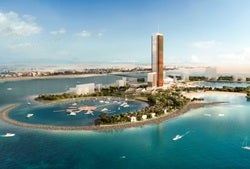
US-based Wynn Resorts said on 11 March that site activity on its resort project on Ras Al-Khaimah’s Al-Marjan Island has restarted after work was temporarily halted. New measures are in place to ensure the safety and security of the workforce.
“Wynn employees have been offered the opportunity to work from abroad, if their home embassy recommends they do so,” the company added.
The $5.1bn project involves the construction of an integrated resort with 1,500 rooms, high-end shopping, MICE venues and the UAE’s first confirmed gaming area. It is scheduled to open in spring 2027.
The 70-floor 283-metre-tall main structure was topped out in December 2025.
Financially, Wynn Resorts holds a 40% equity stake in the joint-venture development company alongside local partners Marjan and RAK Hospitality Holding. Wynn reported in late 2025 that about two-thirds of the project’s budget had already been spent or contractually committed, which provides a degree of protection against fluctuating material costs.
In 2025, Wynn Resorts said it had secured a $2.4bn construction facility to finance the development of the project. In a statement at the time, Wynn said the financing is the largest hospitality financing transaction in UAE history. The loan, available to Wynn Al-Marjan Island FZ-LLC – a subsidiary of the 40%-owned joint venture – is denominated in both AED and US dollars.
Structured as a delayed draw facility, the seven-year term loan offers competitive market interest rates and substantial financial flexibility for the joint-venture partners.
The syndicate includes prominent regional and international banks, with Abu Dhabi Commercial Bank and Deutsche Bank serving as joint coordinators. The joint coordinators, along with First Abu Dhabi Bank, Emirates NBD Capital and the National Bank of Ras Al-Khaimah, acted as mandated lead arrangers, bookrunners and underwriters, and Sumitomo Mitsui Banking Corporation acted as lead arranger. First Abu Dhabi Bank is also the agent and security agent for the lenders.
Dubai-based Alec was appointed as the project’s main contractor in 2023. Earlier in March, Alec said it had resumed on-site and in-office operations across its UAE projects from 4 March.
In a statement, the company said that it is working closely with clients to ensure a prompt and safe return to full-scale activity.
The move follows a temporary work-from-home policy introduced across the company’s UAE operations in response to ongoing events, as Alec Holdings reaffirmed its commitment to protecting its workforce while continuing to deliver in clients’ best interests.
During the same period, the company said its operations in Saudi Arabia remained fully operational.
https://image.digitalinsightresearch.in/uploads/NewsArticle/15952339/main.jpg -
 Egypt raises gas prices by 30% amid Iran war
11 March 2026
Register for MEED’s 14-day trial access
Egypt’s Petroleum & Mineral Resources Ministry increased the price of several petroleum products and natural gas for vehicles on 9 March, according to official statements.
The price of natural gas for vehicles has been put up by 30% to E£13 ($0.25) a cubic metre.
The price of diesel has gone up by 17% to E£20.5 a litre, while 95-octane petrol has been put up by 14.2% to E£24 a litre.
The new prices were put into effect early on 10 March and come amid soaring global energy prices in the wake of the US and Israel attacking Iran on 28 February.
Egypt’s Petroleum & Mineral Resources Ministry said: “This comes in light of exceptional circumstances resulting from geopolitical developments in the Middle East and their direct impact on global energy markets, which have led to a significant increase in import and domestic production costs.
“Disruptions in supply chains, increased risk levels and higher shipping and insurance costs have resulted in a substantial surge in global crude oil and petroleum product prices, levels not seen in energy markets for years.”
The statement also said that Egypt is continuing efforts to boost domestic production and reduce the country’s import bill.
Egypt, the Middle East and North Africa region’s biggest liquefied natural gas (LNG) importer, is facing uncertainty over its LNG supplies in coming months.
Between March 2025 and February 2026, Egypt imported 9,440 kilotonnes of LNG, with the majority of its imports purchased through short-term agreements, mainly with third parties like trading houses.
Last year, it was reported that Egypt had signed deals for around 150 cargoes through to the summer of 2026.
While much of Egypt’s LNG is likely to come from the US, and will not be directly impacted by the effective closure of the Strait of Hormuz, the recent surge in LNG prices could mean that the North African country will struggle to afford shipments.
Exacerbating the need for increased LNG imports, on 28 February, Israel shut down production from its offshore gas fields due to security concerns, cutting pipeline exports to Egypt.
Prior to the fields being taken offline, Egypt was importing about 1.1 billion cubic feet a day from the Tamar and Leviathan fields.
On 4 March, addressing concerns about energy supplies in the country, Prime Minister of Egypt Mostafa Madbouly said that Egypt had just concluded “several contracts” to procure gas shipments at “preferential prices”, in cooperation with several countries and international companies.
However, he did not provide details about the exact pricing of the deals.
On top of the LNG deals Egypt has with trading houses, in January, Cairo signed a memorandum of understanding with Qatar related to 2026 LNG imports.
The preliminary deal included plans for 24 LNG deliveries through the summer of this year, when energy demand typically peaks.
Now, the shuttering of Qatar’s export terminals and the effective closure of the Strait of Hormuz are casting a shadow over the deal and there is increased uncertainty over whether these deliveries will be executed.
https://image.digitalinsightresearch.in/uploads/NewsArticle/15931401/main.jpg