
Bahrain’s willingness to disrupt takes flight with Air Asia
14 November 2025
 Commentary
Colin Foreman
Editor
As the smallest economy in the GCC, Bahrain has long understood that its competitive edge lies in being agile and prepared to disrupt established economic models.
This proactive approach began decades ago with the deregulation of its telecoms sector, positioning it ahead of many GCC peers in opening that market. More recently, the same strategic foresight emerged in the fintech space with the early adoption of regulatory sandboxes and a supportive digital finance ecosystem.
Bahrain’s disruptive lens is now focused on the aviation sector. At the Gateway Gulf investor forum in Manama on 3 November, Bahrain signed a letter of intent with Malaysia-headquartered Capital A Berhad and Air Asia. The agreement covers the establishment of a hub in Bahrain as low-cost carrier Air Asia and its related businesses expand beyond Asia into new markets, including Europe and Africa.
A hub in Bahrain, which is located to the west of its existing hubs in Asia, will allow Air Asia to connect to the European and African markets, allowing it to develop a network that will be a low-cost alternative to the full-service airlines based in the Gulf that also bridge east and west, including Bahrain’s flag carrier Gulf Air.
Bahrain and Air Asia will not be competing on scale; instead, they will disrupt with lower prices. This agility will allow the kingdom to carve out a distinctive niche in an otherwise highly competitive market.
The strategic pivot is made viable by recent, essential capital investment in aviation infrastructure. A new terminal building was opened at Bahrain International airport in 2022. This has significantly increased passenger capacity and modernised operations, creating an attractive platform for a major international low-cost carrier like Air Asia to base its extensive operations.

Register for MEED's guest program now to access this article.
Exclusive from Meed
-
-
-
 Read the April 2026 MEED Business Review
2 April 2026
-
-
 Chevron to drill two gas wells in Egypt before 2027
2 April 2026
All of this is only 1% of what MEED.com has to offer
Subscribe now and unlock all the 153,671 articles on MEED.com
- All the latest news, data, and market intelligence across MENA at your fingerprints
- First-hand updates and inside information on projects, clients and competitors that matter to you
- 20 years' archive of information, data, and news for you to access at your convenience
- Strategize to succeed and minimise risks with timely analysis of current and future market trends
Related Articles
-
Saudi Arabia seeks firms for food testing labs PPP project
2 April 2026
Saudi Arabia’s Ministry of Municipalities & Housing, in collaboration with the National Centre for Privatisation & PPP (NCP), has issued an expression of interest (EOI) notice for a contract to develop and operate municipal food safety laboratories under a public-private partnership (PPP) framework.
The project will be delivered on an equip, operate, maintain and transfer basis, with a contract duration of five years.
The EOI was issued on 1 April, with a submission deadline of 15 April.
The project scope covers the equipping, operation and maintenance of municipal food safety laboratories across five municipalities: Hafr Al-Batin, Northern Borders, Tabuk, Qassim and Al-Ahsa.
Key objectives include upgrading laboratory equipment, expanding chemical and microbiological testing capacity for food and water products, and enhancing testing accuracy to support laboratory compliance across the value chain. The project also aims to ensure effective knowledge transfer and a structured handover to the relevant municipalities at the end of the contract term.
NCP said in a statement: “The project is intended to strengthen public health and safety standards for citizens and residents of the kingdom in alignment with Saudi Vision 2030, while developing the municipal monitoring ecosystem, optimising food and water testing services, and enabling private sector participation in accordance with global best practices.”
In October last year, NCP highlighted the scale and diversity of opportunities in the kingdom’s PPP pipeline.
“At the moment, we have around 200 projects in the pipeline with a total value of roughly $190bn,” said Salman Badr, executive vice president – infrastructure advisory, NCP, during a MEED webinar.
The projects are spread across 17 sectors. “We have a very sizable programme, and it reflects the breadth of the kingdom’s transformation agenda,” he said.
NCP was established in 2017. It serves as the central authority and catalyst for designing and implementing privatisation and PPP projects across the kingdom.
 https://image.digitalinsightresearch.in/uploads/NewsArticle/16236864/main.gif
 -
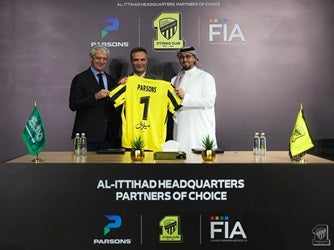
Parsons to project manage Al-Ittihad Sports Village in Jeddah
2 April 2026
US-based engineering firm Parsons Corporation has been awarded a contract by Saudi Arabia’s Al-Ittihad Club Company to act as project management consultant for the Al-Ittihad Sports Village in Jeddah.
Under the contract, Parsons will support the project during the design stage.
The sports village will be developed near King Abdullah Sports City and will include Al-Ittihad’s headquarters, academy training pitches and supporting facilities, performance development centres, administrative offices and a range of commercial components.
The development is being designed in line with Fifa requirements and international best practices, with the aim of strengthening high-performance sports infrastructure in Saudi Arabia.
The latest award follows Parsons’ recent appointment to a 60-month contract by the Public Investment Fund-backed New Murabba Development Company to provide design and construction technical support.
As part of that role, Parsons will support the development of the project’s downtown area, which will span 14 million square metres of residential, workplace and entertainment space.
In October last year, Parsons announced it had secured a SR210m ($56m) contract from Diriyah Company. Its scope includes the design and construction supervision of infrastructure works in phase two of the Diriyah project, covering streets, footpaths, open spaces, and civic buildings and facilities.
In May last year, Parsons also confirmed its appointment as delivery partner for the airside and landside packages at King Salman International airport in Riyadh.
In a statement, Parsons said it had signed two contracts with King Salman International Airport Development Company. The first covers airfield assets, including runways, taxiways, aircraft parking areas and air traffic control towers.
The second contract relates to landside infrastructure, including roads, utilities, tunnels, bridges, rail networks and landscaping.
https://image.digitalinsightresearch.in/uploads/NewsArticle/16233673/main.jpg -
Read the April 2026 MEED Business Review
2 April 2026
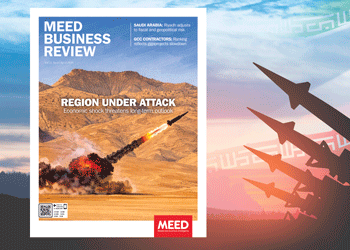
Download / Subscribe / 14-day trial access When the first missiles and drones were fired at the GCC on 28 February, the region’s economic story pivoted abruptly, from long-term vision-building to near-term resilience.
 The conflict is now the Gulf’s most consequential economic stress test in a generation. It is challenging the safe haven premium that underpins capital inflows, while disrupting the physical networks that keep the region’s economies running, from energy exports and shipping lanes to airports and tourism.
MEED editor Colin Foreman asks whether the GCC can sustain investor confidence as energy assets, trade routes, airports and banks absorb the shock. Read more here.
April’s market focus is on Saudi Arabia, where the Iran war is compounding the logic behind the kingdom’s strategic pivot in its investment plans.
This edition also includes MEED’s 2026 GCC contractor ranking, in which Chinese firms have surged to the top as Saudi spending cuts and geopolitical risks weigh on GCC construction activity.
In the latest issue, we explore the region’s evolving arbitration landscape; present exclusive leadership insight from Jacobs on the future of passenger rail in the Middle East; and talk to Leyla Abdimomunova, head of real estate and construction at the Public Investment Fund’s National Development Division, about remaking Saudi construction.
We hope our valued subscribers enjoy the April 2026 issue of MEED Business Review.

Must-read sections in the April 2026 issue of MEED Business Review include:
 > AGENDA: Gulf economies under fire
INDUSTRY REPORT:
GCC contractor ranking
> Construction guard undergoes a shift> LEGAL: Redefining the region’s arbitration landscape
> QATAR LNG: Qatar’s new $8bn investment heats up global LNG race
> INTERVIEW: Leyla Abdimomunova, National Development Division, PIF
> LEADERSHIP: Shaping the future of passenger rail in the Middle East
> SAUDI MARKET FOCUS:
> COMMENT: Risk accelerates Saudi spending shift
> GVT &: ECONOMY: Riyadh navigates a changed landscape
> BANKING: Testing times for Saudi banks
> UPSTREAM: Offshore oil and gas projects to dominate Aramco capex in 2026
> DOWNSTREAM: Saudi downstream projects market enters lean period
> POWER: Wind power gathers pace in Saudi Arabia
> WATER: Sharakat plan signals next phase of Saudi water expansion
> CONSTRUCTION: Saudi construction enters a period of strategic readjustment
> TRANSPORT: Rail expansion powers Saudi Arabia’s infrastructure push> MEED COMMENTS:
> Iran war erodes LNG’s image of reliability
> Dubai's real estate faces a hard test
> Energy resilience matters as much as capacity
> Drawn-out conflict may shift planning priorities> GULF PROJECTS INDEX: Gulf index rises amid tensions
> FEBRUARY 2025 CONTRACTS: Middle East contract awards
> ECONOMIC DATA: Data drives regional projects
> OPINION: The end of the republic and the end of times
> BUSINESS OUTLOOK: Finance, oil and gas, construction, power and water contracts
To see previous issues of MEED Business Review, please click herehttps://image.digitalinsightresearch.in/uploads/NewsArticle/16222272/main.gif -
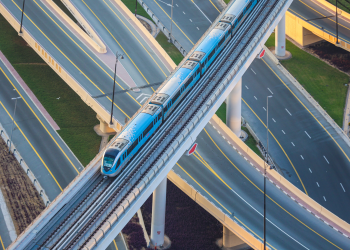
Consultants submit bids for Al-Maktoum airport metro link
2 April 2026
French firm Egis has emerged as the lowest bidder for the design contract for the Route 2020 extension, which will start from the Expo 2020 metro station and connect with Al-Maktoum International airport’s West Terminal.
Egis submitted the lowest bid, priced at AED232.6m ($63.3m).
The other bidders are:
- Halcrow International (UK): $66.4m
- Parsons (US): $71.3m
- Aecom (US): $82.6m
- Surbana Jurong (Singapore): $106m
The extension to the line will run for about 3 kilometres (km) and will feature two stations.
MEED understands that the invitation to bid was issued in January with a submission deadline of mid-March.
The existing Route 2020 metro link is a 15km-long line that branches off the Red Line at Jebel Ali metro station. The line comprises 11.8km of elevated tracks and 3.2km of tunnels, and has five elevated stations and two underground stations.
The Roads & Transport Authority (RTA) awarded the AED10.6bn ($2.9bn) design-and-build contract for the project to a consortium of Spain’s Acciona, Turkiye’s Gulermak and France’s Alstom in 2016.
Dubai’s plans for its metro network do not stop with connecting the extension of the Route 2020 metro line to Al-Maktoum International airport. There are long-term plans for further extensions.
Other metro projects
In October last year, MEED exclusively reported that the RTA had selected US-based engineering firm Aecom to provide consultancy services for the upcoming Dubai Metro Gold Line project, also known as Metro Line 4.
The Gold Line will start at Al-Ghubaiba in Bur Dubai. It will run parallel to – and alleviate pressure on – the existing Red Line, before heading inland to Business Bay, Meydan, Global Village and residential developments in Dubailand.
The other metro lines in the pipeline are the Purple Line and the Pink Line, both of which are in the early stages of development.
Firms are also bidding to update the emirate’s rail masterplan. In October 2025, MEED reported that 10 firms had submitted offers to undertake the project.
The rail masterplan study will update and modify the RTA’s rail network, which includes the Dubai Metro and Dubai Tram. These plans will support Dubai’s 2040 urban masterplan, which aims for all residents to be within a 30-minute metro or light-rail trip to their place of work.
The existing network includes the Red and Green lines of the Dubai Metro and the Dubai Tram, which connects Al-Sufouh and Dubai Marina to the metro network. The last rail project to start operations in Dubai was the Red Line extension that opened for Expo 2020.
There are also existing and planned rail lines connecting Dubai to other emirates that are being developed and operated by Abu Dhabi-based Etihad Rail. These include passenger and freight services as well as a high-speed rail connection.
In December 2024, the RTA awarded a AED20.5bn main contract for the Dubai Metro Blue Line project to a consortium of Turkish firms Limak Holding and Mapa Group and the Hong Kong office of China Railway Rolling Stock Corporation.
The Blue Line consists of 14 stations, including three interchange stations at Al-Jaddaf, Al-Rashidiya and International City 1, as well as a station in Dubai Creek Harbour. By 2040, daily ridership on the Blue Line is projected to reach 320,000 passengers. It will be the first Dubai Metro line to cross Dubai Creek, doing so on a 1,300-metre viaduct.
https://image.digitalinsightresearch.in/uploads/NewsArticle/16233295/main.jpg -
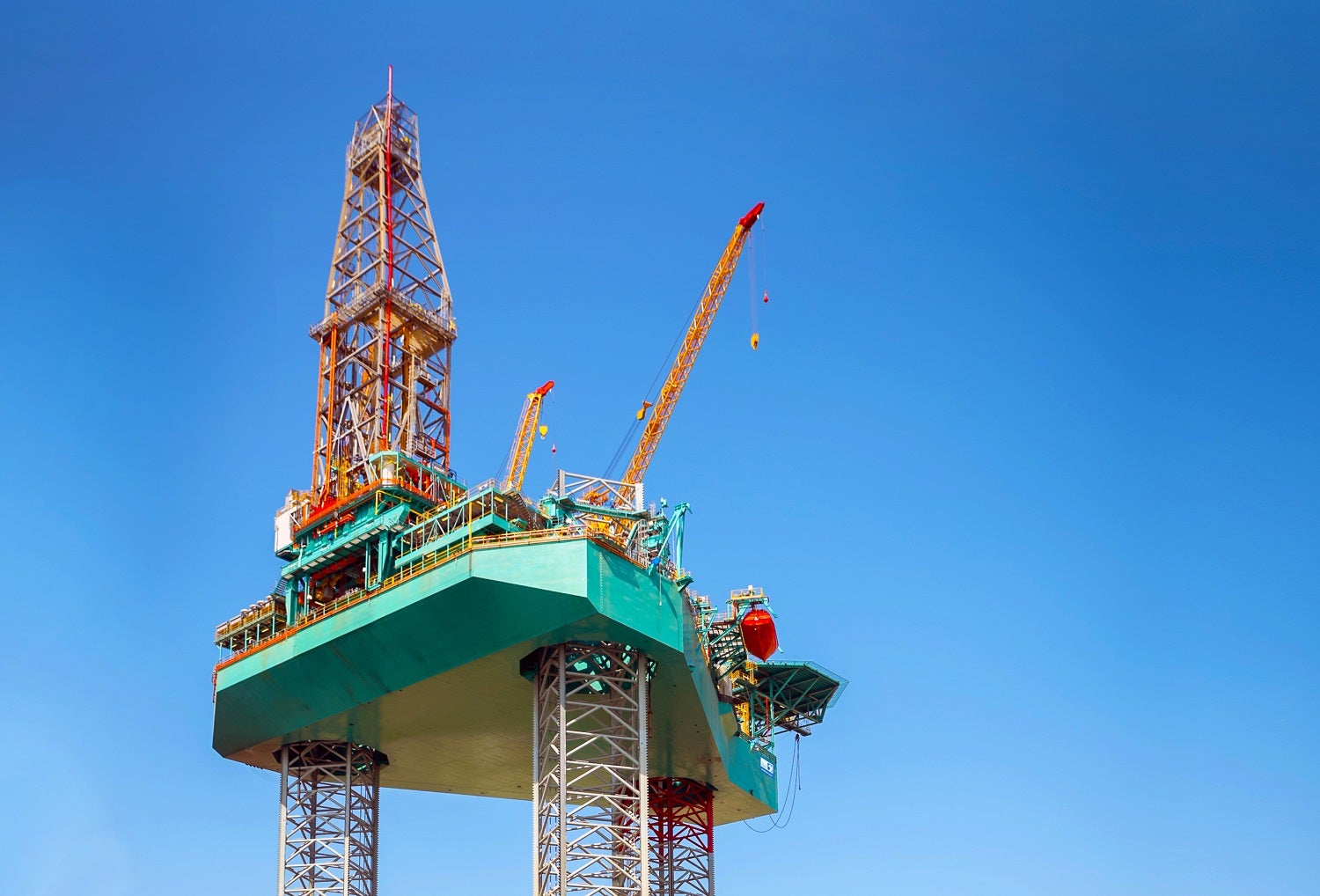
Chevron to drill two gas wells in Egypt before 2027
2 April 2026
Chevron is planning to drill two new gas wells this year, one in the Narges field and another in the Western Mediterranean, according to Clay Neff, the president of exploration operations at the company.
The well in the Western Mediterranean area is due to be drilled in partnership with the London-headquartered oil and gas company Shell.
Egypt and the broader East Mediterranean region will be core pillars of Chevron’s investment roadmap over the coming years, Neff said.
He also said that the investments in Egypt reflected the Eastern Mediterranean’s growing strategic importance within Chevron’s global portfolio
According to Neff, Chevron is aiming to increase its operational production capacity in the region by as much as 50% over the next five years, something that is expected to strengthen cash generation and enhance profitability from its regional operations.
Chevron’s presence in Egypt dates back nearly nine decades, beginning in 1937 with the distribution of petroleum products before expanding into exploration and production activities in recent years.
The company currently produces more than 2 billion cubic feet of gas a day across the Eastern Mediterranean.
Chevron is advancing broader expansion initiatives in the Eastern Mediterranean region that include modernising existing facilities and increasing production capacity, alongside ongoing engineering and design work on the Aphrodite gas field in Cyprus.
A recently signed government agreement enables the construction of a subsea pipeline connecting Cyprus directly to Egypt.
Neff said the company is targeting an early final investment decision on the project next year, expressing confidence that close cooperation between Cairo and Nicosia will support timely progress.
He emphasised that meeting domestic and regional energy demand remains the company’s top priority before directing additional supplies toward export markets in Europe or elsewhere.
Neff said that Egypt’s well-developed energy infrastructure, particularly its pipeline network and liquefaction plants, provided a strategic edge, adding that new discoveries and capacity expansions will gradually support higher export volumes while safeguarding local supply needs.
The comments from Neff come shortly after it was announced that the UK oil and gas company BP was making progress with its campaign to drill five wells in Egypt’s portion of the Mediterranean.
BP’s Fayoum 4 well is scheduled to start production in July, with an estimated output of around 100 million cubic feet of gas a day.
https://image.digitalinsightresearch.in/uploads/NewsArticle/16226687/main.jpg