
Bahrain creaks under the strain of war
5 November 2026

With a small economy and exports almost wholly reliant on passage through the Strait of Hormuz, Bahrain has been painfully exposed to the turmoil caused by the Iran war. The country’s social makeup – with a Shia majority ruled by a Sunni-dominated regime – is also showing signs of strain.
The economy is expected to contract by 11.3% this year, according to the IMF’s latest Regional Economic Outlook report. That is not quite as bad as some of its neighbours, such as Kuwait and Qatar, but it is well above the 4.8% fall expected for the GCC as a whole.
Just as importantly, Bahrain also starts from a much weaker base than its Gulf peers, with a smaller economy, limited hydrocarbon resources and high levels of government debt.
“Countries with the largest reserve declines since the start of the conflict generally entered the shock with comfortable reserve positions, with Bahrain as a notable exception,” the IMF noted in its 22 October report.
Physical disruption
Iran’s closure of the Strait of Hormuz this year has cut Bahrain off from its most important trade route for both exports and imports. In addition, major industrial and military targets have been hit by Iran on multiple occasions, including the US naval base and the Aluminium Bahrain (Alba) plant.
The latter suffered a 32% year-on-year drop in sales volumes and a 61% fall in output in the first half of the year as a result of the Iranian attacks – although higher aluminium prices and lower costs meant that the company’s revenues held steady and profits actually increased year-on-year.
Other areas of the economy have been badly affected too, with the Bapco oil refinery, a desalination plant and an Amazon data centre all hit in Iranian strikes. The IMF also noted that Bahrain has seen one of the worst declines in hotel occupancy rates during the year. Inflation has also been rising, reaching an annual rate of 3% as of July.
As a result, the government’s already weak financial position is under even more pressure. The Central Bank of Bahrain’s reserves have slumped sharply since the start of the war, falling from BD1.8bn ($4.8bn) as the war broke out, to a low of BD568m three months later. They recovered some of the ground lost in the following months, but remain well below the pre-war level. Reserves stood at BD887m by September, supported by drawing on a BD2bn ($5.4bn) currency swap line provided by the UAE in early April.
Total public debt had reached BD20.3bn at the end of August, the most recent data available, up from BD18.2bn a year earlier. That is significantly larger than the country’s GDP, which stood at BD15.7bn in 2025 and is expected to end this year at just BD13.9bn.
To make matters worse, the markets have been pushing up Bahrain’s borrowing costs to levels not seen since 2018, when the government had to turn to Kuwait, Saudi Arabia and the UAE for a bailout to avoid a potential sovereign default.
External support
With no easy way to reduce its debts or plug its budget deficit, Bahrain is likely to seek more assistance from its wealthy neighbours – although any aid will likely come with demands for spending restraint and other reforms that will be uncomfortable for the government to accept.
The appetite of some neighbouring states may also be more limited than in the past, given their own economies have been weakened by the war, but King Hamad Bin Isa Al-Khalifa’s close ties with the UAE leadership in particular are likely to ensure some help is forthcoming.
Asharq Bloomberg reported in late October that Manama has been holding talks with neighbouring states for a fresh round of support, with the UAE expected to emerge with a leading role. However, the timing and scale of any bailout remain unclear.
Without external assistance, the country’s finances are likely to deteriorate further. Ratings agency Capital Intelligence said in an October report that it expected debt levels to rise further in 2027-28, with the budget deficit averaging 9.3% of GDP in those years.
“The burden of government debt on the budget is also very high, with interest payments projected to average 30.7% of revenues in 2026-28, up from 27.1% in 2025,” it noted.
King Hamad Bin Isa Al-Khalifa’s close ties with the UAE leadership in particular are likely to ensure some help is forthcoming
Political tensions
Politically, Manama has appeared increasingly cautious towards its own citizens, with planned elections for both municipal councils and the Council of Representatives delayed until next year. Announcing the postponement of the council elections in mid-October, deputy prime minister Sheikh Khalid Bin Abdulla Al-Khalifa referred vaguely to “the current circumstances and their resulting effects” as the reason for the delay.
The postponement removes a formal channel for the public to express grievances about the country’s current situation. At the same time, the authorities have moved against perceived support for Iran during the conflict. More than 600 people have been arrested this year on charges including espionage and supporting an enemy state, according to the Bahrain Institute for Rights and Democracy (Bird), a London-based advocacy group that is critical of the government. Dozens of people have also had their citizenship revoked.
“Since the outbreak of the Iran war, repression in Bahrain has intensified sharply,” said Bird advocacy director Sayed Ahmed Alwadaei.
Some analysts warn that the crackdown could prove counterproductive. The Bahrain researcher at conflict monitoring group Acled said that tensions between the government and its Shia opposition were gradually placing the country at high risk of instability.
The economic outlook could change quickly if a resolution to the Iran-US conflict is found. The IMF predicts that the economy could rebound to a growth rate of 13.9% next year, before settling back to a more sustainable 3.1% the year after – but that depends on Gulf trade routes reopening and energy production normalising. The country’s political tensions will be harder to resolve.

Register for MEED's guest program now to access this article.
Exclusive from Meed
-
 Al-Maktoum airport is key to Dubai’s aviation hub status
27 November 2026
-
 Emaar tenders Dubai Creek Harbour mall
27 November 2026
-
 Contractor wins Arabian Beauty Horses Village in Qatar
27 November 2026
-
 King Salman airport sets new infrastructure bid deadline
27 November 2026
-
 PIF secures inaugural A+ rating from S&P
26 November 2026
All of this is only 1% of what MEED.com has to offer
Subscribe now and unlock all the 153,671 articles on MEED.com
- All the latest news, data, and market intelligence across MENA at your fingerprints
- First-hand updates and inside information on projects, clients and competitors that matter to you
- 20 years' archive of information, data, and news for you to access at your convenience
- Strategize to succeed and minimise risks with timely analysis of current and future market trends
Related Articles
-
Al-Maktoum airport is key to Dubai’s aviation hub status
27 November 2026
 Commentary
Colin Foreman
EditorDubai’s position as a global aviation hub is central to its economy, and the expansion of Al-Maktoum International airport is critical to maintaining that role.
On 26 November, Dubai awarded AED56.5bn ($15bn) of contracts for the airport expansion, taking the total value of contracts awarded to more than AED80bn ($21.8bn). A workforce of 14,000 is working on the project, which will provide capacity for more than 260 million passengers a year when complete.
The economic stakes are high. A study published by Emirates Group and Dubai Airports in October 2024 found that aviation accounted for 27% of Dubai’s GDP in 2023. The sector contributed AED137bn ($37.3bn) in gross value added and supported 631,000 jobs – about one in five jobs in the emirate. The study forecast that aviation’s share of GDP would rise to 32% by 2030, contributing AED196bn in gross value added and supporting 816,000 jobs.
This year has demonstrated both the vulnerability and resilience of Dubai’s aviation model. Regional conflict has disrupted commercial air traffic across the Gulf since 28 February. Emirates Group’s profit before tax fell 66% year on year to AED4.1bn in the six months to 30 September, while Emirates carried 21.8 million passengers, down 22% on the prior-year period.
However, the network recovered quickly. By 30 September, Emirates was operating 91% of its pre-disruption network, serving 150 airports in 78 countries and territories. Emirates SkyCargo revenue rose 52%, the fleet increased to 289 aircraft, and the airline broke ground in May on a $5.1bn maintenance facility at Al-Maktoum International airport.
Maintaining that connectivity will require additional capacity. If aviation accounts for almost one-third of Dubai’s economy by 2030, as Emirates Group and Dubai Airports forecast, Al-Maktoum International airport will be central to the emirate’s ability to retain its position in global air travel.
https://image.digitalinsightresearch.in/uploads/NewsArticle/21894329/main.jfif -
Emaar tenders Dubai Creek Harbour mall
27 November 2026
Register for MEED’s 14-day trial access
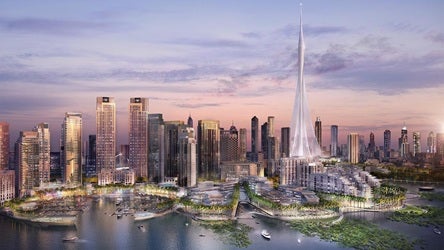
Dubai developer Emaar Properties has invited contractors to submit bids by 9 December for the main construction package of the Dubai Creek Harbour mall, known as Dubai Square.
The development covers a total retail, hospitality and commercial area of 2.6 million square metres, and is scheduled to open within three years.
Emaar unveiled Dubai Square in December 2025 as the anchor of its AED180bn ($49bn) Dubai Creek Harbour development.
The scheme has undergone several redesigns. MEED first reported on Emaar’s plans for a major retail centre at Dubai Creek Harbour in 2016. At the time, the project was envisioned to surpass Dubai Mall as the world’s largest retail destination, though its scale and layout have since evolved.
The mall will connect directly to the planned Dubai Creek Tower at the centre of the development.
UK-headquartered Brewer Smith Brewer Group is the project’s lead consultant, executive architect, architect of record and structural engineer. It is also the construction supervision consultant.
Dubai-based contractor Dutco Construction began mobilising last year for early site works.
In March last year, MEED reported that Emaar was preparing to relaunch development of both the tower and the mall. The developer had earmarked roughly AED14bn ($3.81bn) for the two assets as part of a wider AED65bn ($18bn), five-year capital expenditure programme.
Progress on the tower has been slower. First launched in 2015, it was promoted as the world’s tallest structure, designed to exceed the 828-metre Burj Khalifa. The original design was led by Spanish architect Santiago Calatrava and UK-based RMJM. The project stalled after concrete pile-cap works were completed in 2018.
In 2023, Emaar founder Mohamed Alabbar confirmed design works were continuing following an international design competition. In January 2026, Alabbar stated that a tender for the redesigned tower would be issued within three months. He later said the tender would be deferred until regional geopolitical tensions ease.
 READ THE NOVEMBER 2026 MEED BUSINESS REVIEW – click here to view PDF
Gulf projects keep moving amid conflict; UAE's state spending and oil output flexibility cushion Iran war shock; Project finance lenders weigh risk against infrastructure needs.
Distributed to senior decision-makers in the region and around the world, the November 2026 edition of MEED Business Review includes:
> AGENDA: GCC projects market holds its nerve> MARKET FOCUS: UAE economy shows resilience> INDUSTRY REPORT: Project financiers hold the line> STADIUMS: Stadium spending set to jump 39% in 2027> CONFLICT: Hormuz closure wipes out growth in 2026> INTERVIEW: WSP regional president Dean McGrail> INTERVIEW: UAE Ministry of Energy & InfrastructureTo see previous issues of MEED Business Review, please click herehttps://image.digitalinsightresearch.in/uploads/NewsArticle/21892263/main.jpg -
Contractor wins Arabian Beauty Horses Village in Qatar
27 November 2026
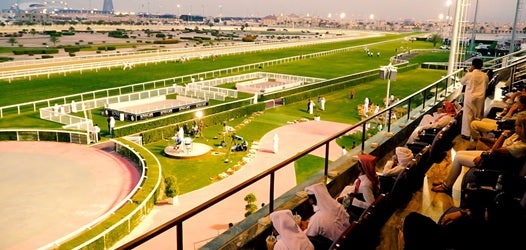
Qatar’s Culture Village Foundation (Katara) has awarded Qatar Trading & Contracting Group a QR574m ($158m) contract to build the Arabian Beauty Horses Village in Al-Uqdah Zone 74, in the Al-Khor area.
The project will include supporting infrastructure and public facilities designed for Arabian show horses and equestrian operations in the Al-Uqdah district.
Zone 74 is already an important centre for Qatar’s equestrian sector, anchored by the Al-Uqdah Equestrian Complex. The Qatar Racing & Equestrian Club began operating the complex in 2020 in coordination with Qatar’s Ministry of Culture and Sports.
The Arabian Beauty Horses Village is part of a broader, multistage state strategy to develop Al-Uqdah, on the outskirts of Al-Khor, as Qatar’s second major equestrian hub, alongside Al-Rayyan and Al-Shaqab in Doha.
According to UK analytics firm GlobalData, Qatar’s commercial construction sector is expected to grow at an average annual rate of 4.5% between 2025 and 2028, supported by investment in hotels, logistics facilities and data centres.
READ THE NOVEMBER 2026 MEED BUSINESS REVIEW – click here to view PDFGulf projects keep moving amid conflict; UAE's state spending and oil output flexibility cushion Iran war shock; Project finance lenders weigh risk against infrastructure needs.
Distributed to senior decision-makers in the region and around the world, the November 2026 edition of MEED Business Review includes:
> AGENDA: GCC projects market holds its nerve> MARKET FOCUS: UAE economy shows resilience> INDUSTRY REPORT: Project financiers hold the line> STADIUMS: Stadium spending set to jump 39% in 2027> CONFLICT: Hormuz closure wipes out growth in 2026> INTERVIEW: WSP regional president Dean McGrail> INTERVIEW: Ministry of Energy & InfrastructureTo see previous issues of MEED Business Review, please click herehttps://image.digitalinsightresearch.in/uploads/NewsArticle/21890026/main.jpg -
King Salman airport sets new infrastructure bid deadline
27 November 2026
Saudi Arabia’s King Salman International Airport Development Company (KSIADC) has set a 10 January deadline for bids for the Zone C1+C2 roads, bridges and utility networks package for King Salman International airport (KSIA) in Riyadh.
The tender was issued on 26 October, with an initial bid-submission deadline of 6 December.
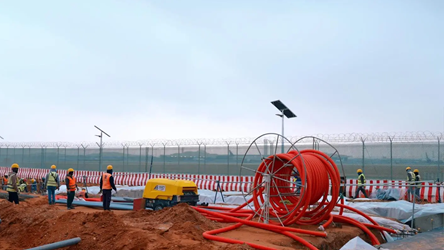
The request for proposals covers the procurement, construction, testing and commissioning of civil infrastructure supporting Terminal 6, alongside the existing Terminals 1-5.
The scope includes upgrades to Airport Road 539, which runs west of Terminals 1-5, and part of Mohamed bin Faraj Road 5333, west of Junction 6.
It also includes new roads, ramps, service roads and signalised at-grade junctions. An additional access road will connect the Terminal 6 site offices to Road 5333.
Structures will include the Junction 6 and Terminal 6 bridges, retaining walls and reinforced-soil structures.
The contractor will also construct the central ground services equipment (GSE) bridge. Before construction begins, the contractor must validate the design, complete any outstanding elements – including mechanically stabilised earth walls, approach slabs, drainage and lighting – and secure the required authority approvals.
Dry utilities will comprise high- and extra-high-voltage containment, a 13.8kV medium-voltage network with package substations, low-voltage distribution and street lighting, and security-surveillance systems.
Wet utilities will include potable water, fire water, irrigation water, treated sewage effluent, district cooling and wastewater networks. Wastewater pipes will range from 200mm u-PVC gravity lines to 1,700mm glass-reinforced plastic mains.
The stormwater network will include channels, culverts, ponds and pipes ranging from 400mm to 1,400mm in diameter. Crossings will be constructed using open-cut excavation, horizontal directional drilling or microtunneling.
Utilities serving the operational terminals will be diverted on a design-and-build basis. Enabling works will include earthworks and the relocation of the security fence and trees. The contractor will also demolish a temporary car park, existing bridges and a sewage pumping station.
Optional works comprise two design-and-build elements that will proceed only at the client’s instruction.
The first is the south GSE bridge. The second is an approximately 1,400-metre, multi-lane access road to the Terminal 6 Transportation Hub, including bridges, underpasses, ramps and tunnels, as well as provisions for future Wadi Loop utilities and structures.
READ THE NOVEMBER 2026 MEED BUSINESS REVIEW – click here to view PDFGulf projects keep moving amid conflict; UAE's state spending and oil output flexibility cushion Iran war shock; Project finance lenders weigh risk against infrastructure needs.
Distributed to senior decision-makers in the region and around the world, the November 2026 edition of MEED Business Review includes:
> AGENDA: GCC projects market holds its nerve> MARKET FOCUS: UAE economy shows resilience> INDUSTRY REPORT: Project financiers hold the line> STADIUMS: Stadium spending set to jump 39% in 2027> CONFLICT: Hormuz closure wipes out growth in 2026> INTERVIEW: WSP regional president Dean McGrail> INTERVIEW: Ministry of Energy & InfrastructureTo see previous issues of MEED Business Review, please click herehttps://image.digitalinsightresearch.in/uploads/NewsArticle/21887157/main3955.png -
PIF secures inaugural A+ rating from S&P
26 November 2026
Saudi Arabia’s Public Investment Fund (PIF) has received an inaugural A+ long-term foreign and local currency issuer credit rating from S&P Global Ratings, with a stable outlook.
The fund’s existing A-1 short-term rating from S&P is unchanged. PIF said its ratings are in line with those of Saudi Arabia.
PIF said S&P’s assessment cited its diversified funding profile, moderate leverage and its focus on value realisation under its 2026-30 strategy. The agency also pointed to the fund’s role in driving the kingdom’s economic transformation.
“The inaugural A+ long-term rating from S&P marks an important milestone in the continued development of PIF’s credit profile and our long-term funding plan,” said Ziyad Alfawzan, head of capital finance strategy at PIF.
The new rating makes PIF one of a small number of sovereign wealth funds with long-term credit ratings from all three leading agencies.
Moody’s Ratings confirmed PIF’s Aa3 long-term issuer rating and aa3 baseline credit assessment in September after a periodic review, with a stable outlook. In October, Fitch Ratings affirmed the fund’s long-term foreign and local currency issuer default ratings at A+, also with a stable outlook.
The Moody’s rating is one notch higher than the A+ grades from S&P and Fitch.
Debt is an increasingly important source of funding for PIF as it pays for domestic investment programmes and gigaprojects.
The fund raised $2bn in January from a 10-year sukuk, its first debt sale of 2026. In May, it raised $7bn from a three-tranche bond, its first hard-currency public issuance since the Iran conflict disrupted regional capital markets.
A full set of long-term ratings is likely to widen PIF’s investor base for future bond and sukuk issuance. The fund also borrows through loans and other debt instruments as part of its funding mix.
PIF is entering what it calls the value realisation phase of its strategy, covering 2026 to 2030. Over this period, it aims to deliver sustainable financial returns while continuing to drive the diversification of the Saudi economy.
MEED’s latest report on Saudi Arabia includes:
> COMMENT: Saudi projects hold steady
> GOVERNMENT: Riyadh looks to reset its regional defence outlook
> ECONOMY: Conflict bolsters case for Saudi economic diversification
> BANKING: Saudi lenders readjust to lower lending and deposit climate
> UPSTREAM: Aramco upstream spending gathers pace
> DOWNSTREAM: Sabic steps up Saudi petchems investment
> POWER: Saudi Arabia’s power award activity slows
> WATER: Saudi water sector hits sharp slowdown
> CONSTRUCTION: Saudi construction defies the headwinds
> TRANSPORT: Saudi infrastructure pushes forward amid conflict
> DATABANK: Saudi data indicates project spending shiftTo see previous issues of MEED Business Review, please click herehttps://image.digitalinsightresearch.in/uploads/NewsArticle/21868102/main.gif