
Bahrain construction activity remains subdued
5 November 2026

Bahrain’s construction and infrastructure sector remains subdued, with project awards still depressed despite a modest uptick this year.
Data from regional projects tracker MEED Projects shows that $737m-worth of construction and infrastructure contracts had been awarded in the kingdom by 29 October 2026. While this exceeds the $686m recorded across the whole of 2025, it confirms that the market remains in a prolonged downturn.
Between 2016 and 2020, Bahrain recorded more than $2bn in annual awards, peaking at nearly $3.9bn in 2016 when major packages for the Bahrain International airport expansion were signed. Awards then fell to $912m in 2021 before rebounding to almost $2bn in 2022. The recovery was short-lived, with awards declining to $1.66bn in 2023, $1.57bn in 2024 and $686m in 2025.
Major awards
Activity this year has been supported by several housing and transport packages.
The largest award was an estimated $400m contract secured by a joint venture of local developer Naseej and China Machinery Engineering Corporation for the Madinat Khalifa project. Procured under the Mega Government Land Development Programme, the scheme involves the design, financing, construction, marketing and sale of more than 2,500 housing units on two government-owned land parcels, alongside roads and electricity, water, sewage and drainage networks.
Road infrastructure also produced a major commitment. The Ministry of Works amended its award for package four of the Busaiteen Link project, appointing a joint venture of Nass Company and Nasser Hazza Al-Subaei Contracting Company under a BD65m ($172m) contract. The three-year deal replaces a BD69.7m ($185m) award made in January to a consortium of Haji Hassan Group, Saudi Arabia’s Alomaier Trading & Construction Company and Greece’s Terna.
The package includes a signature bridge connecting Muharraq with the North Manama Causeway and Bahrain Bay, as well as road works between junctions four and five.
Residential projects provided further volume. Mohammed Abdulmohsin Al-Kharafi & Sons secured a $112.4m contract to build 512 social apartment units on Madinat Salman’s Island 12. Binaa Al-Bahrain also appointed Kooheji Contractors to build Bayview in Manama, a development comprising four residential buildings and 489 apartments.
Early-stage commitments included a BD5m ($13.5m) consultancy contract awarded to US-based Populous for the planned Sports City at Sakhir. The scope covers the masterplan, internal infrastructure, phase 1A design and tender documents. Lebanon’s Dar Al-Handasah won a QR28m ($7.7m) contract to conduct feasibility studies for the proposed 40-kilometre Qatar-Bahrain Causeway, also known as the Friendship Bridge.
Transport links
Transport is the most promising near-term outlet for the market, with a pipeline valued at about $15bn, according to MEED Projects data.
Cross-border rail has re-emerged as a strategic focus. Bahrain has introduced legislation to establish a framework for constructing, operating, maintaining and regulating railway networks, including licensing, safety, cross-border services, and passenger and freight tariffs.
The move comes as Gulf states prepare to advance the GCC railway network, which is expected to begin operating by the end of 2030. Bahrain’s proposed rail link to Saudi Arabia is expected to run via the planned King Hamad Causeway, a second fixed connection between the two countries alongside the King Fahd Causeway.
Road expansion is also progressing. In September, the Bahrain Tender Board received bids from Nass Contracting, Haji Hassan Group, Almoayyed Contracting Group, Mohammed Abdulmohsen Al-Kharafi & Sons, Eastern Asphalt & Concrete Production, Cebarco Bahrain and Kingdom Asphalt for the upgrade of two kilometres of the Sheikh Jaber Al-Ahmed Al-Sabah Highway. The works involve a four-lane dual carriageway with service roads.
Industrial and maritime infrastructure is advancing, too. The Ministry of Works received five bids for engineering and quantity surveying services linked to reclamation works at Salman Industrial City and Bahrain Logistics Zone.
Dar SSH International Engineering Consultants submitted the lowest offer at BD778,580 ($2.1m), followed by Aecom at $2.2m, Ansari Engineering Services at $2.3m, Millet Engineering Bureau at $2.4m and Ayesa at $2.8m. The project involves reclaiming about 1.13 million square metres of land using 9.67 million cubic metres of fill near Khalifa Bin Salman Port.
The government is also preparing the Bahrain Northern Link Road as a public-private partnership. The 29.5km highway will connect the North Manama Causeway with Suhaila Island and the King Hamad Causeway, creating a parallel east-west route to Sheikh Isa Bin Salman Highway and improving links between Khalifa Bin Salman Port and Saudi Arabia.
Building pipeline
Outside transport, Bahrain’s construction pipeline exceeds $6bn. The most prominent project is the Bahrain International Sports City development in Sakhir. In September, 21 local and Saudi Arabian contractors were prequalified for the first-phase construction contract, which is expected to include Bahrain’s largest sports stadium and a multipurpose indoor sports arena.
The planned National Assembly Building in Manama is another significant civic project. Bids submitted earlier this year included three options from Cebarco Bahrain, ranging from $163.8m to $200.3m, alongside offers of $239.4m from Nass Contracting and $316.4m from Kooheji Contractors.
The four-storey complex will be built on a reclaimed island and will include a main hall for joint sessions, separate debating chambers, administrative offices, an auditorium, library, museum, meeting rooms, public spaces, underground parking and supporting facilities.
These projects provide a route out of Bahrain’s multi-year downturn. The market’s recovery, however, will depend on whether the government converts feasibility studies, advisory mandates and prequalification exercises into construction awards.

Register for MEED's guest program now to access this article.
Exclusive from Meed
-
 Aramco-backed firm tenders logistics hub expansion
9 November 2026
-
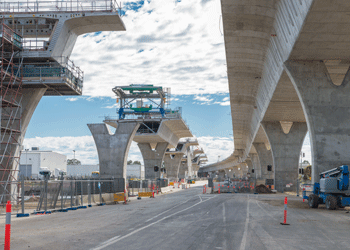 Prequalification begins for multibillion-dollar Dubai road
9 November 2026
-
 Contractor begins early works on Ardara’s AlWadi project
9 November 2026
-
 Syria in talks for refinery project worth $6bn-8bn
9 November 2026
-
 Three Libya oil and gas projects see developments
9 November 2026
All of this is only 1% of what MEED.com has to offer
Subscribe now and unlock all the 153,671 articles on MEED.com
- All the latest news, data, and market intelligence across MENA at your fingerprints
- First-hand updates and inside information on projects, clients and competitors that matter to you
- 20 years' archive of information, data, and news for you to access at your convenience
- Strategize to succeed and minimise risks with timely analysis of current and future market trends
Related Articles
-
Aramco-backed firm tenders logistics hub expansion
9 November 2026
Asmo, the logistics joint venture of Saudi Aramco and DHL Supply Chain, has set a 15 November deadline for a contract to expand the logistics complex at King Salman Energy Park (Spark) in Saudi Arabia’s Eastern Province.
The logistics hub will add over 124,000 square metres (sq m) at Spark.
Al-Khobar-based engineering firm House of Consulting Office is the project consultant.
The tender for the expansion works comes shortly after Asmo awarded an estimated SR820m ($218m) contract to build the logistics complex’s first phase in May this year.
The overall project will feature a 43,000 sq m, temperature-controlled Grade A warehouse; more than 3,000 sq m of offices and staff amenities; 5,300 sq m dedicated to chemicals storage; and an open yard covering about 1.2 million sq m.
Asmo signed an agreement with Bahrain‑headquartered Arcapita Group Holdings in February to deliver the project at Spark.
Planned for large-scale industrial use, the site is expected to incorporate advanced warehouse and building management systems, end-to-end digital connectivity, automation and robotics.
It will also be developed in line with internationally recognised sustainability standards, featuring solar photovoltaic readiness, electric-vehicle charging infrastructure and a target of Leed Gold certification.
The development aims to support the next stage of Saudi Arabia’s logistics and supply chain expansion.
Under the deal structure, Arcapita will provide funding and retain ownership of the asset, while Asmo will develop the facility and then lease and operate it under a 22-year occupational lease.
According to a statement, “the scheme will be executed via a forward-funding model, underscoring a long-term commitment to national infrastructure”.
Asmo added that this will be its first purpose-built logistics centre and one of four strategic locations planned to anchor its nationwide logistics network, aligned with the National Transport and Logistics Strategy under Saudi Vision 2030.
https://image.digitalinsightresearch.in/uploads/NewsArticle/21267403/main.gif -
Prequalification begins for multibillion-dollar Dubai road
9 November 2026
Dubai’s Roads & Transport Authority (RTA) has begun prequalifying contractors for a design-and-build contract for a multibillion-dollar new road that will run parallel to Sheikh Zayed Road.
Contractors have until 30 November to submit their prequalification statements.
The latest development follows contractors’ expressions of interest for the project on 10 October, as MEED reported.
The project’s scope covers about 30 kilometres (km) of works. These include about 15km of viaduct along First Al-Khail Street and more than 14.5km of bridge ramps, along with other associated infrastructure works.
The project is another significant initiative aimed at alleviating pressure on the existing Sheikh Zayed Road section from Hadiqa Street to Hessa Street.
Dubai has previously explored bold concepts to expand capacity on Sheikh Zayed Road, including proposals to introduce double-decker sections to add extra lanes without widening the existing corridor.
The idea was discussed in the context of rising congestion and limited right-of-way along one of the city’s busiest arterial roads, with elevated decks potentially carrying through traffic while existing at-grade lanes served local access.
The plans ultimately became standalone schemes, with subsequent efforts focusing instead on corridor-wide upgrades, interchange improvements and complementary public transport expansions to manage demand more sustainably.
The latest project aligns with Dubai’s continued investment in upgrading and expanding its road network to keep pace with rapid population growth and rising commuting demand.
Planning for growth
Dubai launched the 2040 Urban Master Plan in March 2021, referencing studies indicating that the emirate’s population will reach 5.8 million by 2040, up from 3.3 million in 2020. The daytime population is set to increase from 4.5 million in 2020 to 7.8 million in 2040.
In December 2022, Sheikh Mohammed Bin Rashid Al-Maktoum, Vice President and Prime Minister of the UAE and Ruler of Dubai, approved the 20-Minute City Policy as part of the second phase of the Dubai 2040 Urban Master Plan.
In addition to the road projects, the RTA’s Dubai Metro Blue Line extension and Dubai Metro Gold Line form part of Dubai’s plans to improve residents’ quality of life by cutting journey times, as outlined in the policy.
The policy aims to ensure residents can meet 80% of their daily needs within a 20-minute journey, on foot or by bicycle. This goal will be achieved by developing integrated service centres with all necessary facilities and increasing population density around mass transit stations.
https://image.digitalinsightresearch.in/uploads/NewsArticle/21266194/main.gif -
Contractor begins early works on Ardara’s AlWadi project
9 November 2026
Saudi Arabia’s Shibh Al-Jazira Contracting Company (Sajco) has started early construction works on the first cluster of its AlWadi mixed-use development in Abha.
Ardara, backed by the sovereign wealth vehicle the Public Investment Fund (PIF), is developing the AlWadi project.
Sajco will carry out sewerage works, while local engineering firm Dar Al-Riyadh will provide project management and supervision services for the infrastructure works.
The AlWadi project will cover 2.5 million square metres (sq m) and will be developed around architectural styles informed by the heritage and character of the Aseer region.
The masterplan has a planned gross floor area of about 2.02 million sq m. It includes 7,306 apartments, 90 villas and townhouses, and 2,783 hotel keys.
The scheme will also provide 154,082 sq m of retail and food and beverage space, 64,161 sq m of offices, and 59,075 sq m of leisure and entertainment facilities.
The wider development will comprise five districts and include 16 kilometres of waterfront assets and 17km of walking, cycling and sports tracks.
US-based Parsons is the infrastructure designer, while Miami-based OBMI is providing architectural and public realm design services.
https://image.digitalinsightresearch.in/uploads/NewsArticle/21265927/main.jpg -
Syria in talks for refinery project worth $6bn-8bn
9 November 2026
Register for MEED’s 14-day trial access
Discussions are under way with international companies to develop a refinery in Syria’s Furqlus area, worth $6bn-8bn, according to a senior official at state-owned Syrian Petroleum Company (SPC).
The project will be “very large” and, after completion, will replace Syria’s Homs refinery, according to SPC’s deputy executive president for refining affairs, Tariq Shalash Al-Abdullah, who spoke to Syria’s state-owned daily newspaper Al-Thawra Al-Souriya.
He said the international companies currently involved in talks about the planned refinery project specialise in design work, engineering and technical studies.
He also stated that, for large-scale projects of this type, consortiums are typically formed from a group of companies with complementary interests in study, manufacturing, financing, implementation and operation.
In June, SPC published an invitation for companies to submit proposals to finance, build and operate the refinery under a build-operate-transfer agreement.
The tender document published by SPC said the refinery would have the capacity to process 210,000 barrels a day (b/d).
It also said the facility would be developed with the option to add an “ancillary petrochemical complex”.
Al-Abdullah said the refinery’s total investment value would depend on the equipment's country of origin, adding that the equipment could potentially be procured from the US, Europe or China.
Another factor that could alter the project’s value is the technology licences selected for the project, according to Al-Abdullah.
The refinery project is expected to take around four years to develop from the date of signing the contract and completing other related preparatory activities.
The project will be developed on a site that covers 400 hectares, according to the document that was published by SPC in June.
SPC invited companies to submit three separate documents relating to their proposals.
These were:
- A package outlining the company’s qualifications and legal documents
- A technical proposal
- A financial and investment proposal
According to the tender document, the scope of the refinery project includes developing:
- Three independent atmospheric distillation units, each with a capacity of 70,000 b/d
- Two vacuum distillation units
- Hydrotreating units
- Sulphur recovery units
- A base oil unit
- Power and steam generation facilities
- A grid interconnection substation
- A safe shutdown system
- An environmental water treatment system
- A gas recovery system
- A unit to produce nitrogen and oxygen
- A fire water network
- Maintenance and repair workshops
- Tank farm and storage facilities
Under the plans outlined in SPC’s tender document, at least 85% of the refinery’s products should meet Euro-5 specifications.
SPC is also seeking a “plan for the establishment and integration of an advanced petrochemical complex”, which would be connected to the refinery, according to the document.
Because of this, it said the refinery design must allow diversion of some light and heavy naphtha and liquid petroleum gas (LPG) to be used as feedstock for the future petrochemical complex.
The petrochemical complex is planned to use 20% to 40% of the naphtha and LPG.
https://image.digitalinsightresearch.in/uploads/NewsArticle/21263584/main.png -
Three Libya oil and gas projects see developments
9 November 2026
Three key oil and gas projects in Libya have seen developments amid an uptick in activity in the North African country’s hydrocarbon sector.
The contract scopes include seismic work, subsea pipeline development and drilling services.
An invitation to prequalify has been issued for a project to provide two-dimensional (2D) and three-dimensional (3D) offshore seismic surveying services.
The survey area is the Libyan Offshore Area O1, located in the Sirte Basin.
The winner of the contract will be responsible for:
- Acquisition of approximately 6,100 square kilometres (sq km) of 3D full-fold marine seismic data
- Acquisition of approximately 3,000 sq km of 2D full-fold marine seismic data
The client on the project is the Italian oil and gas company Eni.
In a statement posted on the website of Libya’s National Oil Corporation (NOC), it said: “The objective of the survey is to acquire, within the required operational window from September 2027 to March 2028, high-quality broadband seismic data to improve the imaging of Cretaceous reservoir sequences and support future exploration activities.”
The deadline to submit prequalification documents is 2 December 2026.
Deadline extended
Libya’s Mellitah Oil & Gas Company (MOG) has extended the deadline for companies to submit prequalification documents for a major offshore package as part of its Mellitah complex expansion and CO2 management integrated development project, which is estimated to be worth about $8bn.
The previous deadline of 5 November 2026 has been extended to 3 December 2026.
MOG, a joint venture of NOC and Eni, is the project client.
The package, known as WP4B1, focuses on developing offshore pipelines and subsea systems for the E offshore installation and CO2 project.
The turnkey contract will use the engineering, procurement, installation and commissioning (EPIC) model.
As part of the Mellitah complex expansion and CO2 management integrated development project, two offshore structures – Structure A and Structure E – will be developed in Libya’s offshore block NC 41.
Structure A is also known as wellhead production fixed platform A (WHPA) and Structure E is also known as production platform E (PPE).
Structure A is in the central-western part of the area, about 80 kilometres (km) from the Libyan coast, with a water depth of 95-105 metres.
Structure E is located in the central-eastern part of the area, about 130km from the Libyan coast, in a water depth of 205-235 metres.
The scope of the wider project includes:
- A new production platform installed in about 220 metres of water depth as part of the development of Structure E (Package WP1)
- A new wellhead platform installed in 96 metres of water as part of the development of Structure A (Package WP2)
- Modification of the existing Sabratha platform (Package WP3)
- Sealines and subsea systems extending from the Sabratha platform to Structure A (Package WP4A1)
- Sealines and subsea systems for Structure E and the CO2 system (Package WP4B1)
- Supply of seamless carbon steel pipes for CO2 injection from the Mellitah complex to Sabratha platform (Package WP4B2)
- Subsea Production Systems (SPS) for Structure E and CO2 (Package WP4B3)
- Upgrading the existing onshore Mellitah complex (WP5)
The package known as WP4B1 has been broken down into two phases.
The first phase focuses on the installation of the project’s subsea CO2 pipeline and its related system network.
The second phase of WP4B1 is focused on the pipeline to structure E and its related subsea system network.
Monitoring drilling
MOG has also issued a separate invitation for prequalification relating to a contract to provide hydrogen sulphide monitoring services for offshore drilling.
The contract focuses on providing H2S monitoring services for 18 offshore development wells as part of the “Structures A&E” project.
Four of the wells will be subsea wet wells and a further 14 will be dry tree wells.
The deadline for submitting prequalification documents is 3 December 2026.
The work will be carried out in the zone known as Area D, Block NC41.
H2S monitoring in the oil and gas industry involves tracking H2S gas concentrations in the air using electronic sensors and detectors to protect workers, prevent fatal exposures and avoid equipment damage.
https://image.digitalinsightresearch.in/uploads/NewsArticle/21263383/main.jpg