
Aramco upstream spending gathers pace
14 September 2026

Saudi Aramco has committed capital expenditure (capex) of $50bn-$55bn in 2026, with about 65%-70% of the budget earmarked for upstream oil and gas projects.
The spending will support the Saudi energy giant’s strategy of maintaining its oil production capacity at 12 million barrels a day (b/d) while increasing gas production capacity by 80% by 2030 from a 2021 baseline.
Aramco has already spent $12.25bn on upstream oil and gas projects so far in 2026, according to data from MEED and MEED Projects.
The largest share of spending this year has been on the Dorra gas field development, being undertaken by Al-Khafji Joint Operations (KJO), a joint venture of Saudi Aramco subsidiary Aramco Gulf Operations Company and Kuwait Petroleum Corporation subsidiary Kuwait Gulf Oil Company.
The offshore Dorra gas field is located in the waters of the Saudi-Kuwait Neutral Zone. KJO has divided the engineering, procurement and construction (EPC) scope for the field development into four packages, comprising three offshore packages and one onshore package.
KJO awarded contracts for offshore packages 2A and 2B and onshore package 3, with a combined estimated value of about $6.5bn, in August.
US-based McDermott International secured offshore package 2A, valued at about $1.5bn. The contract covers the engineering, procurement, construction and installation (EPCI) of wellhead topsides, flowlines and umbilicals.
A consortium of India’s Larsen & Toubro Energy Hydrocarbon (L&TEH) and Italian contractor Saipem secured package 2B, estimated to be worth about $3.4bn.
The largest of the offshore packages, the contract covers the EPCI of the Dorra central gathering platform complex, together with export pipelines and cables.
KJO had previously awarded L&TEH offshore package 1, estimated at $140m-$150m, in October last year. The scope covers the EPC of seven offshore jackets and the installation of intra-field pipelines.
Separately, Spanish contractor Tecnicas Reunidas secured onshore package 3, valued at $1.65bn. The contract covers the EPC of onshore gas processing facilities.
The scale of the Dorra awards illustrates the importance of gas development to Aramco's wider upstream investment programme.
Jafurah unconventional gas scheme
Aramco, meanwhile, continues to move forward with its multi-phased Jafurah unconventional gas scheme, for which it received a capex grant of $100bn from the Saudi government at the start of this decade.
During the second quarter of this year, Aramco awarded the main EPC contract for the fourth expansion phase of the Jafurah development to L&TEH.
The project involves the EPC of two gas compression trains at the giant gas basin in Saudi Arabia’s Eastern Province. Each train will have the capacity to process up to 200 million cubic feet a day (cf/d) of gas.
L&TEH confirmed the contract award in August, saying the scope includes gas inlet facilities, gas compression systems, condensate and produced-water handling systems, propane refrigeration systems and associated utilities.
Alongside the fourth expansion phase, Aramco is nearing a decision on the main EPC contract for the fifth expansion phase of the Jafurah programme.
MEED has reported that a frontrunner has emerged for the contract, with the scope understood to be similar to that of the fourth expansion phase.
Offshore spending
Offshore projects remain another major component of Aramco’s upstream investment programme.
The company spent almost $11bn on offshore EPCI contracts last year, more than double its capital expenditure on offshore projects in 2024, marking another year of robust upstream project spending in Saudi Arabia.
Aramco has maintained that momentum in 2026.
In early January, the company selected US-based McDermott for Contract Release and Purchase Order (CRPO) 166. The scope is understood to have been carved out of the estimated $15bn Marjan offshore field development project, under which Aramco awarded contracts for 20 EPCI packages in 2019.
McDermott secured the largest share of work on the overall project, winning two packages with a combined estimated value of about $4.5bn.
The CRPO 166 contract was single-sourced to McDermott without a competitive tendering process and issued as a change order.
Aramco awarded its second offshore contract of the year to Saipem for CRPO 156, estimated to be worth about $500m.
The contract covers the EPCI of a 48-inch trunkline comprising about 65 kilometres offshore and 12km onshore, together with associated subsea facilities at the Safaniya oil field, one of the world’s largest offshore oil fields.
Looking ahead, Aramco is also evaluating bids from its offshore long-term agreement (LTA) contractors for up to 11 further tenders.
These include CRPOs 154 and 155, covering the next phase of infrastructure expansion at Safaniya; CRPO 161, which involves the EPCI of four gas jackets at the Arabiyah, Hasbah and Karan fields; and CRPOs 163 and 164, covering infrastructure at the Abu Safah, Berri, Karan, Marjan and Safaniya fields.
LTA contractors also submitted bids between July and August for a further six CRPOs – 167, 168, 169, 170, 171 and 176 – covering the EPCI of infrastructure at the Abu Safah, Berri, Manifa, Marjan and Zuluf fields.
With further offshore contract awards expected before the end of the year, Aramco’s upstream investment programme is set to remain one of the main drivers of project activity in Saudi Arabia.
The combination of major gas developments, including Dorra and Jafurah, and a substantial pipeline of offshore oil and gas projects suggests that 2026 is on course to become another strong year for upstream investment in the kingdom.

Register for MEED's guest program now to access this article.
Exclusive from Meed
-
 Bahrain sharpens investment pitch after testing year
18 November 2026
-
 Chinese firms win $290m Algeria data centre deal
18 November 2026
-
 Projects market holds firm
18 November 2026
-
 EBRD takes stake in Egypt desalination platform
18 November 2026
-
 Bahrain appoints Northern Link Road transaction adviser
18 November 2026
All of this is only 1% of what MEED.com has to offer
Subscribe now and unlock all the 153,671 articles on MEED.com
- All the latest news, data, and market intelligence across MENA at your fingerprints
- First-hand updates and inside information on projects, clients and competitors that matter to you
- 20 years' archive of information, data, and news for you to access at your convenience
- Strategize to succeed and minimise risks with timely analysis of current and future market trends
Related Articles
-
Bahrain sharpens investment pitch after testing year
18 November 2026
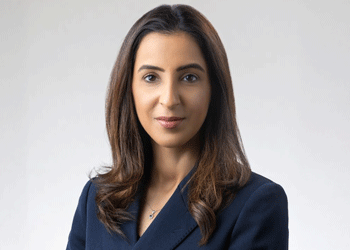
Bahrain is rewriting its trust law, expanding its logistics offering and rethinking its approach to key overseas markets as it works to keep investment flowing through a year of regional conflict.
 Speaking to journalists at the Gateway Gulf investment forum in Manama on 2 November, Noor bint Ali Alkhulaif, Bahrain’s minister of sustainable development and chief executive of the Bahrain Economic Development Board (EDB), said the conflict had sped up work on priorities that were already being considered.
“There are quite a few sectors that we were already looking at, but what has happened has kind of accelerated that thinking,” she said.
Logistics is one of them. Alkhulaif pointed to the announcement at last year’s Gateway Gulf that AirAsia would set up in Bahrain. That deal covers logistics and maintenance, repair and overhaul as well as the airline itself, and the logistics work is already under way. The EDB now wants to use the same model with other international players, and is in talks with Kuwait-based Agility, which attended the forum.
Food and medicine security is another. Alkhulaif said the kingdom had been tested first by Covid-19 and then by this year’s war. Bahrain is pursuing partnerships with neighbouring states, which also import much of what they consume.
Non-oil activity accounts for about 86% of Bahrain’s GDP. Alkhulaif said the sectors most exposed to travel, logistics and supply-chain disruption had come under pressure, while financial services and digital innovation had held up.
We’re not flashy. You can come here and you don’t have to be very visible
Investor confidence
Alkhulaif said the EDB had not seen investors pull out. “People absolutely distinguished the fundamentals of investment attraction, economic growth and visions of the region, and an influence outside of the region’s control,” she said.
Some investors delayed decisions, especially where they needed to travel to sign agreements or start operations. Those talks are continuing, and some investors are making short visits to meet partners before they commit.
Asked whether investor attitudes had changed, she said: “Fundamentally, no.” She said investors who missed events had been stopped by their governments’ travel advice, not by a change of view.
Financial services is the largest sector in Bahrain’s economy, with more than 380 licensed institutions. Alkhulaif said the fastest growth was in digital banks and digital assets.
Under the direction of King Hamad bin Isa Al-Khalifa, the EDB has been building a full ecosystem for wealth management, family offices and trusts. Bahrain has relaunched its golden residency programme and added regulations for multi-family offices. A new trust law, replacing legislation that is regarded as outdated, has been drafted and is being reviewed.
Alkhulaif said the draft makes sharia compliance something trusts opt into rather than out of, and removes the previous limit on how long a trust can last. It also sets out licensing requirements for each type of family office structure, simplifies set-up and makes clear which courts handle disputes.
The drafters examined frameworks in Jersey and Guernsey as well as Singapore, Hong Kong and Dubai. She added that Bahrain’s offer to families choosing between established hubs is discretion. “We’re not flashy,” she said. “You can come here and really you don’t have to be very visible.”
Market review
After a record year in 2025, the EDB is reviewing which sub-sectors and markets it should prioritise. “We’ve always said Germany is a strategic market, but we didn’t ever tackle it in the right way,” Alkhulaif said. An EDB delegation visited Germany the week before the forum.
Ties with Malaysia have strengthened since Malaysia hosted the relocated 2026 Bahrain Grand Prix at Sepang in October. The two countries’ prime ministers have agreed to draw up a cooperation plan, and their foreign ministers are working on a framework. Talks cover halal food security, technology and infrastructure. Malaysian contractors built the Bahrain International Circuit and want to bid for government projects.
The EDB board is also looking at opportunities in artificial intelligence, robotics and autonomous vehicles. The EDB is working with the Ministry of Transportation & Telecommunications on new regulations covering testing and logistics.
Alkhulaif said Bahrain, with a population of about 1.5 million, encourages investors to treat it as a base for the wider GCC. Banks with headquarters in the UAE or Saudi Arabia are putting their technology teams and back- and middle-office functions in Bahrain to save costs. Manufacturers are setting up to supply Saudi Arabia across the King Fahd Causeway. The EDB regularly compares Bahrain’s operating costs with those in cities such as Riyadh.
Those competitive advantages are bearing fruit. There were more than 100 announcements at Gateway Gulf and about 60 at a Bahrain financial event the previous month, including new digital banks.
The EDB said the forum ended with $22.3bn of announcements, partnerships and deals.
MEED’s December 2026 report on Bahrain includes:
> GOVERNMENT: Bahrain creaks under the strain of war
> BANKING: Manama’s lenders hold out for better times
> OIL & GAS: GPIC’s expansion project lifts Bahrain’s energy sector
> POWER & WATER: Bahrain’s utility pipeline shows signs of progress
> CONSTRUCTION: Bahrain construction activity remains subduedTo see previous issues of MEED Business Review, please click herehttps://image.digitalinsightresearch.in/uploads/NewsArticle/21523339/main.gif -
Chinese firms win $290m Algeria data centre deal
18 November 2026
Algeria’s High Commission for Digitalisation has awarded a AD39.8bn ($290m) contract for the study, construction, supply of equipment and commissioning of a national disaster recovery data centre.
The contract was awarded to a joint venture of Chinese firms including China Railway Construction Corporation (CRCC) and Huawei Group.
The contract is split into two lots:
- Lot 1 – Civil engineering and infrastructure: The CRCC-Huawei Group submitted a bid of $67m, including VAT, for a nine-month delivery period
- Lot 2 – Disaster recovery site: The group submitted a bid of $223m, including VAT, with a six-month completion period
The CRCC-Huawei Group comprises CRCC International, CRCC Algeria and Huawei Telecommunication Algeria.
The High Commission for Digitalisation said the group scored 100 out of 100 on both lots, meeting the tender requirements.
The project will provide a national disaster recovery site intended to maintain the availability and recovery of digital systems and data if a disruption affects a primary data centre or IT system.
The scope includes the physical data centre infrastructure under the first lot and the disaster recovery site equipment and systems under the second lot.
The planned facility forms part of Algeria’s wider digitalisation programme, which includes expanding public sector digital services and the supporting infrastructure required to host, secure and protect government data and applications.
 READ THE NOVEMBER 2026 MEED BUSINESS REVIEW – click here to view PDF
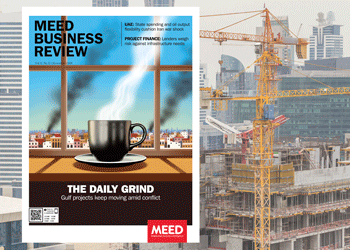
Gulf projects keep moving amid conflict; UAE's state spending and oil output flexibility cushion Iran war shock; Project finance lenders weigh risk against infrastructure needs.
Distributed to senior decision-makers in the region and around the world, the November 2026 edition of MEED Business Review includes:
> AGENDA: GCC projects market holds its nerve> MARKET FOCUS: UAE economy shows resilience> INDUSTRY REPORT: Project financiers hold the line> STADIUMS: Stadium spending set to jump 39% in 2027> CONFLICT: Hormuz closure wipes out growth in 2026> INTERVIEW: WSP regional president Dean McGrail> INTERVIEW: Ministry of Energy & InfrastructureTo see previous issues of MEED Business Review, please click herehttps://image.digitalinsightresearch.in/uploads/NewsArticle/21515726/main.gif -
Projects market holds firm
18 November 2026
 Commentary
Colin Foreman
EditorAfter eight months of conflict in the Gulf, the region’s economies are sustaining heavy damage. The IMF’s October World Economic Outlook forecasts contraction in every GCC state except Oman in 2026. Kuwait’s economy is projected to shrink by 16.7% and Qatar’s by 15.6% as disruption in the Strait of Hormuz cuts energy exports.
 The projects market has held up far better. Data from MEED Projects shows the UAE leading the region for a second consecutive year, with contract awards 6.1% higher than in the same period of 2025. Abu Dhabi has been the standout, with awards up 35% on the back of a sharp rise in public capital spending. Saudi Arabia has awarded $68.8bn of contracts so far this year, 13% less than in 2025.
Two key drivers are shaping the market in 2026. First, private developers, faced with declining off-plan sales, are focusing on project completion to unlock cash from investors who have already purchased property. Second, government and state-related entities have accelerated activity, pushing ahead with large-scale public infrastructure schemes alongside more commercially oriented developments.
Abu Dhabi has been the standout, with awards up 35% on last year
Warning signs remain beneath the headline totals. Tendering has slowed since hostilities resumed after the April ceasefire, and Dubai’s residential market has weakened, marked by a steep year-on-year drop in Q3 transactions. The effect on contract awards is likely to become clearer in the coming months.
The conflict is also generating new demand. Saudi Arabia and the UAE are prioritising ports, pipelines and transport links that bypass Hormuz, and reconstruction and repair work will follow once the fighting ends.
The central question for the final quarter is whether the Q3 slowdown marks a temporary pause or the start of a sustained decline.
Much will depend on when the strait reopens.
READ THE NOVEMBER 2026 MEED BUSINESS REVIEW – click here to view PDFGulf projects keep moving amid conflict; UAE's state spending and oil output flexibility cushion Iran war shock; Project finance lenders weigh risk against infrastructure needs.
Distributed to senior decision-makers in the region and around the world, the November 2026 edition of MEED Business Review includes:
> AGENDA: GCC projects market holds its nerve> MARKET FOCUS: UAE economy shows resilience> INDUSTRY REPORT: Project financiers hold the line> STADIUMS: Stadium spending set to jump 39% in 2027> CONFLICT: Hormuz closure wipes out growth in 2026> INTERVIEW: WSP regional president Dean McGrail> INTERVIEW: Ministry of Energy & InfrastructureTo see previous issues of MEED Business Review, please click herehttps://image.digitalinsightresearch.in/uploads/NewsArticle/21514495/main.gif -
EBRD takes stake in Egypt desalination platform
18 November 2026
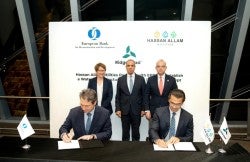
The European Bank for Reconstruction & Development (EBRD) has finalised an agreement to invest up to $31m in Egypt’s RWD Investments BV, a water development and investment arm of Hassan Allam Utilities (HAU).
Under the agreement, EBRD will acquire a 30% equity stake in RWD. HAU is contributing up to $61m towards the platform’s overall $92m equity funding.
The proceeds will support RWD’s near- and medium-term expansion plans, including the development of future large-scale desalination and wastewater projects through public-private partnerships (PPPs). The agreement follows EBRD board approval of the proposed investment in July.
RWD plans to add up to 15,000 cubic metres a day (cm/d) of new desalination capacity annually through 2030. The additional capacity will increase water supplies to businesses in coastal areas that are not connected to municipal networks.
The company will also rehabilitate existing desalination facilities to reduce energy consumption and improve operating efficiency.
Demand for alternative water sources is increasing in Egypt’s coastal areas, where tourism, industrial and other private developments often cannot rely on municipal water networks. The government has also restricted further extensions of Nile-sourced water infrastructure to coastal tourism developments.
Established in 2019, RWD operates in Egypt through Ridgewood for Water Desalination, Sinai for Environmental Services and Ridgewood Egypt for Infrastructure Projects.
The group owns and operates 79 desalination facilities across Egypt’s coastal cities, with a combined design capacity of about 96,340 cm/d as of December 2025.
In October, the Higher Committee for Public-Private Partnership approved the tendering of four industrial wastewater treatment plants in Alexandria, Giza, Beheira and Port Said. The facilities will serve the Amreya, Abu Rawash, Wadi El-Natrun and El-Raswa industrial zones, with capacities of 15,000-35,000 cm/d.
Two further desalination projects were approved for tendering, including a 900,000 cm/d plant in Port Said and a 1 million cm/d plant in Suez.
READ THE NOVEMBER 2026 MEED BUSINESS REVIEW – click here to view PDFGulf projects keep moving amid conflict; UAE's state spending and oil output flexibility cushion Iran war shock; Project finance lenders weigh risk against infrastructure needs.
Distributed to senior decision-makers in the region and around the world, the November 2026 edition of MEED Business Review includes:
> AGENDA: GCC projects market holds its nerve> MARKET FOCUS: UAE economy shows resilience> INDUSTRY REPORT: Project financiers hold the line> STADIUMS: Stadium spending set to jump 39% in 2027> CONFLICT: Hormuz closure wipes out growth in 2026> INTERVIEW: WSP regional president Dean McGrail> INTERVIEW: Ministry of Energy & InfrastructureTo see previous issues of MEED Business Review, please click herehttps://image.digitalinsightresearch.in/uploads/NewsArticle/21513812/main.jpg -
Bahrain appoints Northern Link Road transaction adviser
18 November 2026
Bahrain's Ministry of Works has awarded Ernst & Young a BD2.26m ($6m) contract to provide transaction advisory services on the Bahrain Northern Link Road (BNLR), a highway the government intends to deliver on a public-private partnership (PPP) basis.
The Bahrain Tender Board opened the financial proposals on 6 August. Local units of KPMG, PriceWaterhouseCoopers (PwC) and Ernst & Young (EY) submitted bids, all of which were accepted.
EY will provide financial, technical and legal advisory services, including feasibility studies, project structuring and bid documentation, along with support through tendering, evaluation and negotiation, and assistance up to financial close.
The 29.5-kilometre highway will run from North Manama Causeway Bridge to Suhaila Island and onwards to King Hamad Causeway. The project is intended to serve as a parallel east-west corridor to Sheikh Isa Bin Salman Highway and to support traffic flow between Khalifa Bin Salman Port and Saudi Arabia.
Causeway connection
The BNLR will connect to the planned King Hamad Causeway. Earlier project plans, drawn up in 2016, included an arterial road with six or eight lanes that could run alongside a light rail or rapid bus transit system.
In October 2019, King Fahd Causeway Authority appointed a consortium to provide transaction advisory services for King Hamad Causeway. The $8.9m consultancy agreement was signed with a consortium of Netherlands-headquartered KPMG, US-based Aecom and UK-based CMS. The plan was to fund the project through tolls, as with the existing King Fahd Causeway.
The King Fahd Causeway opened in 1986 and extends for 25km. The bridge cost an estimated $1.2bn to construct and serves about 45,000 vehicles a day on average, rising to about 60,000 at weekends. It has been undergoing an expansion to ease severe congestion during peak periods.
READ THE NOVEMBER 2026 MEED BUSINESS REVIEW – click here to view PDFGulf projects keep moving amid conflict; UAE’s state spending and oil output flexibility cushion Iran war shock; Project finance lenders weigh risk against infrastructure needs.
Distributed to senior decision-makers in the region and around the world, the November 2026 edition of MEED Business Review includes:
> AGENDA: GCC projects market holds its nerve> MARKET FOCUS: UAE economy shows resilience> INDUSTRY REPORT: Project financiers hold the line> STADIUMS: Stadium spending set to jump 39% in 2027> CONFLICT: Hormuz closure wipes out growth in 2026> INTERVIEW: WSP regional president Dean McGrail> INTERVIEW: Ministry of Energy & InfrastructureTo see previous issues of MEED Business Review, please click herehttps://image.digitalinsightresearch.in/uploads/NewsArticle/21511012/main.jpg