
Amazon data centre hit highlights sector vulnerabilities
2 March 2026

Amid ongoing Iranian missile and drone attacks on GCC states, US cloud provider Amazon Web Services (AWS) has reported service outages following separate incidents at two of its UAE data centres.
“At around 4.30AM PST [16.30 UAE time on 1 March], one of our Availability Zones (mec1-az2) was impacted by objects that struck the data centre, creating sparks and fire,” AWS said in an operational update on 1 March.
At 10.46 UAE time on 2 March, the company announced a further update, saying that another of its three UAE Availability Zones had gone down.
“We can confirm that a localised power issue has affected another Availability Zone in the ME-CENTRAL-1 Region (mec1-az3),” it said in the latest update. “Customers are also experiencing increased EC2 APIs and instance launch errors for the remaining zone (mec1-az1). At this point, it is not possible to launch new instances in the region, although existing instances should not be affected in mec1-az1.
“Other AWS services, such as DynamoDB and S3, are also experiencing significant error rates and latencies. We are actively working to restore power and connectivity, at which time we will begin to work to recover affected resources. As of this time, we expect recovery is multiple hours away.”
Regional footprint
The company, part of the US’ giant Amazon group, is one of the world’s largest data centre and cloud operators. It operates three data centres in the UAE – one in Dubai and two in Abu Dhabi – and provides critical IT services to government and private sector operations and systems.
Its Availability Zones consist of infrastructure in separate geographic locations, spaced far enough apart to significantly reduce the risk of a single event affecting customers’ business continuity, yet near enough to provide low latency for high-availability applications that use multiple zones.
The targeting of the two data centres – and potentially others if the conflict continues – highlights the strategic importance of these types of facilities. The AWS attacks are believed to be the first time a data centre has been targeted in a conflict and are likely to drive a reconfiguration of future campus designs to account for similar risks.
Such changes could include increased redundancies – particularly in power provision – enhanced structural resilience, and potentially a reconsideration of the location and clustering of data centre facilities.
WATCH: Ed James explores the rapidly evolving GCC data centres market
Historically, data centres in the region were largely smaller enterprise facilities dedicated to storage services for organisations such as banks. Their locations were often confidential and in areas that were difficult to target, making them harder to disrupt.
However, the emergence of large in-region hyperscale data centres – with IT loads of 200MW or more and larger physical footprints – may necessitate a rethink of how such infrastructure is delivered, not just in the GCC but worldwide.
According to MEED Projects data, there are believed to be about 185 data centres in the region, each with an estimated capex investment value of more than $10m, of which about 99 are either planned or under construction.


Register for MEED's guest program now to access this article.
Exclusive from Meed
-

-

-
-
 Iran launches regional attacks after US and Israel strikes start
28 February 2026
-
 Egypt’s Obelisk equity move merits attention
27 February 2026
All of this is only 1% of what MEED.com has to offer
Subscribe now and unlock all the 153,671 articles on MEED.com
- All the latest news, data, and market intelligence across MENA at your fingerprints
- First-hand updates and inside information on projects, clients and competitors that matter to you
- 20 years' archive of information, data, and news for you to access at your convenience
- Strategize to succeed and minimise risks with timely analysis of current and future market trends

Related Articles
-
Riyadh selects three teams for King Salman airport ECI
2 March 2026
Saudi Arabia’s King Salman International Airport Development Company (KSIADC) has selected three groups for the construction of Terminal 6 at King Salman International airport (KSIA) in Riyadh.
KSIADC, which is backed by Saudi sovereign wealth vehicle, the Public Investment Fund, will deliver the project on an early contractor involvement (ECI) basis.
The selected groups include:
- UCC / CCC (Qatar/Greece)
- Al-Gihaz Holding / TAV / WeBuild (local/Turkiye/Italy)
- PowerChina / MBL (China/local)
MEED understands that the ECI timeframe will be around six months.
The ECI process requires selected contractors to submit methodologies for the project and a design proposal. One team will then be selected for the construction.
In November last year, MEED exclusively reported that KSIADC was targeting mid-2026 to award the contract for the construction of Terminal 6 at KSIA in Riyadh.
In July last year, MEED exclusively reported that several contractor consortiums had submitted proposals for a contract to develop the first phase of Terminal 6 and the Iconic Terminal at KSIA.
MEED reported in May last year that US firm Bechtel Corporation had been appointed as the delivery partner for the terminals at KSIA.
According to local media reports, KSIADC’s acting CEO, Marco Mejia, said the project developer had completed the project’s masterplan.
The reports added that Terminal 6 will boost the airport’s capacity by 40 million passengers.
The project is expected to be delivered before the start of the Expo 2030 Riyadh event.
Project scale
The project covers an area of about 57 square kilometres (sq km), allowing for six parallel runways, and will include the existing terminals at King Khalid International airport. It will also include 12 sq km of airport support facilities, residential and recreational facilities, retail outlets and other logistics real estate.
If the project is completed on time in 2030, it will become the world’s largest operating airport in terms of passenger capacity, according to UK analytics firm GlobalData.
The airport aims to accommodate up to 120 million passengers by 2030 and 185 million by 2050. The goal for cargo is to process 3.5 million tonnes a year by 2050.
Saudi Arabia plans to invest $100bn in its aviation sector. Riyadh’s Saudi Aviation Strategy, announced by the General Authority of Civil Aviation, aims to triple Saudi Arabia’s annual passenger traffic to 330 million travellers by 2030.
It also aims to increase air cargo traffic to 4.5 million tonnes and raise the country’s total air connections to more than 250 destinations.
 https://image.digitalinsightresearch.in/uploads/NewsArticle/15823432/main.jpg
 -
Petrofac cuts staff in Libya and puts oil project on hold
2 March 2026
The financially troubled engineering company Petrofac has cut its staff in Libya and stopped work on a key oil project in the country, according to industry sources.
Between 15 and 20 Libyan members of staff have been released by the company, and work on a project to develop the Erawin oil field has been paused, sources said.
Petrofac secured a contract with Zallaf Libya Oil & Gas Exploration & Production Company to deliver its Erawin field development project phase 1 early production facilities (EPF) in September 2021.
The project’s scope of work encompassed surface equipment, including well pads and flowlines, at the Erawin oil field.
It also included a pipeline to transport crude oil approximately 100 kilometres (km) to the El-Sharara oil field, along with a control room, substation and telecom system located there.
In a statement to MEED, Petrofac said:
“Petrofac has not exited Libya. Our Tripoli office remains operational and we continue to maintain an active presence in the country.
“Regarding the Erawin project, the pipeline infrastructure was completed and has been in operation for more than a year.
“A small number of remaining activities were paused while we continue discussions with the client on the project’s final scope and close‑out arrangements.
“Petrofac has not abandoned the project, nor have we shut down our operations in Libya.”
Commenting on the cut to employee numbers in Libya, the company said:
“Recent workforce adjustments reflect the normal lifecycle of a project.”
The company added: “Libya remains an important market for Petrofac, and we remain committed to supporting the development of the country’s energy sector.
“As discussions with the client are ongoing, we are not in a position to comment further at this time.”
Zallaf Libya Oil & Gas Exploration & Production Company was established in Libya in 2013 and is wholly owned by Libya’s National Oil Corporation.
It awarded the Erawin EPF contract to Petrofac using the engineering, procurement, construction and commissioning (EPCC) contract model.
In a statement in 2021, Petrofac said the contract was valued at over $100m, but did not give a precise figure.
The regional project-tracking service MEED Projects has estimated that the contract was worth $440m.
Petrofac problems
On 27 October last year, Petrofac announced that it had applied to appoint administrators, a move that potentially put thousands of jobs at risk and increased uncertainty for projects worth billions of dollars in the Middle East and North Africa (Mena) region.
At the time, the total value of projects awarded to Petrofac and under construction in the region was $5.83bn, according to information recorded by MEED Projects.
Petrofac also had bids under evaluation for 15 projects in the region worth a total of $19.28bn.
Since then, key parts of the business have been sold off, and many of the company’s staff have been made redundant.
The redundancies included around 180 employees who were issued termination notices in October last year.
In December, the US-based company CB&I announced it had entered into a deal to buy Petrofac’s asset solutions business in the first quarter of 2026.
In January this year, the proposed company voluntary arrangement (CVA) related to the sale of its Asset Solutions business was approved.
Erawin exports
Libya shipped its first cargo of crude from the Erawin oil field in November 2023.
The shipment departed from Libya’s Zawiyah port and consisted of 600,000 barrels of crude.
Australia-based Worley Parsons was appointed as the front-end engineering and design (feed) contractor for the EPF project in 2019.
The Erawin field development project is located about 800km south of Tripoli and 100km southwest of the El-Sharara field.
https://image.digitalinsightresearch.in/uploads/NewsArticle/15821861/main.jpg -
Iran launches regional attacks after US and Israel strikes start
28 February 2026
Iran launched missiles aimed at Bahrain, Jordan, Kuwait, Qatar and the UAE on Saturday, 28 February, after the US and Israel began airstrikes on the Islamic Republic earlier in the day.
Official news agencies in the countries targeted by Iran have confirmed the attacks and that missiles have been intercepted by air defences. There has been limited damage reported from the strikes, although one fatality has been reported in the UAE.
The UAE’s Ministry of Defence (MoD) said there was a blatant attack involving Iranian ballistic missiles and that UAE air defence systems intercepted a number of missiles. It also confirmed that missile debris falling into a residential area resulted in the death of one civilian of Asian nationality. The UAE also said it reserves its full right to respond to this escalation and to take all necessary measures to protect itself.
In Bahrain, the National Communication Centre (NCC) confirmed external attacks targeting sites and installations within Bahrain’s borders. It said the security and military authorities had immediately activated established emergency protocols and were taking all necessary operational measures on the ground.
In Doha, the Ministry of Defence confirmed that Qatar had been attacked and that all missiles were intercepted before reaching Qatari territory.
In Kuwait, the official Kuwait News Agency reported that air defence systems had dealt with missiles detected in Kuwaiti airspace.
Meanwhile, in Amman, a senior military official from the Jordanian Armed Forces (JAF) confirmed that air defences had intercepted and neutralised two ballistic missiles targeting Jordanian territory.
Saudi Arabia has condemned the attacks and has “affirmed its full solidarity with and unwavering support for the brotherly countries, and its readiness to place all its capabilities at their disposal in support of any measures they may undertake”.
Main image: UAE announces successful interception of new wave of Iranian missiles. Credit: Wam
https://image.digitalinsightresearch.in/uploads/NewsArticle/15813394/main.gif -
Egypt’s Obelisk equity move merits attention
27 February 2026
 Commentary
Mark Dowdall
Power & water editorThe first phase of Africa’s planned largest hybrid solar and battery installation project reached commercial operations this week. While the 1.1GW Obelisk facility in Egypt is significant in capacity terms, the more interesting detail may lie in its ownership structure.
Scatec secured the 25-year US dollar-denominated power purchase agreement in 2024 and moved the project into construction as majority shareholder with Norwegian Investment Fund for Developing Countries (Norfund).
In November, France’s EDF acquired a 20% equity stake to join the project as a shareholder, while discussions with additional equity partners are at an “advanced” stage.
With the development risk largely already absorbed and revenues secured under a long-term, dollar-denominated contract, the question arises: how are developers approaching capital allocation in the renewables market?
Especially in emerging markets, sponsors must consider currency convertibility, sovereign exposure and overall balance sheet concentration. Bringing in partners after key milestones reduces that exposure without abandoning the asset.
However, risk mitigation is not the only driver behind these decisions.
This week, Masdar agreed to sell a 60% stake in a portfolio of wind assets in Portugal, a more mature European market with stable regulation and limited currency risk.
Given the developer’s 100GW global target, this would seem a prudent way to recycle capital as part of an aggressive growth strategy.
Meeting global climate targets will require sustained and rapid expansion of renewable capacity. Estimates suggest the world must add more than 1,100GW of renewables annually through 2030 to remain on track.
Increasingly, as pipelines expand and capacity targets rise, developers are likely to weigh carefully when to hold assets and when to release capital.
https://image.digitalinsightresearch.in/uploads/NewsArticle/15798541/main.jpg -
 Petrokemya awards contract for ethylene oxide project
27 February 2026
Register for MEED’s 14-day trial access
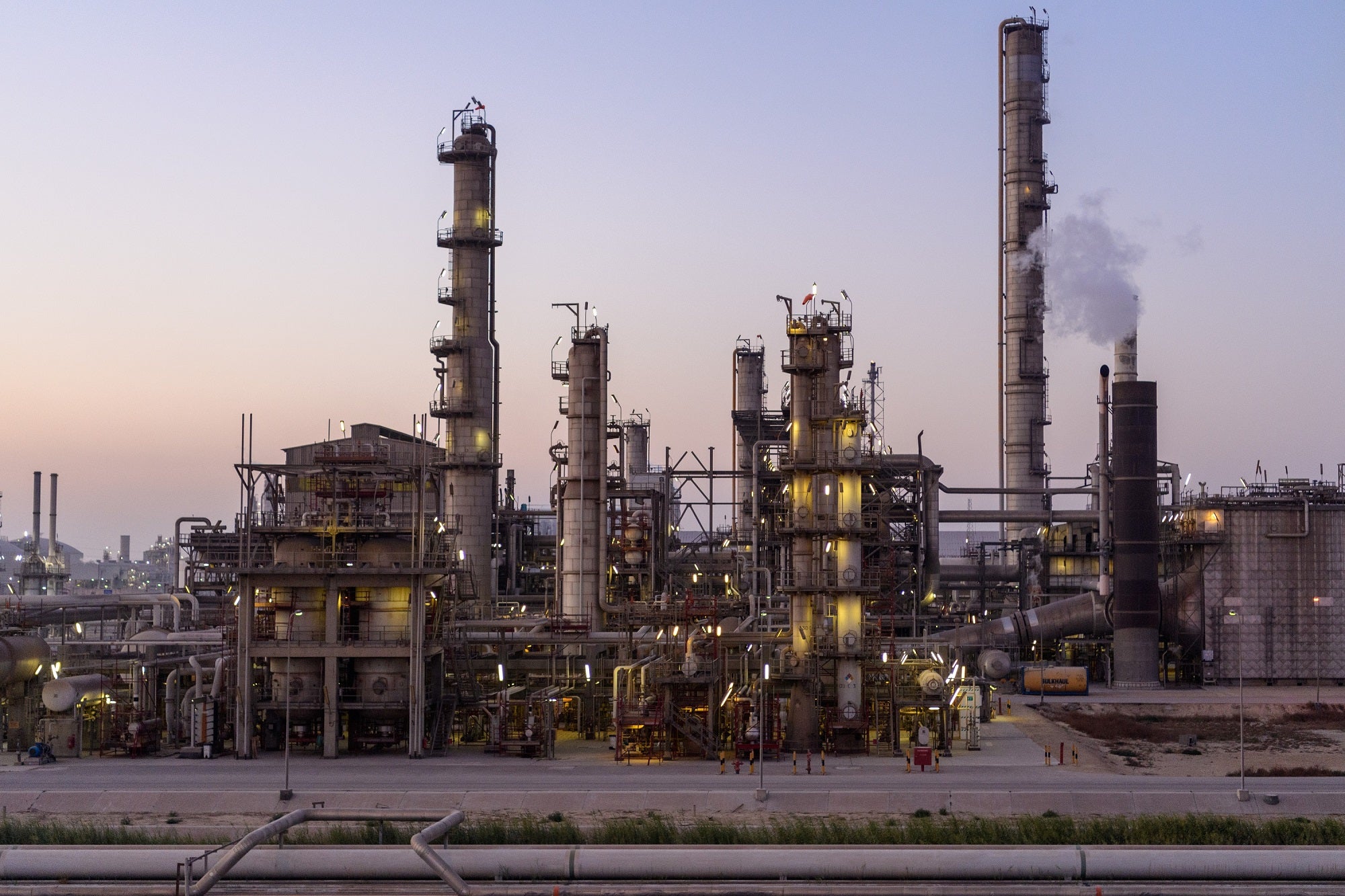
Petrokemya, an affiliate of Saudi Basic Industries Corporation (Sabic), has awarded China National Chemical Engineering Group Corporation (CNCEC) the main contract for an ethylene oxide catalyst project.
The project covers engineering, procurement and construction (EPC) of a new 4,000-tonne-a-year (t/y) ethylene oxide catalyst production unit, encompassing multiple units for catalyst carrier washing and drying, as well as supporting utilities.
Ethylene oxide catalysts are the core technology of the ethylene oxide industry chain, directly determining production efficiency, product quality and energy consumption of the process unit.
Petrokemya is a wholly owned affiliate of Sabic, with its main petrochemical production complex located in Jubail Industrial City, in Saudi Arabia’s Eastern Province.
The ethylene oxide catalyst project is the ninth contract awarded by Petrokemya to CNCEC since 2015. Previous jobs cover EPC works on seven specialty chemical projects and a project to upgrade and expand output capacity at Petrokemya’s main methyl tert-butyl ether (MTBE) production unit.
Petrokemya awarded CNCEC the contract for the MTBE plant expansion project in November 2022, with the contractor starting work the following month.
Through the project, the output potential of Petrokemya’s MTBE unit will increase from 700,000 t/y to 1 million t/y, purportedly making it the world’s largest single-unit MTBE plant.
CNCEC achieved mechanical completion of the MTBE plant expansion project in August last year, and the project is now understood to have been commissioned.
https://image.digitalinsightresearch.in/uploads/NewsArticle/15797372/main4837.jpg