
Acwa Power consolidates power sector dominance
26 September 2025

This package also includes: GCC enters pivotal year for IPPs
Saudi Arabia’s Acwa Power has tightened its grip on the top position in MEED’s 2025 GCC Power Developer Ranking, extending its lead over international competitors as new projects and equity stakes lifted both its net and gross capacity to record levels.
The latest index includes a survey of 140 privately owned and financed power generation plants in the six GCC states, including those with attached water desalination facilities.
These plants have a collective gross electricity generation capacity of about 152.1GW. This includes 31 new schemes for which the contracts were awarded between September 2024 and August 2025. With a total combined gross capacity of 39.7GW, these awards involve 15 solar farms, five wind farms and 11 gas-fired power plants.
 Strong lead
At the top of the ranking, Acwa Power’s net capacity has climbed to 28.1GW in 2025, in a 70% increase on the 16.5GW reported last year. Its gross capacity has also surged by nearly 70%, rising from 45.4GW in 2024 to 76.1GW in 2025 – triple the gross capacity of the company’s closest competitor.
Underlining the extent of its dominance in the GCC market, Acwa Power now holds more equity than the rest of the region’s top 10 developers combined. This reflects the central role it is playing in Saudi Arabia’s power and water transition.
The bulk of Acwa Power’s capacity gains in 2025 are tied to awards for several large-scale renewables projects made directly under the state-owned Public Investment Fund’s (PIF) National Renewable Energy Programme (NREP). These include the 3GW Humaji and Bisha solar plants, the 2GW Starah wind power development, two 2GW solar plants at Afif, a 2GW facility at Khulais and the 1GW Shaqra wind power project.
All were advanced under the PIF’s direct procurement framework, with each of the projects listing Acwa Power as the lead private shareholder. Together, they account for more than 15GW of capacity, representing most of Acwa’s year-on-year growth and reinforcing its privileged position as the PIF’s strategic partner for renewables delivery.
Acwa Power’s surge has been driven not only by new capacity additions with the PIF, but also by acquisitions that expanded its regional footprint. In February, the company agreed to purchase French firm Engie’s stakes in key assets including Kuwait’s Al-Zour North independent water and power project (IWPP) and several plants in Bahrain, adding more than 4.6GW of gas-fired power to its portfolio.
That transfer of assets also explains the fall in Engie’s reported capacity this year. The developer yet retains second place in the ranking, despite a drop in net capacity from 8GW to 6.5GW and no new awards in the region for the second year running.
Acwa Power now holds more equity than the rest of the region’s top 10 developers combined
Market shake-up
The shifting fortunes of other international players show a market where some developers are consolidating while others are slipping back.
Japan’s Marubeni has sustained modest growth, taking its net capacity to 4.6GW, enough to keep its position rather than significantly closing the gap.
France’s EDF, by contrast, is a standout performer among international utilities, having grown its net capacity by more than 1GW to exceed 3GW. New equity in Saudi Arabia’s Taiba 2 and Qassim 2 combined-cycle gas turbine (CCGT) projects, together with the Al-Ajban solar plant in Abu Dhabi, all contributed to the positive year for the firm. EDF has now risen up the rankings for two years in a row.
South Korea’s Kepco meanwhile increased its net capacity by nearly 180% to 2.8GW, alongside the near tripling of its gross capacity to 9GW – catapulting the firm directly into the top six. This came from fresh stakes in combined-cycle projects in Saudi Arabia, broadening its role in the kingdom beyond previous partnerships.
Japan’s developers were less standout, yet they remain a key part of the top tier. Jera added more than 1,100MW in equity to reach 2,936MW net capacity. Mitsui held steady and Sumitomo climbed modestly with this year’s net capacities at 2,537MW and 2,245MW respectively.
Their marginal gains do not quite match the leaps made by EDF and Kepco, but are enough to keep them secure among the region’s elite power developers.
The strong rise of other local companies in 2024 has partly been maintained. Both Saudi Arabia’s Ajlan & Bros and Aljomaih have increased their equity to more than 2GW for the first time, supporting their rankings with stakes in major Saudi solar and CCGT projects.
Ajlan’s presence has been boosted by its role in round four of Saudi Arabia’s NREP, where it took a stake in the 700MW Yanbu wind independent power project (IPP), in addition to further involvement in gas-fired capacity.
Aljomaih, meanwhile, added to its long-standing shares in the Taiba 2 and Qassim 2 CCGT plants through participation in round five of the programme, which awarded the 300MW Rabigh 2 solar IPP. Both firms have sustained their positions with incremental gains rather than significant expansion.
This reshuffle means that China’s Jinko Power, which had held 10th place last year with 1.3GW, has dropped out of the top tier after securing no new contracts.
The fall in Engie’s equity and the relatively modest performance of Japanese firms highlights how Acwa Power’s aggressive growth has shifted the regional balance.
From a competitive standpoint, Acwa Power’s dominance is now such that it holds more than four times the net capacity of Engie, in second place.
This concentration of capacity with a single developer raises questions about market dependency, though it also reflects Saudi Arabia’s strategy of leveraging a domestic champion to deliver large-scale power assets at speed.
Future growth
The GCC power sector continues to be shaped by three main factors.
Renewables remain the backbone of new capacity additions, with solar photovoltaic (PV) and wind projects continuing to define the region’s energy transition.
Gas-fired baseload capacity is still essential to balance intermittent supply from renewables and is increasingly being tied to carbon-capture plans.
Local private participation, which surged in 2024, has in 2025 been more about consolidation, with regional developers holding positions rather than climbing further.
In 2025, new project awards were dominated by renewables, with more than 17GW of solar capacity and nearly 4GW of wind, but gas-fired plants still accounted for over 18GW, reflecting the region’s continued reliance on dependable baseload power.
The outlook for power tariffs remains mixed. While the record-low solar PV tariffs seen in previous rounds are less likely to be repeated, recent contract awards still underline the region’s competitiveness.
Rising financing costs and pressure on engineering, procurement and construction capacity are weighing on pricing and timelines, although falling commodity costs may help to keep tariffs lower than in other parts of the world. For gas-fired
projects, turbine supply chain constraints continue to add cost pressure. CCGT projects with carbon-capture elements are likely to carry premiums compared to conventional schemes.
If the large-scale PIF projects and the Engie acquisitions are stripped out, Acwa Power’s 2025 growth looks far less dramatic. Its expansion would have been limited to schemes such as the Hajr and Marjan gas-fired projects, adding only about 5GW of capacity. The developer would still lead the GCC market, but its margin over international rivals would be much narrower, and its year would have looked more like steady progress than the exceptional leap that has defined it.
However, with Saudi Arabia set to procure up to 20GW a year of renewables and gas-fired capacity under the NREP, Acwa Power’s lead is likely to widen further in the coming years.
International competitors will remain present, but the scale of national programmes and Acwa Power’s position as a domestic champion look set to define the market’s shape. For now, 2025 marks the year Acwa Power moved from being a strong leader to an almost unassailable one in the GCC power developer rankings.
 GCC enters pivotal year for IPPs


Register for MEED's guest program now to access this article.
Exclusive from Meed
-
 Abu Dhabi mends fences with Riyadh
9 October 2026
-
 Abu Dhabi mends fences with Riyadh
9 October 2026
-
 Adnoc secures Thailand LNG supply deal
9 October 2026
-
 Fibrex wins $217m Abu Dhabi Seamont residences contract
9 October 2026
-
 Dubai picks contractor for Al-Maktoum airport terminal
9 October 2026
All of this is only 1% of what MEED.com has to offer
Subscribe now and unlock all the 153,671 articles on MEED.com
- All the latest news, data, and market intelligence across MENA at your fingerprints
- First-hand updates and inside information on projects, clients and competitors that matter to you
- 20 years' archive of information, data, and news for you to access at your convenience
- Strategize to succeed and minimise risks with timely analysis of current and future market trends

Related Articles
-
Abu Dhabi mends fences with Riyadh
9 October 2026
Ongoing political turmoil in the region may be prompting Abu Dhabi to review its approach to key diplomatic issues, not least its relations with its larger neighbour, Saudi Arabia.
In late September, UAE Vice-President Sheikh Mansour Bin Zayed Al-Nahyan travelled to Riyadh for talks with Crown Prince Mohammed Bin Salman and Defence Minister Prince Khalid Bin Salman. Such visits may have been commonplace in the past, but over the past year they have been relatively rare, given the friction between the two Gulf powers over issues such as the conflict zones of Yemen and Sudan, relations with Israel and economic rivalry.
At the start of the year, the UAE retreated from Yemen under pressure from Riyadh, after the UAE-backed Southern Transitional Council made rapid territorial gains at the expense of Saudi-backed groups and advanced close to the kingdom’s southern border.
Since then, against the backdrop of the Iran war, relations have shown further signs of strain, with cross-border financial transactions reportedly being blocked or delayed.
However, there have been intermittent attempts to present a more collegial relationship, such as in July, when a photo emerged on social media of Sheikh Mansour and Prince Khalid posing with their arms around each other, reportedly while on holiday in Europe.
Yemen dynamics
Gains by another group in Yemen may lie behind the latest rapprochement between Riyadh and Abu Dhabi. The visit by Sheikh Mansour on 29 September came in the wake of significant advances by the Houthis, who had recently captured Mokha port and strategically significant areas of land overlooking the Bab El-Mandeb Strait – heightening their ability to menace passing ships.
Saudi Arabia has been leaning on its allies – particularly Pakistan and Turkiye – to support its campaign against the Houthis. It is unclear whether the UAE would be willing to get involved militarily in Yemen again, or whether Riyadh would be happy for it to do so, but it could still be a useful ally in the fight. Analysts have noted that UAE-backed forces have, over the years, had a far greater record than anyone else of scoring battleground victories against the Houthis.
It is also notable that Mansour’s delegation to Riyadh included several senior security officials, including Ali Bin Hammad Al-Shamsi, secretary general of the Supreme Council for National Security; Ali Saeed Matar Al-Neyadi, chairman of the National Emergency, Crisis and Disaster Management Authority; and Nasser Humaid Al-Nuaimi, secretary general of the Tawazun Council for Defence Enablement.
The visit was a surprise, given the GCC states’ lack of unified action this year amid the crises in Yemen and Iran. Speaking at an event in Washington in mid-September, Bernard Haykel, professor of Near Eastern Studies at Princeton University, noted that: “Despite the fact that [the GCC states] all face a common threat in Iran and its proxies, you still don’t see real coordination between them. You still have these differences between the Saudis and the UAE, for instance; you have differences between the Qataris and the UAE. If anything would have united them, this would be it. And you don’t see that kind of unity.”
Writing for the Arab Gulf States Institute in early October, Kristian Coates Ulrichsen, a Baker Institute fellow for the Middle East at Rice University, said Mansour’s visit to Riyadh in late September was “likely meant to signal that the thaw [in bilateral relations] was real” and “designed to enable a more coordinated approach to managing the forces ranged against the Houthis in southern and central Yemen”.
Further signs of warming ties came on 8 October, when UAE Investment Minister Mohamed Hassan Alsuwaidi signed a memorandum of understanding with Saudi Industry and Mineral Resources Minister Prince Abdulaziz Bin Salman covering power grid interconnections, trade in electricity and freight rail connectivity.
On the same day, the Saudi ambassador to the UAE invited President Sheikh Mohamed Bin Zayed Al-Nahyan to attend a GCC-EU Summit in Saudi Arabia later in the month.
Sheikh Mansour was not the only senior Emirati on diplomatic manoeuvres in recent weeks. The day after the vice-president was in Riyadh, national security adviser Sheikh Tahnoun Bin Zayed Al-Nahyan was in Muscat for talks with Sultan Haitham Bin Tariq Al-Said.
Oman is a critical partner for the UAE in several areas. Omani ports have provided a trade lifeline for Emirati importers and exporters at a time when ports in Dubai and Abu Dhabi have been sidelined by Iran’s threats against shipping through the Strait of Hormuz. Muscat’s approach of maintaining dialogue with all actors means it is also able to mediate with both Iran and Yemen’s Houthis.
Strategic independence
The flurry of diplomatic activity may be a sign of closer coordination between the UAE and its neighbours on some critical issues, but that does not necessarily herald a sea change in its approach.
Speaking at the UN General Assembly in New York on 28 September, Minister of State Khalifa Shaheen Al-Marar reviewed the crises in Iran, Sudan, Gaza, Ukraine and elsewhere and said “the importance of developing and reforming regional and international multilateral institutions … remains paramount” – but while he name-checked the UN, he did not mention the GCC.
It is also notable that the UAE has not yet joined either of the two security initiatives launched by Saudi Arabia during the summer: a maritime defence alliance designed to protect shipping in the Red Sea, or a mutual defence pact that Riyadh signed with Turkiye and Pakistan.
In his speech to the UN, Al-Marar listed what he saw as the main pillars of the UAE’s national strength: “strategic independence” was the first item in his list.
https://image.digitalinsightresearch.in/uploads/NewsArticle/20435670/main.gif -
Abu Dhabi mends fences with Riyadh
9 October 2026
Ongoing political turmoil in the region may be prompting Abu Dhabi to review its approach to key diplomatic issues, not least its relations with its larger neighbour, Saudi Arabia.
In late September, UAE Vice-President Sheikh Mansour Bin Zayed Al-Nahyan travelled to Riyadh for talks with Crown Prince Mohammed Bin Salman and Defence Minister Prince Khalid Bin Salman. Such visits may have been commonplace in the past, but over the past year they have been relatively rare, given the friction between the two Gulf powers over issues such as the conflict zones of Yemen and Sudan, relations with Israel and economic rivalry.
At the start of the year, the UAE retreated from Yemen under pressure from Riyadh, after the UAE-backed Southern Transitional Council made rapid territorial gains at the expense of Saudi-backed groups and advanced close to the kingdom’s southern border.
Since then, against the backdrop of the Iran war, relations have shown further signs of strain, with cross-border financial transactions reportedly being blocked or delayed.
However, there have been intermittent attempts to present a more collegial relationship, such as in July, when a photo emerged on social media of Sheikh Mansour and Prince Khalid posing with their arms around each other, reportedly while on holiday in Europe.
Yemen dynamics
Gains by another group in Yemen may lie behind the latest rapprochement between Riyadh and Abu Dhabi. The visit by Sheikh Mansour on 29 September came in the wake of significant advances by the Houthis, who had recently captured Mokha port and strategically significant areas of land overlooking the Bab El-Mandeb Strait – heightening their ability to menace passing ships.
Saudi Arabia has been leaning on its allies – particularly Pakistan and Turkiye – to support its campaign against the Houthis. It is unclear whether the UAE would be willing to get involved militarily in Yemen again, or whether Riyadh would be happy for it to do so, but it could still be a useful ally in the fight. Analysts have noted that UAE-backed forces have, over the years, had a far greater record than anyone else of scoring battleground victories against the Houthis.
It is also notable that Mansour’s delegation to Riyadh included several senior security officials, including Ali Bin Hammad Al-Shamsi, secretary general of the Supreme Council for National Security; Ali Saeed Matar Al-Neyadi, chairman of the National Emergency, Crisis and Disaster Management Authority; and Nasser Humaid Al-Nuaimi, secretary general of the Tawazun Council for Defence Enablement.
The visit was a surprise, given the GCC states’ lack of unified action this year amid the crises in Yemen and Iran. Speaking at an event in Washington in mid-September, Bernard Haykel, professor of Near Eastern Studies at Princeton University, noted that: “Despite the fact that [the GCC states] all face a common threat in Iran and its proxies, you still don’t see real coordination between them. You still have these differences between the Saudis and the UAE, for instance; you have differences between the Qataris and the UAE. If anything would have united them, this would be it. And you don’t see that kind of unity.”
Writing for the Arab Gulf States Institute in early October, Kristian Coates Ulrichsen, a Baker Institute fellow for the Middle East at Rice University, said Mansour’s visit to Riyadh in late September was “likely meant to signal that the thaw [in bilateral relations] was real” and “designed to enable a more coordinated approach to managing the forces ranged against the Houthis in southern and central Yemen”.
Further signs of warming ties came on 8 October, when UAE Investment Minister Mohamed Hassan Alsuwaidi signed a memorandum of understanding with Saudi Industry and Mineral Resources Minister Prince Abdulaziz Bin Salman covering power grid interconnections, trade in electricity and freight rail connectivity.
On the same day, the Saudi ambassador to the UAE invited President Sheikh Mohamed Bin Zayed Al-Nahyan to attend a GCC-EU Summit in Saudi Arabia later in the month.
Sheikh Mansour was not the only senior Emirati on diplomatic manoeuvres in recent weeks. The day after the vice-president was in Riyadh, national security adviser Sheikh Tahnoun Bin Zayed Al-Nahyan was in Muscat for talks with Sultan Haitham Bin Tariq Al-Said.
Oman is a critical partner for the UAE in several areas. Omani ports have provided a trade lifeline for Emirati importers and exporters at a time when ports in Dubai and Abu Dhabi have been sidelined by Iran’s threats against shipping through the Strait of Hormuz. Muscat’s approach of maintaining dialogue with all actors means it is also able to mediate with both Iran and Yemen’s Houthis.
Strategic independence
The flurry of diplomatic activity may be a sign of closer coordination between the UAE and its neighbours on some critical issues, but that does not necessarily herald a sea change in its approach.
Speaking at the UN General Assembly in New York on 28 September, Minister of State Khalifa Shaheen Al-Marar reviewed the crises in Iran, Sudan, Gaza, Ukraine and elsewhere and said “the importance of developing and reforming regional and international multilateral institutions … remains paramount” – but while he name-checked the UN, he did not mention the GCC.
It is also notable that the UAE has not yet joined either of the two security initiatives launched by Saudi Arabia during the summer: a maritime defence alliance designed to protect shipping in the Red Sea, or a mutual defence pact that Riyadh signed with Turkiye and Pakistan.
In his speech to the UN, Al-Marar listed what he saw as the main pillars of the UAE’s national strength: “strategic independence” was the first item in his list.
https://image.digitalinsightresearch.in/uploads/NewsArticle/20432716/main.gif -
Adnoc secures Thailand LNG supply deal
9 October 2026
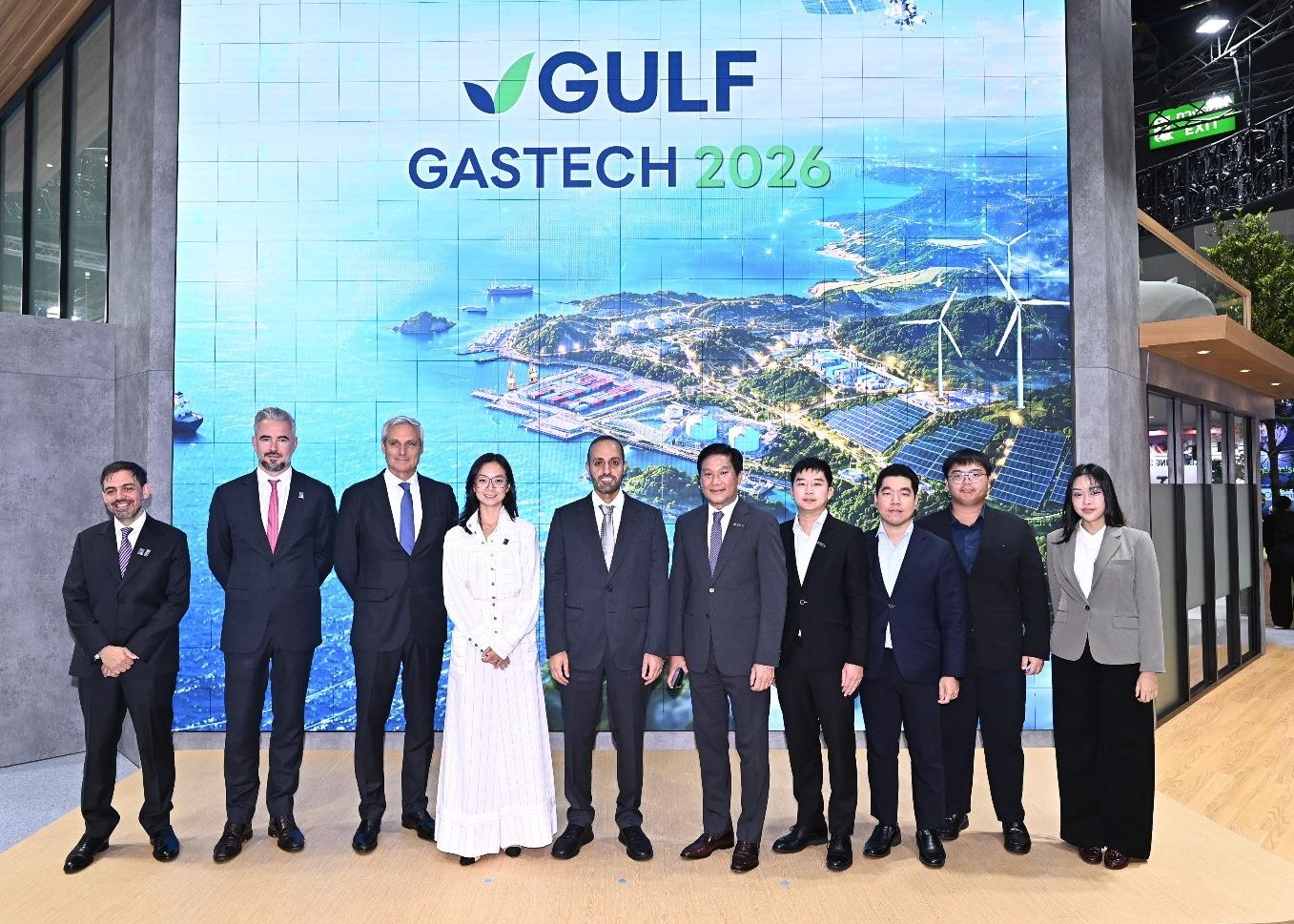
Abu Dhabi National Oil Company (Adnoc) has secured a deal with Thailand-based energy and infrastructure company Gulf Group to supply 2 million tonnes a year of liquefied natural gas (LNG), with deliveries starting in 2027.
The multi-year sale and purchase agreement (SPA), whose exact duration Adnoc did not disclose, builds on an initial LNG supply deal agreed between the two companies last year. The transaction was arranged through Adnoc’s integrated LNG marketing and trading platform, which was established in July within Abu Dhabi Global Market.
The hub integrates the marketing operations of Adnoc subsidiaries Adnoc Gas and XRG with the trading activities of Adnoc Trading. It targets a combined portfolio of 47 million t/y of marketable LNG by 2035. Adnoc Trading has developed an active third-party trading portfolio over the past four years, operating from commercial offices in Abu Dhabi, Singapore and Geneva.
ALSO READ: Adnoc signs energy agreements with Japan and South Korea
Separately, Adnoc has secured offtake commitments covering approximately 90% of the 9.6 million-t/y capacity planned for its low-carbon Ruwais LNG project.
In July, Adnoc signed a 15-year SPA with Japan’s Inpex Corporation for the supply of up to 1 million t/y from Ruwais. That contract marked Adnoc’s third long-term Ruwais supply agreement with a Japanese buyer, following deals with Osaka Gas and Mitsui & Co in March and April 2025, respectively. Together, the agreements with the three Japanese firms account for 2.4 million t/y – one-quarter of the terminal’s total capacity, which will be delivered across two 4.8 million-t/y liquefaction trains.
Adnoc has also secured long-term Ruwais LNG supply agreements with Malaysia’s Petronas, Germany’s EnBW Energie Baden-Wurttemberg and SEFE (Securing Energy for Europe), China’s ENN Natural Gas, UK-based Shell and Indian Oil Corporation.
Currently under construction in Ruwais Industrial City, Abu Dhabi, the facility is scheduled to begin commercial operations in 2028. Its commissioning will more than double Adnoc’s LNG production capacity to approximately 15 million t/y.
https://image.digitalinsightresearch.in/uploads/NewsArticle/20421415/main4048.jpg -
Fibrex wins $217m Abu Dhabi Seamont residences contract
9 October 2026
Register for MEED’s 14-day trial access
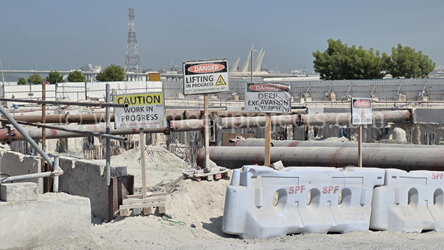
Abu Dhabi-based contractor Fibrex Construction Group has won an AED800m ($217m) contract to build the Seamont Autograph Collection Residences project, located on Al-Reem Island in the UAE capital.
Abu Dhabi-based real estate developer Royal Development Holding, a subsidiary of Emirates Stallion Group, and local firm Saas Properties awarded the contract.
The development comprises two 22-storey towers offering 497 residences, ranging from one- to four-bedroom apartments.
The construction programme is scheduled to run for 27 months, with completion due in December 2028.
Fibrex will begin mobilisation immediately, following the completion of enabling works this month, which were undertaken by Sharjah-based Swiss Pro Foundations.
Dubai-based architectural firm Dewan Architects & Engineers is the project consultant.
The contract marks another major win for the contractor. Last year, Dubai-based developer Nakheel awarded Fibrex a AED2.6bn ($708m) contract to build the Bay Villas project at Dubai Islands.
That contract includes the construction of 636 villas.
 READ THE OCTOBER 2026 MEED BUSINESS REVIEW – click here to view PDF
Industry and logistics drive development at Neom; Saudi Arabia’s investment priorities realign amid conflict; MEED’s 2026 power developer ranking.
Distributed to senior decision-makers in the region and around the world, the October 2026 edition of MEED Business Review includes:
> AGENDA: Oxagon takes centre stage at Neom> MARKET FOCUS: Saudi projects hold steady> INDUSTRY REPORT: MEED’s 2026 GCC power developer ranking> LEADERSHIP: The future city does not need to hang above the groundTo see previous issues of MEED Business Review, please click herehttps://image.digitalinsightresearch.in/uploads/NewsArticle/20420509/main.jpg -
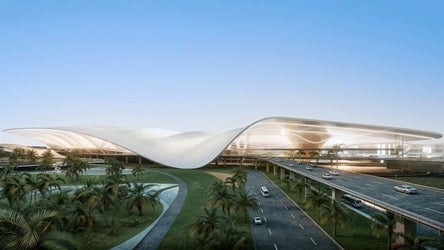
Dubai picks contractor for Al-Maktoum airport terminal
9 October 2026
Dubai Aviation Engineering Projects (DAEP) has selected a contractor for an estimated AED10bn ($2.7bn) substructure package for the West Terminal, as part of the first phase of the $35bn expansion of Al-Maktoum International airport.
A joint venture of Beijing-headquartered China Civil Engineering Construction Corporation (CCECC) and Abu Dhabi-based Tristar Engineering & Construction will execute the contract.
According to a description on DAEP’s website, the expanded airport’s West Terminal will be a seven-level facility spanning 800,000 square metres, with annual capacity for 45 million passengers.
The terminal will be the second of three planned terminals at Al-Maktoum International airport. It will connect to the airside via a 14-station automated people-mover (APM) system.
In July, MEED exclusively reported that DAEP had awarded an estimated $1.5bn contract to a joint venture of Japan’s Mitsubishi Corporation and Indian contractor Larsen & Toubro for the APM system.
The APM will run beneath the apron and terminal areas, using multiple tracks to transport passengers between terminals and concourses. Four underground stations are planned in the first phase, while the full airport development is expected to include 14 stations.
The latest awards form part of a wider programme of contracts recently signed by DAEP, covering enabling works, the second runway, initial structural foundations for passenger terminals and concourse substructures.
Upcoming awards
In June 2026, DAEP said it will award construction contracts worth over AED55bn ($15bn) for Al-Maktoum International airport by the end of the year.
At the time, DAEP said the planned awards included substructure works for the West Terminal, the fourth aircraft concourse and the baggage-handling system. The programme also included superstructure works for the West Terminal and the first, second and third aircraft concourses.
The packages are expected to include long-span structural frameworks for buildings covering about 1.5 million square metres, infrastructure works for the southern airfield area, and power-generation and district-cooling plants supporting the construction programme.
DAEP also plans to award façade and roofing packages in 2026.
The Dubai Government approved updated designs and timelines for its largest construction project in April 2024. In September 2024, MEED exclusively reported that a team comprising Austria’s Coop Himmelb(l)au and Lebanon’s Dar Al-Handasah had been confirmed as lead masterplanning and design consultants for the Al-Maktoum International airport expansion.
Construction of the airport is planned in three phases. Once complete, the airport will cover 70 square kilometres south of Dubai and include five parallel runways and 430 aircraft gates.
It will be five times the size of Dubai International airport and is planned to have a passenger-handling capacity of 260 million passengers a year – the largest in the world. For cargo, it is planned to have the capacity to handle 12 million tonnes a year.
READ THE OCTOBER 2026 MEED BUSINESS REVIEW – click here to view PDFIndustry and logistics drive development at Neom; Saudi Arabia’s investment priorities realign amid conflict; MEED’s 2026 power developer ranking.
Distributed to senior decision-makers in the region and around the world, the October 2026 edition of MEED Business Review includes:
> AGENDA: Oxagon takes centre stage at Neom> MARKET FOCUS: Saudi projects hold steady> INDUSTRY REPORT: MEED’s 2026 GCC power developer ranking> LEADERSHIP: The future city does not need to hang above the groundTo see previous issues of MEED Business Review, please click herehttps://image.digitalinsightresearch.in/uploads/NewsArticle/20417755/main.jpg