
Abu Dhabi’s Tadweer aims to revolutionise waste management
30 September 2025

Tadweer Group has launched a new company, Tadweer Collection (Tajmee’e), that aims to revolutionise waste management in Abu Dhabi. The new entity has been tasked with transforming waste collection and treatment through advanced technologies, data-driven operations and community engagement, with the goal of diverting 80% of waste away from landfill by 2030.
 “Technology is the central nervous system of Tajmee’e’s operations,” says Matt Rogers, executive director of technology and digital at Tadweer Group (pictured, right).
“It is no longer just a supporting function but a core strategic driver alongside community engagement and partnerships. Every aspect of the business, from collections and asset management to customer service and sustainability reporting, is built around digital integration.”
Technology core
Tajmee’e’s activities are structured around an integrated waste management platform that brings together collection, transportation and treatment into a single system. The company has adopted artificial intelligence to optimise collection routes, improve fuel efficiency and reduce emissions. Collection vehicles are equipped with telemetry systems to monitor speed, braking, idling and fuel use. At the same time, containers are fitted with sensors that measure fill levels and transmit data in real time, enabling dynamic scheduling of collections according to need rather than fixed timetables.
Other digital technologies reinforce this approach. Radio frequency identification (RFID) tags allow bins to be tracked, while computer vision systems inspect containers for damage, contamination or overflow as trucks arrive. These innovations collectively aim to transform waste collection from a fixed, schedule-based service into a flexible, intelligent logistics operation.
Investment is also being directed at downstream treatment facilities. At new material recovery plants, optical sorting systems and robotics guided by artificial intelligence will be introduced to increase efficiency, reduce contamination and improve the quality of recycled materials. Waste-to-energy plants are also planned to process non-recyclable materials, generating energy and reducing reliance on landfill.
Strategic asset
The technological transformation is underpinned by the systematic collection and analysis of data. Every pick-up generates operational information on weight, type and volume of material, as well as vehicle and environmental data. Fleet management software records driving behaviour and emissions, while facility monitoring systems capture energy yields and recycling rates.
This data is processed through predictive models that allow Tajmee’e to forecast future waste volumes, manage contamination levels and plan capacity requirements.
Rogers says the objective is to become a “big data enterprise” that makes strategic decisions guided by real-time information. This approach supports the company’s headline target of diverting 80% of waste away from landfill by 2030.
Artificial intelligence is central to this process. Beyond route optimisation and robotic sorting, it is being applied in areas such as health and safety. Cameras in vehicles can detect whether drivers are wearing seatbelts or engaging in unsafe behaviour, allowing managers to intervene and improve training. “Some of these less tangible uses of AI provide the greatest value,” says Rogers.
The adoption of advanced technology inevitably involves cost. “You do see a slight uplift in costs compared to traditional models, but it is quickly recouped through efficiency gains,” says Rogers.
International potential
Tajmee’e’s ambitions extend beyond Abu Dhabi. The company has been established with a mandate to explore international markets, with potential entry routes ranging from acquisitions and joint ventures to licensing of technology platforms. Options are open at this stage and will be pursued on a case-by-case basis.
Centralised operations in Abu Dhabi provide the foundation for this expansion. The company has created a command-and-control centre that monitors live camera feeds and data flows from across the city. Artificial intelligence enables automated responses to incidents, reducing the need for human oversight. Once established, this model can be scaled to monitor operations in other markets regardless of geography. “Distance is not an issue,” says Rogers. “With AI support, we can manage fleets and facilities on the other side of the world.”
Such capabilities allow Abu Dhabi to serve local needs and export expertise, in much the same way that the UAE has leveraged its experience in aviation, ports and logistics to create global businesses.

Register for MEED's guest program now to access this article.
Exclusive from Meed
-
 Egypt raises gas prices by 30% amid Iran war
11 March 2026
-

-
-
 Ruwais industrial complex struck by drones
10 March 2026
-
All of this is only 1% of what MEED.com has to offer
Subscribe now and unlock all the 153,671 articles on MEED.com
- All the latest news, data, and market intelligence across MENA at your fingerprints
- First-hand updates and inside information on projects, clients and competitors that matter to you
- 20 years' archive of information, data, and news for you to access at your convenience
- Strategize to succeed and minimise risks with timely analysis of current and future market trends

Related Articles
-
Egypt raises gas prices by 30% amid Iran war
11 March 2026
Register for MEED’s 14-day trial access
Egypt’s Petroleum & Mineral Resources Ministry increased the price of several petroleum products and natural gas for vehicles on 9 March, according to official statements.
The price of natural gas for vehicles has been put up by 30% to E£13 ($0.25) a cubic metre.
The price of diesel has gone up by 17% to E£20.5 a litre, while 95-octane petrol has been put up by 14.2% to E£24 a litre.
The new prices were put into effect early on 10 March and come amid soaring global energy prices in the wake of the US and Israel attacking Iran on 28 February.
Egypt’s Petroleum & Mineral Resources Ministry said: “This comes in light of exceptional circumstances resulting from geopolitical developments in the Middle East and their direct impact on global energy markets, which have led to a significant increase in import and domestic production costs.
“Disruptions in supply chains, increased risk levels and higher shipping and insurance costs have resulted in a substantial surge in global crude oil and petroleum product prices, levels not seen in energy markets for years.”
The statement also said that Egypt is continuing efforts to boost domestic production and reduce the country’s import bill.
Egypt, the Middle East and North Africa region’s biggest liquefied natural gas (LNG) importer, is facing uncertainty over its LNG supplies in coming months.
Between March 2025 and February 2026, Egypt imported 9,440 kilotonnes of LNG, with the majority of its imports purchased through short-term agreements, mainly with third parties like trading houses.
Last year, it was reported that Egypt had signed deals for around 150 cargoes through to the summer of 2026.
While much of Egypt’s LNG is likely to come from the US, and will not be directly impacted by the effective closure of the Strait of Hormuz, the recent surge in LNG prices could mean that the North African country will struggle to afford shipments.
Exacerbating the need for increased LNG imports, on 28 February, Israel shut down production from its offshore gas fields due to security concerns, cutting pipeline exports to Egypt.
Prior to the fields being taken offline, Egypt was importing about 1.1 billion cubic feet a day from the Tamar and Leviathan fields.
On 4 March, addressing concerns about energy supplies in the country, Prime Minister of Egypt Mostafa Madbouly said that Egypt had just concluded “several contracts” to procure gas shipments at “preferential prices”, in cooperation with several countries and international companies.
However, he did not provide details about the exact pricing of the deals.
On top of the LNG deals Egypt has with trading houses, in January, Cairo signed a memorandum of understanding with Qatar related to 2026 LNG imports.
The preliminary deal included plans for 24 LNG deliveries through the summer of this year, when energy demand typically peaks.
Now, the shuttering of Qatar’s export terminals and the effective closure of the Strait of Hormuz are casting a shadow over the deal and there is increased uncertainty over whether these deliveries will be executed.
https://image.digitalinsightresearch.in/uploads/NewsArticle/15931401/main.jpg -
Delays expected to $3.3bn Kuwait gas project due to Iran war
11 March 2026
Register for MEED’s 14-day trial access
Significant delays are now expected for state-owned Kuwait Gulf Oil Company's (KGOC's) planned tender for the development of an onshore gas plant next to the Al-Zour refinery, according to industry sources.
The project budget is estimated to be $3.3bn and the last meeting with contractors to discuss the project took place in Kuwait on 10 February.
In February, contractors were told to expect the invitation to bid to be issued in late March, but this schedule is now expected to be extended significantly due to uncertainties created by the US and Israel attacking Iran on 28 February
Under current plans, the plant will have the capacity to process up to 632 million cubic feet a day (cf/d) of gas and 88.9 million barrels a day of condensates from the Dorra offshore field, located in Gulf waters in the Saudi-Kuwait Neutral Zone.
Ownership of the field is disputed by Iran, which refers to the field as Arash.
Iran claims the field partially extends into Iranian territory and asserts that Tehran should be a stakeholder in its development.
One source said: “Developing this gas field in the waters so close to Iran will be impossible in the current security environment.
“Everyone is expecting extended delays to progress on this project and all related projects, such as the planned onshore processing facility in Kuwait.
“The offshore elements of the project would be especially vulnerable to attacks from Iran and there are likely to be security concerns over the development of this field for some time to come.”
In July last year, MEED reported that KGOC had initiated the project by launching an early engagement process with contractors for the main engineering, procurement and construction tender.
France-based Technip Energies completed the contract for the front-end engineering and design.
https://image.digitalinsightresearch.in/uploads/NewsArticle/15931284/main.png -
Sharakat plan signals next phase of Saudi water expansion
10 March 2026
Sharakat, formerly Saudi Water Partnership Company, released its latest seven-year statement in March, outlining the next phase of the kingdom’s water infrastructure plans.
According to the document, desalination capacity from Sharakat-procured projects is expected to rise from about 3.88 million cubic metres a day (cm/d) in 2025 to roughly 7.18 million cm/d by 2031, reflecting the continued reliance on desalinated water to meet rising urban demand.
The expansion will be supported by seven additional independent water plants (IWPs) with a combined capacity of about 2.8 million cm/d, alongside projects already operating, under construction or in procurement.
Against this backdrop, 2025 proved to be the busiest year for desalination awards since before the Covid-19 pandemic. Total water infrastructure awards also remained strong at $10bn, despite dipping on the two previous years.
Desalination projects accounted for $2.2bn across four schemes. The largest award was the $700m Shoaiba 6 seawater reverse osmosis (SWRO) desalination plant, which will have a capacity of 500,000 cm/d.
Another key development came when Sharakat awarded the contract to develop the Ras Mohaisen IWP on the Red Sea coast.
The project will treat 300,000 cm/d of seawater using reverse osmosis technology and will supply areas including Mecca and Al-Bahah. The developer consortium is led by Acwa Power, which holds a 45% stake, alongside Haji Abdullah Ali Reza & Partners with 35% and Al-Kifah Holding with 20%.
Transmission projects
Large transmission infrastructure continues to move forwards, with new contracts reaching $6.2bn in 2025, more than 60% of total awards.
This includes a contract with Sharakat to develop and operate the kingdom’s second independent water transmission pipeline (IWTP) project. The winning consortium comprises local firms Aljomaih Energy & Water, Nesma Company and Buhur for Investment Company.
The 587-kilometre (km) pipeline, capable of transporting 650,000 cm/d of water, will link Jubail in the Eastern Province with Buraydah in the Qassim region. Construction is expected to begin in the second quarter of 2026.
In December, local firm Vision Invest was named as the preferred bidder to develop and operate the 859km Riyadh-Qassim IWTP, Sharakat’s third IWTP project.
Vision Invest’s offer to develop the project with a levelised tariff of SR2.627 ($0.70) a cubic metre was almost 20% lower than the next nearest bidder
Further transmission projects are also advancing through Saudi Arabia’s Water Transmission Company (WTCO).
Bidding opened in September for the Jubail-Buraydah transmission scheme and the Ras Mohaisen-Baha-Mecca independent water transmission system, which together will deliver more than 1.38 million cm/d of water across central and western Saudi Arabia. An initial deadline was set for the end of the year, although this has been extended several times.
WTCO has also issued a tender for the construction of a $700m IWTP project in Qassim, including a 350km water transmission pipeline and 11 storage tanks. The main contract bids are expected in the coming weeks.
Storage and wastewater treatment
Saudi Arabia’s national water strategy aims to build reserves equivalent to seven days of municipal demand, requiring more than 115 million cubic metres of storage capacity by 2030.
Alongside this, Sharakat’s seven-year plan envisages wastewater treatment capacity rising from 1.79 million cm/d to about 3.19 million cm/d.
In February, a consortium of Saudi utilities provider Marafiq, the regional business of France’s Veolia and Bahrain/Saudi Arabia-based Lamar Holding reached financial close on a $500m wastewater treatment plant in Jubail Industrial City 2
The project will be developed under a concession-style model similar to a public-private partnership, with the developer consortium responsible for building and operating the plant over a 30-year period.
Some developers have also started to return to the Saudi water market, with Metito CEO, Rami Ghandour, explaining: “We took a break for a few years from bidding for municipal projects in the kingdom as we felt the market was overheating.”
A consortium of Metito, Etihad Water & Electricity (EtihadWE) and SkyBridge was named the preferred bidder for the Hadda independent sewage treatment (ISTP) in December with a levelised tariff of SR2.354 ($0.63) a cubic metre.
Meanwhile, a group comprising Miahona, Marafiq and Buhur for Investment Company was selected as the preferred bidder for the Arana ISTP with a levelised tariff of SR1.35 ($0.36) a cubic metre. Both the Hadda and Arana ISTP projects in Mecca Province are set to reach financial close this year.
Outlook
The project pipeline suggests that large transmission projects will continue drive contract activity. About $9.3bn of projects are currently under bid evaluation, with water pipeline schemes accounting for more than half, while a further $12bn of projects are in prequalification.
The request for proposals has already been issued for the Riyadh East ISTP, which will have a treatment capacity of 200,000 cm/d in its first phase, expanding to 400,000 cm/d in the second phase. The bid submission deadline is 2 April.
On the desalination front, IWP schemes at Ras Al-Khair, Tabuk, Shuqaiq and Jizan, have seen shifts in expected procurement timelines following earlier prequalification rounds.
The largest of these is phase two of the Ras Al-Khair IWP, which has been in development for more than a decade and involves the construction of a 600,000 cm/d reverse osmosis desalination plant.
According to the revised timeline, the $400m Al-Shuqaiq 4 IWP project will be the first of seven planned IWPs to reach commercial operations in 2029. The main contract is set to be tendered later this year.
https://image.digitalinsightresearch.in/uploads/NewsArticle/15926412/main.jpg -
Ruwais industrial complex struck by drones
10 March 2026
Register for MEED’s 14-day trial access
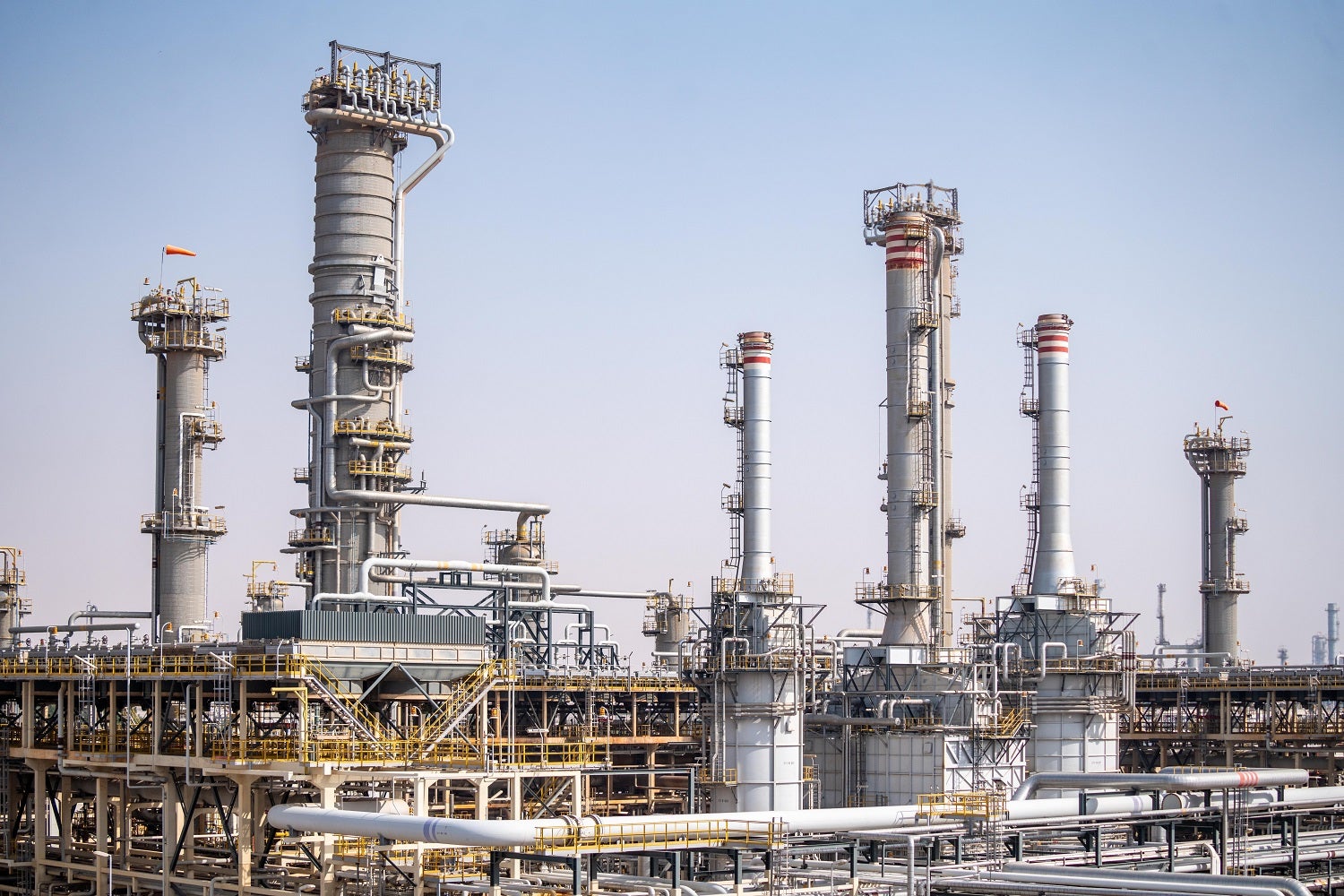
Abu Dhabi authorities are responding to a fire that has broken out at a facility in Ruwais industrial complex, caused by a drone attack.
The Ruwais industrial complex, located in Abu Dhabi's Al-Dhafra region, houses the world's fourth-largest single-site oil refinery and is operated by Abu Dhabi National Oil Company (Adnoc).
No injuries have been reported at this time, the Abu Dhabi Media Office said.
The UAE continues to intercept drones and missiles fired from Iran, as attacks on the Gulf countries continue for a 11th day in the ongoing regional conflict.
Apart from the Ruwais refining complex, which has a capacity of 922,000 barrels a day (b/d) of crude oil and condensates, Ruwais industrial complex is also home to petrochemicals producer Borouge’s main production complex.
Additionally, Adnoc is in an advanced stage of engineering, procurement and construction (EPC) on a liquefied natural gas (LNG) project within the Ruwais industrial complex, which will have the capacity to produce about 9.6 million tonnes a year (t/y) of LNG from two processing trains, each with a capacity of 4.8 million t/y. When the project is commissioned, which is due to take place in 2028, Adnoc’s LNG production capacity will more than double to about 15 million t/y.
Separately, Taziz – a 60:40 joint venture of Adnoc Group and Abu Dhabi’s industrial holding company ADQ – is overseeing the development of at least seven specialty chemicals plants in its planned derivatives zone in Ruwais Industrial City.
https://image.digitalinsightresearch.in/uploads/NewsArticle/15926385/main2738.jpg -
Contractors submit bids for Dorra offshore gas project packages
10 March 2026
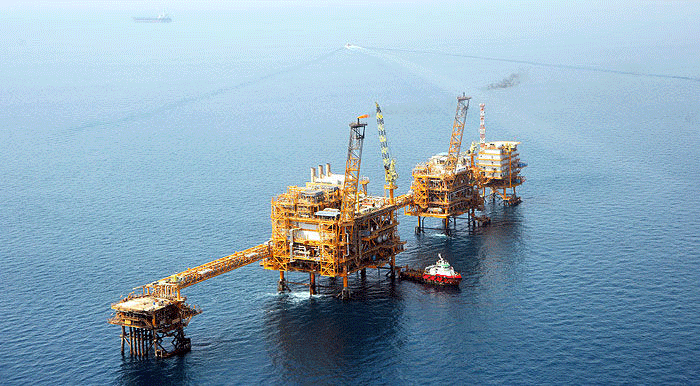
Contractors have submitted bids to Al-Khafji Joint Operations (KJO) for engineering, procurement and construction (EPC) works on a project to develop natural gas from the Dorra gas field, located in the waters of the Saudi-Kuwait Neutral Zone.
KJO, which is jointly owned by Saudi Aramco subsidiary Aramco Gulf Operations Company and Kuwait Petroleum Corporation (KPC) subsidiary Kuwait Gulf Oil Company (KGOC), has divided the project’s scope of work into four EPC packages – three offshore and one onshore.
Indian contractor Larsen & Toubro Energy Hydrocarbon (L&TEH) has won package one of the Dorra facilities project, which covers the EPC of seven offshore jackets and the laying of intra-field pipelines. The contract awarded by KJO to L&TEH is estimated to be valued at $140m-$150m, MEED reported in October.
Contractors submitted bids for the remaining three packages – offshore packages 2A and 2B and onshore package three by the final deadline of 9 March, according to sources.
Two consortiums of contractors submitted bids for the packages, sources told MEED:
- NMDC Energy (UAE) / Hyundai Heavy Industries (South Korea)
- Saipem (Italy) / Larsen and Toubro Energy Hydrocarbon (India)
KJO had extended the bid submission deadlines for these packages several times since last year.
The EPC scope of work for package 2A includes Dorra gas field wellhead topsides, flowlines and umbilicals. Package 2B involves the central gathering platform complex, export pipelines and cables. Package three includes the EPC of onshore gas processing facilities.
Saudi Arabia and Kuwait are pressing ahead with their plan to jointly produce 1 billion cubic feet a day (cf/d) of gas from the Dorra gas field.
The two countries have been producing oil from the Neutral Zone – primarily from the onshore Wafra field and offshore Khafji field – since at least the 1950s. With a growing need to increase natural gas production, they have been working to exploit the Dorra offshore field, understood to be the only gas field in the Neutral Zone.
Discovered in 1965, the Dorra gas field is estimated to hold 20 trillion cubic metres of gas and 310 million barrels of oil.
The Dorra facilities scheme is one of three multibillion-dollar projects launched by subsidiaries of Saudi Aramco and KPC to produce and process gas from the Dorra field that has advanced in the past few months.
AGOC onshore Khafji gas plant
AGOC has set a current bid submission deadline of 22 April for seven EPC packages as part of a project to construct the Khafji gas plant, which will process gas from the Dorra field onshore Saudi Arabia.
MEED previously reported that AGOC issued main tenders for the seven EPC packages in 2025. Contractors were initially set deadlines of 24 October for technical bid submissions and 9 November for the submission of commercial bids, which was then extended by AGOC until 22 December.
The seven EPC packages cover a range of works, including open-art and licensed process facilities, pipelines, industrial support infrastructure, site preparation, overhead transmission lines, power supply systems and main operational and administrative buildings.
France-based Technip Energies has carried out a concept study and front-end engineering and design (feed) work on the entire Dorra gas field development programme.
Progress has been hampered by a geopolitical dispute over ownership of the Dorra gas field. Iran, which refers to the field as Arash, claims it partially extends into Iranian territory and asserts that Tehran should be a stakeholder in its development. Kuwait and Saudi Arabia maintain that the field lies entirely within their jointly administered Neutral Zone – also known as the Divided Zone – and that Iran has no legal basis for its claim.
In February 2024, Kuwait and Saudi Arabia reiterated their claim to the Dorra field in a joint statement issued during an official meeting in Riyadh of Kuwaiti Emir Sheikh Mishal Al-Ahmad Al-Jaber Al-Sabah and Saudi Crown Prince and Prime Minister Mohammed Bin Salman Bin Abdulaziz Al-Saud.
Since that show of strength and unity, projects targeting the production and processing of gas from the Dorra field have gained momentum.
KGOC onshore processing facilities
KGOC has initiated early engagement with contractors for the main EPC tendering process for a planned Dorra onshore gas processing facility, which is to be located in Kuwait.
KGOC is at the feed stage of the project, which is estimated to be valued at up to $3.3bn. The firm is now expected to issue the main EPC tender within the first quarter of this year, MEED recently reported.
The proposed facility will receive gas from a pipeline from the Dorra offshore field, which is being separately developed by KJO. The complex will have the capacity to process up to 632 million cf/d of gas and 88.9 million barrels a day of condensates from the Dorra field.
The facility will be located near the Al-Zour refinery, owned by another KPC subsidiary, Kuwait Integrated Petroleum Industries Company.
A 700,000-square-metre plot has been allocated next to the Al-Zour refinery for the gas processing facility and discussions regarding survey work are ongoing. The site could require shoring, backfilling and dewatering.
The onshore gas processing plant will also supply surplus gas to KPC’s upstream business, Kuwait Oil Company, for possible injection into its oil fields.
Additionally, KGOC plans to award licensed technology contracts to US-based Honeywell UOP and Shell subsidiary Shell Catalysts & Technologies for the plant’s acid gas removal unit and sulphur recovery unit, respectively.
https://image.digitalinsightresearch.in/uploads/NewsArticle/15926065/main5801.gif