
Abu Dhabi and US firms form $25bn power joint venture
20 March 2025
Abu Dhabi-based critical infrastructure-focused sovereign investor ADQ and US-headquartered Energy Capital Partners (ECP) have agreed to establish a 50:50 partnership to build new power generation and energy infrastructure.
ECP is the largest private owner of power generation and renewable facilities in the US.
The firms plan to make total capital investments of more than $25bn across 25GW-worth of projects, with the US as the primary focus.
The combined initial capital contribution from the partners is expected to amount to $5bn.
“The partnership will focus on serving the needs of data centres and industrial centres in the US and selected other international markets over the long-term,” ADQ said in a statement on 19 March, a day after UAE national security adviser and Abu Dhabi deputy ruler, Sheikh Tahnoon Bin Zayed Al-Nahyan, met with US President Donald Trump at the White House.
ADQ said the partnership aims to service the growing power needs of data centres, hyperscale cloud companies and other energy-intensive industries.
“As the continuity and quality of power supply is crucial for these high-growth industries, the need for captive power plants that are in proximity is often a prerequisite,” ADQ said.
The partnership is focused on meeting these needs over the long term, with its mandate including greenfield development, new build and expansion opportunity projects.
A portion of the capital may also be allocated to opportunities in selected other international markets.
The statement cited a recent report by the International Energy Agency (IEA) stating that the world’s electricity consumption is forecast to rise at its fastest pace.
The growing need for data centres and industrial electrification partly account for the surging consumption.
In the US, for instance, a substantial increase in electricity demand is expected to add the equivalent of California's current power consumption to the national total over the next three years.
Recent research also forecasts that global power demand from data centres will increase by 50% by 2027 and by as much as 165% by the end of the decade, driven by the expansion of artificial intelligence (AI) and high-density data centres.
The US Department of Energy estimates that data centre load growth has tripled over the past decade and is projected to double or triple by 2028.

Register for MEED's guest program now to access this article.
Exclusive from Meed
-
 Projects market holds firm
18 November 2026
-
 Bahrain appoints Northern Link Road transaction adviser
18 November 2026
-
 OMV to drill Libya oil and gas exploration well
18 November 2026
-
 Indonesian contractor wins Algerian gas project deal
18 November 2026
-
 Local/Chinese team wins Saudi phosphate railway deal
17 November 2026
All of this is only 1% of what MEED.com has to offer
Subscribe now and unlock all the 153,671 articles on MEED.com
- All the latest news, data, and market intelligence across MENA at your fingerprints
- First-hand updates and inside information on projects, clients and competitors that matter to you
- 20 years' archive of information, data, and news for you to access at your convenience
- Strategize to succeed and minimise risks with timely analysis of current and future market trends
Related Articles
-
Projects market holds firm
18 November 2026
 Commentary
Colin Foreman
EditorAfter eight months of conflict in the Gulf, the region’s economies are sustaining heavy damage. The IMF’s October World Economic Outlook forecasts contraction in every GCC state except Oman in 2026. Kuwait’s economy is projected to shrink by 16.7% and Qatar’s by 15.6% as disruption in the Strait of Hormuz cuts energy exports.
 The projects market has held up far better. Data from MEED Projects shows the UAE leading the region for a second consecutive year, with contract awards 6.1% higher than in the same period of 2025. Abu Dhabi has been the standout, with awards up 35% on the back of a sharp rise in public capital spending. Saudi Arabia has awarded $68.8bn of contracts so far this year, 13% less than in 2025.
Two key drivers are shaping the market in 2026. First, private developers, faced with declining off-plan sales, are focusing on project completion to unlock cash from investors who have already purchased property. Second, government and state-related entities have accelerated activity, pushing ahead with large-scale public infrastructure schemes alongside more commercially oriented developments.
Abu Dhabi has been the standout, with awards up 35% on last year
Warning signs remain beneath the headline totals. Tendering has slowed since hostilities resumed after the April ceasefire, and Dubai’s residential market has weakened, marked by a steep year-on-year drop in Q3 transactions. The effect on contract awards is likely to become clearer in the coming months.
The conflict is also generating new demand. Saudi Arabia and the UAE are prioritising ports, pipelines and transport links that bypass Hormuz, and reconstruction and repair work will follow once the fighting ends.
The central question for the final quarter is whether the Q3 slowdown marks a temporary pause or the start of a sustained decline.
Much will depend on when the strait reopens.
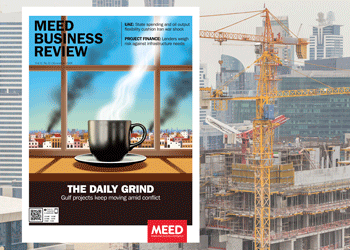
 READ THE NOVEMBER 2026 MEED BUSINESS REVIEW – click here to view PDF
Gulf projects keep moving amid conflict; UAE's state spending and oil output flexibility cushion Iran war shock; Project finance lenders weigh risk against infrastructure needs.
Distributed to senior decision-makers in the region and around the world, the November 2026 edition of MEED Business Review includes:
> AGENDA: GCC projects market holds its nerve> MARKET FOCUS: UAE economy shows resilience> INDUSTRY REPORT: Project financiers hold the line> STADIUMS: Stadium spending set to jump 39% in 2027> CONFLICT: Hormuz closure wipes out growth in 2026> INTERVIEW: WSP regional president Dean McGrail> INTERVIEW: Ministry of Energy & InfrastructureTo see previous issues of MEED Business Review, please click herehttps://image.digitalinsightresearch.in/uploads/NewsArticle/21514495/main.gif -
Bahrain appoints Northern Link Road transaction adviser
18 November 2026

Bahrain's Ministry of Works has awarded Ernst & Young a BD2.26m ($6m) contract to provide transaction advisory services on the Bahrain Northern Link Road (BNLR), a highway the government intends to deliver on a public-private partnership (PPP) basis.
The Bahrain Tender Board opened the financial proposals on 6 August. Local units of KPMG, PriceWaterhouseCoopers (PwC) and Ernst & Young (EY) submitted bids, all of which were accepted.
EY will provide financial, technical and legal advisory services, including feasibility studies, project structuring and bid documentation, along with support through tendering, evaluation and negotiation, and assistance up to financial close.
The 29.5-kilometre highway will run from North Manama Causeway Bridge to Suhaila Island and onwards to King Hamad Causeway. The project is intended to serve as a parallel east-west corridor to Sheikh Isa Bin Salman Highway and to support traffic flow between Khalifa Bin Salman Port and Saudi Arabia.
Causeway connection
The BNLR will connect to the planned King Hamad Causeway. Earlier project plans, drawn up in 2016, included an arterial road with six or eight lanes that could run alongside a light rail or rapid bus transit system.
In October 2019, King Fahd Causeway Authority appointed a consortium to provide transaction advisory services for King Hamad Causeway. The $8.9m consultancy agreement was signed with a consortium of Netherlands-headquartered KPMG, US-based Aecom and UK-based CMS. The plan was to fund the project through tolls, as with the existing King Fahd Causeway.
The King Fahd Causeway opened in 1986 and extends for 25km. The bridge cost an estimated $1.2bn to construct and serves about 45,000 vehicles a day on average, rising to about 60,000 at weekends. It has been undergoing an expansion to ease severe congestion during peak periods.
READ THE NOVEMBER 2026 MEED BUSINESS REVIEW – click here to view PDFGulf projects keep moving amid conflict; UAE’s state spending and oil output flexibility cushion Iran war shock; Project finance lenders weigh risk against infrastructure needs.
Distributed to senior decision-makers in the region and around the world, the November 2026 edition of MEED Business Review includes:
> AGENDA: GCC projects market holds its nerve> MARKET FOCUS: UAE economy shows resilience> INDUSTRY REPORT: Project financiers hold the line> STADIUMS: Stadium spending set to jump 39% in 2027> CONFLICT: Hormuz closure wipes out growth in 2026> INTERVIEW: WSP regional president Dean McGrail> INTERVIEW: Ministry of Energy & InfrastructureTo see previous issues of MEED Business Review, please click herehttps://image.digitalinsightresearch.in/uploads/NewsArticle/21511012/main.jpg -
OMV to drill Libya oil and gas exploration well
18 November 2026
Austrian oil and gas company OMV is planning to start drilling an exploration well in Libya’s Marwa concession before the end of this month, according to a statement from the North African country’s National Oil Corporation (NOC).
In its statement, NOC said that it held an “extensive technical meeting” with officials from OMV to discuss the company’s plans and contractual obligations.
The meeting reviewed activities carried out throughout 2026 alongside programmes scheduled for 2027.
NOC said: “Officials also addressed ways to overcome challenges hindering the completion of remaining work, including seismic surveys and exploration well drilling.”
During the meeting, OMV confirmed that preparations are under way to drill its first exploration well at the Marwa concession in Contract Area 103/3 (NC74B) by the end of November, targeting a depth of approximately 6,500 feet.
NOC’s Exploration Department said that intensifying oil and gas exploration is a key strategic priority for the organisation.
In June, NOC announced a capacity target of 2 million barrels of oil a day by 2030.
Earlier this month, Libya’s Audit Bureau said it had held a meeting with NOC to discuss tendering a project to rehabilitate and develop Libya’s Dahra oil field.
The head of the Audit Bureau, Khaled Shakshak, met with NOC head Masoud Suleiman on 15 November.
During the meeting, they discussed options for tendering the Dahra oil field development project, previously estimated at $1bn and expected to significantly increase the field’s oil production.
The oil field in central Libya has suffered from years of poor maintenance and was sabotaged by Islamic State militants in 2015.
https://image.digitalinsightresearch.in/uploads/NewsArticle/21479617/main.jpg -
Indonesian contractor wins Algerian gas project deal
18 November 2026
Indonesia’s Synergy Engineering has been officially awarded a design contract for a planned gas project in Algeria, according to a statement published in the country’s official energy and mining procurement bulletin.
The official contract award follows a provisional award that was announced on 29 July.
The front-end engineering and design (feed) contract has been awarded by Pertamina Algeria Eksplorasi Produksi (PAEP), which is a subsidiary of Indonesia’s state-owned energy company.
PAEP awarded the contract in association with Algeria’s national oil and gas company Sonatrach and Spain’s Repsol.
Sonatrach, Pertamina and Repsol are partners in Block 405a of the Menzel Ledjmet Nord (MLN) field.
The feed contract covers the development of a liquefied petroleum gas plant and a water injection facility at the MLN field as part of the field’s fifth development phase.
The contract has a 24-month term, according to the official statement.
Block 405a is situated onshore in the Illizi-Ghadames Basin in eastern Algeria. It comprises eight oil and gas fields split over three onstream development areas.
Algeria is home to Africa’s second-largest proven natural gas reserves after Nigeria. It is also Africa’s largest natural gas producer.
Amid ongoing issues exporting oil and gas from the GCC due to disruptions to shipping through the Strait of Hormuz, Algeria is seeking to increase its oil and gas exports to meet European demand.
In July, Algerian President Abdelmadjid Tebboune oversaw the signing of dozens of bilateral agreements as part of a wider push to bolster political and economic ties between Germany and Algeria.
The agreements included several focused on oil, gas and energy.
On 2 July, Sonatrach delivered its first shipment of liquefied natural gas (LNG) directly to Germany’s Wilhelmshaven 1 floating LNG import terminal.
https://image.digitalinsightresearch.in/uploads/NewsArticle/21479337/main.gif -
Local/Chinese team wins Saudi phosphate railway deal
17 November 2026
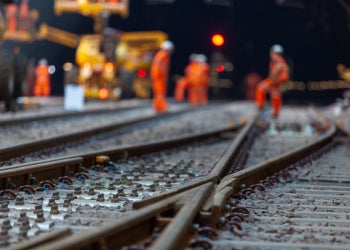
A joint venture of Riyadh-based contractor Alomaier Trading & Contracting Company and Beijing-headquartered China Civil Engineering Construction Corporation (CCECC) has won an estimated SR640m ($170m) contract to double the tracks on the existing phosphate transport railway network connecting the Waad Al-Shamal mines to Ras Al-Khair in the kingdom’s Eastern Province.
Saudi Arabia’s national rail operator, Saudi Arabia Railways (SAR), awarded the contract.
It covers construction works on the second section of the railway line, spanning more than 150 kilometres (km).
The scope of work includes civil works, alignment modifications, track and loop construction, and associated infrastructure such as bridges and culverts, as well as enhancements to signalling and telecommunications systems.
SAR floated the tender in February, and bids were submitted in April.
Alomaier’s latest contract award adds to its previous work order on the Phosphate 3 rail programme. In August, MEED exclusively reported that SAR had awarded Alomaier an estimated SR4bn-plus ($1.1bn) contract to add another track to the first section of the existing phosphate transport railway network.
The scope includes track doubling, alignment modifications, utility bridges, culvert widening and hydrological structures, as well as the conversion of the AZ1 siding into a mainline track. It also covers support works for signalling and telecommunications systems.
The existing railway runs from the Waad Al-Shamal mines to Ras Al-Khair. The first-section works will cover about 100km, connecting the AZ1/Nariyah Yard to Ras Al-Khair.
Switzerland-based engineering firm ARX is the project consultant.
Formerly known as the North-South Railway, the North Train is a 1,550km freight line running from the phosphate and bauxite mines in the far north of the kingdom to the Al-Baithah junction. From there, it diverges into a line south to Riyadh and another line east to downstream fertiliser production and alumina refining facilities at Ras Al-Khair on the Gulf coast.
Adding a second track and freight yards will significantly increase the network’s cargo-carrying capacity and support growth in industrial production. Project implementation is expected to take four years.
State-owned SAR is also considering increasing the localisation of railway materials and equipment, including developing a cement sleeper manufacturing facility.
https://image.digitalinsightresearch.in/uploads/NewsArticle/21469211/main.jpg