
PIF’s 2025 results back 2026-30 strategy shift
3 July 2026
Saudi Arabia’s Public Investment Fund (PIF) has published its audited consolidated financial statements for the year ended 31 December 2025, the first full set of annual results to follow the board’s approval of the fund’s 2026-30 strategy.
The results show a sharp improvement in profitability last year even as leverage rose and volatility in its listed equity holdings widened. The performance helps explain the strategic shift towards capital discipline and focus on private sector partnerships set out in April.
In April, PIF’s board, chaired by Crown Prince Mohammed Bin Salman Al-Saud, approved a new five-year strategy structured around three portfolios, the Vision Portfolio, the Strategic Portfolio and the Financial Portfolio, and organised around six domestic ecosystems: tourism, travel and entertainment; urban development and liveability; advanced manufacturing and innovation; industrials and logistics; clean energy, water and renewables infrastructure; and Neom as a standalone ecosystem.
Project reprioritisation
The strategy followed a period of reprioritisation across PIF’s gigaproject portfolio and set out a renewed emphasis on private capital, with PIF stating it would “further enable the role of the private sector as an effective partner for sustainable economic development”.
PIF’s consolidated profit for 2025 rose to SR65.2bn ($17.4bn) in 2025, up 152% from SR25.8bn in 2024. The increase was driven by operating profit more than doubling, to SR78bn from SR34.7bn, as revenue growth outpaced cost of revenue and general and administrative expenses moderated relative to the prior year. Profit attributable to the owner of the fund rose to SR46.4bn, up from just SR1bn in 2024, a swing that accounts for most of the year-on-year improvement.
Total revenue, comprising SR312bn of operating revenue and SR137.9bn of income from investment activities, rose 8.8% to SR449.9bn. Core operating revenue alone was up 9.9%, from SR284bn in 2024.
Segment mix
The segment breakdown shows where that growth came from, and it lines up closely with the six ecosystems named in the 2026-30 strategy. Banking and financial services remained the largest single revenue line at SR85.3bn, followed by telecommunications at SR76.8bn ($20.5bn), which was down slightly on 2024. Mining revenue rose 19.3% to SR38.8bn, consistent with the strategy’s focus on industrials and logistics, while revenue from electronic gaming and related services held broadly flat at SR15.6bn, an area PIF governor Yasir Al-Rumayyan specifically cited as a sector for strategic investment alongside artificial intelligence and renewable energy. Agricultural and livestock revenue nearly tripled, to SR7.6bn from SR2.5bn, and revenue from events operations rose to SR7.6bn from SR6bn, both pointing to the diversification into domestic ecosystems the strategy describes. Real estate operations revenue and revenue from advanced electronics and aerospace both declined slightly year-on-year.
Total assets grew 5.1% to SR4.54tn from SR4.32tn, continuing the expansion PIF has reported since 2015, when the strategy document put assets under management at $150bn, against more than $900bn today. The two figures are not directly comparable, since the IFRS consolidated balance sheet captures the full assets of consolidated subsidiaries such as the fund’s banking, telecommunications and mining operations, while PIF’s publicly cited assets-under-management figure uses a different valuation methodology, but both point to the same order of scale.
Total equity, by contrast, fell 2% to SR2.63tn ($701bn) from SR2.68tn, despite the sharp rise in reported profit. The gap is explained by other comprehensive income, which swung to a loss of SR113.3bn for the year, driven primarily by a SR112.8bn fair-value loss on equity instruments measured at fair value through other comprehensive income. In other words, unrealised mark-to-market losses on part of PIF’s listed equity portfolio outweighed the operating profit improvement, leaving total comprehensive income attributable to the owner of the fund at a loss of SR64.7bn for the year, though this was narrower than the SR154.4bn loss recorded in 2024.
Total liabilities rose 16.7%, to SR1.91tn from SR1.64tn, driven mainly by loans and borrowings, which climbed 27.2% to SR725.3bn from SR570.4bn. Property, plant and equipment grew 6.3%, to SR429.6bn, reflecting continued capital spending across PIF’s real estate and gigaproject portfolio, including the stadium, hospitality and urban development programmes.
Strategy context
The scale of PIF’s investment activity in the run-up to 2025 is set out in the April strategy announcement rather than the financial statements themselves. Between 2021 and 2025, PIF says it invested more than $199bn in new projects in Saudi Arabia, contributed $243bn to real non-oil GDP and spent more than $157bn with the local private sector, alongside growing assets under management six-fold and delivering an annualised total shareholder return of more than 7% since 2017. Read against the 2025 results, the rise in mining, gaming, agricultural and events revenue is an early indication that this domestic ecosystem investment is beginning to show up in operating performance, even as the wider balance sheet shows the cost of that expansion in higher borrowing and greater sensitivity to listed equity markets.
The results reinforce a theme demonstrated by PIF’s ongoing award of construction contracts for Expo 2030, the 2034 Fifa World Cup and other gigaprojects in the kingdom. Growth is increasingly funded through a combination of retained earnings, debt and, with the new strategy, private co-investment, rather than balance-sheet expansion alone. The explicit retention of Neom as a named ecosystem in the 2026-30 strategy, despite the cancellation of several Trojena contracts and the loss of the Asian Winter Games over the past year, suggests PIF intends to continue funding the project, but within a more disciplined framework most likely centred on industrial development around the Port of Neom, which is also known as Oxagon.
The 2025 results and the 2026-30 strategy point to a fund entering a new phase: profit generation has improved markedly, but leverage has grown and comprehensive income remains exposed to swings in listed markets, both factors consistent with a strategy that emphasises capital efficiency, institutional excellence and a larger role for private capital rather than a further scaling-up of gigaproject spending on PIF’s own balance sheet.

Register for MEED's guest program now to access this article.
Exclusive from Meed
-
 State-backed spending cushions UAE construction slowdown
13 October 2026
-
 Consortium signs EPC contract for Rabigh 2 IPP expansion
13 October 2026
-
 Contractors submit Riyadh road scheme bids
13 October 2026
-
 Contractor groups prequalify for Dubai Metro Gold Line
13 October 2026
-
 Egypt discusses technology cooperation with SLB
13 October 2026
All of this is only 1% of what MEED.com has to offer
Subscribe now and unlock all the 153,671 articles on MEED.com
- All the latest news, data, and market intelligence across MENA at your fingerprints
- First-hand updates and inside information on projects, clients and competitors that matter to you
- 20 years' archive of information, data, and news for you to access at your convenience
- Strategize to succeed and minimise risks with timely analysis of current and future market trends
Related Articles
-
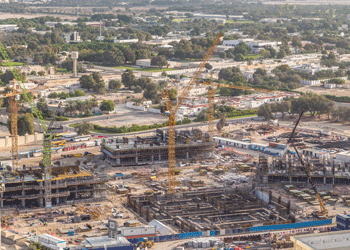
State-backed spending cushions UAE construction slowdown
13 October 2026

The UAE projects market is undergoing a structural realignment. Following a surge in private real estate investment after the Covid-19 pandemic, activity in the commercial and residential segments has softened amid regional geopolitical uncertainty.
Rather than allowing the market to contract, state and government-related entities (GREs) – particularly in Dubai – have stepped in to offset the shortfall, deploying balance-sheet capital countercyclically into strategic infrastructure, cultural and tourism projects.
Dubai recalibrates
Dubai’s construction sector has remained resilient at a headline level. On-site work continues, and major international contractors are securing new work.
A clear indicator of this stability came in September, when China State Construction Engineering Corporation secured an AED5bn ($1.3bn) contract from Dubai Holding for the developer’s new headquarters and the Jumeirah Residences Emirates Towers scheme.
Beneath this headline stability, however, procurement drivers have shifted dramatically. Private real estate activity, which supported the market’s post-pandemic resurgence, cooled following the onset of regional conflict at the end of February. Off-plan residential sales declined from a monthly peak of $9bn in February to $4bn in August.
Monthly contract awards for residential projects mirrored this contraction, dropping from $3bn to $306m over the same period as private developers deferred new project launches and conserved capital.
Government and government-related clients have absorbed much of the resulting shortfall. Dubai awarded $52.6bn of contracts in 2025, of which state-backed clients accounted for $26bn, or about 49%.
In 2026 to date, government and GRE procurement has reached $22.4bn of the $34.6bn in contracts awarded, representing almost two-thirds of total market activity.
The shift towards sovereign-backed spending appears intended to support construction activity and limit pressure on the supply chain during a period of private sector retrenchment.
This state intervention is underpinned by an unawarded projects pipeline of $530bn in Dubai, according to MEED Projects data.
The city’s future construction pipeline remains heavily weighted towards housing and integrated urban developments. Unawarded construction projects in the emirate total about $144.5bn, with residential and mixed-use developments accounting for almost 89% of the total value.
Planned residential schemes account for $66.5bn, or 46%, of the pipeline, followed by large-scale mixed-use developments at $62bn, or 42.7%. The remainder comprises hospitality projects ($5bn), commercial offices ($4.8bn), telecommunications ($2bn) and retail ($2bn), alongside smaller allocations for education and civic facilities.
Abu Dhabi accelerates
A similar dynamic is evident in Abu Dhabi, where sovereign-backed entities continue to shape construction procurement. Unlike Dubai, which has historically relied more heavily on private developers, Abu Dhabi’s market is largely led by state-affiliated master developers.
Entities such as Aldar Properties and Modon Holding remain the primary engines of the emirate’s residential and mixed-use pipeline, progressing vast masterplans across Saadiyat Island, Yas Island and Hudayriyat Island.
At the same time, Abu Dhabi is directing public capital expenditure towards entertainment, culture and hospitality as it pursues the objectives of its Tourism Strategy 2030.
Rather than moderating capital deployment amid regional geopolitical strains, state-backed entities are accelerating destination developments designed to expand visitor capacity and build long-term economic resilience.
Leisure developer Miral has already confirmed plans to invest more than AED12bn ($3.2bn) across Yas Island over the next five years. The investment will fund new attractions and expand hotel capacity, separate from the planned Disney development.
Work is already under way on a 63,000-square-metre phase-two expansion of Warner Bros World Yas Island, featuring a Harry Potter-themed zone.
Major civic entertainment venues are also moving to construction. In May, Alec Engineering & Contracting received the letter of award for the $1.7bn Sphere Abu Dhabi project on Yas Island. The venue is being developed by the Department of Culture and Tourism–Abu Dhabi (DCT Abu Dhabi) in partnership with US-based Sphere Entertainment, and is scheduled to be completed in the third quarter of fiscal year 2029.
On neighbouring Saadiyat Island, DCT Abu Dhabi has broken ground on Dar Al-Funoon, a performing arts venue designed by the late Frank Gehry. The project is planned to accommodate more than 6,000 people across a 2,000-seat multipurpose hall, an open-air amphitheatre, a studio theatre and a jazz venue. Main contract bids are currently under evaluation ahead of an imminent award and a 2030 opening.
Abu Dhabi’s unawarded projects pipeline is led by mixed-use and residential developments, which together account for about $51.3bn, or 54% of the roughly $95bn total shown.
Telecommunications and data infrastructure forms the single largest individual segment at $33.4bn (35%). Subsequent phases of the estimated $40bn Stargate project represent the bulk of the emirate’s planned data-centre capacity. The planned artificial intelligence infrastructure initiative is designed to strengthen Abu Dhabi’s position as a regional data and connectivity hub, with construction on phase one already under way.
Hospitality accounts for a further $7.6bn (8%) of the pipeline. The remaining balance of roughly $2.6bn is distributed across retail, culture, leisure, healthcare, public facilities, commercial offices, earthworks and education.
Along with Dubai’s $79.6bn in near-term tenders, the combined $116bn in active procurement confirms that sovereign liquidity will continue to insulate the UAE construction market from broader private sector volatility.
https://image.digitalinsightresearch.in/uploads/NewsArticle/20536766/main.gif -
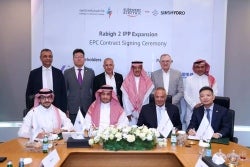
Consortium signs EPC contract for Rabigh 2 IPP expansion
13 October 2026
A consortium comprising PowerChina, Egypt’s Elsewedy Electric and Beijing-headquartered Sinohydro has signed an engineering, procurement and construction (EPC) contract for Saudi Arabia’s Rabigh 2 combined-cycle gas-turbine (CCGT) independent power project (IPP) expansion.
The signing ceremony took place in Riyadh on 12 October and the contract involves the plant’s design, procurement, installation, construction, commissioning, grid connection and performance testing.
MEED previously reported that construction works had commenced, with Elsewedy Electric and Sinohydro carrying out works on the project.
The signing follows the project’s financial close earlier this month, after it secured SR9.69bn ($2.58bn) in long-term financing.
The financing has a tenor of approximately 34 years and was provided by a consortium of local, regional and international lenders.
The project is being developed by Al-Morjan Two Electricity Company, in which Acwa and Saudi Energy, formerly Saudi Electricity Company, each hold a 40% stake.
In April, MEED reported that Acwa and Saudi Energy had signed a 31-year power purchase agreement (PPA) with Saudi Power Procurement Company (SPPC) for the project.
The agreement is valued at SR11.5bn ($3.07bn) and covers the development of a CCGT plant in the Mecca region under a build, own and operate arrangement. The project also includes the development and expansion of a 380kV electrical substation. The plant is designed to be ready for the future installation of carbon-capture technology.
 READ THE OCTOBER 2026 MEED BUSINESS REVIEW – click here to view PDF
Industry and logistics drive development at Neom; Saudi Arabia’s investment priorities realign amid conflict; MEED’s 2026 power developer ranking.
Distributed to senior decision-makers in the region and around the world, the October 2026 edition of MEED Business Review includes:
> AGENDA: Oxagon takes centre stage at Neom> MARKET FOCUS: Saudi projects hold steady> INDUSTRY REPORT: MEED’s 2026 GCC power developer ranking> LEADERSHIP: The future city does not need to hang above the groundTo see previous issues of MEED Business Review, please click herehttps://image.digitalinsightresearch.in/uploads/NewsArticle/20535598/main3026.jpg -
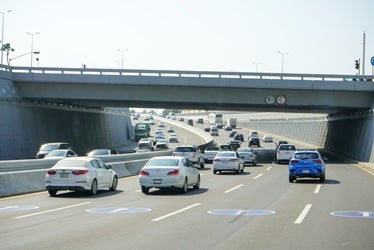
Contractors submit Riyadh road scheme bids
13 October 2026
Register for MEED’s 14-day trial access
Contractors submitted bids in the first week of October to upgrade a section of the Al-Urubah Road axis leading to Prince Bandar Bin Abdulaziz Road in Riyadh.
The project scope involves upgrading about 15.5 kilometres of the road to increase capacity to about 200,000 vehicles a day.
MEED understands that the bidders include:
- Al-Ayuni Investment & Contracting
- Al-Rashid Trading & Contracting
- China Civil Engineering Construction Corporation / Al-Omaeir Trading & Contracting
- Mofarreh Alharbi & Partners
- Nesma & Partners
The project aims to increase traffic capacity, streamline vehicular movements and eliminate conflict points along the corridor.
The US-based engineering firm Parsons is overseeing the project’s implementation after winning a $53m contract from the Royal Commission for Riyadh City (RCRC) in 2024.
The contract includes project management services for RCRC’s main and ring roads programme.
The programme includes 500km of new roads and upgrade works in and around Riyadh.
In 2021, Saudi Arabia’s Crown Prince Mohammed Bin Salman Bin Abdulaziz Al-Saud said Riyadh’s population would double to 15-20 million people by 2030.
He directed government entities to work closely with the RCRC to prepare the city’s development strategy.
The RCRC’s major projects include Riyadh Metro, Riyadh Art, Sports Boulevard, King Salman International Park, Green Riyadh and several road development projects in the capital.
READ THE OCTOBER 2026 MEED BUSINESS REVIEW – click here to view PDFIndustry and logistics drive development at Neom; Saudi Arabia’s investment priorities realign amid conflict; MEED’s 2026 power developer ranking.
Distributed to senior decision-makers in the region and around the world, the October 2026 edition of MEED Business Review includes:
> AGENDA: Oxagon takes centre stage at Neom> MARKET FOCUS: Saudi projects hold steady> INDUSTRY REPORT: MEED’s 2026 GCC power developer ranking> LEADERSHIP: The future city does not need to hang above the groundTo see previous issues of MEED Business Review, please click herehttps://image.digitalinsightresearch.in/uploads/NewsArticle/20533695/main.jpg -
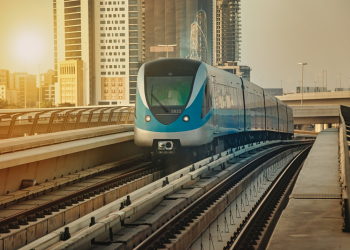
Contractor groups prequalify for Dubai Metro Gold Line
13 October 2026
Six contracting groups submitted prequalification statements on 9 October for the contract to build Dubai Metro’s new Gold Line.
The Roads & Transport Authority (RTA) issued the request for qualification notice for the project in June, as MEED exclusively reported.
The consortiums formed to bid for the main contract are:
- Alstom / China Railway Engineering Corporation / National Projects Construction / Dogus Construction (France/China/local/Turkiye)
- CRRC / Limak / Mapa Group (China/Turkiye/Turkiye)
- Hitachi / China Harbour Engineering Company / China State Construction Engineering Corporation (Japan/China/China)
- Siemens / Petrojet / Concord Engineering & Contracting / Rowad Modern Engineering (Germany/Egypt/Egypt/Egypt)
- Hassan Allam / IC Ictas / Siemens (Egypt/Turkiye/Germany)
- Larsen & Toubro / Powerchina / Wade Adams (India/China/local)
Dubai officially announced the Gold Line in April.
In a post on social media site X, Sheikh Mohammed Bin Rashid Al-Maktoum, UAE Vice President and Prime Minister and Ruler of Dubai, said the project would cost about AED34bn ($9.2bn).
The Gold Line will increase the Dubai Metro network’s total length by 35%. The project is scheduled to be completed in September 2032.
The fully underground line will extend for more than 42 kilometres and include 18 stations. It will pass through 15 areas of Dubai and serve 1.5 million residents.
The project is expected to connect more than 55 under-construction real estate developments.
The Gold Line will begin at Al-Ghubaiba in Bur Dubai and terminate at Jumeirah Golf Estates. It will connect with the existing Red and Green lines and integrate with the Etihad Rail passenger network.
The contractor will be responsible for the design and construction of all civil works, electromechanical equipment, rolling stock and rail systems. The selected contractor will also be required to support systems maintenance and operations during an initial three-year period.
In October last year, MEED exclusively reported that the RTA had selected US-based engineering firm Aecom to provide consultancy services for the Dubai Metro Gold Line project.
Stage one covers concept design; stage two, preliminary design; stage three, tender-document preparation; stage four, construction supervision; and stage five, the defects-liability period.
READ THE OCTOBER 2026 MEED BUSINESS REVIEW – click here to view PDFIndustry and logistics drive development at Neom; Saudi Arabia’s investment priorities realign amid conflict; MEED’s 2026 power developer ranking.
Distributed to senior decision-makers in the region and around the world, the October 2026 edition of MEED Business Review includes:
> AGENDA: Oxagon takes centre stage at Neom> MARKET FOCUS: Saudi projects hold steady> INDUSTRY REPORT: MEED’s 2026 GCC power developer ranking> LEADERSHIP: The future city does not need to hang above the groundTo see previous issues of MEED Business Review, please click herehttps://image.digitalinsightresearch.in/uploads/NewsArticle/20531469/main.png -
Egypt discusses technology cooperation with SLB
13 October 2026
Egypt is in talks with US-based oilfield services company SLB to expand technical cooperation in the country’s oil and gas sector, according to a statement from the Ministry of Petroleum & Mineral Resources.
Egyptian Minister of Petroleum and Mineral Resources Karim Badawi met SLB chief executive Olivier Le Peuch in Riyadh, the ministry said.
During the meeting, they discussed ways to strengthen their strategic partnership and expand cooperation in technology and digital transformation.
They also discussed how SLB could support exploration and production activities, with the aim of increasing output and attracting further investment in Egypt’s oil and gas sector.
Badawi emphasised the importance of extending the existing partnership with SLB, including its role in technology transfer and the development of technical capabilities in Egypt’s oil sector, according to the statement.
He said Egypt should build on existing areas of cooperation and deploy advanced technological solutions to reduce exploration risk, increase recovery and production rates from existing fields, and improve operational efficiency.
Badawi and Le Peuch also discussed progress on a seismic survey project being undertaken by SLB in partnership with France-based Viridien.
The project includes an ocean-bottom node seismic survey covering about 95,000 square kilometres of Egypt’s eastern Mediterranean waters.
The discussion focused on the data processing and analysis schedule, the steps required to prepare and release preliminary results, and the drilling schedule.
Badawi and Le Peuch also discussed expanding the use of horizontal drilling technologies in Egypt. This would involve identifying suitable locations and developing a commercial and contractual model for their deployment.
The Ministry of Petroleum & Mineral Resources and SLB are also exploring opportunities to expand the use of artificial intelligence in reservoir management and production optimisation.
This work is being explored in partnership with the Egyptian General Petroleum Corporation and Egyptian Natural Gas Holding Company.
READ THE OCTOBER 2026 MEED BUSINESS REVIEW – click here to view PDFIndustry and logistics drive development at Neom; Saudi Arabia’s investment priorities realign amid conflict; MEED’s 2026 power developer ranking.
Distributed to senior decision-makers in the region and around the world, the October 2026 edition of MEED Business Review includes:
> AGENDA: Oxagon takes centre stage at Neom> MARKET FOCUS: Saudi projects hold steady> INDUSTRY REPORT: MEED’s 2026 GCC power developer ranking> LEADERSHIP: The future city does not need to hang above the groundTo see previous issues of MEED Business Review, please click herehttps://image.digitalinsightresearch.in/uploads/NewsArticle/20517735/main.jpg