
Saudi Arabia launches new mineral exploration licensing round
24 June 2026
Register for MEED’s 14-day trial access
Saudi Arabia’s Ministry of Industry & Mineral Resources (MIMR) has launched its tenth round of a mineral exploration licensing competition, qualifying 24 local and international companies and consortiums to participate.
The exploration opportunities offered under Round 10 cover about 13,000 square kilometres across the regions of Medina, Mecca, Riyadh, Qassim and Hail. They encompass several highly prospective mineralised belts that are said to contain significant deposits of gold, copper, silver, zinc and nickel.
One of the key areas offered in the round is the Nabithah-Ad Duwayhi (Dahlat Shabeb) Belt, which hosts the Ad-Duwayhi Mine, one of Saudi Arabia’s largest gold-producing operations, with annual production of approximately 180,000 ounces of gold.
Other notable exploration zones include the Sukhaybarat-Al-Safra Belt, recognised for its gold and base metals potential and home to the Sukhaybarat and Bulghah mining operations, as well as the Al-Nuqrah Belt, known for substantial gold resources and volcanogenic massive sulphide mineralisation rich in copper and zinc.
According to MIMR, 17 companies that previously qualified under Round 9 have retained their eligibility, while seven additional companies and consortiums successfully completed the Round 10 prequalification process.
The newly qualified bidders in Round 10 are:
- Anaam Al-Qarat for Trading / Sahara Mining Company consortium
- Danakali / Masadar Al-Zamarda for Mining consortium
- Power Metallic Mines
- PT ANTAM Tbk
- Saudi Arabian Mining Company (Maaden)
- Thurb Al-Hayya for Trading Company
- Wildsky Resources
The previously qualified participants from Round 9 are:
- Al-Ghazal Al-Arabi Mining Company
- Almasar Minerals Holding
- Al-Tasnim Enterprises
- Aurum Global Group
- Batin Al-Ard for Gold Company
- China National Geological and Mining Corporation
- DesertEx
- Eqleed-Indotan Mining Company
- Helderberg
- Jacaranda Minerals
- Midana Exploration
- Royal Road Arabia
- Saudi Gold Refinery
- Sierra Nevada Gold
- Sun Peak Metals
- The Distinguished Consortium Mining Company
- Vedanta
In a statement carried by the official Saudi Press Agency, MIMR said exploration licence competitions are conducted through a structured three-stage process designed to ensure transparency, competitiveness and equal opportunity for all participants.
The process begins with prequalification assessments covering technical expertise and financial capability, followed by a site-selection phase through the ministry’s digital mining platform, Taadeen. Where multiple bidders compete for the same exploration site, the process advances to a public, multi-round bidding stage, with licences awarded based on exploration expenditure commitments and predefined evaluation criteria.
The next phase of Round 10 will allow qualified bidders to select available exploration sites via the Taadeen platform, in accordance with established procedures that promote fair competition and enable companies to pursue opportunities aligned with their technical capabilities and investment strategies.
ALSO READ: Aramco and Maaden seek to form joint venture
“The continued participation of major international and regional mining companies reflects growing confidence in Saudi Arabia’s mining sector and the effectiveness of its transparent licensing framework,” MIMR said in its statement.
Jarrah Aljarrah, a ministry spokesperson, said increasing participation in successive exploration licensing rounds demonstrates growing investor confidence in the kingdom’s mining ecosystem, supported by regulatory reforms, improved availability of geological data, transparent licensing mechanisms and a steadily expanding pipeline of exploration opportunities.
Saudi Arabia’s metals and mining sector is pivotal to the country’s non-oil growth trajectory. Commercial exploitation of the kingdom’s mineral resource base – most of which remains untapped – is a key component of the Saudi Vision 2030 socio-economic transformation strategy.
The kingdom took a first step towards realising the commercial potential of its mineral resources when it enacted the Mining Investment Law in 2021. Since the law came into effect, MIMR has awarded about 3,248 mining permits to local and foreign firms under its accelerated exploration initiative, including alone.
Addressing the Future Minerals Forum in Riyadh in January 2024, Bandar Alkhorayef, the kingdom’s minister of industry and mineral resources, said Saudi Arabia’s natural resources are worth $2.5tn – an increase of more than 90% compared to the 2016 estimate.
This near-doubling of natural resource estimates – which exclude fossil fuels and include phosphate, gold and rare earths – is expected to provide a stimulus to the kingdom’s nascent mining industry.
ALSO READ: Maaden mineral resources grow by 7.8 million ounces

Register for MEED's guest program now to access this article.
Exclusive from Meed
-
 Contractors prepare bids for Oxagon wastewater plant
14 September 2026
-
 Saudi Arabia shuts East-West oil pipeline after drone strikes
14 September 2026
-
 WSP wins Dammam airport expansion design works
14 September 2026
-
 Dubai seeks contractors for multibillion-dollar road scheme
14 September 2026
-
 Kuwait postpones contractor meeting for $3.3bn gas project
14 September 2026
All of this is only 1% of what MEED.com has to offer
Subscribe now and unlock all the 153,671 articles on MEED.com
- All the latest news, data, and market intelligence across MENA at your fingerprints
- First-hand updates and inside information on projects, clients and competitors that matter to you
- 20 years' archive of information, data, and news for you to access at your convenience
- Strategize to succeed and minimise risks with timely analysis of current and future market trends
Related Articles
-
Contractors prepare bids for Oxagon wastewater plant
14 September 2026

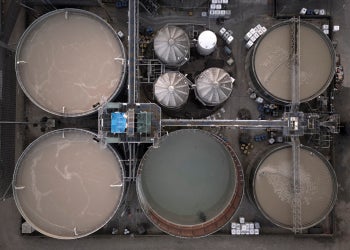
Contractors are preparing to submit bids to build a wastewater treatment plant for Oxagon, Neom’s industrial cluster.
The industrial wastewater treatment package will have an initial capacity of 35,000 cubic metres a day (cm/d), supplied in modular trains of 5,000 cm/d each. A separate sanitary wastewater treatment package will have a capacity of 1,000 cm/d.
The contract is structured as a design-build-operate project and covers the supply, installation and commissioning of industrial and sanitary wastewater treatment packages, as well as three years of operation and maintenance.
Bids are due on 2 October, a source close to the project told MEED.
It is understood that Neom’s water utility Enowa issued the request for proposals earlier this year. The plant is designed to provide “interim wastewater treatment” capacity for Neom’s Oxagon Industrial Quarter as industrial development in the area progresses.
Enowa has described the treatment systems as interim and de-mountable, allowing them to be installed and subsequently removed or relocated as requirements at Oxagon develop. The plant can be expanded to a maximum of 45,000 cm/d.
The tender documents also state that Neom may consider export credit agency (ECA) financing for the project, with the strength of bidders’ ECA financing proposals forming part of the commercial evaluation.
The project follows an earlier tender for the Oxagon Village Water Recycling Plant, which was cancelled despite contractors submitting bids in 2024.
MEED reported at the time that Beijing-based PowerChina, the local Alfanar Company and Cairo-headquartered Orascom had submitted bids for the project. It is understood that these firms are also likely to participate in the latest tender.
The earlier scheme included truck receiving facilities, pretreatment, biological treatment using food chain reactor technology, tertiary treatment, sludge handling and recycled-water storage.
The latest procurement appears to represent a reworked approach to wastewater treatment at Oxagon Industrial Quarter, with the previous engineering, procurement and construction scheme replaced by an interim, modular and de-mountable facility.
https://image.digitalinsightresearch.in/uploads/NewsArticle/19640903/main.jpg -
Saudi Arabia shuts East-West oil pipeline after drone strikes
14 September 2026
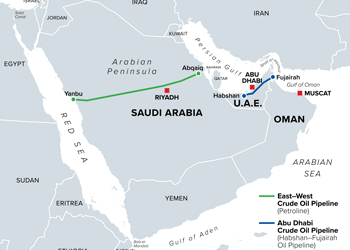
Saudi Arabia has temporarily closed its 1,200-kilometre East-West pipeline after it was targeted by multiple drones launched from Iraq, disrupting one of the kingdom’s most critical energy export routes and threatening global oil supplies already strained by conflict across the region.
The Ministry of Energy said the pipeline, which connects the Abqaiq oil field in the east to the Red Sea port of Yanbu, was hit in the Riyadh and Medina regions on 12 September. Specialised teams have begun securing the facility and assessing damage. A Foreign Ministry statement said the attack resulted in injuries and “some damage that is currently being addressed”.
The closure removes about 4 million barrels a day from the global market, representing 4% of world oil supply. The pipeline’s role has become increasingly critical since the US-Iran conflict forced a near-complete shutdown of flows through the Strait of Hormuz in March.
Saudi Arabia has been using the East-West route to bypass the chokepoint, but the assault has left the kingdom dependent on substantially reduced Hormuz exports and Red Sea shipping routes now threatened by Iran-backed Houthi forces in Yemen.
Iraqi Prime Minister Ali Al-Zaidi’s office confirmed the drone strike on the East-West Pipeline originated in the Maysan province, which borders Iran. The government formally condemned the attack, announced an investigation into the Maysan operations command and dismissed its commander. No armed group has claimed responsibility, but security analysts attribute the strike to Iran-backed militias operating from Iraqi territory.
Riyadh said it was not retaliating “at this stage”, choosing instead to support Iraqi efforts to prevent further strikes from its territory.
The attack comes amid wider regional upheaval. Houthi forces have rapidly advanced along Yemen’s coast, seizing the strategic Mokha port and the Zuqar Island in the southern Red Sea, moving closer to the Bab El-Mandab strait. Saudi authorities said the group simultaneously launched dozens of drones and missiles at the southern kingdom on 11 September, striking civilian and economic targets and injuring 73 people.
Oil analysts and traders reported that Yanbu’s storage capacity, estimated at around 35 million barrels, now holds supplies sufficient for only five to seven days of exports without pipeline operations. Storage facilities at Egypt’s Ain Sokhna and Sidi Kerir ports have similar constraints. Repair timelines remain uncertain, with sources citing estimates ranging from days to five or six weeks.
The dual disruption of both the pipeline and Red Sea shipping has compressed global energy supplies. Energy analysts warned that without pipeline repairs, oil prices could return to the $120-a-barrel peak reached earlier in the regional conflict.
https://image.digitalinsightresearch.in/uploads/NewsArticle/19641513/main.gif -
WSP wins Dammam airport expansion design works
14 September 2026
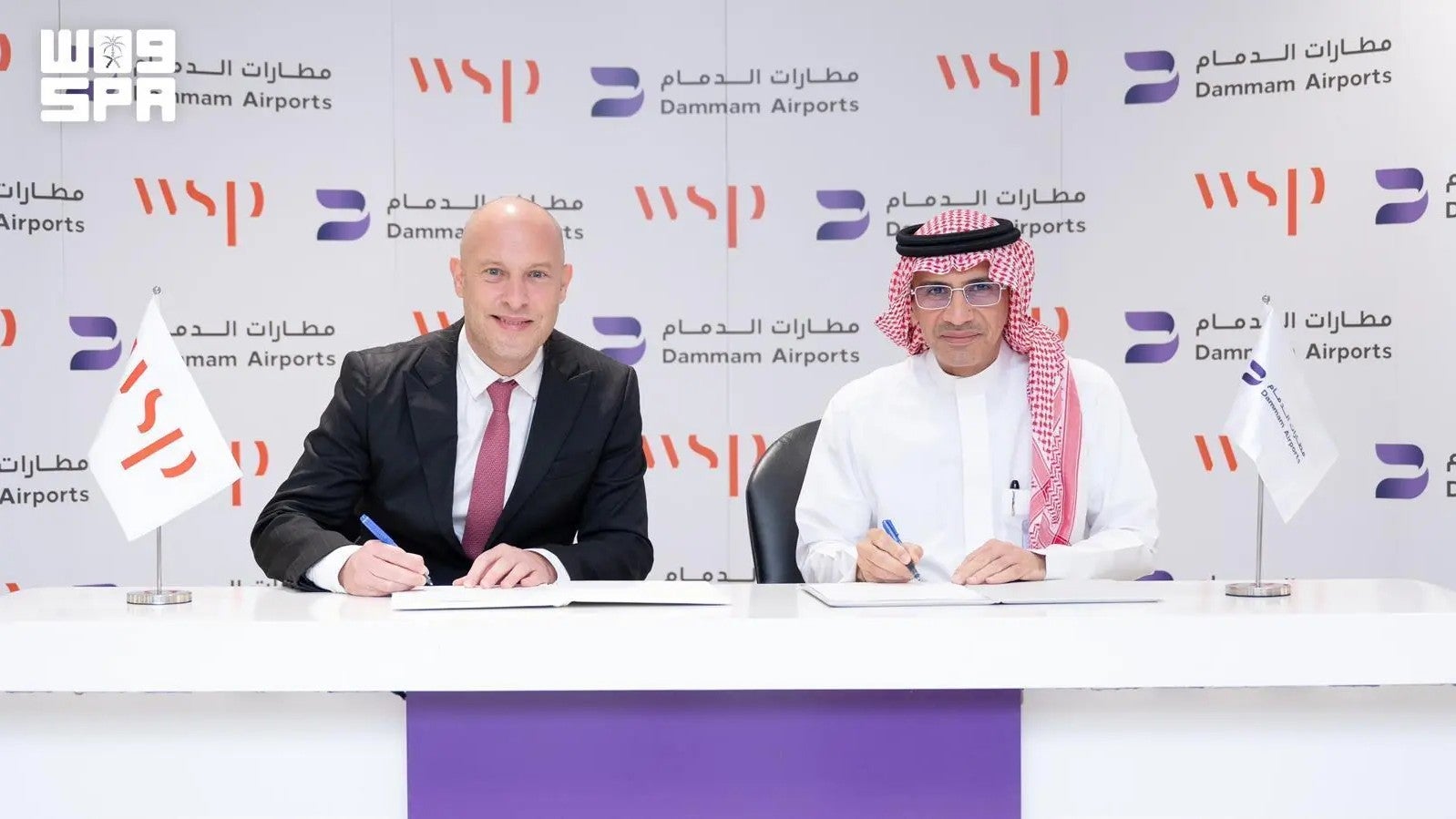
WSP Middle East, the regional arm of Canadian engineering firm WSP, has won a design contract to expand King Fahd International airport in Dammam, Saudi Arabia.
Dammam Airports Company (DACO) awarded the contract.
The scope includes designing passenger terminal expansions, facility upgrades, and improvements to airport entrances and access roads.
It also covers the development of baggage-handling systems, digital services and other associated infrastructure.
The expansion works will be carried out in line with the airport’s approved masterplan, which targets serving more than 19 million passengers a year by 2030.
The plan also aims to increase air cargo capacity to more than 600,000 tonnes a year and raise aircraft operational capacity to 77 movements per hour, supported by comprehensive expansions to infrastructure, runways and general aviation facilities.
This contract forms part of DACO’s ongoing efforts to strengthen the airport ecosystem, enhance operational efficiency, and support the Aviation Programme and Saudi Vision 2030 objectives.
King Fahd International airport is the kingdom’s third-largest airport by annual passenger traffic, behind Jeddah’s King Abdulaziz International and Riyadh’s King Khaled International.
DACO was formed in July 2017 to manage, operate and develop King Fahd International airport in Saudi Arabia’s Eastern Province.
It was established as part of the broader Saudi Vision 2030 privatisation and economic reform programme to corporatise the aviation sector, increase operational efficiency, upgrade infrastructure, and transition state-run airports into commercially viable, world-class regional aviation hubs.
https://image.digitalinsightresearch.in/uploads/NewsArticle/19639910/main.jpg -
Dubai seeks contractors for multibillion-dollar road scheme
14 September 2026
Register for MEED’s 14-day trial access
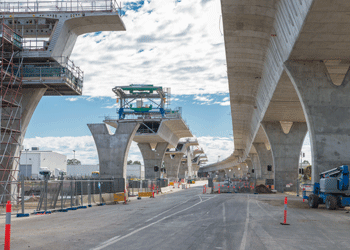
Dubai’s Roads & Transport Authority (RTA) is seeking contractors to design and build a multibillion-dollar new road that will run parallel to Sheikh Zayed Road.
MEED understands that the scope covers the construction of about 30 kilometres (km) of works.
These include about 15km of viaduct along First Al-Khail Street and more than 14.5km of bridge ramps, along with other associated infrastructure works.
The RTA floated the expression of interest notice to contractors in early September, with a submission deadline of 10 October.
The project is another significant initiative aimed at alleviating pressure on the existing Sheikh Zayed Road section from Hadiqa Street to Hessa Street.
Dubai has previously explored bold concepts to expand capacity on Sheikh Zayed Road, including proposals to introduce double-decker sections to add extra lanes without widening the existing corridor.
The idea was discussed in the context of rising congestion and limited right-of-way along one of the city’s busiest arterial roads, with elevated decks potentially carrying through-traffic while the existing at-grade lanes served local access.
The plans ultimately progressed as standalone schemes, with subsequent efforts focusing instead on corridor-wide upgrades, interchange improvements and complementary public transport expansions to manage demand more sustainably.
The latest project aligns with Dubai’s continued investment in upgrading and expanding its road network to keep pace with rapid population growth and rising commuting demand.
Planning for growth
Dubai launched the 2040 Urban Master Plan in March 2021, referencing studies indicating that the emirate’s population will reach 5.8 million by 2040, up from 3.3 million in 2020. The daytime population is set to increase from 4.5 million in 2020 to 7.8 million in 2040.
In December 2022, Sheikh Mohammed Bin Rashid Al-Maktoum, Vice President and Prime Minister of the UAE and Ruler of Dubai, approved the 20-Minute City Policy as part of the second phase of the Dubai 2040 Urban Master Plan.
In addition to the road projects, the RTA’s Dubai Metro Blue Line extension and Dubai Metro Gold Line form part of Dubai’s plans to improve residents’ quality of life by cutting journey times, as outlined in the policy.
The policy aims for residents to have 80% of their daily requirements within a 20-minute journey, on foot or by bicycle. This goal will be achieved by developing integrated service centres with all necessary facilities and increasing population density around mass transit stations.
https://image.digitalinsightresearch.in/uploads/NewsArticle/19639621/main.gif -
Kuwait postpones contractor meeting for $3.3bn gas project
14 September 2026
State-owned Kuwait Gulf Oil Company (KGOC) has rescheduled a key meeting about the development of the planned onshore gas plant next to the Al-Zour refinery, according to industry sources.
The project was tendered last month with an estimated budget of $3.3bn and a bid deadline of 29 December 2026.
If it goes ahead as planned, the project is expected to be the country’s biggest oil and gas sector contract award in more than a decade.
The meeting with contractors is now scheduled for 14 October 2026. Previously, it was scheduled to take place on 14 September.
Sources said contractors have not been told why the meeting date was pushed back.
While the date for the initial meeting with contractors has been postponed, the bid deadline of 29 December 2026 remains the same, according to industry sources.
The proposed plant will have the capacity to process up to 632 million cubic feet a day of gas and 60,000 b/d a day of condensates from the Dorra offshore field, located in Gulf waters in the Saudi-Kuwait Neutral Zone.
In February, MEED reported that at least seven companies had shown interest in participating in the tender.
Contractors that sent representatives to previous meetings to discuss the project include:
- Samsung E&A (South Korea)
- Larsen & Toubro (India)
- Tecnicas Reunidas (Spain)
- Saipem (Italy)
- Hyundai Engineering & Construction (South Korea)
- Hyundai Engineering Company (South Korea)
- JGC (Japan)
The tender process is using a fast-track model, which means that Kuwait’s Central Agency for Public Tenders (Capt) will not be involved in the tender process.
Capt typically reviews the technical and commercial evaluations of bids and verifies that the bidding process is competitive.
It is understood that not requiring Capt to approve this tender is expected to speed up the tender process.
Iran disputes ownership of the field, referring to it as Arash.
Iran claims the field partially extends into Iranian territory and asserts that Tehran should be a stakeholder in its development.
The Dorra field’s close proximity to Iran could make development difficult due to current security concerns.
The offshore elements of the wider Dorra field development project are expected to be especially difficult to protect from attacks from Iran.
https://image.digitalinsightresearch.in/uploads/NewsArticle/19639451/main.jpg