
Oman green hydrogen projects cancelled
8 December 2025
Hydrogen Oman (Hydrom), France’s Engie and South Korea’s Pohang Iron & Steel Company (Posco) have cancelled plans to move forward with the $6.7bn HyDuqm green hydrogen project.
In a joint statement, the firms said they had reached a decision to end the scheme by mutual consent following an “in-depth assessment” of global renewable hydrogen offtake dynamics and investment frameworks.
The HyDuqm scheme was one of the largest green hydrogen projects awarded under Oman’s first auction round in 2023.
The proposed development included around 5GW of combined solar and wind capacity, supported by battery energy storage, to power an electrolysis plant producing hydrogen for conversion into green ammonia.
The facility was expected to deliver up to 1.2 million tonnes of green ammonia a year by 2030, with Posco as the main offtaker to support the decarbonisation of its steel operations.
The consortium, led by Posco (28%) and Engie (25%), had secured a 47-year concession with the state-owned Hydrom to develop a 320-square-kilometre site near the Port of Duqm.
Samsung Engineering, Korea Southern Power and Korea East-West Power had a 12% stake, with Thailand’s PTTEP holding the remaining 11%.
As recently as May, the partners were still targeting a final investment decision in 2027, subject to detailed economic and technical feasibility assessments.
Separately, a second hydrogen project in the same area, owned by the UK’s BP, has also been cancelled. BP withdrew its plans for the Duqm green hydrogen project, which had secured land rights for the 1.5GW facility.
Hydrom managing director, Abdulaziz Al-Shidhani, told the 2025 Green Hydrogen Summit in Oman last week that only seven of the nine original projects that won land tenders were progressing.
Wider slowdown
The cancellations come amid a broader slowdown in green hydrogen development globally. Several major schemes have been postponed, scaled back or withdrawn as project economics have tightened.
In Europe, more than one-fifth of planned hydrogen projects had been stalled or cancelled by the end of 2024, according to research and consultancy firm Westwood Global Energy, largely due to high costs, uncertain demand and slow progress securing long-term offtake.
A similar trend has emerged in the GCC, where Saudi Arabia’s flagship Neom green hydrogen project has also faced offtake and market pressures despite reaching an $8.4bn financial close in 2023.
The 4GW scheme, designed to produce about 1.2 million tonnes a year of green ammonia, has reportedly struggled to secure multiple international buyers, with only limited offtake confirmed to date.
Hydrogen production costs
Global green hydrogen production costs also remain significantly higher than conventional alternatives, typically in the range of $3-$8 a kilogram compared with roughly $0.5-$2/kg for hydrogen produced from fossil fuels, leaving large export-oriented projects exposed to pricing and demand uncertainty.
The combination of elevated capital costs, slow offtake development and evolving policy frameworks has created headwinds for investment decisions across the sector.
In the joint statement, however, Hydrom said it is committed to “developing a competitive hydrogen-centric economy” aligned with Oman’s Vision 2040.
It added that projects awarded in the first two auction rounds are progressing on schedule towards the country’s target of producing more than one million tonnes a year of green hydrogen by 2030.
The company also highlighted continued international interest in the sector, noting that the third auction round is under way with strong foreign participation.


Register for MEED's guest program now to access this article.
Exclusive from Meed
-
 Saudi Arabia raises electricity tariffs
26 October 2026
-
 Dubai Municipality confirms AED3bn Tasreef drainage awards
26 October 2026
-
 Nakheel awards $259m Dubai Islands buildings contract
26 October 2026
-
 Expo 2030 Riyadh tenders Culture of Wisdom Pavilion
26 October 2026
-
 Morocco plans second high-speed rail phase to Agadir
26 October 2026
All of this is only 1% of what MEED.com has to offer
Subscribe now and unlock all the 153,671 articles on MEED.com
- All the latest news, data, and market intelligence across MENA at your fingerprints
- First-hand updates and inside information on projects, clients and competitors that matter to you
- 20 years' archive of information, data, and news for you to access at your convenience
- Strategize to succeed and minimise risks with timely analysis of current and future market trends
Related Articles
-
Saudi Arabia raises electricity tariffs
26 October 2026
Register for MEED’s 14-day trial access
Saudi Energy, formerly Saudi Electricity Company, has announced revised electricity tariffs, which will take effect on 1 January 2027.
The revised tariff schedule, published on the company’s official website, covers residential, commercial, industrial, agricultural, charitable and government customers.
The largest percentage increase in consumption rates is 16.7%, for residential customers using up to 6,000 kilowatt-hours (kWh) a month. Residential customers will pay 21 halalas/kWh for monthly consumption of up to 6,000kWh, up from 18 halalas. For consumption above 6,000kWh, the rate will rise from 30 to 33 halalas/kWh, a 10% increase.
The industrial tariff will increase by 15%, from 20 to 23 halalas/kWh. Commercial customers, private healthcare facilities and private educational facilities will pay 25 halalas/kWh, up from 22 halalas, for consumption up to 6,000kWh a month, and 35 halalas/kWh above that level, up from 32 halalas.
Tariffs for charities and government customers will also increase. In addition to consumption-based charges, customers will pay a fixed monthly fee based on the capacity of their electricity meter. This replaces the previous separate charge for meter reading, maintenance and billing, with VAT applied to the revised tariffs.
Electricity investment
The new tariffs coincide with changes to water consumption tariffs announced by the National Water Company, also effective from 1 January 2027.
King Salman Bin Abdulaziz Al-Saud directed support measures following a proposal presented by Crown Prince and Prime Minister Mohammed Bin Salman Bin Abdulaziz Al-Saud.
This includes raising the minimum wage required for Saudi nationals to count as full employees towards private sector localisation quotas under the Nitaqat programme.
The tariff changes come as Saudi Arabia plans substantial investment in its electricity infrastructure. In September 2025, Saudi Energy announced plans to invest SR220bn ($58.7bn) in power infrastructure projects between 2025 and 2030.
A June 2025 report by Fitch Ratings forecast negative free cash flow of about SR16bn a year over the period and rising leverage, reflecting the financial demands of the programme.
https://image.digitalinsightresearch.in/uploads/NewsArticle/20924301/main.jpg -
Dubai Municipality confirms AED3bn Tasreef drainage awards
26 October 2026
Dubai Municipality has confirmed it has awarded four contracts worth AED3bn ($817m) to expand the emirate’s stormwater drainage network by about 100 square kilometres under phase three of the Tasreef programme.
The projects will cover Jumeirah, Umm Suqeim, Al-Quoz, Al-Barsha, Al-Wasl and Al-Marmoom. The works include constructing and extending main stormwater drainage lines with diameters of up to three metres.
The four packages are part of Dubai’s AED30bn Tasreef programme, which aims to increase the emirate’s stormwater drainage capacity by 700% and reduce costs associated with pumping stations, network operations and maintenance by 20%.
The contracts have been awarded to China State Construction Engineering Corporation (CSCEC) and three local firms: Arifco Group, Nael Construction & Contracting (NCC) and Detech Contracting. Dubai Municipality did not state which projects the awards relate to.
According to sources, the contract awards include packages TF-15-C1, TF-15-C2 and TF-13-C1.
The first package, TF-15-C1, involves the construction of 21 kilometres of main and secondary drainage lines along Al-Wasl Road and in surrounding areas. It will cover Za’abeel 2, Al-Wasl, Jumeirah 1 and 2, Al-Bada’a, Al-Satwa and Dubai World Trade Centre. The estimated $100m contract was awarded to Detech in July, as exclusively reported by MEED.
The second package, TF-15-C2, covers the corridor between Sheikh Zayed Road and Al-Khail Road. It includes about 14km of main drainage lines serving Al-Quoz Industrial Areas 1, 3 and 4, and Al-Barsha 1. In July, MEED reported that CSCEC had won the engineering, procurement and construction contract for this project.
The third package, TF-13-C1, covers Al-Marmoom, where 23km of drainage infrastructure will be developed. According to a source, Arifco has been awarded this contract.
The final package covers Jumeirah and Umm Suqeim, where about 42km of main drainage lines will serve Umm Suqeim 1, 2 and 3; Umm Al-Sheif; Jumeirah 3; Al-Safa 1 and 2; and Al-Manara.
In May, MEED reported that NCC had been awarded a contract to build a sewage and stormwater drainage system, DS-204. However, it is unconfirmed whether this relates to the same project.
Earlier, in February, the municipality confirmed it had awarded contracts for five new projects under phase two of the programme to expand and strengthen Dubai’s stormwater drainage network.
These included two contracts awarded to Detech and one to CSCEC for stormwater drainage infrastructure. In addition, two consultancy contracts were awarded for the study and design of drainage systems in selected areas across the emirate.
Cumulatively valued at AED2.5bn, the new projects will serve 30 vital areas, spanning approximately 430 million square metres and supporting an estimated population of three million residents by 2040.
Previously, in April 2025, an earlier package of awards was announced under phase one of the Tasreef programme. The overall masterplan aims to expand Dubai’s rainwater drainage capacity by 700% by 2033.
https://image.digitalinsightresearch.in/uploads/NewsArticle/20923924/main4827.jpg -
Nakheel awards $259m Dubai Islands buildings contract
26 October 2026
Dubai-based master developer Nakheel, part of Dubai Holding Real Estate, has awarded local firm Parkway International Contracting a construction contract valued at about AED950m ($259m) for phases two and four of Bay Grove Residences on Dubai Islands.
The package covers 617 residential units across eight buildings, ranging from one to four bedrooms, together with basement structures, infrastructure and community amenities including swimming pools, sports courts and fitness centres.
Phase two comprises 360 homes across four buildings, with main construction scheduled for completion in late 2028.
Phase four includes 257 homes across four buildings, with completion targeted for the second quarter of 2029.
The award follows an earlier contract valued at about AED800m ($218m) awarded to local contractor Metac General Contracting Company for phases one and three, covering 537 homes across seven buildings.
Together, the two contracts total more than AED1.75bn ($476m) and account for all 1,154 planned homes across the 15 buildings of Bay Grove Residences.
Project activity on Dubai Islands has gathered pace in recent months. Earlier this month, Nakheel awarded local firm Mar Marine & Building Contracting a contract for marine and coastal works on Island B. The scope includes constructing breakwaters, removing existing rock revetments and creating a new 320-metre beach near the Bay Villas development, as well as remedial and refurbishment works along approximately 3 kilometres of the island’s western shoreline.
In August 2025, Nakheel awarded Fibrex Contracting a AED2.6bn ($708m) construction contract for the Bay Villas residential project. That followed a AED527m ($143m) contract awarded to Al-Nasr Contracting Company in April 2026 for primary infrastructure and utilities on Island B.
https://image.digitalinsightresearch.in/uploads/NewsArticle/20923389/main.jpg -
Expo 2030 Riyadh tenders Culture of Wisdom Pavilion
26 October 2026

Saudi Arabia's Expo 2030 Riyadh Company (ERC) has tendered the design-and-build main contract for the construction of the Culture of Wisdom Pavilion in the expo’s Humanity District.
The tender was issued on 1 October, with a bid submission deadline of 6 January 2027.
The scope covers the pavilion’s design and the delivery of the building, visitor experience, landscape and public-realm works, in addition to testing, commissioning and operational handover.
The pavilion will be built on a plot of at least 12,293 square metres and will include a one-level basement, ground- and first-floor public areas, three interconnected courtyards, exhibition spaces on three levels, and an auditorium.
Other facilities will include visitor engagement areas, food and beverage outlets, retail space, VIP areas, offices, back-of-house and technical spaces, as well as vertical circulation and building services.
The facility is designed to accommodate at least 20,000 visitors a day during peak periods, with an anticipated average daily footfall of about 15,000 visitors. The project has a target of Leed Gold certification.
The successful contractor will complete the design, including specialist contractor design portions, and will coordinate the works with the lead design consultant. The scope also includes substructure and early works, including earthworks, excavation, soil improvement, raft foundations, basement reinforced-concrete walls, waterproofing and backfilling.
The main works tender is based on Royal Institute of British Architects' Stage 3 design at 60%, with the 100% Stage 3 design to be issued by addendum.
The main contractor will take over early construction, foundation works and the lead designer’s role. Visitor experience works will be confirmed at a later stage.
The contract also covers the building envelope; internal fit-out; mechanical, electrical and plumbing systems; information and communications technology; fire and life safety systems; security; specialist lighting; landscaping; utilities; and digital and immersive visitor-experience installations.
ERC has also tendered the design-and-build main contract for the Adaptation and Innovation Pavilion in the exhibition’s Technology District, as MEED reported last week.
Expo 2030 Riyadh will run from October 2030 to March 2031 with the theme Foresight for Tomorrow, with host authorities projecting approximately 42 million visits.
The masterplan covers 6 square kilometres, making it one of the largest sites ever designated for a World Expo event.
Situated north of the Saudi capital, the site is located near the future King Salman International airport and will provide direct access to Riyadh landmarks.
The Public Investment Fund, Saudi Arabia’s sovereign wealth vehicle, launched ERC – a wholly owned subsidiary – in June 2025 to build and operate facilities for Expo 2030.
 READ THE OCTOBER 2026 MEED BUSINESS REVIEW – click here to view PDF
Industry and logistics drive development at Neom; Saudi Arabia’s investment priorities realign amid conflict; MEED’s 2026 power developer ranking.
Distributed to senior decision-makers in the region and around the world, the October 2026 edition of MEED Business Review includes:
> AGENDA: Oxagon takes centre stage at Neom> MARKET FOCUS: Saudi projects hold steady> INDUSTRY REPORT: MEED’s 2026 GCC power developer ranking> LEADERSHIP: The future city does not need to hang above the groundTo see previous issues of MEED Business Review, please click herehttps://image.digitalinsightresearch.in/uploads/NewsArticle/20921052/main.jpg -
Morocco plans second high-speed rail phase to Agadir
26 October 2026
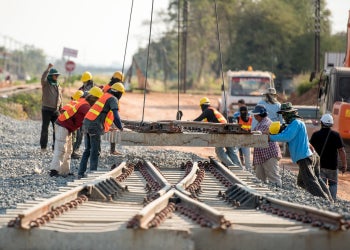
Morocco has outlined a second rail investment cycle for 2030-35, which includes beginning construction of a high-speed rail extension from Marrakech to Agadir and connecting Essaouira to the national rail network.
The pipeline forms part of the government’s 2026-31 programme, presented to parliament last week.
The Marrakech-Agadir link is estimated to cost close to MD55bn ($5.5bn) and will cover a 240-kilometre (km) route through the High Atlas Mountains via Chichaoua. Civil engineering structures, including tunnels and viaducts, are expected to account for nearly 70% of the alignment.
In September, the government issued a decree declaring the Marrakech-Agadir and Chichaoua-Essaouira rail corridors to be of public utility, paving the way for land acquisition and expropriation procedures.
Under the long-term masterplan Plan Rail Maroc 2040, Essaouira is expected to connect to the network via a separate line branching off at Chichaoua, designed for operating speeds of up to 200km an hour. The mainline to Agadir is designed for speeds of up to 320km/h.
The 2030-35 cycle also includes rehabilitating the Casablanca-Khouribga-Oued Zem line; constructing a new line between Oued Zem and Beni Mellal via Bejaad, with a branch to Fquih Ben Salah; doubling and upgrading the 140km Benguerir-Safi line; expanding capacity on the Fez-Oujda corridor; and building new-generation passenger stations.
The plans follow Morocco’s ongoing MD134bn ($13.4bn) 2024-30 rail investment programme, which focuses on completing the Kenitra-Marrakech high-speed line ahead of the 2030 Fifa World Cup.
The programme also includes developing regional express network services across five regions, electrifying the Fez-Oujda line and completing a freight rail link to the Nador West Med port.
Work on the Kenitra-Marrakech line had reached about 30% by May 2026, with commercial services targeted to begin in September 2029.
https://image.digitalinsightresearch.in/uploads/NewsArticle/20920349/main.jpg