
Firms submit revised bids for Ruwais sulphur terminal expansion
7 May 2025

Register for MEED’s 14-day trial access
Contractors have submitted revised proposals to Adnoc Gas for a project to expand the second sulphur handling terminal (SHT-2) in Ruwais, Abu Dhabi.
The Ruwais SHT-2 terminal receives 22,000 tonnes a day (t/d) of solid sulphur granules from the Habshan gas processing plant and about 11,000 t/d from the Shah sulphur station via the Etihad Rail network.
MEED previously reported that Adnoc Gas, the natural gas processing business of Abu Dhabi National Oil Company (Adnoc), had initially requested contractors to submit revised technical bids for the Ruwais SHT-2 expansion project by 21 April, with the deadline later extended until 30 April.
Contractors submitted an initial round of technical bids for the project to Adnoc Gas by 30 August 2024, MEED reported.
Adnoc Gas later expanded the scope of work on the Ruwais SHT-2 expansion project, as a result of which contractors were asked to revise their bids.
Bidders for the project are understood to include a consortium of Egyptian contractors Engineering for the Petroleum & Process Industries (Enppi) and Petrojet, and Abu Dhabi-based Al-Jaber Energy Services.
Project objectives
The main objective of the project is to increase the sulphur handling capacity of SHT-2 to 27,000 t/d, along with other upgrades to the unit.
The granulated sulphur received at Ruwais SHT-2 is transported to Adnoc’s customers worldwide on ships, with ship loaders available at its jetty facilities.
The facilities at Ruwais SHT-2 are experiencing high levels of sulphur dust because of the breakage of the solid granulated sulphur.
Adnoc Gas, in its expression of interest (EoI) document for the project, attributed this to factors including "multiple handling of the products, inadequate dust suppression and extraction systems in place that affect HSE [health, safety and environment] aspects, as well as the facilities’ integrity and reliable operation”.
Adnoc Gas issued the EoI document for the Ruwais SHT-2 expansion project to contractors on 29 February 2024, with contractors submitting responses by 14 March 2024, MEED previously reported.
The main engineering, procurement and construction (EPC) tender for the project was released in August last year.
The expanded scope of work on the project now involves the construction of a railway bridge that will connect the Ruwais SHT-2 facility with the Etihad Rail network, along with the EPC of the following units and services:
- Dust collection and wet scrubber system – replacement of eight wet scrubber systems
- Rail car unloading building dump hopper modification – upgrade of the system is required
- Magnetic separator – installation of new magnetic separators and demolition of existing magnetic separators
- Metal detectors – installation of new metal detectors
- Fire and gas system upgrade – implementation of recommendations of fire and gas systems mapping study performed during front-end engineering and design
- Rail car unloading building drainage upgrade – provision of new drainage system and modification for diverting effluent to appropriate existing systems outside the building.
Adnoc Gas manages a sulphur handling facility in the Ruwais industrial area located 240 kilometres southwest of the city of Abu Dhabi.
The terminal consists of two sulphur handling units, SHT-1 and SHT-2, designed to receive liquid sulphur from trucks, pipelines and ships; produce granulated sulphur; and export granulated and liquid sulphur by ship.
Ruwais SHT-1 expansion
Adnoc Gas has separately undertaken a project to expand the capacity of Ruwais SHT-1. MEED recently reported that the operator had awarded the main contract for that project, estimated to be worth $700m, to China-headquartered Wison Engineering.
The goal of the Ruwais SHT-1 expansion project is to increase the sulphur granulation capacity of the two SHT-1 berths from 8,750 t/d to 9,900 t/d.
When Adnoc’s $17bn Hail and Ghasha offshore sour gas field development project comes on stream towards the end of this decade, it will generate significant volumes of sulphur that will need to be processed at the Ruwais complex.
ALSO READ: Contractors get more time for Shah gas expansion project bids

Register for MEED's guest program now to access this article.
Exclusive from Meed
-
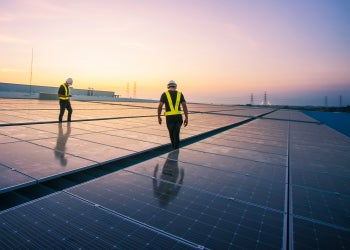 KBR seeks renewable energy contracts in Libya
29 September 2026
-
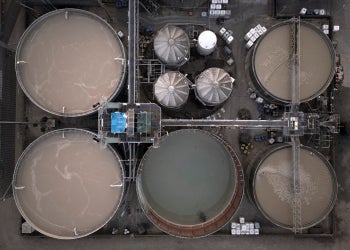 Sharakat receives bids for Riyadh East sewage treatment plant
29 September 2026
-
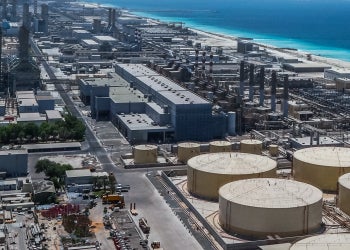 Egypt firm wins Al-Dabaa desalination O&M contract
29 September 2026
-
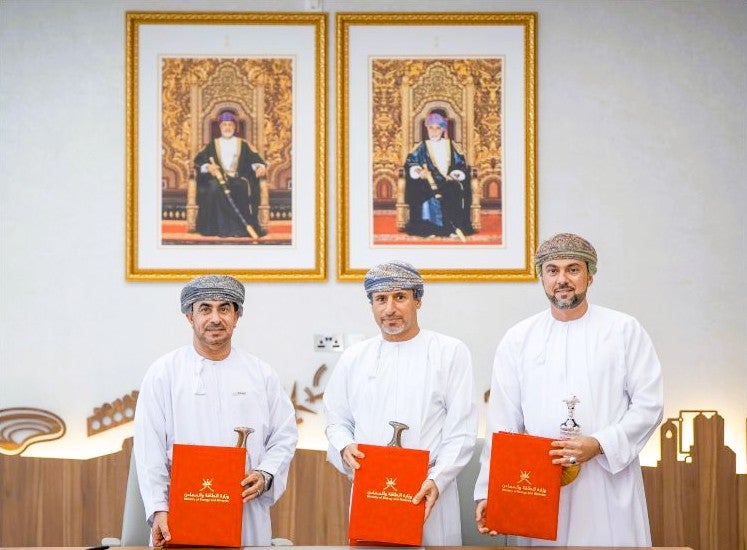 Oman awards exploration blocks to state upstream firm
28 September 2026
-
 Saudi Arabia qualifies firms for gas-fired IPPs
28 September 2026
All of this is only 1% of what MEED.com has to offer
Subscribe now and unlock all the 153,671 articles on MEED.com
- All the latest news, data, and market intelligence across MENA at your fingerprints
- First-hand updates and inside information on projects, clients and competitors that matter to you
- 20 years' archive of information, data, and news for you to access at your convenience
- Strategize to succeed and minimise risks with timely analysis of current and future market trends
Related Articles
-
KBR seeks renewable energy contracts in Libya
29 September 2026
The US-headquartered technology and engineering company KBR is seeking renewable energy project contracts in Libya.
Representatives from KBR met with Abdussalam Elansari, chairman of the Renewable Energy Authority of Libya, earlier this month to discuss project opportunities, sources said.
The meeting with Elansari followed KBR’s opening of a new branch in Libya and its securing of several contract awards in the oil and gas sector.
In March, KBR announced that it had been awarded a contract by Zallaf Exploration, Production & Refining of Oil & Gas Company to provide project management and technical services for the South Refinery Project in Libya’s southern city of Ubari.
Under the terms of the contract, KBR will provide contract management, project management and supporting technical services throughout the engineering, procurement and construction (EPC) phases of the project, according to a company statement.
The EPC work is expected to be executed over a 50-month period.
KBR is also carrying out work to re-evaluate the front-end engineering and design (feed) for the project to develop Libya’s J6 North Gialo field.
In January, KBR signed a memorandum of understanding (MoU) with the state-owned Libyan Post, Telecommunications & Information Technology Company.
Under the MoU, KBR agreed to support efforts to develop and improve Libya’s communications infrastructure and enhance fifth-generation (5G) mobile networks in the country.
KBR has previously provided engineering services for major national projects in Libya, but was forced to shut down its office in the country several times amid political instability and security issues.
When the company was known as Brown & Root, it worked on the Great Man-Made River Project in Libya, which is widely recognised as the largest irrigation project in the world.
https://image.digitalinsightresearch.in/uploads/NewsArticle/20081880/main.jpg -
Sharakat receives bids for Riyadh East sewage treatment plant
29 September 2026
Saudi Arabia’s state water offtaker Sharakat has received bids for the contract to develop the $150m Riyadh East independent sewage treatment plant (ISTP).
Bids were submitted on 28 September.
The plant will have a treatment capacity of 200,000 cubic metres a day (cm/d) in its first phase, expanding to 500,000 cm/d in the second phase.
Five consortiums made offers, including:
- EtihadWE (UAE) / Metito (UAE) / Thrustboring Construction Company (TCC, Saudi Arabia)
- GS Inima (Spain) / Alkhorayef (Saudi Arabia)
- Lamar (Bahrain) / China Harbour Engineering Company (CHEC)
- Miahona (Saudi Arabia) / Marafiq (Saudi Arabia) / Bin Omairah Holding (Saudi Arabia)
- Suez (France) / Civil Works Company (Saudi Arabia) / Alwael (Saudi Arabia)
In May, MEED exclusively reported that groups had begun to form for the project, which will be developed under a build‑own‑operate‑transfer model with a 25‑year concession term.
It is understood that at least two other potential consortiums weighed up making an offer for the contract, but did not bid.
In 2024, Sharakat prequalified 53 companies that could bid for the Riyadh East ISTP, part of seven planned ISTP projects it said it would procure between 2024 and 2026. The request for proposals was issued last October.
WSP is the technical adviser, and KPMG Middle East is the lead and financial adviser.
The targeted commercial operation date for the facility is 2029.
https://image.digitalinsightresearch.in/uploads/NewsArticle/20066914/main.jpg -
Egypt firm wins Al-Dabaa desalination O&M contract
29 September 2026
Elsewedy Utilities has been awarded a three-year operation and maintenance (O&M) contract for a seawater desalination plant in Al-Dabaa on Egypt’s north coast.
The plant has a production capacity of 40,000 cubic metres a day (cm/d), and the contract runs for three years.
The award reflects Egypt’s increased focus on involving local private sector companies in operating and maintaining existing seawater desalination plants.
In March, Egypt’s Ministry of Housing, Utilities & Urban Communities directed that a number of existing desalination plants with capacities of more than 10,000 cm/d be offered to specialised local private sector companies for O&M. The plants include facilities in Al-Dabaa, Matrouh and El-Alamein, as well as sites in the Red Sea region and North and South Sinai.
The government said the move is intended to improve operating efficiency, strengthen maintenance systems and make greater use of specialised technical expertise. The contract value was not disclosed.
Elsewedy Utilities is the utilities and facilities management arm of Elsewedy Electric, with activities spanning engineering, procurement and construction, O&M and utility management.
As MEED understands, the contract is separate from the South Med desalination project at Al-Dabaa, which is being developed for the Engineering Authority of the Armed Forces’ Water Management Department.
Elsewedy Electric Infrastructure previously announced it is the main engineering, procurement and construction contractor for the planned 160,000-cubic-metre-a-day seawater reverse-osmosis plant.
Cairo-headquartered Engineering Experience Group also won a design and engineering services contract for the project in June.
https://image.digitalinsightresearch.in/uploads/NewsArticle/20066727/main41574303.jpg -
Oman awards exploration blocks to state upstream firm
28 September 2026
Oman’s Ministry of Energy & Minerals (MEMR) has awarded state-owned upstream firm OQ Exploration & Production (OQEP) exploration rights for three hydrocarbon blocks in the sultanate.
OQEP, which is 75% owned by Omani state energy group OQ, has secured rights for Blocks 36, 43A and 66.
Under the agreements, OQEP will conduct geological and geophysical surveys, analysis and modelling, and drill exploratory wells at the three blocks, with the aim of developing recoverable reserves.
Neither MEMR nor OQEP disclosed the blocks’ locations, areas or prospective reserves in their statement.
OQEP’s portfolio comprises 14 upstream oil and gas exploration and production assets in Oman, covering onshore and offshore operations and assets held under service contracts.
Formerly known as Oman Oil Company Exploration & Production, OQEP’s flagship assets include Block 60, which contains the Abu Tubul and Bisat oil fields, and Block 48. The company also holds strategic interests in gas-producing Blocks 9, 10 and 61.
Offshore expansion
OQEP has been expanding its offshore exploration portfolio. In February, the company acquired a 30% participating interest in offshore Block 18, following MEMR’s award of exploration rights to a joint venture between OQEP subsidiary OQ Exploration & Production Al-Batinah Offshore and PC Oman Ventures, a wholly owned subsidiary of Malaysia’s Petronas.
Located off Oman’s northeastern coast, Block 18 covers more than 21,000 square kilometres in the Sea of Oman, with water depths ranging from 50 metres to 3,000 metres. No confirmed discoveries have previously been reported in the block.
ALSO READ: Concession deals boost momentum in Oman mining
Under the concession agreement, Petronas holds a 70% participating interest and operatorship, while OQEP holds the remaining 30%.
OQEP has also expanded its producing portfolio through the acquisition of a 35% interest in onshore Block 27 from Japan's Mitsui E&P Middle East in April. The transaction was valued at RO28.8m ($75m).
Block 27 is operated by US-based Occidental Petroleum, which holds a 65% participating interest under an exploration and production-sharing agreement valid until 2035.
OQEP expects its interest in the block to contribute approximately 3,500 barrels of oil equivalent a day (boe/d) in additional net production this year.
In June, MEMR signed an with OQEP and state-owned Turkiye Petroller AO (TPAO), granting the companies exclusive exploration, appraisal, development and production rights for offshore Block 80.
The block covers approximately 5,737 sq km in the Gulf of Oman, near the Strait of Hormuz and off Musandam governorate. It includes the producing Bukha and West Bukha oil and gas fields.
The agreement stipulates a minimum exploration investment commitment of $90m over an initial eight-year exploration period. The work programme is divided into two phases to evaluate the block’s hydrocarbon potential.
https://image.digitalinsightresearch.in/uploads/NewsArticle/20063097/main2825.jpeg -
Saudi Arabia qualifies firms for gas-fired IPPs
28 September 2026
Register for MEED’s 14-day trial access
Principal buyer Saudi Power Procurement Company (SPPC) has qualified 13 companies to bid for the third round of Saudi Arabia’s combined-cycle gas turbine (CCGT) independent power producer (IPP) programme.
The projects will comprise new CCGT plants developed on a build-own-operate basis. Each project will be implemented through a special-purpose project company wholly owned by the successful bidder.
The qualified firms are:
- Abu Dhabi National Energy Company [Taqa] (UAE)
- Acwa (Saudi Arabia)
- Al-Bawani Capital (Saudi Arabia)
- Al-Jomaih Energy & Water (Saudi Arabia)
- EDF (France)
- Etihad Development Company (UAE)
- Kepco (South Korea)
- Marafiq (Saudi Arabia)
- Mitsubishi Power (Japan)
- Nesma Renewable Energy (Saudi Arabia)
- PowerChina (China)
- Saudi Energy (Saudi Arabia)
- Sumitomo Corporation (Japan)
Developers submitted statements of qualification for the round on 23 August, as exclusively reported by MEED.
Some have already begun “the process of forming consortiums to bid” for the project, with up to three or four groups likely to make offers.
Also in September, MEED exclusively reported that US-based GE Vernova was close to finalising a turbine reservation agreement with SPPC for the plants.
The new plants will use advanced H-class or J-class gas turbine technology. Each IPP is expected to comprise two or three gas turbine generators, corresponding heat recovery steam generators with duct firing, and one or two steam turbine generators.
The request for qualifications released by SPPC in July did not specify the number, locations or capacities of the projects, which mark the next stage of its CCGT IPP programme.
The first round comprises Taiba 1, Taiba 2, Qassim 1 and Qassim 2, with a combined capacity of 7,200MW.
The second round comprises Rumah 1, Rumah 2, Nairyah 1 and Nairyah 2, also with a combined capacity of 7,200MW.
Saudi Arabia’s Acwa recently said it had begun initial commercial operations at the Taiba 1 and Qassim 1 CCGT power plants.
US/India-based Synergy Consulting is the financial adviser for the procurement; Germany’s Fichtner is the technical adviser; and UK-headquartered Eversheds Sutherland is the legal adviser.
 READ THE SEPTEMBER 2026 MEED BUSINESS REVIEW – click here to view PDF
Nuclear power ambitions gather pace; Kuwait keeps dealmaking alive despite war; Region invests in raising gas processing capacity.
Distributed to senior decision-makers in the region and around the world, the September 2026 edition of MEED Business Review includes:
> AGENDA: Gulf nuclear revival takes shape> MARKET FOCUS: Kuwait keeps dealmaking alive under fire> INDUSTRY REPORT: Gas processing takes centre stage in Mena regionTo see previous issues of MEED Business Review, please click herehttps://image.digitalinsightresearch.in/uploads/NewsArticle/20055392/main.jpg