
2024 breaks all project records
10 January 2025

Register for MEED's 14-day trial access
Last year was the best year on record for the GCC projects market as the region continues to enjoy unprecedented levels of capital expenditure across all sectors.
According to data from the MEED Projects project-tracking platform, a total of $264bn-worth of contracts were awarded last year, some 6.5% higher than the previous record of $248bn set in 2023, and more than double 2022’s $124bn number.
Saudi Arabia was once again the largest market, with $144.3bn-worth of contracts let, the highest total ever recorded by a single country in the region. This represented a rise of 22.3% on the $118bn-worth of contracts awarded in 2023 – itself a record – and underlines the kingdom’s commitment to its transformative Vision 2030.
The UAE was the second-largest market in the GCC, with $81.3bn-worth of contract awards. This marked a decline of 12.1% on the previous year, but was still its second-highest annual total and far above its $46.9bn 10-year average.
The other four GCC projects markets recorded much lower contract award totals, although Kuwait and Oman, at $9.2bn and $11.3bn, respectively, posted their best numbers since 2017.
By sector
In terms of sectors, construction remains the single-largest market segment, with $72.8bn-worth of signed contracts, a fall of 10.5% from 2023’s record number. It was almost matched by the power sector, which had the highest number of deals ever, at $64.4bn, driven primarily by a considerable increase in new renewable energy schemes.
Record levels of expenditure were also seen in the transport and infrastructure and oil segments, with respective project totals of $32.3bn and $28bn.
New paradigm
Last year’s performance dispels any notion that the sharp rise in project expenditure in 2023 was an outlier and demonstrates the region’s new paradigm for projects activity.
The sole exception remains Qatar, which has struggled to repeat the levels of spending seen in advance of the 2022 Fifa World Cup. In 2024, it awarded some $15.7bn-worth of contracts, below its $17.5bn 10-year average.
The past two years have been marked by a unique convergence of heavy hydrocarbons, real estate and utilities spending, ensuring that stakeholders across all market segments have benefitted from the increased expenditure.
This has been reflected by the sectoral diversity of 2024’s largest projects.
Leading the way was the $5.6bn contract to design and build Dubai Metro’s Blue Line, which was awarded in December to a Turkish/Chinese consortium. It was closely followed by a $5.5bn deal to build Adnoc’s liquefied natural gas terminal in Ruwais, while the $4.7bn Trojena main dam contract at Neom, awarded to Italy’s Webuild, rounded off the top three.
Other top 10 signed projects last year include the second phase of Qatar’s North Field Production Sustainability programme ($4bn), the high-voltage direct current scheme interconnecting the three major Saudi Electricity Company operating areas ($3.7bn), the 3,600MW Qurrayah combined-cycle power plant ($3.6bn), also in the kingdom, and its National Housing Company’s 20,000 housing unit deal ($3bn).
Leading contractors
In terms of the top contractors by value of work won in 2024, China’s Sepco 3 led the way in the oil, gas, power, water and industrials market segments, with an estimated $9.1bn-worth of awarded contracts.
This is the first time a Chinese contractor has ranked first in any given year, reflecting the increasing dominance of Chinese firms in the GCC projects market.
Other international engineering, procurement and construction contractors in the top 10 include Italy’s Saipem, India’s Larsen & Toubro, South Korea’s Samsung E&A and Spain’s Tecnicas Reunidas.
Two regional contractors appear in the rankings. Saudi Arabia’s Alfanar Projects is in sixth place at $5.5bn, followed by Abu Dhabi’s NMDC in ninth position at $4.1bn.
On the civil construction side, covering the construction and transport sectors, China State Construction Engineering Corporation is ranked first with $5.2bn of awarded work. In second and third place are Saudi Binladin Group and its compatriot Modern Building Leaders, with $3.5bn and $2.5bn, respectively.
Rounding off the top five are two other Chinese firms: CRRC Corporation and China Harbour Engineering Company.
Gigaproject expenditure
Another notable feature of the market last year was the performance of Saudi Arabia’s gigaprojects. While the $850bn-plus gigaprojects programme has made headlines in recent years, spending on Public Investment Fund subsidiary and other similar major government expenditure drives was actually down on 2023.
After year-on-year growth in the five years up to 2023, when just under $33bn-worth of gigaproject contracts were awarded, in 2024, the total fell by 40% to just $20.2bn. This confirms the slowdown in gigaproject activity following the pause and reprioritisation in the programme reported early last year.
At this stage, it is unclear if the programme will continue at its previous pace, with some observers saying Riyadh will focus on its event-driven developments, such as the 2030 World Expo and 2034 Fifa World Cup.
However, if gigaproject expenditure does accelerate from its 2024 levels, then Saudi Arabia and the regional projects market as a whole could potentially reach even greater heights in 2025.
Published on 31 December 2024 and distributed to senior decision-makers in the region and around the world, the MEED Yearbook 2025 includes:
|
> PROJECTS: Another bumper year for Mena projects
> GIGAPROJECTS INDEX: Gigaproject spending finds a level
> INFRASTRUCTURE: Dubai focuses on infrastructure
> US POLITICS: Donald Trump’s win presages shake-up of global politics
> REGIONAL ALLIANCES: Middle East’s evolving alliances continue to shift
> DOWNSTREAM: Regional downstream sector prepares for consolidation
> CONSTRUCTION: Bigger is better for construction
> TRANSPORT: Transport projects driven by key trends
> PROJECTS: Gulf projects index continues ascension
> CONTRACTS: Mena projects market set to break records in 2024
|
The MEED Yearbook 2025 country data files include:

Register for MEED's guest program now to access this article.
Exclusive from Meed
-
 US DFC approves $1.8bn financing for Jordan National Water Carrier
24 September 2026
-
 Hitachi wins Al-Mashaer Al-Muqadasah metro revamp
24 September 2026
-
 Contractor wins 6GW data centre campus infrastructure
24 September 2026
-
 Algeria officially launches major phosphate project
24 September 2026
-
 Design review nearly complete for Libya upstream project
24 September 2026
All of this is only 1% of what MEED.com has to offer
Subscribe now and unlock all the 153,671 articles on MEED.com
- All the latest news, data, and market intelligence across MENA at your fingerprints
- First-hand updates and inside information on projects, clients and competitors that matter to you
- 20 years' archive of information, data, and news for you to access at your convenience
- Strategize to succeed and minimise risks with timely analysis of current and future market trends

Related Articles
-
US DFC approves $1.8bn financing for Jordan National Water Carrier
24 September 2026
The US International Development Finance Corporation (DFC) has approved a loan of up to $1bn and political-risk insurance of up to $800m for Jordan’s National Water Carrier Project.
The $1bn loan will be provided to National Carrier Project Company (NCPC) to finance the design, development, construction, operation and maintenance of the project’s seawater desalination plant, water conveyance system and dedicated solar generation plant.
The $800m of political-risk insurance will be provided to Paris-based investment and utility firms Meridiam and Suez, which are developing the project.
The National Water Carrier, also known as the Aqaba-Amman Water Desalination and Conveyance Project, is being developed under a public-private partnership between Jordan’s Ministry of Water & Irrigation and NCPC, a special-purpose vehicle owned by Meridiam (90%) and Suez (10%).
The project involves the design, development, construction, operation and maintenance of a seawater desalination plant, a water transmission system and dedicated renewable power generation facilities under a build-operate-transfer model.
Jordan signed the project’s final technical and legal agreement with Meridiam in April, following months of negotiations.
The project’s capital cost was put at about $4.3bn, with total costs including financing estimated at $5.8bn.
Financial close has not yet been completed. The project’s technical director said in July that the final agreements required for financial close were still being prepared, with construction expected to start in the fourth quarter of 2026. Water pumping is scheduled to begin in the fourth quarter of 2030.
Jordan’s cabinet approved a $97m financing agreement with the French Development Agency in July as the government continued to complete the project’s financing arrangements.
The cabinet also approved a package of facilities and exemptions for the National Water Carrier Project on 17 September to help finalise start-up procedures for the project in the Aqaba Special Economic Zone.
Jordan’s water needs
The Aqaba-Amman water desalination and conveyance project will desalinate 300 million cubic metres of seawater annually. It will also include a 450-kilometre pipeline and pumping systems reaching elevations of up to 1,100 metres.
The project is intended to help address Jordan’s severe water scarcity. As one of the world’s most water-stressed countries, Jordan consumes nearly 1 billion cubic metres of water a year.
The domestic sector consumes approximately 50% of this, with only 61 cubic metres of water available per person a year, far below the global absolute water scarcity level of 500 cubic metres of water per capita.
According to the government, the scheme will increase overall water supply by 40%, with per capita availability expected to rise to 110 cubic metres annually.
Annual output from the Water Carrier Project will be nearly equivalent to the total storage capacity of all dams in the kingdom and almost three times the output of the Disi Water Project.
The project is expected to supply about 40% of Jordan’s drinking water needs, with operations scheduled to begin in 2030. It will also include a 280MW solar photovoltaic plant in Al-Quweira covering roughly 30% of the project’s energy needs.
Financing
The government previously said the project had secured about $663m in grants from international partners, including the US, the European Union, Germany, the Netherlands, the UK, France, Italy, Japan and the Green Climate Fund.
The Jordanian government is contributing $722m.
Meridiam is arranging about $2.9bn in private sector financing from international financial institutions. The financing package includes support from institutions including the World Bank Group, European Investment Bank, European Bank for Reconstruction & Development, Islamic Development Bank, Proparco, Japan International Cooperation Agency and the Opec Fund for International Development.
A consortium of Jordanian banks led by Housing Bank is providing up to $1.1bn in local financing, with the Social Security Investment Fund also taking an equity stake alongside Meridiam.
Local manufacturing
The project is also beginning to generate associated industrial investment.
On 30 August, Jordan’s cabinet approved the establishment of a steel pipe manufacturing and coating plant in Aqaba with investment of up to JD120m ($169m). The plant is expected to allocate 50% of its production to the National Water Carrier and create about 420 jobs. Its output will also be available for future water, gas transmission and pumping projects.
The Aqaba Special Economic Zone Authority and the Ministry of Water & Irrigation also launched a dedicated single-window platform in August to streamline licensing and permitting for the National Water Carrier project.
Once operational, the project is expected to remain under the PPP structure for 26 years before ownership transfers to the Jordanian government.
https://image.digitalinsightresearch.in/uploads/NewsArticle/19943001/main.jpg -
Hitachi wins Al-Mashaer Al-Muqadasah metro revamp
24 September 2026
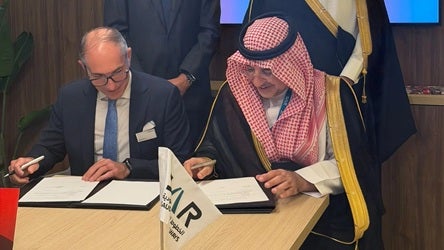
Saudi Arabia Railways (SAR) has signed a contract with Japan’s Hitachi Rail to revamp the Al-Mashaer Al-Muqadasah metro project in Mecca.
The 18-kilometre line includes nine stations and has a design capacity of about 72,000 passengers an hour in each direction.
The scope includes upgrades to improve reliability, operational performance and long-term maintainability.
SAR chief executive Bashar Al-Malik and Hitachi Rail’s Middle East and Africa signalling and rail solutions vice-president, Carlo Piacenza, signed the contract.
The rail line operates during the Hajj period and transports pilgrims between Mina, Muzdalifah and Arafat.
It was developed to reduce reliance on buses, ease congestion on pilgrimage routes, and improve safety and crowd management during Hajj.
The Saudi authorities procured the project on a fast-track basis to meet a fixed operational deadline for Hajj. It entered initial operation in 2010, with China Railway Construction Corporation acting as the main contractor for civil works and overall delivery.
Hitachi Rail supplied key rail systems, including signalling and telecommunications. SAR subsequently assumed responsibility for the asset and has led later improvement and upgrade programmes.
https://image.digitalinsightresearch.in/uploads/NewsArticle/19941437/main.jpg -
Contractor wins 6GW data centre campus infrastructure
24 September 2026
Dammam-based construction firm Alyamama Company has won a contract to develop infrastructure for a planned 6GW hyperscale artificial intelligence (AI) data centre campus in Riyadh.
The project will be delivered on an early contractor involvement (ECI) basis. Under the ECI process, selected contractors are required to submit methodologies and design proposals, after which one team will be selected to deliver the construction works.
Saudi Arabia’s AI company Humain, owned by the Public Investment Fund (PIF), tendered the contract in May, as MEED reported.
The scope of infrastructure work covers:
- Construction of 380kV/132kV/33kV electrical distribution network, two substations with a capacity of 500MVA and 200MVA, bulk supply point (2,000MVA)
- Water network and fire protection systems
- Sewage treatment plant and wastewater network
- Stormwater systems
- Roads
- Underground cable and fibre optic networks
- Landscaping works
The client is being supported by Canadian engineering firm Hatch, France’s Egis and US-based firm JLL.
The development will be built on a 24-square-kilometre site in the Al-Saad area in east Riyadh. It will be delivered in two phases across six plots, each with a capacity of 1GW.
Humain was launched in May last year to operate and invest across the AI value chain.
Humain is building full-stack AI capabilities across four core areas: next-generation data centres, hyper-performance infrastructure and cloud platforms, and advanced AI models, including Allam.
Also in May 2025, Humain signed preliminary deals with US chipmakers AMD and Nvidia to build multibillion-dollar advanced digital infrastructure in the kingdom.
AMD said it will invest up to $10bn to deploy 500MW of AI compute capacity in Saudi Arabia over the next five years.
In October 2025, PIF and Saudi Aramco signed a non-binding term sheet setting out key terms under which Aramco would acquire a minority stake in Humain, with PIF retaining majority ownership.
https://image.digitalinsightresearch.in/uploads/NewsArticle/19940798/main.jpg -
Algeria officially launches major phosphate project
24 September 2026
Algeria’s Minister of State and Minister of Hydrocarbons, Mohamed Arkab, has officially launched the construction of the country’s Integrated Phosphate Project (IPP) during a visit to the province of Annaba.
This major phosphate project spans the provinces of Annaba, Souk Ahras, Tebessa and Bir El-Ater.
The scope of the IPP includes:
- A raw phosphate extraction and beneficiation complex at the Bled El-Hadba site (Bir El-Ater): designed for 5.5 million tonnes a year (t/y) of ore extraction and 3.2 million t/y of phosphate concentrate production
- An industrial complex at the Oued Keberit site: to include several production units, with the capacity to produce 2.4 million t/y of phosphate fertilisers as well as 570,000 t/y of nitrogen fertilisers
- Port facilities at the port of Annaba: for exporting surplus fertiliser production
- Utilities and auxiliary infrastructure
In a statement, the Ministry of Hydrocarbons said that Arkab’s official visit was taking place “within the framework of periodic field monitoring of the project’s implementation stages”.
It said: “The project stands as one of the most significant strategic and structural initiatives for the national economy; it aims to develop and exploit national mineral resources and to process and add value to phosphate locally, thereby boosting value-added output and increasing non-hydrocarbon exports.”
It added: “The integrated phosphate project is part of a comprehensive vision to valorise national mineral resources and develop associated downstream industries.
“This initiative aims to boost national production of fertilisers and high-value-added chemical products, support food security, create jobs, and contribute to diversifying the national economy and increasing non-hydrocarbon exports.”
On 12 August, Algeria’s national oil and gas company Sonatrach and the Algerian Chinese Fertilisers Company (ACFC) signed two engineering, procurement and construction (EPC) contracts for the project.
The contracts were part of the Bled El-Hadba phosphate development project, which is expected to be worth $7bn.
The contracts were signed by Italy’s Saipem and China Harbour Engineering Company (CHEC) as part of the first phase of the integrated phosphate project.
Saipem’s contract was worth about €500m ($577m), according to a statement from the Italian company.
It focuses on constructing fertiliser processing and production facilities.
The contract with CHEC focuses on constructing port facilities at the Port of Annaba.
ACFC was created in March 2022 by Algerian companies Asmidal and Manadjim El-Djazair (Manal), which own 56% of the company, and Chinese groups Wuhuan and Tianan, which own the remaining 44% stake.
Manal and Asmidal are both subsidiaries of Sonatrach.
https://image.digitalinsightresearch.in/uploads/NewsArticle/19927744/main.jpg -
Design review nearly complete for Libya upstream project
24 September 2026
US-headquartered KBR is nearing completion of its re-evaluation of the design for the project to develop the J6 North Gialo field in Libya, according to industry sources.
In June, MEED reported that Libya’s Waha Oil Company (WOC), a subsidiary of state-owned National Oil Corporation (NOC), had launched a review into the tender process for the J6 North Gialo oil field development project, and that this would include re-evaluating the front-end engineering and design (feed).
The Waha concessions are held by a consortium of Libya’s NOC (59.16%), TotalEnergies (20.42%) and US-based ConocoPhillips (20.42%).
They are operated by WOC, which is 100% owned by NOC.
WOC is planning to tender the main contract for the project to develop the J6 field before the end of this year, although it may be tendered in the first quarter of 2027 if there are delays.
KBR in Libya
KBR has previously provided engineering services for major national projects in Libya, such as the Great Man-Made River project, which is widely recognised as the largest irrigation project in the world.
In March, KBR was awarded a contract by Zallaf Exploration, Production & Refining of Oil & Gas Company to provide project management and technical services for the South Refinery project in Libya’s southern city of Ubari.
Under the terms of the contract, KBR will provide contract management, project management and supporting technical services throughout the engineering, procurement and construction (EPC) phases of the project.
The EPC work is expected to be executed over a 50-month period.
In its statement, KBR said the project aligns with its “long-standing commitment to advancing vital oil and gas infrastructure in Libya”.
Upstream development
In March, MEED reported that South Korea’s Daewoo had pulled out of the tender process for Libya’s J6 North Gialo oil field development project.
Daewoo had formed a partnership with Egypt’s Petrojet to participate in the tender process.
The only other company to submit a bid for the project was UK-based Petrofac, which filed for administration in October last year.
In January, TotalEnergies signed an agreement extending the Waha concessions agreement up to 31 December 2050.
This agreement set new fiscal terms, allowing an increase in the production of these concessions that were, at the time, producing about 370,000 barrels of oil equivalent a day (boe/d).
In January, TotalEnergies said that the deal paved the way for “a new phase of investments, including the development of the North Gialo field, which is expected to add 100,000 boe/d of production”.
The J6 North Gialo project is the first of three field development projects that WOC has prioritised.
The other two are known as NC98 and Gialo 3.
Together, the three projects are expected to double Waha’s production from about 300,000 barrels a day (b/d) of oil to 600,000 b/d.
The Waha concession covers 13 million acres.
https://image.digitalinsightresearch.in/uploads/NewsArticle/19927052/main.jpg