
Maghreb rail sector heads for boom
5 July 2024

The Maghreb region is headed for a potential surge in railway scheme development, with upcoming projects worth tens of billions of dollars in pre-execution and set to swell the $7.6bn of rail schemes currently at the execution stage, according to regional projects tracker MEED Projects.
There are $18.5bn-worth of rail projects in prequalification or bid in Algeria and Morocco right now, led by an $11.2bn expansion of Morocco’s high-speed railway network.
Building on a $2.4bn stretch of high-speed rail between Tangier and Casablanca that was delivered in 2018, the expansion plans include a further $4.5bn-worth of line development between Kenitra and Marrakech and a $5.6bn line across the more mountainous terrain from Marrakech to Agadir.
Morocco’s rail prospects are also being boosted by the revival of the Spain-Morocco tunnel project.
In June 2023, the Spanish government revived plans for a Morocco-to-Spain undersea rail link project after allocating about $2.5m for a renewed design study. The project was first launched in 2003 but was put on hold after the 2008 financial crisis. It has undergone several rounds of feasibility studies but remains in the study stage after nearly two decades of funding-linked delays.
The plans involve a double-rail track with an additional service line stretching 38.5 kilometres (km) from Tarifa in Spain to Tangier in Morocco. The technically challenging scheme involves a 28km section running under the Mediterranean Sea at a maximum depth of 475 metres below sea level.
This is significantly deeper than the comparable Channel Tunnel between the UK and France, which at its deepest lies only 75 metres below the seabed and 115 metres below sea level.
In Algeria, there is meanwhile upwards of $5bn-worth of work in prequalification as part of the National Railway Programme being pursued by the country’s rail authority Anesrif, including a multibillion-dollar planned rail line to connect Oran on the northwest coast to the Algeria-Mali border.
There is also a significant volume of work in the design and study phases, including a $10bn electrification scheme announced by Algeria and due for prequalification in 2025 and award in early 2026 – a clear sign that Algiers is committed to delivering a modern public transport network.
Other planned rail modernisation and expansion schemes in the region include the Mohammadia-Mascara railway line in Algeria, the extension of Rabat-Sale light rail in Morocco and the extension of the Sfax light rail in Tunisia.
Ongoing projects
In terms of projects already under execution, the rail activity in the region is currently being led almost entirely by $7.4bn-worth of work Algeria. Many of the existing rail projects are long-standing ones, however, with the average duration of ongoing projects exceeding four-and-a-half years.
The value of new project awards in the rail sector in recent years has been subdued. In the past two years, there have been just $1.2bn of rail awards across the four countries of the Maghreb region.
The largest ongoing projects in Algeria are the Oued Tlelat-Akid Abbes railway line upgrade, the Tlemcen-Akid Abbes railway and the Tebessa-Ain M'lila railway line – the combined value of which is about $3.5bn.
In April, Anesrif also restarted the Relizane-Tiaret-Tissemsilt component of its $1.9bn East-West rail network expansion after a pause of several years and a change of contractors.
The contract with the previous group of contractors, which included Spain’s Fomento de Construcciones y Contratas (FCC) and local company Groupe ETRHB Haddad, was terminated.
In June, the client awarded a new $231m contract for lots one and two of the project to a consortium of local contractors, including EPTP Alger, GCB, Infrafer and Societe Algerienne des Ponts et Travaux d’Art.
Lot one includes works on the Relizane, Tiaret, Tissemsilt and Saida/Tiaret sections, spanning 10km. The remaining works are expected to be completed in 10 months. Lot two includes works on the Tiaret and Tissemsilt section, covering 63.5km, and will be due within 20 months.
Another major rail project under way in Algeria is the project to connect the Gara Djebilet iron ore mine in Western Algeria’s Tindouf province with the national rail network at Bechar.
In January, Algeria selected a team of Beijing-headquartered China Railway Construction Corporation and local contractor Cosider Travaux Publics for a contract to build a 575km railway line. The precise value of the project is unknown, but it could be worth $900m-$1.2bn.
In Tunisia, railway projects worth over $227m are in the execution phase. The biggest railway schemes under way include lots one and five of the country’s Rapid Rail Network. Morocco and Libya do not have any major railway schemes under execution, according to MEED Projects.
In general, with few significant projects awarded in the past two years, construction companies and rail sector suppliers will be eagerly awaiting the upcoming opportunities in the region.
If even a modest share of the large volume of work planned in Algeria and Morocco comes to fruition, contractors in the rail sector in the region could experience a boom.

Register for MEED's guest program now to access this article.
Exclusive from Meed
-
 Aldar and Mubadala acquire Masdar City Square
17 September 2026
-
 Dubai announces new 80km highway corridor
16 September 2026
-
 Engineering progresses on Ras Laffan LNG terminal berths
16 September 2026
-
 Design completed for Libyan oil field development
16 September 2026
-
 Chinese contractor wins Qiddiya e-games arena
16 September 2026
All of this is only 1% of what MEED.com has to offer
Subscribe now and unlock all the 153,671 articles on MEED.com
- All the latest news, data, and market intelligence across MENA at your fingerprints
- First-hand updates and inside information on projects, clients and competitors that matter to you
- 20 years' archive of information, data, and news for you to access at your convenience
- Strategize to succeed and minimise risks with timely analysis of current and future market trends

Related Articles
-
Aldar and Mubadala acquire Masdar City Square
17 September 2026
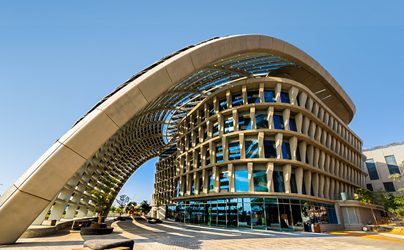
Abu Dhabi-based sovereign wealth fund Mubadala Investment Company and local developer Aldar have completed the acquisition of Masdar City Square at Masdar City, in a transaction valued at AED918m ($250m).
The deal was executed through their joint venture established in 2024.
Masdar City Square comprises more than 47,000 square metres (sq m) of net leasable area across seven office buildings.
Completed in Q1 2026, the development is 99% occupied. Tenants include Taqa, the Department of Energy, Emirates College and the Mohamed Bin Zayed University of Artificial Intelligence.
The transaction expands the joint venture’s real estate portfolio in Masdar City, which is now valued at AED4.7bn ($1.3bn).
Masdar City is one of the region’s leading hubs for clean energy, artificial intelligence, advanced research and sustainable urban development.
The joint venture acquired The Link project at Masdar City for AED654m ($178m) in April.
Comprising about 32,000 sq m of net leasable area across five buildings, The Link is fully leased to a portfolio of major tenants, including Abu Dhabi Future Energy Company (Masdar) and the Mohamed Bin Zayed University of Artificial Intelligence.
The asset includes Grade A, Leed Platinum office space, a net-zero-energy headquarters building, a multi-use hall and residential accommodation, supporting its position as a high-performing, integrated component of Masdar City.
https://image.digitalinsightresearch.in/uploads/NewsArticle/19748241/main5814.png -
Dubai announces new 80km highway corridor
16 September 2026
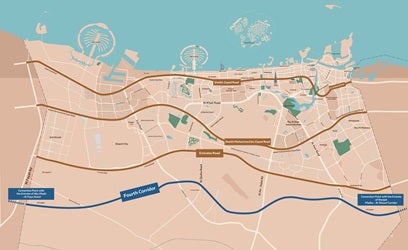
Dubai has approved the construction of the new fourth corridor, a major highway programme aimed at boosting inter-emirate connectivity, increasing road capacity and easing congestion.
The corridor will extend 80 kilometres, from Al-Faya Road in Abu Dhabi to Al-Shanouf Road in Sharjah.
It will include 12 lanes, 72 bridges and 17 tunnels.
The project is expected to reduce travel times by up to 60% and serve more than 3.1 million people, while providing links to Al-Maktoum International airport and Etihad Rail.
It will have the capacity to accommodate 24,000 vehicles per hour in each direction.
The project will be delivered in two phases. The first phase, running from Al-Shanouf Road to Dubai-Al Ain Road, will be delivered at a cost of AED3.5bn ($953m).
The second phase will stretch from Dubai-Al Ain Road to Al-Faya Road in Abu Dhabi.
Hamdan bin Mohammed: In line with the directives of His Highness Sheikh Mohammed bin Rashid Al Maktoum to boost investment in infrastructure, I approved the New Fourth Corridor to strengthen Dubai’s road network and enhance connectivity with the UAE’s federal road network.… pic.twitter.com/zlIyY2yKBN
— Dubai Media Office (@DXBMediaOffice) September 16, 2026
The scheme adds a fourth spine to a network that has long relied on three main corridors: the E11 (Sheikh Zayed Road/Al-Ittihad Road); the E311 (Sheikh Mohamed Bin Zayed Road) and the E611 (Emirates Road), which together carry more than 850,000 vehicles commuting between Dubai and the northern emirates daily.
That concentration has made the route one of the country’s most congested, with peak-hour bottlenecks a persistent problem for residents. The new corridor is designed to divert a significant share of that traffic onto a higher-capacity route, rather than add pressure to the existing network.
The project also aligns with the Dubai 2040 Urban Master Plan, which anticipates population growth to 5.8 million by 2040 and calls for the expansion of roads, railways, airports and ports to support that growth and reinforce Dubai’s position as a global trading hub. This is reflected in the corridor’s direct links to Al-Maktoum International airport and Etihad Rail.
https://image.digitalinsightresearch.in/uploads/NewsArticle/19725878/main.jpeg -
Engineering progresses on Ras Laffan LNG terminal berths
16 September 2026
Register for MEED’s 14-day trial access
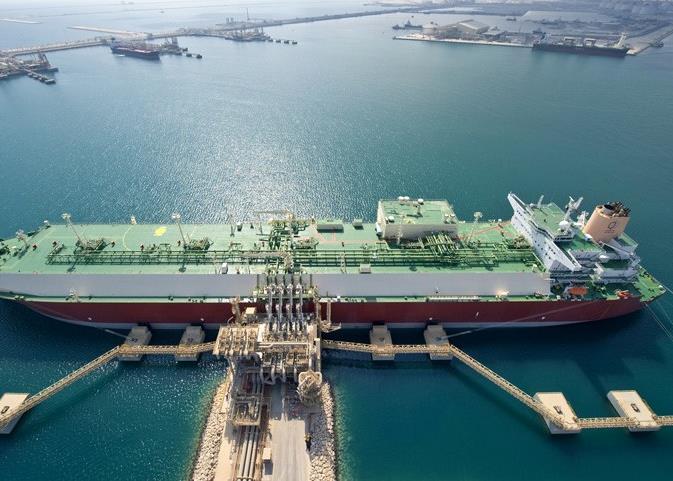
Front-end engineering and design (feed) works are progressing on a QatarEnergy LNG project to build 13 liquefied natural gas (LNG) loading berths at the south export terminal in Qatar’s Ras Laffan Industrial City.
Ras Laffan Industrial City, which lies about 90 kilometres north of Doha, is the world's largest integrated LNG production and export complex, comprising 15 processing trains with a total capacity of 77.5 million tonnes a year (t/y). QatarEnergy began LNG operations at the facility, which houses all its processing trains and export infrastructure, in 1984.
According to sources, QatarEnergy LNG, a subsidiary of state enterprise QatarEnergy, awarded the feed contract for the project to build 13 LNG berths at the south export terminal at Ras Laffan to Australia-headquartered Worley.
The contract was awarded to Worley in the second quarter of this year. Its duration is estimated to be 200,000-250,000 man hours, sources told MEED.
Ras Laffan’s LNG processing and export capabilities will increase by up to about 63% when the three phases of QatarEnergy’s estimated $40bn North Field LNG expansion project come into operation by the end of this decade. Engineering, procurement and construction (EPC) works on all three projects are progressing.
QatarEnergy is understood to have committed nearly $30bn to the first two phases – North Field East (NFE) and North Field South (NFS) – which will lift Qatar’s LNG production capacity from 77.5 million t/y to 126 million t/y by 2028.
QatarEnergy awarded the main EPC contracts for NFE in 2021. The project was intended to raise LNG output to 110 million t/y by 2025. The $13bn EPC package – covering the engineering, procurement, construction and installation of four LNG trains, each with a capacity of 8 million t/y – was awarded in February 2021 to a consortium of Japan’s Chiyoda and France’s Technip Energies.
In May 2023, QatarEnergy awarded the $10bn main EPC contract for NFS to a consortium of Technip Energies and Consolidated Contractors Company (CCC). The contract includes two LNG trains, each with a capacity of 7.8 million t/y.
Once fully operational, the first two phases are expected to add 48 million t/y of LNG supply to the global market.
QatarEnergy took the final investment decision on the third phase, North Field West (NFW), this year, awarding an EPC contract estimated at $8bn to a joint venture comprising Technip Energies, CCC and Gulf Asia Contracting in February.
Chiyoda carried out the feed work for the NFW LNG project.
The NFW scope covers the EPC of two LNG trains with a combined capacity of 16 million t/y, as well as associated facilities for gas treatment, natural gas liquids recovery and helium extraction.
In addition to LNG, NFW is expected to produce about 175,000 barrels of oil equivalent a day of condensate, ethane and liquefied petroleum gas.
With all three phases under EPC execution – and NFE scheduled for commissioning later this year – QatarEnergy is positioning itself to remain one of the world’s largest LNG suppliers in the long term.
 READ THE SEPTEMBER 2026 MEED BUSINESS REVIEW – click here to view PDF
Nuclear power ambitions gather pace; Kuwait keeps dealmaking alive despite war; Region invests in raising gas processing capacity.
Distributed to senior decision-makers in the region and around the world, the September 2026 edition of MEED Business Review includes:
> AGENDA: Gulf nuclear revival takes shape> MARKET FOCUS: Kuwait keeps dealmaking alive under fire> INDUSTRY REPORT: Gas processing takes centre stage in Mena regionTo see previous issues of MEED Business Review, please click herehttps://image.digitalinsightresearch.in/uploads/NewsArticle/19715235/main5946.jpg -
Design completed for Libyan oil field development
16 September 2026
Register for MEED’s 14-day trial access
Design work has been completed for a project to develop Libya’s I/R oil field, according to industry sources.
The front-end engineering and design work was completed by a team in the London offices of Italy’s EniProgetti and paves the way for the main engineering, procurement and construction contract to be tendered.
One source said: “At the moment, there is no fixed date for when the invitation to bid for the main contract will be issued, but the project has a lot of momentum and is progressing towards tendering.”
The I/R oil field is located in Murzuq Basin in southwestern Libya.
In June this year, Libya's National Oil Corporation (NOC) signed a unified operating agreement for the field.
The I/R field is operated by Akakus Oil Operations, which is a joint venture of NOC in partnership with Spain’s Repsol, France’s TotalEnergies Repsol, Austria’s OMV and Norway’s Equinor.
The agreement in June was signed by NOC as well as its concession partners.
NOC said the agreement would unify operational and administrative procedures related to field management, optimise resource utilisation and support production sustainability.
READ THE SEPTEMBER 2026 MEED BUSINESS REVIEW – click here to view PDFNuclear power ambitions gather pace; Kuwait keeps dealmaking alive despite war; Region invests in raising gas processing capacity.
Distributed to senior decision-makers in the region and around the world, the September 2026 edition of MEED Business Review includes:
> AGENDA: Gulf nuclear revival takes shape> MARKET FOCUS: Kuwait keeps dealmaking alive under fire> INDUSTRY REPORT: Gas processing takes centre stage in Mena regionTo see previous issues of MEED Business Review, please click herehttps://image.digitalinsightresearch.in/uploads/NewsArticle/19711588/main.jpg -
Chinese contractor wins Qiddiya e-games arena
16 September 2026
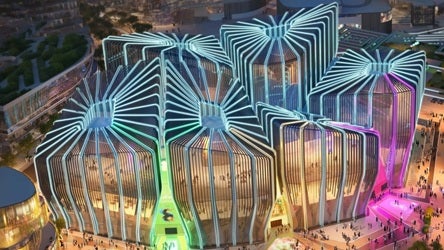
Saudi gigaproject developer Qiddiya Investment Company (QIC) has awarded an estimated $500m-$600m contract to build an e-games arena, also known as the Fortress Arena, at its Qiddiya Entertainment City development outside Riyadh.
The contract was awarded to Beijing-headquartered Metallurgical Corporation of China.
The scope of work covers the construction of an auditorium with a capacity of about 5,100 seats, as well as commercial areas, hospitality facilities and other associated infrastructure.
The e-games arena will provide space for local, national and international competitions.
MEED understands that QIC tendered the contract in January, with bids submitted in March.
Completion is expected by April 2029.
US-based architectural firm Populous designed the project, supported by New York-based Thornton Tomasetti.
The project is located in District 18, Upper Plateau, in Qiddiya City.
The Fortress Arena is one of several major projects within the wider Qiddiya development.
Other projects include the Dragon Ball theme park, Prince Mohammed Bin Salman Stadium, a horse racing venue, a performing arts centre, the Speed Park, the National Tennis Centre and the Six Flags theme parks and Aquarabia waterpark.
The project is a key part of Riyadh’s strategy to boost leisure tourism in the kingdom. According to UK analytics firm GlobalData, leisure tourism in Saudi Arabia has grown significantly in recent years.
https://image.digitalinsightresearch.in/uploads/NewsArticle/19661939/main.jpg